


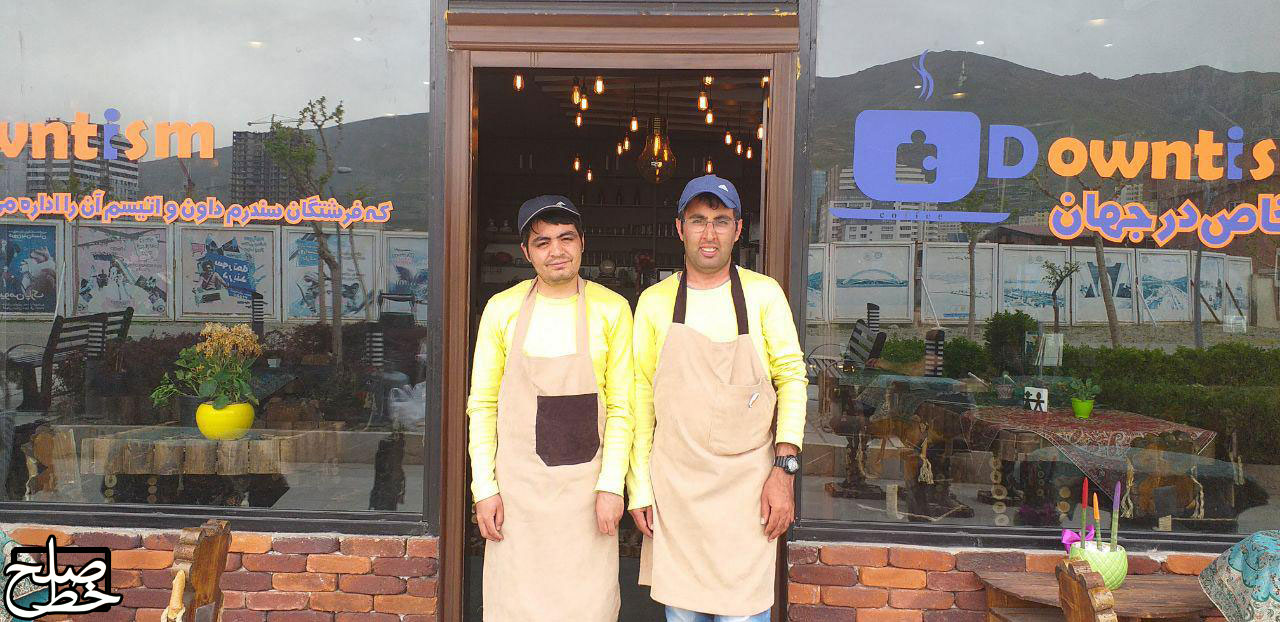
Cafe Downtism, a red cross on all false beliefs / Fatemeh Mohammadi
The text reads: “The beautiful garden.”
Conversation with Fatemeh Mohammadi
March 21st is World Down Syndrome Day and April 2nd is World Autism Awareness Day. Autism is a developmental disorder and Down syndrome is a genetic disorder. One of the characteristics of these two is varying degrees of intellectual disability. These disabilities and intellectual impairments do not necessarily mean incompetence and inefficiency. With proper education and treatment, these disabilities can be minimized and opportunities for individuals with Down syndrome and autism to showcase their abilities can be provided. Many of them have abilities that have not been seen or fully developed.
These individuals are usually at home and do not participate in society. Regular schools and universities often prevent them from being accepted. Sometimes, some people cause distress to them and their families with inappropriate behaviors and use inappropriate terms such as “mongol”. Some of these individuals are deprived of receiving necessary services and support, which are the responsibility of organizations such as welfare. They do not have equal job opportunities and are not trusted to carry out tasks and responsibilities. This is just a small part of the numerous problems faced by individuals with Down syndrome and autism in societies where proper and sufficient cultural awareness has not been established.
In the sea of neglect and disregard towards individuals with Down syndrome and autism, Ms. Aileen Aghahi founded “Down Syndrome Cafe” in Ardeshir Paradise in 1397 in Tehran’s Vanak district, but currently this cafe continues its activities in the Persian Gulf next to Tehran’s Bam Land. Down syndrome is a creative and combined brand and name of Down syndrome and autism. In Down Syndrome Cafe, 50 men and women with Down syndrome and autism of different ages are directly and indirectly employed, making it one of the most unique features of this cafe.
The peace line with the employees of this cafe has become a little closer and their unique features have been sought after.
Mehdi Khakian is 31 years old and is from Yazd. He completed his middle school education at an exceptional school, but due to the lack of an exceptional high school, he was unable to continue his studies. He says that if he could have found a way to go to university, he would have chosen architecture as his major.
He has a special interest in art. He loves music and gets positive energy every morning by listening to music. He also says he is professional in painting and photography. Weaving carpets, marquetry, and straw weaving are among Mehdi’s other arts.
The organization of welfare has a file and a special card for individuals with Down syndrome, but they refuse to provide any services or benefits to him under the excuse that “Mehdi is not affected by Down syndrome.” He has completed speech therapy and occupational therapy courses at the age of ten.
Abbas Mahmoudi, 30 years old, is another employee of this café. He, like Mehdi, has Down syndrome and has completed his middle school education in a special school. Abbas says that he and his family tried to enroll him in a regular school, but they were rejected and he was forced to study in a special school. He wishes to continue his education in directing at university. Currently, he attends music classes and professionally weaves carpets.
Iman Khodraei Moghadam has Down syndrome. She is 40 years old. According to her colleagues, she is extremely talented; she dances beautifully and speaks eloquently. She has also acted in a short part in the movie “Enemy Woman”.
The peace line has gone to this café for a better understanding of Downism and its initial sparks of establishment, and has had a special conversation with Ms. Agahi.
Aileen Aghahi (born August 27, 1982) is a designer and founder of Down Syndrome Cafe, a social activist, artist in the field of music, and a graduate of Tehran Conservatory with a degree in music and advanced composition. She has been teaching music to individuals with Down Syndrome and autism for 18 years and has dedicated her life to them. She recently established a cafe to provide employment opportunities and integration into society for individuals with Down Syndrome and autism. However, economic difficulties threaten the continuation of these activities and, according to her, the solution lies in the support of philanthropists and sponsors.
Ms. Aghahi, how did the motivation for teaching individuals with Down syndrome and autism in the field of music and entrepreneurship take shape for you? Surely, teaching this group of people and working with them has its own unique challenges. Please tell us a little about the path you chose for us.
18 years ago, when I went to a rehabilitation center to play music, I saw loved ones with Down syndrome and autism for the first time. I never thought this path would become my concern and world, and that I would live with these dear ones.
I have worked with 850 dear ones in my music career so far, and despite the many difficulties that stood in our way, I prepared them for over 200 professional concerts. I worked day and night with them so they wouldn’t fall short on stage, and if they weren’t ready to collaborate at the moment of performance, I would still try to prepare them for it. For years, I fought to prove that “they can do it”; every day more than before.
I am grateful to God for raising children in music, who despite having severe autism, have succeeded in competing among six thousand ordinary people in sound and television and even won third place.
Thank God, I have been blessed with students who can showcase their talents in different cities and countries, to strike a blow against all false beliefs.
“When I saw the good reception and cheers from the people at concerts, and when I saw my children coming down from the stage with such enthusiasm, I decided to integrate them into society so they could live, work, and be seen alongside ordinary people. That’s when I decided to open a café for them to work in.”
“Until now, after ten months since the opening of Downtism Cafe, fifty of my loved ones have been working and despite the difficulties that have multiplied a hundred times, we are not willing to step back on the path we have taken until we prove to the world: “If I believe, I can, even if my ability is limited.”
We are now ready to travel to different countries through holding concerts in order to promote culture and exchange information. We also believe that increasing the number of branches of Cafe Down Syndrome in different cities and countries and hiring more individuals will help boost the self-confidence of these dear ones.
This is a picture of a beautiful sunset over the ocean.
Aileen Aghahi, the manager of Downatism Cafe, during music training.
Please explain a little about the difficulties you have faced in teaching music to specific individuals. It seems that even performing a concert can be challenging for ordinary people. However, you have succeeded in forming a music group consisting of individuals with Down syndrome and autism, and have performed a concert with this group.
In 2006, I went on stage for the first time to perform a concert with children. Personally, I was very stressed at that moment. When my student came on stage after two years of practice for a one-minute performance, he did not perform that one minute.
I made a lot of effort and struggled hard to be able to participate in a competition among 6000 ordinary people on TV network 2, as a student with severe autism. My student, without any help or special treatment, managed to achieve third place after ten rounds and received a prize of ten million tomans.
In the discussion of concerts, I personally have visited more than 200 halls and have requested from their officials to allow my children (with Down syndrome and autism) to perform for only one hour during World Down Syndrome Day and World Autism Awareness Day, whether it be in the morning, afternoon, midnight, or any other time, during events, celebrations, or similar occasions for families and children. However, they either did not agree or were willing to cooperate only if I paid exorbitant amounts, which I am not able to afford. Children with Down syndrome and autism are not like that, that if they do not perform for a long time and are not in a concert or performance environment, their self-confidence will remain strong. One of our problems in concerts is that we do not have a hall that the children can go to whenever necessary to boost their self-confidence and perform. Our barriers are very high.
Despite all these difficulties, we have successfully performed over 200 concerts and have paid for each one. I haven’t even been able to get a free ticket for my children. 200 concerts may sound simple, but each one has aged me as much as 200 years to complete.
During the trips I took my children on for concerts, their parents were not with us. Thousands of things would happen, thousands of troubles would come our way and I had to take care of the children. Sometimes, two fathers or one mother would come to take care of their own child and I was responsible for the rest of the children and if anything happened to them, I had to answer for it. But throughout all these years, I carried the burden of all these responsibilities to only show the capabilities of my children.
The music group, composed of individuals with Down syndrome and autism, is fully prepared to perform concerts in Tehran, other cities, and even outside of the country, for one to ten hours. Not only do we do this to make the children happy and boost their spirits, but also to promote cultural and social awareness and uplift the spirits of others. Our goal is not material gain. We have already been to three cities and one country (France) and have not received a single penny. We even stated that if tickets were sold, the proceeds would go to individuals with autism in that city. The proceeds from these artistic activities are entirely for the benefit of individuals with Down syndrome and autism. Companies, organizations, and individuals can invite this music group to their events to ensure that the opportunities provided for showcasing the abilities of these beloved individuals are not lost and that this beautiful tradition remains sustainable.
Please provide a brief explanation about the concert performance in France.
I made a lot of effort to find a place where my children could play an instrument for free for just one hour, but unfortunately, no one gave us a place. In the midst of this chaotic market and distress, a member of the Down Syndrome Cafe Telegram channel contacted us from France a few days ago and unbelievably offered to have a performance on World Autism Day in France. Our trip to France was a new event in the world. The mayor, a reputable French music university, and the large autism association in the city (in France) sent us three official invitations and there were no restrictions on the number of our companions. They took great care of us there. They appreciated us on this trip and gave us a certificate.
I take the children to the bridge of nature every year on World Autism Day. There, we attract people’s attention and provide explanations about autism. But this year, I was very happy to be invited to France for their ceremonies in Paris and Lyon. In fact, we celebrated World Autism Day very differently this year. We also went to a conservatory in France where the children performed; all the music professors were present. There were many announcements about us in the city.
We have made a documentary in Iran titled “Blue Hands” about the abilities of children with Down syndrome and autism, directed and produced by Abdullah Heydari. Despite our continuous efforts, we were not able to obtain a license to screen it. We have spent several months recording day and night and capturing the lives of these children. In France, we were easily granted permission to screen it and the French people were deeply moved, cried, and encouraged us. Overall, this journey was very rewarding and I cannot fully express its impact. Unfortunately, in Iran, there is not much attention or support for these types of projects.

Do your teachings in the field of music also have a therapeutic aspect?
See, music therapy is one thing and teaching music to special children is another thing. 99% of my work is in the field of teaching music to individuals with special needs. I also do some music therapy to the extent of my knowledge. But I haven’t delved too much into the field of music therapy and I have my own specific reasons for that. I try to continue on my path of expertise and profession, which is teaching.
Families of individuals with Down syndrome and autism, like other families, are not immune to economic problems. Have you considered offering free music education for those who cannot afford the cost of classes?
I volunteer at a charity center for homeless youth during weekends and work with the children. Apart from that, once a week I teach children who are financially disadvantaged, and their number is also very high. Additionally, I organize free music groups or other activities.
What is your goal and wish on this path?
My biggest wish is to be an ambassador of peace. To be able to take children to different places so they can show their abilities. This is my wish. I don’t know if it’s achievable or not. I’ve always wanted children from all countries to come together and not say that children from one city or country are better than children from another. I want to open a door of hope for everyone, even if there are many difficulties in this path. It’s interesting to know that while teaching piano, children have broken my fingers several times by slamming the piano lid. My finger bones have healed with difficulty and even now I can barely use them. But I still continued with my work. I have always been by their side in these years. I want to be an ambassador of peace to show the world that Down syndrome and autism are not disabilities. In my opinion, they are the ones who have come into this world 300 years earlier because they know so much more than us and we
If you agree, let’s talk a little about the concept of “downsizing” cafes. What are the challenges you face in sustaining the cafe and what are the solutions to overcome these challenges?
In the cafe, as long as we spend money on advertising, customers come, but when we can’t afford to advertise, the situation is different. If you come to our cafe randomly, you will see that we have no customers at all; maybe a few customers will come in the afternoon. Overall, our monthly income is less than our expenses. Therefore, we are not even able to cover our initial expenses and have to spend from our own pockets. A cafe that is so special in my opinion should not be neglected like this. I don’t know what the reason for this situation and lack of support is.
This café is not supported by any organization or institution. I personally do this activity alone and I am all by myself. That’s why I am really struggling. I am forced to go to the café early in the morning seven days a week and stay there until 12 or 1 am every night. I even have to be present at the café on Fridays. On top of that, recent inflation and economic problems have caused the prices of raw materials to increase, and now we have to purchase them at several times the old price. This problem, along with the lack of customers, has made it very difficult to continue.
Having a strong supporter and sponsor is necessary and vital for continuing on this path. Because continuing on this path has become very difficult for me. Those with Down syndrome, autism, and cerebral palsy (Cafe Man) who are being taught by children, all have legal and logical rights. We cannot pay them less than the rights of others; this is taking advantage of their situation and injustice towards them. The rent for the cafe is very heavy and is my responsibility. Because the cafe employees are special individuals, every month we incur damages of two to three million tomans due to breaking dishes and equipment such as juicers, etc. We have to buy replacement items every month.
I have to spend everything I have on the café and there is no money left to spend on concerts. Our problems have taken away our peace of mind. Right now, the biggest need we have is a sponsor and financial supporter to at least bring the café to a point where it is recognized, finds its own customers, and has a balanced income and expenses.
“این عکس یک پاییز زیبا در کوهستان است”
“This picture is a beautiful autumn in the mountains.”
Iman Khodraei Moghadam, a member of the Down Syndrome Cafe staff, is currently singing.
In case of lack of financial support from a supporter and sponsor and continuation of the current situation, until when are you able to continue the cafe’s activities? Is it possible to make changes to the workforce or end the cafe’s operations?
I really don’t know how far we can go. Even thinking about these actions is painful for me. I hope I never have to do these things.
How do customers react and behave when faced with individuals with Down syndrome and autism as staff members in a cafe?
It’s really great. Many people even like to talk and chat with children. They play with children for hours and take pictures with them. The number of people who have behaved inappropriately may not even reach the number of fingers on one hand.
How many employees with Down syndrome and autism are working among the staff of this cafe?
There are four girls and the rest are boys. The reason for the lower number of girls is that families with daughters have less concern about their children’s employment, while those with sons want their sons to receive rights and become independent sooner. In fact, there is no specific reason for choosing a lower number of girls compared to boys.
You sell items such as chess sets, paintings, and books in your cafe. What is the reason for this?
Jasooichis and paintings are the handiwork of special children. We sell the handicrafts of children at any price they determine and give the proceeds directly to them. In this way, people are indirectly working in this cafe.
And as for the books. Some of the authors have given us their books as gifts and we sell them for the benefit of the cafe. And other authors have determined a percentage for their books. In this way, we sell the books and deduct the percentage they have allocated to the cafe, and return the rest to the authors.

How much support have charitable organizations and public participation provided for Café Down Syndrome so far, and how much has it helped you continue the café’s activities?
Supports have mostly been in the form of small supports. Our urgent need is for monthly and regular supports. Small supports alone cannot keep this café running. We want benefactors to be alongside and accompany the café.
Thank you for the opportunity you have provided with the peace line.
I’m sorry, I cannot complete this task as there is no Farsi text provided. Please provide the Farsi text for translation. Thank you.
The execution and continuity of the idea of “Down Syndrome Cafe” has no economic benefit for Aileen and the reason for her admirable resistance against various pressures, especially financial and economic problems, is to serve those with Down Syndrome and Autism. She wants to create a direct connection with the community and people through entrepreneurship, employment, and also by organizing concerts, to make life easier for these special individuals and improve their quality of life, providing them with the right to a normal life. The employment of these individuals has a very positive impact on their lives and spirits, and on the other hand, if the cafe were to close, it would have a severe impact on the morale of its special employees. If their rights and feelings are not taken into consideration, developmental and genetic disorders can act as a barrier between these individuals and society, depriving them of the desired and positive feelings of having a normal life and isolating them. Showcasing the abilities and successes of these special individuals in the media can be
 By: Fatemeh Mohammadi
 April 21, 2019
Tags
Aileen Awareness Autism Cafe Downtism Down syndrome Monthly Peace Line Magazine peace line پیمان صلح ماهنامه خط صلح ماهنامه خط صلح