


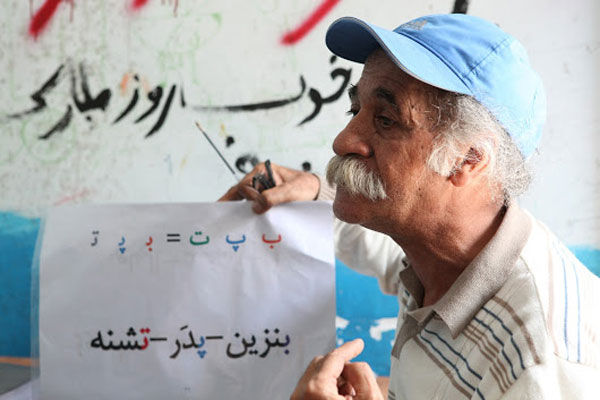
Innovative Method of Basic Education; A Conversation with Ali Sadeghi Khayat/Conversation with Elaheh Viewer
In this interview, we went to Ali Sadeghati, also known as Uncle Tailor. He is the creator of a new method of teaching “reading and writing” that has been successful in recent years in teaching street children, workers, and those who have not had the opportunity to receive a formal education. This method is based on the structure of the Persian language and aims to simplify the teaching of basic language skills for those who are interested in learning this language. The main goal of this method is to eradicate illiteracy, especially among the marginalized groups of society.
Ali Sadeghati was born in Mashhad in 1946. In 1976, after completing his studies in sociology in France, he returned to Iran and was imprisoned in various prisons such as Evin, Gohardasht, Qezelhesar, and Vakilabad in Mashhad from 1978 to 1989. He officially began his activities as a writer in 199
The conversation with Uncle Tailor continues below:
What was the origin of your concern about the issue of public education and creating solutions to overcome educational barriers? What was or is the problem that led you towards a different approach?
I haven’t talked much about this topic. It’s only mentioned in one film by Ersalan Amiri and two other films and TEDx. Close to four or five documentary films have been made on this subject. I briefly explained what the situation was like when we were conducting creativity classes, which started in 1999. The kids had grown up, gone to work, and become literate. They were writing stories, reciting poetry, and drawing. But some of the kids were not very interested in these activities and had to work more to pass their time. Usually, from the age of 12, they are forced to go to work. Families who cannot meet their needs have to use these kids as labor. These kids were with me for two, three, or five years and then went to work. These creativity classes that I was in charge of were only held on Friday afternoons in a few places: Shush, Darvazeh Ghar, Goode
In what year did you implement your own method?
87; This was not my method. I looked into other languages and saw that it doesn’t take more than a year to learn reading and writing in other languages. Why is it that in Iran, a fourth grader can’t read and write properly? Fifth and sixth graders are the same, and the closer we get to the outskirts and villages, the worse the literacy rate becomes. In bilingual classes in tenth and eleventh grade, we have students who can’t read and write. I had this issue in mind and examined the Persian language. I saw that it can easily be taught as long as it is the student’s native language. Learning one’s native language is very easy. After my research, I found out that a ten-year-old child has about four thousand words in their vocabulary from their daily interactions. In all languages, someone who wants to express their thoughts and be understood by others needs about 3500 to 4000 words, in all languages. I used this method
What were the first steps taken to expand the reading and writing education program and what obstacles did you face along the way?
In the literacy movement, the approach varies depending on the individual who is involved. Those who have a broader perspective on the issue, they all had problems. It was not acceptable for them. Even when they tried and saw, they would say, “Wow! This method works.” But in terms of perspective, it was not acceptable for them. Well, yes, these institutions, the entrance exams, and those cartels, all go under question. “If they are supposed to learn reading and writing in 15 days, they should be able to write on the board afterwards! The entrance exam should be abolished, these talks are no longer relevant.” Well, now we no longer have rote learning in the world. Everywhere, books are open, books are in hand. You have the internet and you have to solve the problem. Rote learning is gone and the world no longer works this way. Well, we also had a special method and they all had problems with it. Some people
Do you see your voluntary activities within the framework of non-governmental organizations? What role has the non-governmental organization played in expanding your work?
First of all, I talked about organizations and NGOs. Every organization and NGO, wherever they were, from east to west and from north to south of Iran, I said it doesn’t matter, bring any teacher you have with two illiterate people to the class. Their gender doesn’t matter either. We have no age restrictions. You come to the class. I will make all of them literate in 15 days. I will explain how to teach. Everyone needs to be taught in a different way. This was the hardest part of the work. It requires experience. They have to attend the class multiple times. There should be different classes. So that they can learn well, they need to be very strong in their studies. They need to know psychology and how the brain works, and they need to know how to store vocabulary in order to succeed.
Your opinion is that it mostly depends on the teacher?
Exactly. There were many who were not trained as teachers, but became very good teachers. They were people who learned and now teach in the same way, but due to the problems I mentioned earlier, continuing this work becomes very difficult. It’s like my phone is always ringing. They call from all over Iran, even while teachers are in the middle of teaching, asking for advice on how to teach a student who is not learning well. I give them counseling and solutions, but it takes time and dedication. You have to be passionate about learning. We see people who were completely illiterate at the age of 20 or 25. You can’t compare them. Everyone is different. For example, a teacher might say that a student has learned this part, but hasn’t reached this level. I ask, what is the problem? I tell them to go back to that part. These things need to be emphasized more or they get tired. There are various factors that unfortunately prevent some teachers
Are these people more interested in NGO work or outside of it?
No, people from different places are interested. School teachers in Hormozgan, Isfahan and many other places. The same people who previously had problems immediately call. Well, but the downside is that if a teacher does not teach for three months and takes a break from teaching reading and writing. They will have problems. There are so many issues and the mind must be the queen. I did not keep anything for myself. I always put everything at everyone’s disposal. Some forgot. Some did not take notes. Then they refer back to the movies that are available. They pay attention to make it right.
Based on your rich experience with individuals who have dropped out of education, what do you think is the best way to create a suitable platform for promoting educational justice in Iran?
I understood your question. I will go back to a more important topic. See, our education has a fundamental problem. We need to solve this problem at its root. Where is the root? Our language is Persian. Our grammar is Arabic! Verb, subject, object, trilateral, trilateral mazid, exaggeration form. These are related to Arabic. We don’t have these in Persian at all. Persian is a different language. Every language has its own characteristics. First, a language is formed. From the language, grammar is extracted. Unfortunately, due to the ideological view we have towards everything and everywhere, we also looked at language ideologically. Our language is Persian, but we have Arabic grammar. Persian has 32 signs. In Arabic, we have 28 signs. This itself is a problem. Second, Persian is a connecting and attaching language, while Arabic is inflectional. They are completely different worlds and unfortunately, in these 1400 years, no
In your opinion, to what extent can a teacher play a role in creating more motivation for students?
Everything goes back to the teacher. We don’t have anyone who is not teachable. I don’t accept this at all. I had a student with Down syndrome who learned how to read and write. In my recent experience, he learned in just 15 days. We were on Qeshm Island and had a student with Down syndrome who sat with the rest of the children and learned to read in just 15 days. Everyone was amazed. They said it’s impossible for him to learn. It’s strange! Everything depends on the teacher. The teacher is not capable. It’s the teacher’s lack of teaching ability, not the child’s. They say “he can’t learn.” I say “you’re wrong to say he can’t learn! What are you doing? You should read some psychology books!” None of our teachers are reading books now. I say Piaget. They ask who Piaget is. They don’t even know. They say it’s individual psychology. What
How do you evaluate the future prospects of literacy, especially for the education of working children and individuals who have dropped out of school in Iran? What methods can we use to completely overcome illiteracy?
It doesn’t matter! Let’s offer a free course for first grade teachers. We didn’t take any money from anyone. Let’s have a course where some of these first grade kids who want to go to school, sit in the same class. Each teacher can bring their own student, we’ll work for thirty sessions and teach all the kids reading, writing, and math. Teachers can also learn how to teach each student. The kids are afraid of the teachers. Our class here in Qeshm (Dargahan) was the same. The teachers used to say to the kids, “Come to the board,” and they were scared. In my class, when I say, “Who’s coming to the board?” everyone knows to come. You should see what they did to these kids. The kids are running away from their lessons. They want to learn and enjoy learning. They want to show themselves, “I’m not stupid. Don’t hit me like that.”
Your perspective is that with your method, we will no longer have a problem with literacy?
See, the issue is the mistakes of the past. We continue on the same path as before. We teach the Persian language like Arabic. On our books it says “Persian book,” we don’t say “Parsi.” Arabs, because they don’t have “P,” say “Farsi.” We haven’t shown enough wisdom in this culture. This is Persian. They didn’t understand this difference. Someone whose language is Arabic is very respected. They don’t have “P,” they say “F.” What’s the problem? It’s their language. We don’t have any problems, we don’t have any ethnic issues here. I want to emphasize this. When I teach these children, I tell them I first teach in their mother tongue. I teach a Turk first in Turkish with their own words. I teach them to read and write Turkish, then Persian. I do the same for Kurds, Lurs, and Arabs. I first teach them Arabic, then Persian. Arabic
In your opinion, how can individuals who come up with independent and voluntary solutions for educational problems create a new path based on their abilities? What difficulties may arise in this process?
I don’t see any difficulty in this path. Let’s get to work. But there is one issue, like the book “One Hundred Years of Solitude” by Marquez; the ice has been discovered and the gentleman wants to discover it! You see, there are flaws in teaching reading and writing. The problem has been discovered, what do you want to innovate? Come, recognize this issue and hit it in your own name. Come, recognize it and take a step forward. I kiss this person’s hand. I am proud of their existence. It’s great. We just want to innovate. The ice has been discovered! There’s no need to discover it. Does that mean our hearts are not burning for our nation, because of illiteracy, we are burning for the sake of naming innovation? I say the Persian language has this capability. I didn’t bring this from my mother’s house, it has been inside the language. Our teachers, our educators have not yet
If you have any other points, please mention them.
I have no additional notes. The questions were very comprehensive. I am grateful to you and all the IELTS instructors who were very kind to me and accompanied me. Thank you all.
Thank you for the opportunity you have provided by offering the peace line.
 Created By: Admin
 March 20, 2020
Tags
Ali Sadeghati the tailor Basic training Blackboard Child labor Monthly Peace Line Magazine Number 107 peace line Survivor of education Survivors of studying lessons The art of reading and writing. The spectator/goddess. Uncle Tailor پیمان صلح ماهنامه خط صلح ماهنامه خط صلح