


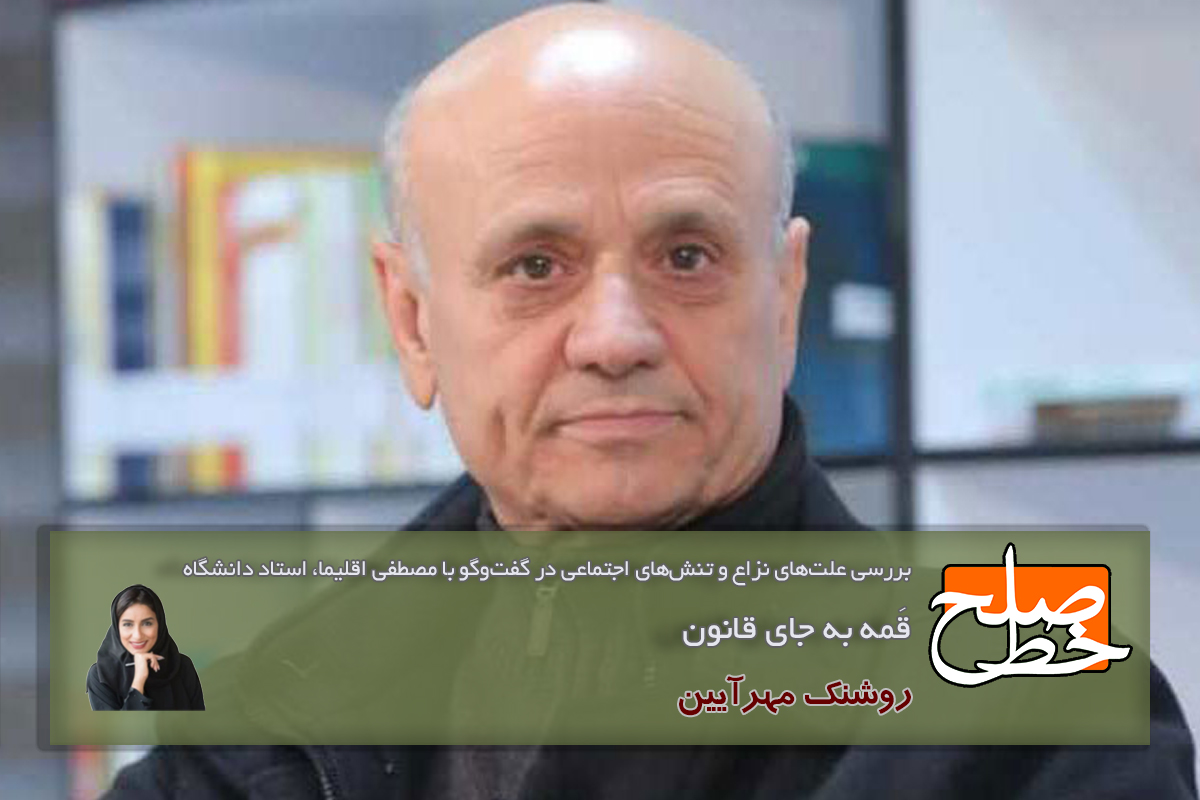
Investigating the causes of conflicts and social tensions in a conversation with Mostafa Eghlima/Roshanak Mehrayin.
“Peak instead of law”
Two months ago, the Forensic Medicine Organization announced that last year, six hundred thousand people across the country visited the organization’s centers due to street conflicts. Although, according to this government agency, the number of visits due to street fights and conflicts did not increase compared to 1399. However, this number of visitors could be a serious warning about the increase of tension and conflicts in Iranian society. What are the reasons and factors behind these social tensions and conflicts? What issues are driving Iranian society towards aggressive behaviors? Why is the path of dialogue closed and the path of conflict open? We discussed these questions with Mustafa Aghlima, the head of the Iranian Forensic Medicine Scientific Association and a university professor.
“سلام”
“Hello”
In light of the statistics from the Legal Medical Organization regarding referrals to their centers, what is the reason for social tensions and conflicts and the occurrence of violent behaviors?
This issue has turned into a social problem for years. When a significant number of individuals in a social group exhibit such behaviors, one must look for structural and social factors. For example, consider a classroom where out of thirty students, seven of them are aggressive and display violent behaviors; one must see what problems the teachers, the educational system, and the school have that cause a few students to engage in violent behaviors.
Social issues arise in the long term and take a long time to be resolved. When we talk about social tensions and refer to conflicts among people, we must follow the underlying causes. These issues are the result of various factors. There are many factors; people’s patience is worn out, there are intense pressures on all groups in society. A father who is violent towards his family, someone who gets into a fight with another person in a park, and other examples are not indicative of these individuals being violent, sick, or outcasts of society; rather, it is a reflection of the turmoil within society. Hope for the future, work, job security, daily inflation, lack of response from authorities to economic pressures, and lack of accountability for justice have all increased pressure in society. We can hear the statement “I can’t take it anymore” from many people. No one is born a thief, murderer, or violent person; it is the harsh conditions of their family, social, and political
In your opinion, are the factors of involvement and violence in society structural and political?
“All races and their causes are structural. Because this social identity that tends towards violence and conflict is formed in society. People learn lies in their homes and this home is as vast as a country. So we are the ones who bring people to this point. In no modern and advanced society, thieves are condemned, but rather the social system is condemned.”
In the past, carrying a knife and spear by some individuals existed. Can it be said that the tendency towards conflict and using force with a knife has existed in our culture since then?
No. I disagree with this perspective. In all third world countries where poverty and social pressure are high, laws are not properly enforced; therefore, people are forced to make their own laws. Today, we are faced with a phenomenon called thugs, which the government has created. For example, if you have a bounced check, you go to the police or judicial authority and they do not take care of your case, so you are forced to pay a bribe to get your check back. So we see that the law is not enforced, the law does not guarantee my rights. So this law is not right, it does not work, and everyone is forced to carry a knife to protect themselves.
In the past, the situation was different. It was a traditional society and there was no written or official law. Those who were famous for their bravery would enforce the unwritten law with the same stick and knife. That means whenever they saw injustice, they would try to take their rights by force. But today, there is a modern system of law and judiciary, and citizens are no longer the enforcers themselves. However, when this law fails and social pressure rises, the same old violent methods remain, which are much more brutal.
Furthermore, this issue varies in major cities and other regions. In small towns, there is social monitoring. If someone behaves inappropriately or violently, they are ostracized by their community due to this social monitoring. However, in major cities, there is no social monitoring in the form of small communities, so the law must take its place, which does not work in Iran.
In developed cities, there is social surveillance. Why doesn’t it exist in major cities in Iran?
It is true. In order for the law to protect and defend your rights. If everyone in Iran knows that there is no law.
Does social supervision mean creating a legal support system?
Yes. However, social control in small and traditional communities such as towns, means the same as custom or people’s perspective, has a function in the law. But in big cities, it is the laws that create social control. As a family, we were involved as responsible and rulers in this matter. We made the members of society aggressive and do not address the reasons.
Do you think the ruling system welcomes the increase of violence in society? Does it promote it itself?
This creates these conditions. Anyone from the responsible and ruling individuals can behave as they wish and create these conditions. There is no place in the world where the actions of security and police officers are similar to Iran. Just a few days ago, the morality police shot the husband of that lady under the pretext of hijab. The police are servants of the people, they take the people’s money to ensure their security. As a university professor, I am considered a servant of the people and the same is attributed to many professions because the police or I, as a university professor, receive our salaries from the people’s taxes and money.
The police have no right to insult any citizen. Everyone has legal rights in society. I cannot take away the rights of the people as a police officer or ruler. In all countries, the public’s desires are written into law by representatives in parliament. However, in the Iranian parliament, the beliefs of the representatives become the law, which none of the members of society accept. When the law is not formed based on the public’s desires, it is not enforced by the people. For example, a parliament member takes the bus lane, the police stop them, and then the parliament member has a violent encounter with the police. After that incident, the parliament members passed a law allowing them to use the bus lane. This means that the parliament member created a law that goes against their own actions. We, as responsible individuals, are supposed to educate the people. We organize the social conditions in a way that promotes violence, conflict, and disputes.
These tensions have increased in comparison to the past in the political space; meaning that a portion of the people are involved with the social base of authority. What psychological damages does the accumulation of these tensions cause to the people?
I will answer this question by referring to the current state of public protests. Look at the gatherings of teachers, retirees, and other groups in society. None of them behaved violently or abnormally. On the other hand, gathering is a legal and customary right; it is an issue that people are aware of; they know they have the right to protest. But when they protest, they are met with violent reactions from the police and security forces. This right belongs to all people in all human societies, to protest, to demand answers from their government officials, or to criticize their president, and no institution has the right to stop their protests. The law does not come from God, it is the people who must determine the law; because no institution or individual is above the people. But in our society, this is not the case. From me, a university professor, to anyone in a position of power, everyone sets and enforces the law in their own favor, and this extends to the
One of the recent behaviors of the government that sparked controversy was the news of cutting off the fingers of some thieves; how effective are these behaviors as deterrents? Do these same behaviors of the government not reproduce violence?
A few days ago, the chief of police in Tehran announced that half of the thieves who were arrested were stealing for the first time. Let’s look at this trend. A person who is forced to steal goes to prison and, for example, is imprisoned for three months. When they come out, because they have a criminal record, they cannot find a job and have no choice but to steal again. Therefore, they become a lifelong thief. Their children also live in this cycle of social exclusion and crime, which we call lifelong convicts.
“We catch the thief by imprisoning him, but we not only do not eliminate the crime, but we also contribute to it by creating a criminal record. Now, for example, they want to prevent theft with Islamic law. But didn’t the same law and the Prophet of Islam say that if someone steals, we must first provide them with work and shelter? Meaning, we don’t even follow the laws of Islam.”
On the one hand, behaviors towards individuals are contradictory. People question why the hand and finger of someone who embezzles and steals billions of dollars are not cut off, but a person who steals out of poverty must face such behavior? So in essence, there is no law. The law differs for the rich and powerful compared to ordinary people, so it doesn’t work and no matter how harsh it may be, it is not a deterrent.
How long can this social pressure continue?
Social issues and problems in Iran are getting worse year by year. In these forty years, the situation has gradually worsened and the factors that have had an impact on these problems have increased every day. For example, inflation has gone from eight percent to fifteen percent and now we have forty percent inflation, while salaries and wages have not increased in proportion to inflation. This means that people have become forty percent poorer compared to the past, and are experiencing a more stressful life. People are forced to work multiple jobs to reduce this tension and endure increased pressure.
In the same way, people’s awareness is also influenced. When a university professor is forced to teach in multiple places, they do not have time to study; they also do not have money to buy books to study, so their literacy level decreases and they cannot teach with quality and up-to-date methods, which affects the literacy level of the student or student. By doing this, the university professor is essentially stealing the time and life of the student and giving them to society with a low literacy level. All of these factors contribute to each other and disrupt the social organization. Then we see abnormal social behaviors and a decrease in awareness level.
We cannot predict how long this situation will continue. Change with revolution is a 30 to 40-year process that requires a suitable foundation. Therefore, we cannot say how long, we can only predict that it will get worse. Because many sociologists have been warning about the worsening conditions for years.
Is the current society of Iran experiencing a social collapse?
It seems that discrimination and force have put pressure on this society and brought it to a point where it is out of control. The leader of the Islamic Republic has always advised that they should be just and accountable to the people, but we have seen that they did not even follow their own words. If we had responsible officials, a president and ministers who responded to the people’s demands, we would not have experienced these conditions.
Today, the main factors of social harms are lack of management and law, which have been imposed by officials. The responsibility for these harms lies with them, not the people. When every protest is met with suppression, no worker, teacher, or retiree is allowed to protest, there is no hope for improvement, and the pressure increases day by day. The first consequence is the increase of social harms, followed by social collapse. As the ruling body, our behavior and actions make the people violent and aggressive.
Our people have problems, they are not sick. If the statistics of addiction, theft, and harm are high, it is due to economic problems and pressure on the people; otherwise, our people are neither depressed nor sick. Aggression in society is the result of discriminatory behaviors in the workplace and society. Unfortunately, there is no one who wants to find and address these causes.
Thank you for the opportunity you have provided us with to use the peace line.
 Created By: Admin
 June 22, 2022
Tags
"Light of the ceremony" 8 Peace Treaty 1348 Monthly Peace Line Magazine Mustafa Aghlima peace line Social collapse Social harms Violence پیمان صلح ماهنامه خط صلح ماهنامه خط صلح