


Mohammad Yunus is the enemy of poverty.
Mohammad Yunus was born in 1940 in a middle-class family in the commercial center of Chittagong, Bangladesh. From a young age, he was always encouraged by his father to continue his education, but it was his mother, Sofia Khatoon, who had the greatest influence on him. Until recently, he lived in a two-bedroom apartment in the Grameen Bank building in Dhaka with his wife, Afrouzi, and their daughter, Dina. During his college years, he excelled and was able to obtain his PhD in economics from Vanderbilt University in Tennessee in 1965. In 1972, he returned to Bangladesh and was appointed as the head of the economics department at Chittagong University. After a while, and due to the famine in 1974 that had a profound impact on his life, he became aware of the deteriorating living conditions of the people in his newly independent country.
As he writes in his book “Banker to the Poor”, he was a professor of economics at Chittagong University in southern Bangladesh in 1974, when Bangladesh was suffering from a terrible famine that resulted in the death of thousands. He says that at that time, there was an attempt to ignore the bitter truth of poverty, but seeing the emaciated bodies of people in the capital city of Dhaka, he could no longer ignore the widespread poverty. Hungry and desperate people were everywhere, so much so that they were unaware of their own life or death. They all looked the same, old men like children and children like old men!
The role that Yunus had as a university professor in teaching chic economic theories and concepts to his students changed. He thought that while people were dying of hunger on the streets, he was teaching useless economic theories at the university. Therefore, he decided to turn to the community and see if he could do something positive. He started teaching the poor and went to a village called Jobra to search for economic realities among the poor. Since he truly wanted to help, he began experimenting with several economic plans with the help of his students and discovered that out of thousands of ideas, one could be practical, which was giving small self-employment loans (micro-credit) to the poor. This was how the initial spark for the creation of Grameen Bank was ignited and the economic revolution of Muhammad Yunus began.
Many accounts of the formation of Grameen Bank are attributed to Muhammad Yunus, but perhaps the most credible ones are those quoted by Stephen Covey, the renowned author of “The 7 Habits of Highly Effective People” and “The 8th Habit,” who described his meeting with Yunus as follows: “I met a woman who was making four-legged stools out of bamboo. After talking to her, I found out she only earned two cents a day. I couldn’t believe someone could work so hard and make such beautiful stools and only receive such a small amount of money. She said she had to borrow from someone because she couldn’t afford to buy bamboo and make the stools. The merchant had said he would only lend her the money if she promised to sell the stools to him at a price he determined. Seeing this bitter reality, I decided to make a list of the victims of usury in nearby villages. The final list showed the names of 42 people who had

This idea is very simple and revolutionary in terms of impact and benefit. Grameen Bank (which means “village” in Bengali) has been managed by Yunus for years and is now the largest rural bank in Bangladesh. More than three million people have taken loans from it and the bank has branches in over half of the villages in Bangladesh. Interestingly, over ninety percent of the loan recipients from this bank are women. In the first stage, Grameen Bank gives small loans to women without collateral. These loans are prioritized from the poorest to the less poor. However, in order to receive a loan, the poor family must have a small amount of agricultural land. The loans given by Grameen Bank range from a few dollars to a maximum of one hundred dollars. In rural areas, even this small amount of money has a great impact on people’s lives. According to statistics, Grameen has so far lent five billion dollars to four and a half million rural families
Mohammad Yunus’ model is recognized by the United Nations as one of the most effective and widespread methods for combating poverty and utilizing charity resources in the world. In fact, the UN designated 2005 as the International Year of Microcredit in recognition of this model and provides extensive support for microcredit-based initiatives in developing countries.
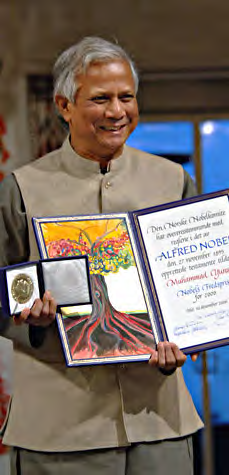
In 2006, Dr. Yunus succeeded in winning the Nobel Peace Prize due to his commendable services in the fight against poverty, along with his bank. In his acceptance speech, he said, “Most of the congratulatory messages I have received for winning the Nobel Prize have come from Bangladeshi borrowers who, from remote areas of the country, have expressed their pride and honor in my receiving this award. Receiving this prize is so hopeful and joyful that almost all of our bank’s customers in Bangladesh have gathered around the nearest television in their villages to watch this ceremony live. This prize is a great honor and credibility for all Bangladeshi women who struggle every day with many difficulties to provide a better life for their children. Surely, the moment of receiving the Nobel Prize by me is a historic moment for all of them. Personally, I believe that terrorism cannot be eliminated by military operations. Although terrorism must be strongly condemned and we must take all necessary measures against it,

Mohammad Younes, alongside his work of providing small loans with the goal of self-employment for the poor, also pursues ideas for transformation in their lives. He encourages and motivates the members of his bank, which has millions of members, to implement 16 decisions in the areas of home ownership and education. He always supports them, including sending children to school, eating vegetables, drinking clean water, keeping the environment clean, etc. With his innovative ideas, even the poor and beggars can become successful in business, take out loans, invest, and improve their lives. This was Mohammad’s initial dream. He says it is true that our bank has become known as the bank of the poor, but we want those who are poor and members of our bank to gradually achieve prosperity.
Nowadays, more than 250 institutions in 100 countries around the world are using the microcredit system based on the Grameen Bank model. According to economic experts, Muhammad Yunus’ idea of providing small loans has been the most important development program in third world countries in the past hundred years.
In the United States, approximately five hundred centers are dedicated to providing these types of loans. On the other hand, in Britain, these types of projects are also being evaluated and implemented. In this way, different countries establish their own unique form of the Grameen Bank by examining their specific conditions and the characteristics of their poor population. Yunus has received honorary doctorates from many universities in the United States, Canada, England, and several other countries. The World Bank has also chosen him to lead the advisory committee for expanding his idea worldwide.
He has also founded companies alongside Grameen Bank, including Grameen Phone and Grameen Telecom, which were able to bring mobile phone technology to rural areas of Bangladesh. Grameen Phone has over fifteen million customers, making it the largest telecommunications company in Bangladesh. Grameen Phone is a joint venture between Telenor from Norway with a 62% stake and Grameen Telecom Bangladesh with a 38% stake.
In 2007, the documentary film “Portrait” won the Golden Panda Award at the Sichuan Festival in China. In this short film, Muhammad Yunus talks about poverty and different ways of economic development. With footage from Bangladesh, we are introduced to the activities of Grameen Bank and social assistance programs for small loans to the poor, bringing us closer to the profile of a man involved in changing the world.
This November, Dr. Mohammad Yunus will be appointed as the president of the University of Glasgow Caledonian. In a ceremony at the university, he was awarded this position and the officials of the University of Glasgow considered it a milestone in the history of the university. Additionally, Mohammad Yunus expressed hope that he can use his experiences to contribute to the progress of the University of Glasgow.
In response to the question of how he would describe himself, he says: “At times, I consider myself a stubborn person. Whenever I come to the conclusion that something is right and necessary, I do not give up until I accomplish it. For example, everyone thought that establishing Gramin Phone Company was impossible and people would not welcome it; but I proved the opposite.”
In another place, Dr. Younes says: I deeply believe that human will can create a world without poverty; provided that all people in the world believe in it. In such a world, we can only find poverty in museums. In the future, when students are taken to museums to see poverty, they will be amazed by the misery and destitution that some people used to suffer from. Perhaps these students will feel sadness and grief for the suffering that their ancestors endured, a suffering that many people had to endure for a long time.
I believe that we can have a world free of poverty, because poverty is not the result of the poor’s actions. In fact, poverty is the product of social and economic systems, as well as beliefs and policies that human society has designed for itself; poverty exists because our theoretical frameworks ignore the capabilities of human beings.
Sources:
Wikipedia website
“Sarmayeh Newspaper – M.A. Azari Nia – 7/1382”
A World Without Poverty – Dr. Muhammad Yunus
Entrepreneurship School Website “Paryo”
“Economic World Monthly”
Fararo Website
 Admin
Admin October 10, 2013