


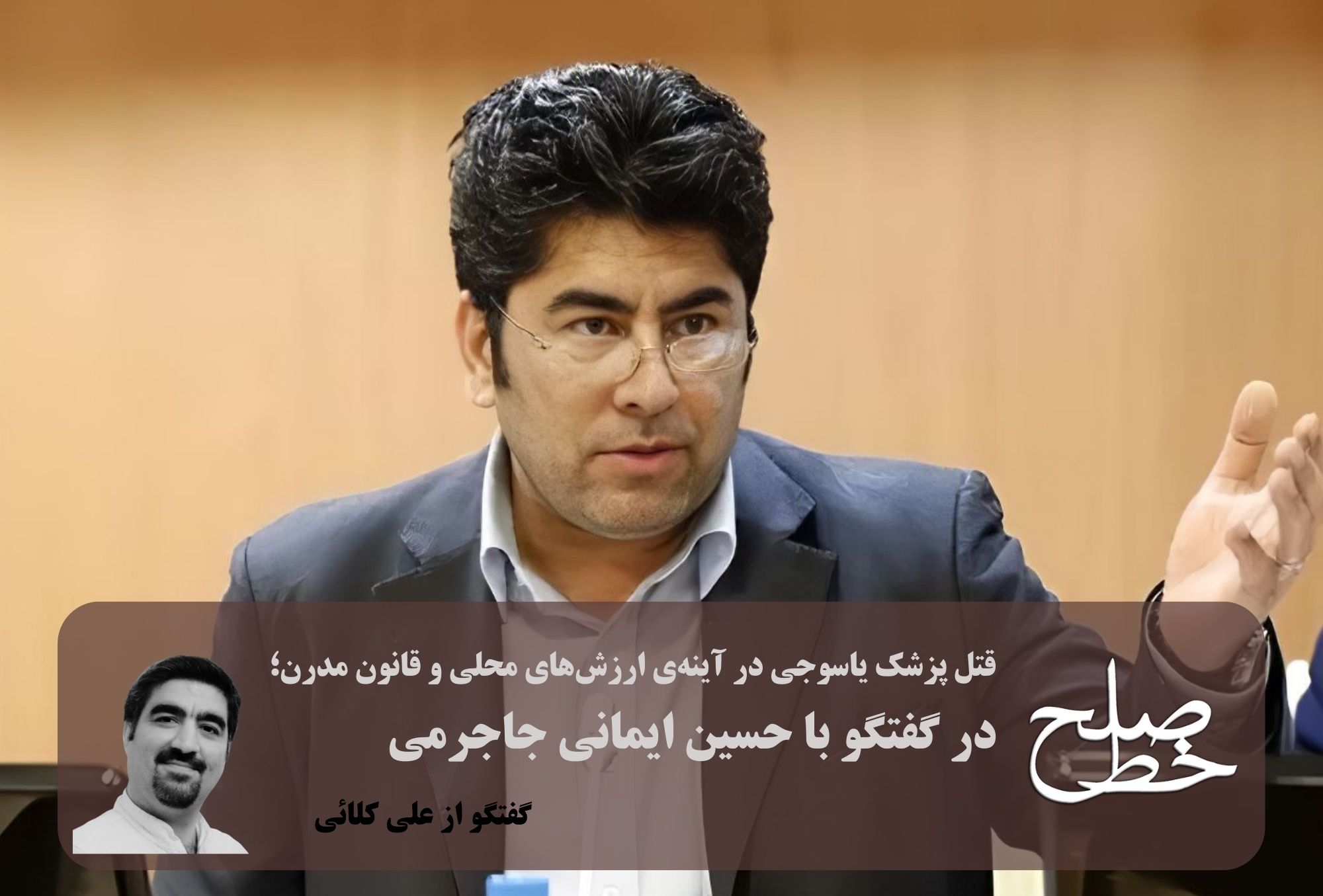
The Murder of the Yasouj Doctor Through the Lens of Local Values and Modern Law; A Conversation with Hossein Imani Jajarmi/ Ali Kalaei
The case of the murder of a doctor in Yasouj, the grand funeral of the convicted killer after his public execution, the participation of a local preacher in the ceremony, and ultimately the presence of a member of parliament at the home of the executed man to offer condolences have raised serious questions in the public sphere and among observers about the relationship between law, culture, and justice. How a criminal act is transformed into an act of honor—or even a justified action—within local narratives, and what causes formal structures of justice to become weakened or retreat in the face of tribal normative and semantic systems, are questions that require reflection beyond mere legal references. Another pressing question is how such a mechanism is reproduced and what consequences it holds for the legitimacy of official institutions.
This incident once again highlighted that the gap between the logic of modern legal systems and deeply rooted local values remains active in certain parts of the country and can present challenges to the legitimacy and societal acceptance of formal institutions. In this light, Peace Mark Monthly Magazine spoke with sociologist and university professor Hossein Imani Jajarmi. Dr. Imani, who also heads the Institute for Social Studies and Research at the University of Tehran, analyzes the social causes and conditions behind such events using sociological concepts and approaches—from the role of tribal ties and the weakening of traditional mediation mechanisms to the performance of the judiciary and the consequences of ignoring cultural differences in public policy.
Below is the full interview of Peace Mark Monthly Magazine with Dr. Hossein Imani Jajarmi:
In the case of the murder of the Yasouj doctor, we were dealing with a criminal act that, through its social portrayal, was transformed into an act of honor—even of justice-seeking. From a sociological perspective, how does this shift in meaning occur, and what social conditions make it possible?
What we’re seeing here are two systems. One is the modern urban system centered in Tehran, and the other is the traditional tribal system that still holds powerful sway in the western regions of the country. The events that took place reflect the conflict between these two systems. A case of medical malpractice should be handled by specialized institutions, and the punishment is certainly not death. But in a legal system grounded in tribal structures, blood ties, and close relationships, that doctor is not viewed as a trained professional but rather as a murderer. Therefore, members of the tribe to which the deceased belonged are expected to react. And that reaction, essentially, is one of revenge. I view this issue within that framework. The act that led to the doctor’s murder was a form of tribal revenge, which is precisely why the killer became a local hero.
How do we understand and evaluate the transformation of a killer’s action—what you call a local hero—into an act of justice-seeking?
I wouldn’t call it justice-seeking.
Even if not justice-seeking, as you said, the individual has become a local hero.
Exactly, and this is the issue of the act taking on an honor-based dimension. What you have here are two value and normative systems. According to the modern normative and value system, what this individual did is a crime. He committed a criminal act and, under Iranian law, was sentenced to death. But under their local value and normative system, this person performed a heroic act—he avenged his brother’s death and seemingly embraced death himself. The presence of a large crowd at his funeral and the subsequent ceremonies does not suggest that a criminal was brought to justice. Even a member of parliament went to offer condolences to his family. This shows that the tribal and clan-based value and normative system is significantly stronger than the modern system in that region—strong enough that a parliamentarian, who is essentially a modern political figure, felt compelled to conform to local social expectations.
After the killer’s execution, we saw an extensive and symbolic funeral ceremony. How do you interpret this? What social and symbolic function did that ceremony serve?
Émile Durkheim has a classification of “mechanical and organic” societies. I think this classification is quite useful here. In mechanical societies and traditional communities, you’re not dealing with individuals. The individual is a product of the modern world, where individuality becomes important. Hence, individuals also accept legal responsibility. According to Durkheim, modern legal systems are restorative—they aim to repair the collective conscience wounded by wrongdoing or error. But in traditional societies, the individual is meaningless. The act of the killer in this case is not seen as an individual act—it is a collective response. That’s why those who gathered and honored him saw themselves as part of the action. Here, you’re dealing with a collective, not an individual. You have to view the matter from the standpoint that this man is not merely an individual but part of a larger group that felt compelled to take revenge.
Why did this group feel compelled to take revenge—especially when a legal and judicial process existed? Why did they feel the need to act on their own and carry out an honor-based act?
We need more information about this case. We need to know exactly what happened because these kinds of cases are often surrounded by rumors and misleading information. But based on what we do know, the doctor in question was not a local—he was considered an outsider. Another important point is that, unfortunately, our medical system fails to consider the social dimensions of its work. It doesn’t train doctors going to culturally different regions to understand that certain considerations are necessary. In other words, they need what we call “cultural literacy.” Iran has a wide range of cultures: Arab, Turkmen, Lori, Balochi, and others. This is not a culturally homogenous and fully modernized country.
I believe part of this issue stems from the medical system itself forgetting the social dimensions of its work. Another issue is that the doctor allegedly committed medical malpractice—I don’t know if that’s true—but it appears that the doctor’s actions led to the death of a patient. The local community here isn’t just one person or family—it’s a tribe that felt one of its own had been killed, and the justifications provided were not acceptable to them. That’s why revenge was taken and the killer’s act was viewed as heroic and honorable. This must be understood within that framework. It’s similar to many honor killings. There are many such cases in Iran: someone kills his daughter or sister, and the local community praises him. While such actions are considered crimes under modern legal and judicial standards, in the traditional framework, they are seen as acts of honor and dignity meant to protect the family or tribe’s reputation.
You mentioned tribes. In a tribal context (like the one where this event occurred), what role did tribal elders, local leaders, and community figures play in legitimizing or solidifying this narrative?
I think that if those tribal elders and leaders had retained their traditional authority and influence, things might not have escalated this far. These individuals usually try to mediate and find conciliatory solutions. Part of the problem may be that the traditional tribal authority no longer functions as it used to. So decisions are made at lower levels, and those decisions may be arbitrary. But since traditional social and historical ties still hold strong, such actions are praised in that context.
Can such actions be seen as purely cultural, or should they be viewed as social-political acts?
My understanding is that it wasn’t political. It was more of a collective revenge against an outsider whom the group believed had committed a fatal error. The tribal group didn’t see the medical error as negligence or malpractice but as intentional murder. So they retaliated. In my view, this particular case had no political dimension.
In such cases, where is the line between social sympathy with the killer’s family and the whitewashing or legitimizing of violence?
We don’t have a universally accepted normative system in our society that everyone subscribes to. Even in advanced countries, you see cultural differences. For example, in Sweden, some people from the Sami ethnic group are still herding reindeer. They have a cultural system different from that of the Swedish majority. Human societies often have such characteristics.
So when an action takes place, it must be interpreted within its cultural and social context. Our minds are conditioned to assess actions using universal standards—we tend to think in generalist terms. But if tradition remains strong in a particular area, it’s a different matter. I’m referencing Talcott Parsons’ concept of pattern variables here. Universalism is a trait of modern societies, whereas societies that are not yet fully modern or have ambiguous modernity are particularist. That means individuals there don’t care about the law, rules, courts, or medical systems. They simply say, “This person killed my brother, I must take revenge.” You could argue with such a person all you want—they’re not operating within that legal framework.
The problem is that local subcultures still hold significant power and presence. But in our policymaking and planning, we ignore them. And so these issues manifest in this way. That’s why I said that anyone practicing medicine and going to areas with strong subcultures and historical backgrounds must understand the demands of their work. For example, during World War II, Americans stationed in Iran were given a booklet instructing them to study cultural codes about Iranians. It explained, for instance, that Iranians tend to be very polite and that if they offer you something, don’t immediately accept it. Or if you go to a poor household for dinner, don’t eat everything—because some family members may have sacrificed their own meals out of hospitality. These details were taken seriously then. But today, we send young specialists to different regions without any training in local culture, and these problems arise.
After all, the cultural contexts of different parts of Iran are vastly different. Iran is a multicultural country, and we need to acknowledge that.
Given the phenomenon we’re discussing and based on your points, could sympathy with the killer’s family reproduce violence? That is, might another person from the same tribe see how such an act is praised and feel encouraged to commit a similar act? Where is the line?
The point is, they don’t see that person as a killer. To them, he is an honorable person who sought revenge and restored his tribe’s tarnished dignity. What I’m saying is that the concepts and roles we easily talk about are not necessarily universal. You see a difference in perspective and position here. From the point of view of you and me—urban-educated individuals—that person is a killer. But from the perspective of people who are his tribal kin, he may not be seen that way.
This brings us back to cultural and social considerations. A modern state aiming to build a universal legal system must make accommodations for communities with strong internal cultures. In countries like the U.S., India, or Malaysia, there are indeed specific legal or administrative considerations for various ethnic and cultural groups.
In Iran, fortunately, all these groups identify as Iranian, and we don’t have deep cultural divides in that regard. But this subject is worth further discussion. There’s no clear solution right now to say, “Do this to prevent the reproduction of violence.” We have to accept that these issues exist in Iran and that we’ve neglected them. The consequences are what we see today: a person dies due to alleged medical malpractice, a doctor whom many believe was wrongfully killed, and a young man executed for seeking revenge. All of this is cause for concern. These are damages—losses for Iran. These were valuable individuals in different ways.
Part of the problem, in my opinion, is that we’ve underestimated the role of culture and value systems. We thought these would fade over time. But that’s not the case. In fact, modernity—and especially the recent widespread access to the internet—has actually empowered expressions of local identity. Local identities in Iran are now stronger than before, because they have the tools and platforms to represent themselves and connect globally. We’re facing a more complex reality than in the past. Sadly, we’re neglecting this.
In this case, we even witnessed more bizarre actions: a member of parliament expressing sympathy with the family of the executed man and a preacher praising him during the funeral. What’s your take on this?
That shows the strength of local ties and the power of that community—so much so that even those who are supposed to represent universal values capitulate. I see this as a sign of the strength of that local community. Of course, one would expect a parliamentarian or public official to take the side of the law. When they don’t, they’re shirking their professional and moral responsibility. A parliamentarian should be neutral and speak within the framework of law. So when one goes to console the family of an executed person, what we’re witnessing is a role conflict. But even that shows how powerful these local cultures are. The representative knows that if he doesn’t go, he may not be re-elected next time. Because in regions outside Tehran and major cities, our political system often relies on ethnic and tribal affiliations.
So if the preacher or representative hadn’t attended, they would have lost their social credibility?
Yes. If you live in a place with strong local ties and want to remain part of that society, you must respect its rules and fulfill the role expectations people have for you. This may result in a role conflict with national laws, but it’s a reality.
Can we say that in this case, while the judiciary followed legal procedures, it failed to convince the local community?
I believe the judiciary must also consider cultural factors. The problem is that social sciences in Iran are not taken seriously. One of the key tasks of this field since its inception—particularly at the University of Tehran—has been cultural and tribal studies. For example, the Institute for Social Studies and Research had a powerful tribal studies section, and figures like Nader Afshar Naderi and Javad Safinejad conducted in-depth research on Iran’s tribes.
We even have an Organization for Nomadic Affairs, and one of its responsibilities is to inform other agencies of such considerations. If we can’t convince a significant portion of the population about the legitimacy of the law, we’re failing. It’s vital that the law be respected by a large majority and that law enforcers be seen as rightful actors. But I don’t believe our public institutions—whether in medicine, the judiciary, or elsewhere—account for these cultural realities.
Are you suggesting that the judiciary should treat murder in certain regions differently?
Yes. If you take cultural and social considerations into account, you realize that murder does not have the same meaning everywhere. When something happens, you must interpret it within its local context and see what mechanisms are available. Suppose instead of taking the matter to the general judiciary, traditional mechanisms had been used. The deceased patient’s family could have spoken with tribal elders. Even if authority has weakened, some respect remains. If a system of elders and local mediation had been used, the outcome could have been different.
I believe all parties have lost in this case: the medical system, the legal system, and the local community. In the eyes of the broader society, taking personal revenge on a doctor is not acceptable. Doctors on social media are sharing stories of what they’ve experienced. As a sociologist, I see much of it stemming from a lack of cultural awareness. People move from one cultural context to another, and mismatched expectations lead to misunderstandings and conflicts. But with the right information, many of these issues could be avoided. The example remains that WWII-era cultural guidebook for Americans in Iran. Over 80 years ago, they provided those guidelines to their personnel—yet we, as Iranians, still lack awareness about our own country. We’re all residents of the same land and must understand one another better.
Doesn’t treating such cases differently create inequality—say, handling a murder case one way in Tehran and another in Yasouj?
It’s a matter of legitimacy and acceptability of an organization’s actions. Specifically, we’re talking about the judiciary. If this doesn’t matter to you, you’ll apply the law uniformly, regardless of cultural context. But if it does matter, it’s not contradictory to judicial principles to consider cultural factors.
They say, “Don’t untie a knot with your teeth if you can use your hands.” A bit of sociological knowledge helps us realize that there are social mechanisms we can use rather than relying solely on rigid, culturally tone-deaf laws. These laws were drafted by a handful of jurists and parliamentarians who often lacked sufficient insight and whose work contains gaps.
Perhaps one of our system’s flaws is that we don’t have juries. Juries serve this very purpose: to assess the crime within its social context and give advisory input to the judge. That’s what happens in modern legal systems. Durkheim is right when he says the purpose of modern justice is not to punish and inflict pain—it’s not about revenge. I don’t want to cut off someone’s limbs or behead them so they suffer. That’s not useful in modern society.
That’s why juries include grocers, teachers, and drivers—not legal professionals. They represent collective wisdom and public understanding. We lack that. A jury could improve judicial decisions. Perhaps if we had juries, many issues we’ve tried to resolve with legal force could have been handled more gently or restoratively. Modern justice isn’t about revenge—it’s about repairing the collective conscience wounded by a murder or similar event. The goal is to restore normalcy.
Our legal system isn’t like that. We don’t have juries. Everything depends on the interaction between the prosecutor, judge, and defendant—especially the judge. So a social issue is left to one person to decide. That’s why our legal cases often take years. Juries would improve the quality of decisions and provide a broader perspective. That’s my view—legal professionals may disagree—but as a sociologist, I believe our judicial systems must have a social dimension. In modern systems, that dimension is the jury.
In your view, if murder is portrayed in such narratives as a “last resort of justice-seeking,” what effect will this logic have in the long run on the professional security of groups like doctors, judges, and public service workers?
It clearly has a negative impact. I saw what doctors were saying on social media about Yasouj and its people. There was bitterness, frustration, and even ethnic insults. This is not a good sign for the future.
Watch Masoud Kimiai’s film Qeysar. It’s a symbolic film. A man who has been wronged doesn’t believe public institutions will defend him, so he takes justice into his own hands—motivated by honor and dignity. That works in traditional systems, but we are millions living side by side. We can’t rely on particularistic standards. I’ve said the judiciary must consider cultural sensitivities. In a pluralistic society of millions, there is no other way.
You must have universal laws—but ones that enjoy broad public acceptance. And in places with cultural differences, people coming from other regions must be trained in cultural sensitivity. We need to acknowledge cultural differences in Iran, because we are not culturally uniform.
Thank you for your time with Peace Mark Monthly Magazine.
 Created By: Ali Kalaei
 December 22, 2025
Tags
Ali kalaei Doctor Yasouj Emil Durkheim Execution Human dignity Judicial system Judiciary Justice in humanity Killer Mahmoud Ansari Masoud Davoudi Medical malpractice peace line Peace Line 176 Personal revenge Revenge Vigilantism Yasuj