


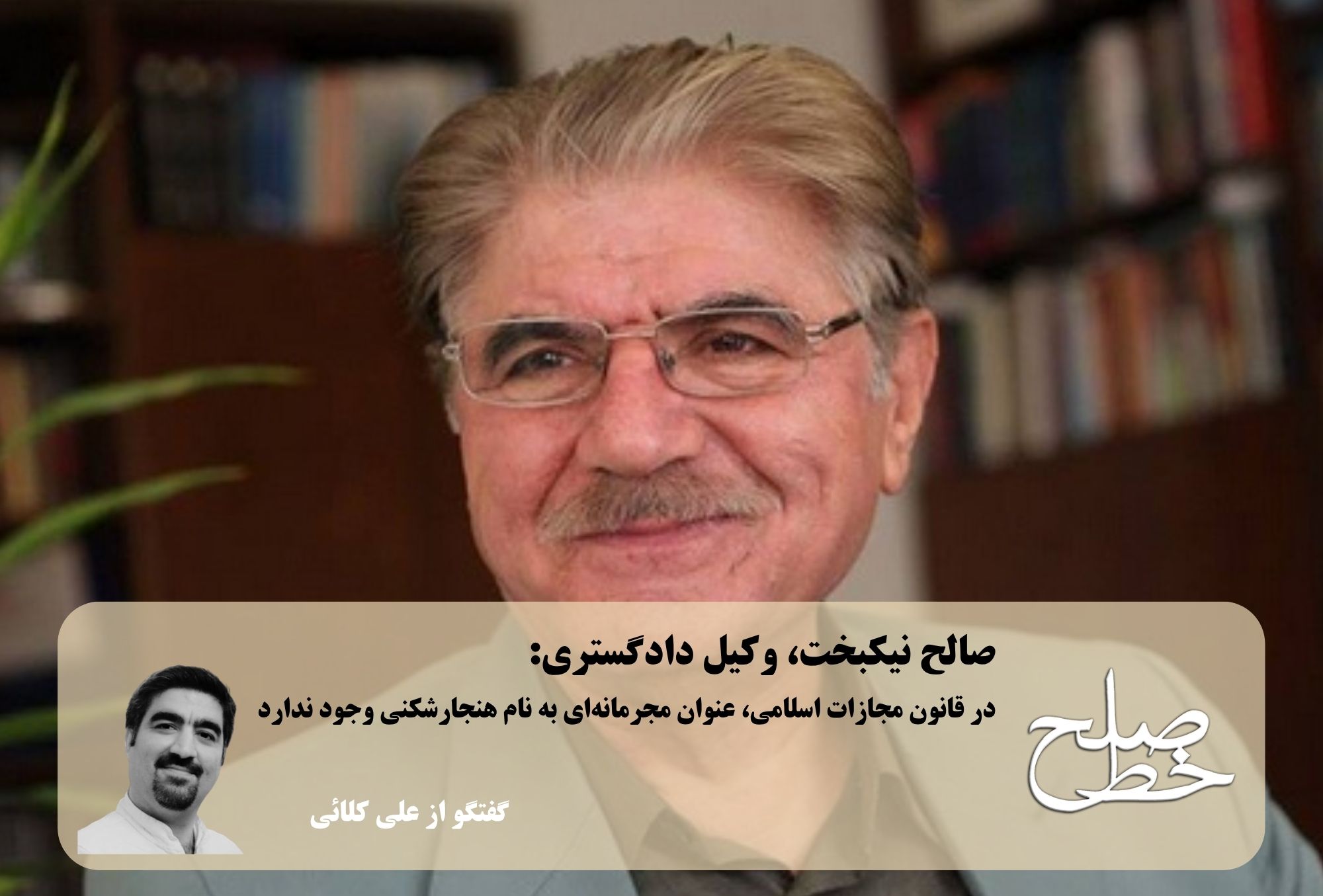
Saleh Nikbakht: There Is No Criminal Offense Called “Norm-Breaking” in the Islamic Penal Code/ Ali Kalaei
Following the subsiding of direct clashes between Iran and the United States and Israel, and while Iran continues to remain in a state of “neither war nor peace,” the intensification of business closures, pressure on cafés and social spaces, and actions against activists and social media pages have raised serious questions about the relationship between security conditions and the expansion of social control. At the same time, these actions have once again brought to the fore debates over the legal basis of concepts such as “norm-breaking” and “public decency,” the limits of business owners’ responsibility, and the principle of personal criminal responsibility.
This prompted Peace Mark Monthly Magazine to speak with “Saleh Nikbakht,” a jurist and attorney-at-law, to ask him about the legal basis of these actions, the limits of business owners’ responsibility, and the relationship between these measures and the expansion of social control policies and conflicts within the ruling establishment. In this interview, Nikbakht, while emphasizing the principles of legality of crime and punishment and personal criminal responsibility, stated that there is no criminal offense called “norm-breaking” in the Islamic Penal Code and that business owners cannot be held responsible for customers’ behavior or compelled to control their patrons. He also described these actions as part of internal struggles within the ruling establishment and believes that continuing this approach, rather than achieving its intended goals, will lead to the expansion of “passive resistance” in society.
What follows is Peace Mark Monthly Magazine’s full interview with Saleh Nikbakht, jurist and attorney-at-law.
In your view, what does the intensification of business closures and social control policies indicate, at a time when the likelihood of intense war in Iran has diminished, and what objective does it pursue?
As you know, despite the efforts made over the past forty-seven years by government officials to create national unity and eliminate disagreements between different factions, two factions have always emerged within the ruling establishment. One faction is a current that, in the most recent parliamentary elections and also the presidential election, was shown to have the fewest votes, meaning between five percent and at most twenty percent support. Judging by their writings and actions, until they monopolize all power, they effectively put obstacles in the way of other state institutions and agencies, as well as rival factions. They prevent their opponents from functioning in the executive and legislative branches and have also caused disruption in fundamental matters and in the administration of the country.
Under current conditions, given the state of neither war nor peace in which we find ourselves, it is often this minority faction, representing less than ten percent of the establishment, that prevents cafés and other places of business, exhibitions, recreational venues, and similar places from operating, especially in locations where mostly young people gather, such as cafés in Tehran and other cities that they believe are susceptible to protests. For example, these people, on Sanaei Street and Square in Tehran, near one of the old police stations in that area, demolished curbs and roadside gardens and created problems around the square in order to force the cafés there out of operation. This has caused concern among shopkeepers and residents of the street. In my view, their goal is to obstruct a government that supports negotiations and an end to war by carrying out unlawful actions.
So you consider the implementation of these policies to be part of the conflict between factions within the ruling establishment?
Yes. I believe that through these actions, these factions have another objective. But they display it through these actions.
Expressions such as “norm-breaking” are used in these actions. What exactly does this term mean from a legal perspective, and does a criminal offense with this wording even exist in Iranian law?
First of all, there is no criminal offense called norm-breaking in the Islamic Penal Code. But generally speaking, norm-breaking, exactly like other crimes, must have three foundations or three elements: material, mental, and legal. That is, norm-breaking, in whatever form or manner it may take, psychologically means the movement of the norm-breakers’ mind toward carrying out actions that in practice place people in a state of psychological and emotional insecurity. The material element of norm-breaking, like other crimes, is its commission through different methods and various forms, either individually or collectively. As for the legal element, although it is not called norm-breaking, it refers to those religious and legal rules and regulations that address acts causing security and social disruptions. In addition, norm-breaking conduct is behavior carried out by norm-breakers against the established order. Their main objective is to confront the state and people in this land who do not think like the norm-breakers. These norm-breakers seek to establish their own thinking in society and among the people.
Can concepts such as “public decency” and “society’s psychological security” serve as a legal basis for sealing businesses?
Although I gave some explanation at the end of my previous answer, I will again address the point you mentioned. The norm-breakers claim that the existence of these cafés together with their patrons is contrary to public decency and that the presence of young people or other groups in these cafés disregards concepts such as public decency and, more importantly, disrupts public order. But it is unclear on whose orders and under which law and judgment these individuals carry out such acts. Those who raise issues under headings such as public decency, violations thereof, and so on have no legal basis whatsoever. As I explained, such actions must be carried out on the basis of specific laws and regulations.
What I really mean is that these individuals take actions for which it is unclear what laws and regulations they are based on or who has authorized them to act arbitrarily toward society. They themselves are lawbreakers who believe they have the right to stop anything that does not conform to their wishes and views. As I also said in response to the first question, their aim is to disrupt public order and also to remove authority and governing power from the hands of official state authorities.
To what extent is a café owner, tour manager, or business owner responsible for the clothing and behavior of customers and visitors?
Owners of cafés, shops, restaurants, public venues, exhibitions, and so on bear no responsibility whatsoever for the clothing and behavior of visitors and customers. Their only duty is to provide written or verbal notice within the framework of the country’s regulations.
What kind of notice?
For example, that Islamic hijab must be observed. In practice, even now in the cafés, restaurants, and places that I see, it has been stated that Islamic standards and clothing regulations should be observed. Whether the visitors comply with these requirements or not, no responsibility falls on the café owner. Café owners are not the government’s watchmen, expected to pressure people. And there are certainly not enough buckets of yogurt in these cafés to pour over customers’ heads!
Well, in that situation, if a customer does not accept the warning, can the café owner refuse to provide service?
If these claimants of Islam themselves owned or managed these places, the only thing they could do would be to give a verbal warning, which in the Islamic system is regarded as enjoining good and forbidding wrong. Beyond such a warning, they have no right. These people arbitrarily endanger society’s security. Ironically, they act as atash-be-ekhtiyar—with a free hand—and no one is capable of confronting them.
Does compelling business owners to control customers not effectively turn them into an arm of government surveillance?
Business owners cannot be forced to control customers. In all civilized countries of the world that are not inhabited by barbarians, all people in a country, as well as government bodies and institutions, are required to comply with regulations and laws. State bodies also cannot act without the passage of legislation and identification of the acts that must be prohibited. It is unlikely that these actions in Iran are being carried out through state and official institutions. In our country, not only does no such law exist, but neither is there a governmental decree of the kind that is sometimes issued in this area. As for hijab, I will explain later if it comes up in the questions.
What legal basis do compulsory pledges have, and can they replace judicial proceedings and judgments?
Under the law, no undertaking and no contract whose performance is impossible can be accepted as valid and official. Therefore, compulsory pledges obtained from owners of cafés, restaurants, and public centers have no legal standing and cannot replace judicial proceedings.
Is a pledge obtained under pressure from closure or deprivation of the right to operate legally valid and admissible?
Even if such pledges are obtained, they cannot constitute a binding governmental obligation. They can even be challenged through a complaint, and the institution can be compelled to stop forcing people to sign such pledges. The Administrative Justice Court is part of Iran’s judicial system and deals with unlawful conduct by state institutions. This court can dissolve and invalidate such undertakings.
What legal basis exists for actions against bloggers, content removal, and blocking pages?
Based on the principle of legality of crime and punishment, all acts and measures carried out against young people, artists, writers, and bloggers, without legislation and despite existing laws governing such matters, are contrary to regulations. Actions concerning issues such as public decency and so forth, in relation to places of business such as cafés, restaurants, and others that I mentioned, and considering the principle of personal responsibility of the perpetrator, relate to those who actually commit these acts. People have also given warnings within the framework of the law or enjoining good and forbidding wrong. Beyond this, neither those who enjoin good, as these gentlemen claim to be, nor law enforcement authorities and similar bodies responsible for administering public establishments can impose any obligation whatsoever. They cannot force anyone to do something.
That concerns public places. Our question is about cyberspace. Pages are being blocked online. Do these actions have a legal basis?
Matters such as writings, media outlets, and online publications were addressed in the Press Law adopted in the past. Such actions concerning cyberspace and internet pages may only be taken pursuant to judicial orders issued by judicial authorities, meaning prosecutors’ offices. As long as orders from prosecutors’ offices are not observed in such cases, in my view, whenever people encounter such a situation they can say that it is contrary to the laws of the judicial system for someone to seek to prohibit them from an activity or force them to do something.
The question is whether the coincidence of these measures with business closures indicates an expansion of the pattern of social control.
In answering this question, I must first offer an introduction. Such actions, under the current security conditions and the existing state of neither war nor peace, cannot become the normal practice of government officials, let alone of those groups who gather at night in various places and wave flags. This is because they have failed to achieve results from most of the actions they previously took, whether concerning hijab, bloggers, artistic matters, or similar issues. They certainly will not achieve results from these actions either. They themselves know very well that in the past they acted even more severely and intensely on matters such as artistic activities, newspapers, cafés, and similar issues, and did not achieve results. In other words, these actions happened before as well, and instead of resisting them directly, people engaged in passive resistance and, without entering into direct confrontation, evaded the restrictions and continued what they were doing either in the same place or somewhere else. This passive resistance is one of the problems the ruling establishment faces.
Throughout all these years—both during the years when I was in prison and afterward—these actions always began in spring and declined in autumn. Some people who have now become intellectuals once pushed thumbtacks into the foreheads of women who did not wear hijab. The following year, these actions still did not cause people, when Farvardin and Ordibehesht arrived, to put on chadors and do what the authorities had ordered. Even if they had to comply somewhere because an officer was present, six steps away they would go back to doing what they wanted.
One matter that sensible people in the government or some representatives who can understand people’s suffering can look at is precisely this issue within the judiciary. The highest degree of control over individuals and their behavior has existed within the judiciary, with which we too have had extensive dealings. I have seen many women in courts and tribunals wearing full clothing and hijab. But once they came outside, they would remove their chadors and, like most ordinary women in the country, observe hijab only to the extent that they were not uncomfortable, and then continue on their way. When repeatedly refraining from doing something becomes normalized, people also acquire immunity from it and find various other ways to avoid doing it.
So this new pattern of social control will also fail?
Yes. Hijab is an example. Despite the existence and passage of the hijab law, which was very severe and harsh, after the case of Mahsa Amini—and I am the lawyer for Mahsa Amini’s family—it is not being implemented.
Is sealing a business because of customers’ behavior compatible with the principle of personal criminal responsibility?
Not at all. We have the principle of personal criminal responsibility and punishment and the principle of legality of punishment. The principle of legality of punishment means that until an act is recognized as a crime and until a punishment is prescribed for that crime, no one can be accused of it. The principle of personal criminal responsibility and punishment is also one of the legacies of the Renaissance. Crime is a personal matter and it is not like in past or tribal eras, when members of a tribe could be punished because of the crime of one member of that tribe. Today, too, a café owner cannot be punished because a person in the café fails to observe hijab or commits any other act that these people consider contrary to public decency. Because this leads to a situation in which, in order to prevent their café from being shut down, the café owner has to confront me and others and ask why we have not observed order and regulations, or confront women who enter and ask why they have not observed hijab. But the issue is that this group, acting as atash-be-ekhtiyar, creates problems for citizens. If citizens consult lawyers in this regard—public willingness to consult lawyers had increased since the reform era, but has now declined, perhaps because of financial issues and the perception that lawyers are costly—lawyers can help them.
As you know, in the final week of Mordad this year, the general outlines of the bill to counter infiltration by foreign intelligence services, governments, or institutions were approved by Parliament. Are restrictions arising from security conditions and the passage of such bills becoming a normal method of governance, and what legal and social consequences will continuation of this trend have?
I have read the general outlines of this matter. But I cannot say anything about it before its details are presented in the parliamentary session, adopted, and approved by the Guardian Council. The government has also said that it opposes the bill. I believe this proposal was put forward by some members of Parliament, the same percentage-based representatives who have four or five percent or less of the people’s votes. I must say that the foundation, structure, and basis of this matter are contrary to the country’s Constitution. Most of these people do not even believe in the country’s Constitution, because if they did, they would know that the Constitution divides and specifies the duties of the three branches and that no branch has the right to interfere in the work of another. Ultimately, the Guardian Council and then the Expediency Council must prevent any law that is contrary to the Constitution and Sharia. If the judiciary also does something contrary to the Constitution and Sharia, the person must go to the courts, and if the courts are independent, they will overturn the judiciary’s actions. This happened in the past, but has now become somewhat limited and less visible. Moreover, if the executive branch commits an unlawful act, the judiciary can intervene. Parliament itself can also issue warnings, impeach a minister, and refuse to give them a vote of confidence. These actions are carried out arbitrarily and are usually undertaken by one particular faction.
Regardless of this bill, and considering what had already been happening before the general outlines of the bill were approved, what is your view? Is this becoming a normal method of governance, and what legal and social consequences would continuation of this trend have?
Certainly, if it continues, it will lead people to engage in passive resistance. On the other hand, laws and regulations are enforceable only under specific temporal and spatial conditions. For example, regarding the hijab law, the government of the Islamic Republic announced that it was not prepared to implement it. This occurred during the lifetime of the previous Leader of the Islamic Republic as well, and he did not question the government about why it was not implementing it. This indicates that the implementation of laws and regulations under specific temporal and spatial conditions can require that some laws not become enforceable. For this reason, the same actions concerning cafés, bloggers, artists, journalists, and so on, and even this baseless proposal by the parliamentary minority whose general outlines have been approved, even if fully enacted, will lead nowhere.
For example, I had a client who was arrested during the events of Dey last year. This person was a PhD student in IT and had created a page or application. Through this page or application, he could connect two people and, in one place, up to fifteen people without a VPN to websites, television channels, and radio stations that are prohibited, allowing them to use those services. In this case, considering the law adopted last year, the Law on Intensifying Punishment for Espionage and Cooperation with the Zionist Regime and Hostile Countries Against National Security and Interests, the trial judge, even better than my colleague and me, stated in his judgment that, given that this idea had emerged and it had not been proven that anyone other than these two people had used it, and since the matter concerned technical devices and technological tools, this so-called special IT application could not be punished under the intensified punishment law I mentioned. In other words, just as happens elsewhere in the world, the judiciary itself can be one of the interpreters that clarifies the law for people. A ten-year prison sentence had been requested for this individual, but he was sentenced to one year in prison, and that was on the charge of propaganda against the system. What I mean is that these bills and practices do not produce results. Just as they did not before, this new bill will not be implemented either.
Thank you for giving your time to Peace Mark Monthly Magazine.
 Created By: Ali Kalaei
 August 23, 2026
Tags
Immorality