


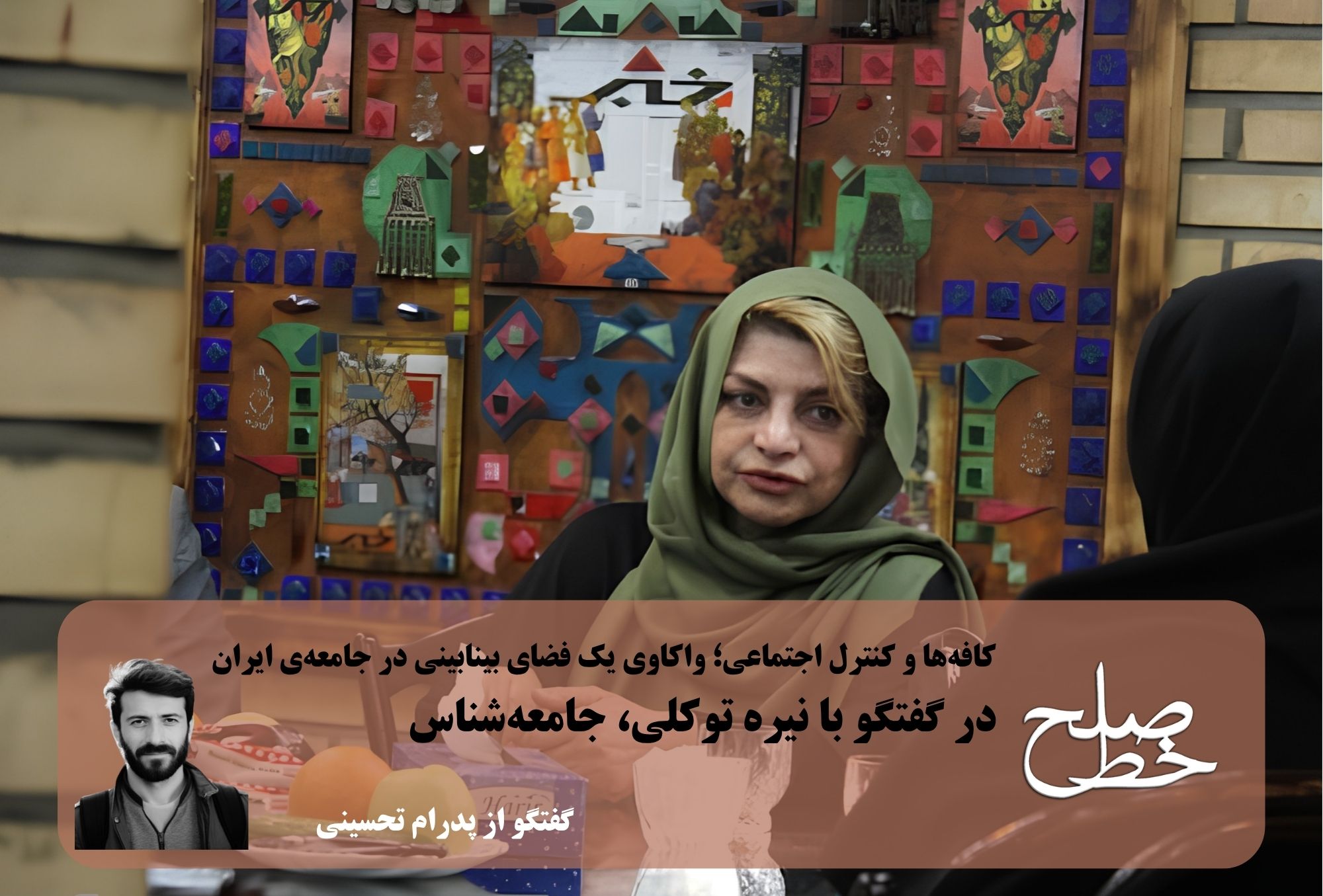
Cafés and Social Control: Examining an Intermediate Space in Iranian Society; An Interview with Nayereh Tavakoli/ Pedram Tahsini
In contemporary Iranian society, urban spaces have become not only the setting of everyday life, but also arenas for redefining identities, values, and social relations. Among these, cafés, as one of the most important intermediate public-private spaces, play a dual role: on the one hand, they are places where young people gather, converse, and spend their leisure time; on the other, they have become focal points for clashes between norms, government policies, and different lifestyles. The questions raised in this context go beyond a merely recreational venue: why have cafés become one of the focal points of confrontation and social control? Why does the government focus on intermediate spaces, and do these spaces reflect the deep gap between social customs and official policies? To examine this complex and multilayered phenomenon, we spoke with Dr. “Nayereh Tavakoli,” sociologist, faculty member at Payame Noor University, and member of the Iranian Sociological Association. Taking a pathological perspective grounded in social realities, she analyzes this issue and, in this interview, examines sociologically the excesses, deficiencies, and the gap between the public and private spheres.
What follows is the result of this conversation; a conversation in which Nayereh Tavakoli seeks, from her own perspective, to reveal the hidden dimensions of the issue and examine it from historical, class, and cultural angles. From analyzing class-based customary control in pre-revolutionary society to examining the consequences of mandatory hijab, from exploring the exposure of private spaces to criticizing pure hedonism and indifference toward current events, this conversation attempts to present a picture of the challenges facing Iranian society in its encounter with intermediate spaces.
Cafés today, particularly for young people and those under forty, have become cozy and pleasant places for spending leisure time and occupy a considerable part of their everyday lives. These spaces have gradually become one of the main centers of social interaction for the younger generation. The fundamental question is why such places, which on the surface have merely recreational and social functions, have today become one of the arenas of confrontation and social control. Moreover, why does the government show such focus and sensitivity toward intermediate spaces—that is, spaces defined as neither completely private nor entirely public—and should cafés also be considered among these intermediate spaces?
Personally, I view the pathology of private-public spaces somewhat differently, and I believe that no one has remained immune from the harms of extremism, especially women and the middle class. In other words, everyone has witnessed excesses and restrictions whose response has always been assumed to be an opposite excess. It has also always been said that when society does not move according to its own customs, a very deep gap emerges between the public and private spheres.
This means that in society, when many ordinary matters are pushed behind closed doors, no relationship, identity, or standard will exist within that closed space. In recent years, we have witnessed, first, excesses that have led to opposite excesses. For example, extremely strict families have now sent a large proportion of their children—who can be seen enjoying themselves in Europe and the United States or in similar environments in other countries—abroad. These people are in fact the children of officials’ families who often belong to the upper classes of society and are considered part of the oligarchy. They have benefited from the rents of this society and, without exception, have all gone abroad, particularly to the United States and Europe. A recent example that was widely circulated is the case of Mrs. Ebtekar’s daughter-in-law. What I have in mind is the pathology of excess and deficiency, as well as the gap between public and private space and the resulting lack of identity, to the extent that the social landscape has been unable to transmit its customary standards to the new generation.
Nor should one imagine that before the revolution the issues of hijab and recreation lacked a class dimension, because class analysis cannot be removed from the pathology of this issue. According to class analysis, before the revolution, lack of hijab and the use of the standards and symbols of European society belonged largely to the upper and affluent urban classes. In other words, in Tehran, lack of hijab could be seen in the city center, and in tourist cities such as Isfahan, it was also visible in the city center; but as soon as one entered neighborhoods—even in a city like Tehran, especially its southern districts—that clothing and behavior were no longer seen.
The same custom you refer to is, in fact, what shapes customary social control in terms of behavior and conduct?
It had a class dimension. Around ninety percent of people, particularly women and girls, did not have the opportunity to move freely through urban spaces. For example, in many activities, including sports and university educational camps, families did not allow their daughters to participate, and only a small number from the urban middle or upper classes granted such permission.
Although these restrictions also existed before the revolution, the major difference was that there was not such a significant gap between private and public space. In other words, what was visible to society did not differ greatly from what happened inside the home. But in the Islamic Republic and after the revolution, this gap increased dramatically. On the one hand, the restrictions that were created provided an opportunity for lower-class women and deprived women to enter sports and social spaces.
In other words, the remarkable growth of the middle class after the revolution brought this class to a level of power and influence unprecedented in Iran’s contemporary history.
That was one factor, and also, because of changes in religious approaches, girls could participate in numerous activities while wearing hijab. In addition, mandatory hijab, contrary to what many believe, in practice created certain opportunities. It gradually led to the disappearance of the chador from many settings, while manteaus and headscarves became officially accepted across the country, even in the most remote areas. In this way, that deep divide that previously existed, according to which women in smaller towns necessarily had to wear a chador, disappeared. This transformation facilitated greater participation both for lower, deprived, and traditional classes and for urban groups active in rural areas, smaller cities, and factories.
In other words, restrictions sometimes function like a container: they both limit and provide a framework for activity. In any case, activity requires a framework, and although this container has boundaries, it prevents a vacuum and the absence of any framework. Therefore, customary norms should always be observed, while society should also be able to manage social space not merely through law, directives, or coercion, but through internal reform and by relying on people’s outlook, which itself constitutes a customary standard.
The gap mentioned was the result of many matters being pushed behind closed doors; but at the same time, Iranian girls in general were able to achieve considerable progress. For example, in the Islamic Countries Games, among Muslim countries, Iranian women have won the greatest number of medals. It is noteworthy that Iranian society, compared with other Muslim countries, has made remarkable progress. For example, Uzbekistan and Kazakhstan, despite their Soviet background and the absence of serious religious restrictions, may participate in some disciplines in which Iranian women do not, yet the statistics for Iranian female medalists and participants in recent Islamic Countries Games are still far higher than those of other countries.
Therefore, there have also been positive aspects for society. As I said, restrictions can provide a framework for activity. But at the same time, extremism widened the gap between private and public space. Your reference to cafés is not new. For years, the upper classes of society have used their financial resources to turn private environments into places where every standard is violated, from gardens around Tehran and Isfahan to large and small towns, where by spending money it became possible to disregard norms and even surpass European countries in terms of appearances.
What has happened now is that these spaces have become “visible.” In other words, the private, identity-less, standard-less space that was neither subject to legal supervision nor social control has now been exposed. This exposure has also contributed to its expansion. In these years, Iranians, especially the middle and upper-middle classes, have been given the impression that they do not belong to this society and that their utopia should be the lifestyle of the affluent one percent in the United States or Europe. Nowhere else in the world have people been given such a message that they should only enjoy themselves, go on vacations, travel, and go to Antalya. It was assumed that Iranians should live this way throughout the year.
Although the sharp rise in prices and exchange rates has now created some restrictions, the Iranian middle class is still confronted with the message that “you do not belong to this society.” This very issue is deepening the existing gap. It seems that after a period of excess, an opposite excess is now taking shape and, subsequently, a kind of balance is emerging. For example, a more realistic image of women is sometimes shown on television, or efforts are made in that direction, and in many areas previous restrictions have eased.
But the toxic element that continues to be injected is complete indifference to events in the country, so that war, widespread mourning, and human tragedies are of not the slightest importance to young and affluent people. This outlook reflects the sanctification of pure hedonism: mere pleasure-seeking without regard for one’s surroundings. Not only places such as Gaza and Lebanon, but even the ugly face of capitalism that devours the world and reduces human beings to second-class status is irrelevant to them. They have been made to feel that they belong nowhere and are given no sense of identity, while failing to understand that they are Iranian and belong to the Global South. In the eyes of those whom they have chosen as models for their lives, they will never be regarded as first-class human beings. For this reason, they are told that their only duty is to enjoy themselves.
Now, too, this outlook is being reinforced by the claim that many strict standards have long been disregarded and it has even been legally announced that the morality police are no longer active; yet instead there are provocative actions and deliberate poking that emphasize that your only duty is to go out and enjoy yourself.
Do you mean complete indifference to the events taking place around society?
It seems this indifference is deliberately reinforced to emphasize that “what does it have to do with you?” and that you have no role in these matters at all. It is as though there should be a country provided solely for their enjoyment. Not everyone can take currency out of the country. Those who have managed to do so have gone to Turkey, London, and elsewhere, and many of them are not only from ordinary or profiteering classes, but even include sociologists and university professors who themselves witnessed these developments and even acted as tour guides!
You believe that these cafés belong only to affluent and wealthy groups. Yet evidence shows that these spaces are not only expanding, but have spread from the north of the city to the south and are increasing even in small towns.
This expansion is accompanied by financial support. It appears that efforts are being made from within to provoke incidents in these places.
The main question is this: given the current high prices, even I, as a retired university professor, struggle to cover my living expenses, so how do young people afford these places? It appears that café-going, whether among youth from the affluent northern districts, the middle class, or those who see such spaces as places to escape the realities of life, is becoming a model of youth lifestyle.
The issue is that government sensitivity toward them has increased, as the high number of closures clearly demonstrates. The fundamental question is: what is the root of this sensitivity?
Because there needs to be some movement, meaning some balance must be created with regard to that private space that is suddenly becoming public. Falling into the trap on this side as well—for example, regarding hijab—is also a major mistake. But it must be understood that any form of crossing boundaries means falling into the same conspiracies, both by opposing them and by becoming caught up in them.
What is called unlimited, framework-free freedom, while even now pole dancing or certain types of clothing at weddings, parties, and private spaces are not accepted by the general customs of society. In the name of youth, and through reclassification and secrecy, like party organizations that have now taken on a sectarian character, people do not attend these gatherings with their families. Whereas the presence of families itself indicates observance of customary norms.
In fact, it is a trap laid from this side as well, just like addiction and many other things. Our responsibility, first of all, is to ensure that the customary condition of society does not become such that indifference toward it is considered a source of pride, as in the attitude of “what does it have to do with us?”
Of course, we intend to discuss the concept of governance, the place of society in decision-making processes, and the influence of public opinion on political and social trends.
The government itself is not homogeneous, and both conservatives and reformists consist of different classes with different views. All of them, from a class perspective—that is, those who have enjoyed carefree prosperity—now think only about their personal interests, and the interests of the country are irrelevant to them; that is, resisting the idea that Iran must survive. Separating the government from the people and conveying to young people that Iran is the only country that should not have a government or an army—all of this is an attempt to separate people from their national identity.
Whereas in every other country, they somehow choose a name for resistance forces and make them hated. For example, in Yemen they use the word “Houthi,” whereas 95 percent of the people of Yemen, who now control the country, are fighting Saudi Arabia. In Palestine, too, the term “Hamas” is used, not Palestinians. In every country you consider, these groups are presented as evil and hated groups that must be eliminated; otherwise, their own country remains intact. Yet what we see is that none of the countries attacked in this way, such as Libya, Syria, Lebanon, and Palestine, have escaped unharmed. Venezuela, which faced kidnapping and the abduction of its president, is it in a better situation now? Not only has the social situation not benefited them, even natural disasters have not been on their side.
Let us return to the main discussion. You mentioned that under current conditions, café owners’ businesses have prospered. My question is: can policies of pressure and coercive measures force café owners, in order to protect their interests, to restrain customers’ behavior and accept imposed restrictions?
It seems that the issue is not hijab or lack of hijab. We have moved beyond that matter for some time. What is now being confronted is behavior outside accepted custom. The issue is not hijab or lack of hijab; as can be seen, even in mosques, people without hijab come and go.
So you mean the main problem is not the confrontation and closure itself, but unconventional clothing?
Yes, and unconventional behavior. Of course, one should not fall into this trap. Hopefully, neither side will become trapped in this matter, neither this side nor the other. At a time when corruption, divisiveness, and currency smuggling should be fought, instead of sealing cafés and taking similar actions, those who have embezzled and fled should be tracked down and it should be determined where the embezzled money has gone. This situation shows that money is being spent from both sides to distract people from the main issues and to draw the government into these marginal matters, so that ultimately both sides lose.
From the street to cafés, clubs, and tourism tours, what does this expansion of enforcement tell us about methods of social control?
Certainly, social control has undergone a transformation. I strongly believe that this issue is unfolding in a targeted and calculated manner and that resources are being spent on these confrontations.
By whom?
Meaning that some people are being pushed forward to create these situations.
So in your view, money is being spent to promote unconventional forms of clothing? Interestingly, Tehran’s Friday Prayer Leader said exactly the same thing!
I agree with anyone who has said this! The reality is that provocations are taking place from this side. For a long time now, people have dressed freely in streets and alleys, and for years there has been little intervention in private spaces such as weddings and parties. Although strict measures have sometimes occurred, the situation had gradually been moving toward balance. But now, given the particular atmosphere, efforts are being made to separate young people from society and convince them that they should pursue only pleasure. Money is being spent for this purpose.
In other words, you believe a trap has been laid to ensnare both sides.
Exactly. Moreover, similar laws exist throughout the world. For example, on beaches in France, you cannot wear ordinary clothes and walk around, or during the Shah’s period, to walk on the beach you had to wear a swimsuit, even if you had no intention of swimming. What percentage of Iranian society wore swimsuits? Not even half a percent. The situation is similar on French beaches; a few years ago, a Muslim woman’s clothing was forcibly removed because she was walking there dressed in it. This shows that governments intervene according to their laws.
Even in Antalya, you cannot enter a restaurant wearing a swimsuit. Everywhere has rules according to which governments intervene and impose fines, for example concerning complete nudity or similar matters. But what is now being conveyed is that there should be no laws at all in Iran and that every kind of intervention is wrong. This pressure on social space can lead to social self-censorship, changes in behavior, and even the direct presence of government forces. I believe that if there is no intervention and provocation, society will regulate itself. Government intervention can also exist within the framework of law, as in any other government.
As I mentioned at the beginning, during the Shah’s period, social custom did not permit certain things. For example, in the southeast, custom did not allow them. There were laws that, conversely, opened more spaces to ordinary people. Ordinary people, who were often from smaller towns and wore hijab, could not enter the former Aryamehr Park, now the Isfahan Birds Park, wearing a chador, whereas today one can enter wearing a chador, without hijab, or with a headscarf.
I asked this question once before. Can pressure on these spaces cause people to censor themselves and change their behavior even when government officers are not present? In other words, can the pressure become so intense that space owners and ordinary people themselves are forced to alter the environment and comply with new rules?
No! There are also good cafés that are cultural spaces. It is important not to follow a prevailing atmosphere blindly. This is a current that will find its own path, just as it has up to now. Some cafés are spaces where young people can engage in legitimate and useful social activities. These will remain, and the rest will themselves become the outcome of what should exist.
In your view, can closure or the threat of closure affect young people’s sense of security and everyday behavior in public spaces?
I absolutely believe that both sides fall into the trap. There is so much insistence on crossing boundaries, and some people truly spend money to disrupt the atmosphere. One cannot say in absolute terms that there should be nothing and no enforcement at all, nor can one say that this enforcement is good and should exist. But the ultimate outcome of this will be positive in the future.
In the long term, what effect will restricting such spaces have on social relations, urban life, and the gap between the younger generation and the government?
The same thing that happened before: the restrictions we previously had, the excesses and opposite excesses that existed and are now being repeated.
The generation that has entered the arena in Iran today has neither direct experience of the pressures of the 1980s nor lived in that same context; rather, it has grown up under different circumstances. In such a situation, can the negative effects of current restrictions be overlooked?
The new generation must also learn that it is living in Iran. Some people were deceived by foreign media seeking to separate people from Iran under the claim that Iran’s government is the worst government in the world and must be changed. When a film festival is held in Saudi Arabia, not a single Saudi woman is present. It is all for propaganda. Nothing is organic or compatible with the structure and fabric of that society. Yet some still regard it as a sign of freedom, while women there fundamentally do not have a social presence.
But it has been promoted in such a way that the only bad government and regime in the world is Iran’s government, and therefore it must be overthrown. Many things may have changed, but one should not simply accept everything, and everything should not be accepted in the name of freedom or ideology. I am optimistic about the future.
Thank you for giving your time to Peace Mark Monthly Magazine.
 Created By: Padram Tahsini
 August 23, 2026
Tags
Pedram Tahsini