


“Circumcision of boys; a health procedure or child abuse?; In conversation with Mahmoud Amiri Moghadam / Simin Rouzgar”

Conversation with Simin Rouzgar
Almost all men in Iran are circumcised during infancy or childhood. The commotion of young boys before undergoing this surgical procedure, their discomfort after the operation, and the celebrations and parties of “Khatneh Suran” which are sometimes accompanied by grandeur and extravagance, are familiar and common images.
But why do men, even at a very young age, have to be circumcised and what is the necessity of such an act? We have probably heard: “To become a Muslim” or “Circumcision is necessary for personal hygiene”; but is it really necessary?!
Of course, male circumcision is not only relevant to our country and Muslims, but it is also important among some other religions and denominations such as Judaism. In 2011, when some citizens of San Francisco in the state of California in the United States, who were against male circumcision, tried to make this act illegal through collecting signatures and holding a referendum, they ultimately failed according to the ruling of a judge in America. The judge stated that making a decision about such a matter at a local level is against the law. Some also believe that banning circumcision restricts religious freedom.
But in late Ordibehesht month, news spread about the death of a two-year-old child in Yazd, named Younes Ghaemi, after undergoing circumcision in a hospital, which prompted us to address the issue. Therefore, we went to Mahmoud Amiri Moghadam, a doctor and human rights activist residing in Norway…
Mr. Amiri Moghadam, as the first question, please tell us where the philosophy of male circumcision comes from and in which countries is this practice more prevalent?
I do not have accurate historical and philosophical information in this regard, but it seems to have been established based on religious beliefs, in Judaism and Islam. What is heard in this regard is that, for example, Muslims believe that this act is beneficial in terms of hygiene and also mention its role in preventing male genital cancer, while according to medical science, the validity of such a claim is not that simple. On the other hand, health systems in countries around the world have not conducted comprehensive research in this regard and no statistics have been presented regarding the incidence of male genital cancer among circumcised and uncircumcised men. It is also difficult to compare such individuals with each other in countries like Iran, as uncircumcised men are almost non-existent.
Some studies have been conducted in some universities in Europe and America, which in the first stage show that genital cancer is one of the rarest cancers in the world. It also has the lowest incidence in America and other Western countries, and the highest incidence is related to African countries, South America, and some Asian countries. It should be noted that, for example, in many states in America, circumcision is a common practice, but in contrast, in European countries, only Muslim and Jewish citizens circumcise their boys. The issue that such research shows is that in poor countries of the world, the incidence of genital cancer is high and even reaches 20% in some regions. This indicates that although the number of people with circumcision may be higher compared to those without, the incidence of genital cancer is directly related to not following health guidelines, AIDS, and sexually transmitted diseases. In fact, these factors increase the risk of such cancer, and even in industrialized countries, the statistics are so low
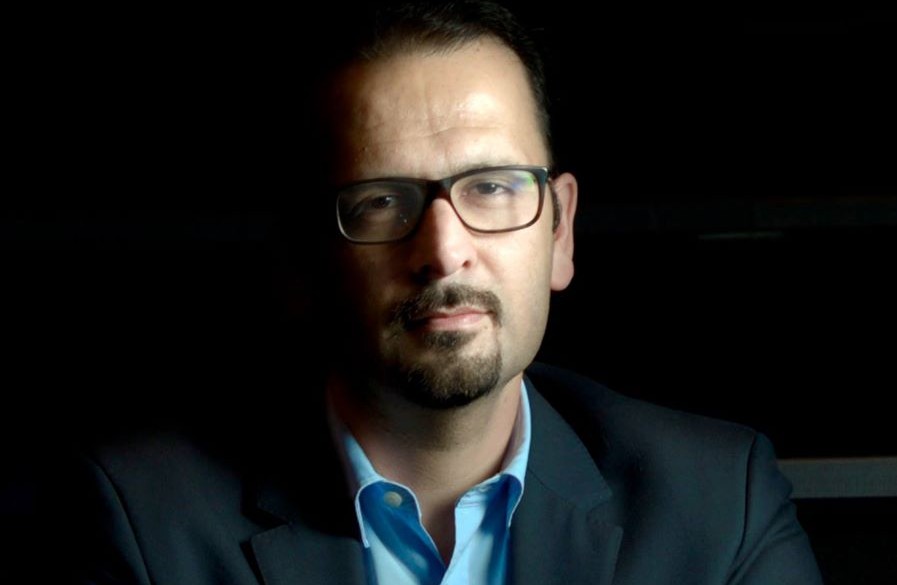
Mahmoud Amiri Moghadam
In your opinion, how necessary is circumcision for boys?
In the field of medicine, when we want to determine whether a treatment is necessary or not, we always look at its positive and negative aspects and come to the conclusion whether that treatment – which in this case includes surgical procedures – is necessary or not. This issue, in relation to male circumcision, requires further and more comprehensive studies, but as an example, it can be mentioned that those who suffer from physical defects or even lose their lives due to this procedure, how many of them can we base our conclusion on regarding the necessity of circumcision? Unfortunately, there is no specific statistics in this regard, or at least I am not aware of it. The absence of such statistics is a flaw in the healthcare system. Even this year in Norway, a Muslim boy lost his life due to severe bleeding after circumcision.
In fact, my point is that if we consider circumcision as a surgical procedure, we can argue that every surgical procedure carries a certain level of risk; we must look at its positive and negative aspects in order to make a decision about its necessity. A surgical procedure is necessary when not performing it will make the patient’s condition more difficult or put them at a greater risk.
In this regard, it should not be forgotten that people over the age of 60 are usually affected by genital cancer and therefore, it should be noted how beneficial such a procedure would be for a child.
Furthermore, the most important issue here is who can decide for a newborn or underage boy to undergo surgery? In this regard, usually the parents, as the guardians of the child, make such a decision; but can they make such a decision based on a religious belief and tradition that has not been scientifically proven and lacks comprehensive information? The answer to this question from a human rights perspective will not be positive.
You mentioned the death of a Muslim boy in Norway due to severe bleeding after circumcision; in the past few days, a two-year-old boy in Yazd also lost his life after undergoing circumcision surgery at the hospital. During such a procedure, (even if performed by a specialist doctor) what physical risks can threaten a child’s life?
Every action, even if performed in hospitals and sanitary environments, carries a series of risks such as infection and bleeding, which can lead to serious illness or even death during or even a few days after the procedure. Furthermore, at older ages – from 18 years and above – the risk of surgery decreases due to increased physical strength.

Circumcision of boys in Iran is usually performed in the early months and years after birth, and sometimes in unsanitary conditions.
Based on this – as I mentioned – we must establish that if an action is not necessary, it should not be done. For example, we vaccinate our children because comprehensive research has been conducted and proven that the risk of children contracting certain diseases is significantly higher if they do not receive vaccinations. Vaccinations also have risks, but the risk is much lower compared to the risk of contracting a disease if not vaccinated, and as a result, the United Nations and health systems around the world invest in this issue.
On the other hand, it should be noted that if we look at the issue historically, we come to the conclusion that perhaps at the time when such a practice prevailed, there were reasonable reasons for it, but this matter has not been reconsidered and remains only as a tradition; a tradition that involves removing a part of a child’s body through surgery. Therefore, in relation to such a tradition, there are two reasons why there is a serious need for reconsideration: firstly, it is done without thought and secondly, it is done in an unethical manner, without considering the individual’s desire or lack thereof, and at a very young age. This is why, with the current advancements in science, the priority is towards health. Based on this, perhaps improving a healthcare system would be sufficient in this regard.
Regarding our country, the issue is the same and the reason for circumcision is mostly due to tradition, and it is unlikely that if someone is not circumcised in Iran, they will face legal problems. In this regard, it is necessary for society to move the country’s healthcare system towards a review. But more importantly, in the prelude to that, it must be emphasized that circumcision should only be performed in healthcare settings, hospitals, and under the supervision of a specialist. For example, in our country, as far as I know, this procedure is only performed in hospitals and sometimes without the supervision of a specialist and in non-sanitary environments, which increases the risk.
What can be the psychological problems resulting from this operation and can circumcision of boys be considered a form of child abuse? Has any research been done on this matter so far?
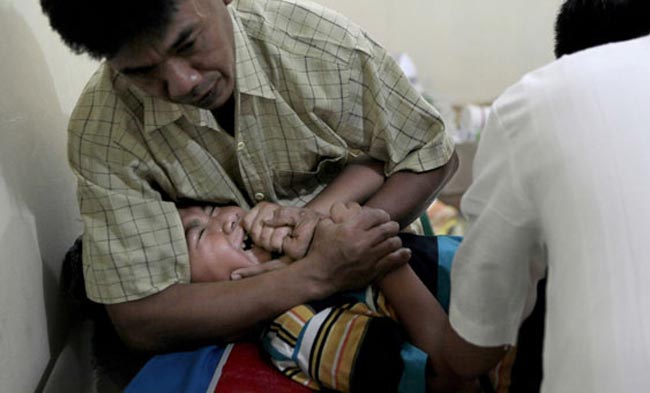
Circumcision of an Indonesian Muslim child in Jakarta.
Unfortunately, I am afraid that a comprehensive research has not been conducted on the impact of circumcision on an individual’s sexual relationships in adulthood. As a result, due to the lack of sufficient studies, we can only speculate; perhaps for some, it may have long-lasting or even permanent effects, while for others it may not have a significant psychological impact. However, from a human rights perspective, your argument is valid and I agree with you; as this issue goes against the Convention on the Rights of the Child. I also recall that the European Union had issued a statement on this matter some time ago. However, the United Nations has not taken this issue seriously. Of course, the process is very difficult and lengthy; as the United Nations is composed of the same countries that may have a serious belief in performing this act and these countries can hinder strictness in this matter or even create a law. But in the first step, the World Health Organization – which is related to the United Nations – can
Currently, the focus is more on female circumcision, which has been proven to be a form of sexual mutilation. Fortunately, in Western countries, there are strict laws regarding it, while there is not much talk about male circumcision and people have mostly accepted it without any research or study, believing it reduces the risk of genital cancer and is hygienic. However, there is still a possibility that millions of children undergo this operation without any benefit and end up in the worst situation under the surgeon’s knife. If this issue is proven to be practical, it will undoubtedly harm the child. We must not forget that many people have accepted this issue without even thinking about it.
What is the solution with these interpretations? Especially since religion can also be a major obstacle in prohibiting such an act…

Circumcision of boys in Iran is usually performed in the early months and years after birth and sometimes in unsanitary conditions.
I believe that if the global community comes to the conclusion that this is a form of child abuse, ultimately religion cannot be a serious obstacle to its creation. However, as I mentioned, the more important issue is that there is no strong argument in this regard. Therefore, we must also refer to the role of civil society and the impact it can have in this regard. Additionally, scientific research requires a budget and these budgets must be provided with the help of governments. However, the World Health Organization can also conduct good studies and research in this regard. I have heard that currently a research is being conducted in Morocco and we should wait for its results. Of course, in Norway and some European countries, this issue has been raised to some extent, but due to cultural and religious considerations and the fact that there was not enough research to rely on, they have only focused on the fact that such an act should only be done in hospitals to minimize the risk, which although necessary, is not enough.
If there is a specific point that you have in mind at the end, please let me know.
If this issue becomes a bigger problem, it can have an impact. In this regard, there must also be a determination and people must come forward and say that we are victims of this violation of human rights and shed light on the physical and psychological effects of this act, especially in childhood.
While emphasizing that there must be credible studies that demonstrate the difference between circumcision and non-circumcision.
Thank you for the opportunity you have given us in the monthly magazine of “Line of Peace”.
Created By: Simin Rouzgard May 24, 2016
Tags
America Circumcision Circumcision of boys Circumcision of Suran Islam 2 Judaism Mahmoud Amiri Moghadam Muslim Norway peace line Simin Daytrip Statistical Studies Subtraction World Health Organization 2 ماهنامه خط صلح