


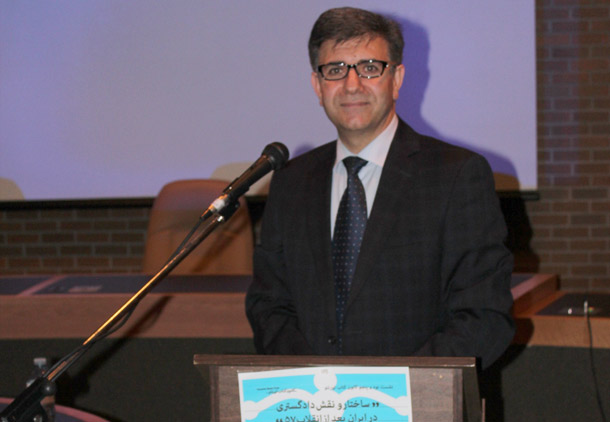
Hossein Raeisi: The traditional legal system in Iran is the breeding ground for domestic violence/ Siavash Khorramgah.

Conversation with Siavash Khoramgah
Hossein Raeisi, has graduated from Shiraz and Tehran universities in the fields of judicial law and criminal law, and is currently a human rights professor at the University of Ottawa in Canada. Mr. Raeisi, who has more than twenty years of experience as a lawyer, has a special focus on certain areas of human rights, including women’s rights, and currently provides legal counseling to victims of domestic violence online.
In light of the special topic of this issue of the monthly magazine Khat-e-Solh, we have had a conversation with this Canadian resident lawyer and asked for his opinion on the necessary support for victims of domestic violence, the importance of safe houses, and the impact of existing laws in Iran on the increase of this type of violence.
Mr. Raeesi, recently, news related to domestic violence against women has significantly increased in the media. How do you assess the reason behind this?
The answer to why there is an increase in violence against women, or at least why we are seeing such violence today, can be studied in detail through various cases and other major incidents. There are various reasons that we can consider for this.
The first answer that I can give about the reason for this issue goes back to the inequality and lack of legal balance between men and women, which has created an open and hidden war between men and women within Iranian families and society, Islamic societies, and even in some non-Islamic societies. In our own society – meaning Iran – this inequality is palpable and visible, and manifests itself in various forms, including physical, psychological, and demeaning. Within the existing legal framework in Iran, there is no balance or equilibrium between the rights of men and women. In fact, in the main structure, it takes away the infinite rights of men and can be seen in various forms such as the right to control and manage the family, the right to custody of children, the right to divorce, and the right to inheritance. In contrast, the only right given to women is a dowry, which is merely a financial right and cannot balance this situation.
Of course, this legal imbalance between men and women has always existed and is not specific to today. However, we can say that the reason for the increase in violence today is because legal developments – even in small increments – are moving towards giving more value to women, and the growth of media and the increase in women’s education have caused this war and conflict between men and women to be more evident. In the past, there were many self-immolations among women that were exactly to combat the injustice that was being imposed on women within the family, and it was never brought to light; a cry accompanied by fire to show the injustice that was being tolerated towards women.
We see in the statistics of the Iranian police that a high percentage of annual murders are attributed to domestic violence. In this regard, a small percentage of women are responsible for killing men, while a high percentage of this statistic is attributed to men killing women.
In fact, the lack of legal equality and access to women’s rights has caused an increase in violence in Iranian society. Legal laws in Iran have a minimal and very traditional approach to this issue, and as long as this traditional approach remains, it cannot prevent domestic violence. Another important point to mention is that the Islamic Republic of Iran has not joined the Convention on the Elimination of All Forms of Discrimination Against Women, and there are no comprehensive laws to combat or prevent domestic violence.
The problem that exists is that the lack of sufficient support (if we don’t say no support at all) amplifies the dimensions of these atrocities against women. In your opinion, to what extent do Iranian laws need to be amended and improved in this regard?
We can talk about how we can provide this support that we are talking about and is necessary for women who have been harmed from different perspectives. In relation to a specific case like Azam or multiple cases that I have experienced myself – both during my time as a lawyer and now as a consultant – the first challenge for providing necessary support is the lack of a comprehensive legal system. When we say a comprehensive legal system, we mean a system that addresses the details and includes protective measures, whether criminal, legal, or civil. At the same time, we need to change our fundamental laws, the laws that create rights. On the other hand, in a comprehensive system, there is a need for a telephone, website, and various tools for immediate access for the victim or someone who is in danger, regardless of whether the violence has started, is ongoing, or is being repeated. In a comprehensive legal system, there must be centers where the victim can quickly contact and receive support, so that the victim
The legal system in Iran does not provide such an opportunity for the victims; the Welfare Organization, which is responsible for this issue, does not have a comprehensive plan in this regard, the number of safe houses in Iran is very low and even those that exist are in big cities and lack sufficient facilities. However, even these minimum facilities are not advertised so that victims can access them quickly. Therefore, a comprehensive legal system sees all of these, while our laws are traditional laws.
What is your perspective on the traditional nature of law in Iran?
This means that the laws governing the relationship between men and women in our current legal structure, first appeared in the Iranian Civil Code and later in the Family Protection Law, both of which are based on the interpretation of Shia jurisprudence and were passed in Iran about ninety years ago (1307). Many of these laws remain unchanged to this day, which is indicative of the traditional nature of laws in Iran. However, some aspects of these laws, including the Family Protection Law, have become even worse after the revolution. This law was initially completely abolished and for a long time, no new law was considered as a replacement. Finally, in 2012, a new law was passed under the title of the Family Protection Law, which has nothing new to offer.
In a simpler view, the civil law of Iran differentiates between the age of social responsibility for women and men, with the age being 9 years for girls and 15 years for boys. This same issue is seen in the marriage law, where according to Article 1141 of the civil law, the age of marriage is set at 13 years for girls and 15 years for boys, and the new family protection law also repeats this. This same issue has also arisen in criminal law, where the Iranian Criminal Procedure Code, based on the same traditional view, sets the age of criminal responsibility at 9 lunar years for girls and 15 lunar years for boys. All of these ultimately result in the superiority of men and bring violence with them.
Regarding the predetermined age for marriage, which is 13 years for girls and less for boys (now let’s not forget that even the age of 15, which is determined for boys, is not a suitable age for marriage), it automatically brings violence. The first violence is being deprived of education. The next violence is engaging in sexual relations. Another form of violence is experiencing motherhood during childhood. And many other rights are lost one by one under the influence of these factors.
In another example, we can refer to the Islamic Penal Code and the discussion of retribution, where in the case of intentional murder, men and women are not equal in terms of the death penalty. Although, of course, if a man intentionally kills a woman, he can still be subject to retribution, but the legal conditions for the death penalty are not equal in this case. Furthermore, we must not forget social issues. I have been a lawyer for numerous women who were accused of killing their husbands, and I have evidence and have seen behaviors from judges who are strongly biased against the woman accused of killing her husband simply because she is a woman. This issue unfortunately exists in society as a whole, and when newspapers write about such cases, people show a negative reaction towards the woman who has killed a man. It shows that people are not happy with the patriarchal system that is in power. All of these are part of a chain that has its roots in the lack of legal support.
In fact, the traditional and simplistic interpretation of translating Islamic jurisprudence as the law of punishment, civil law, and family protection has been placed on the judges’ desks, which not only does not eliminate violence, but these laws can also be violent and provide a platform for violence.
As an example, the new Family Protection Law, which is related to the year 91, not only does not completely prohibit marriage under the age of 18, but also emphasizes on the marriage of girls at the age of 13. In that law, it is only mentioned that if a girl under the age of 13 marries without the permission of the court and that marriage results in her death or serious harm, the husband will be responsible for paying the blood money and if the father is the one who caused the marriage, he will be punished. Interestingly, only the blood money punishment is specified for a man who causes the death of a girl due to sexual intercourse, and this law does not foresee the punishment of intentional murder or serious punishment for this incident.
Therefore, we cannot expect to have a non-violent relationship or at least one with less violence, or a violence that can be controlled and supported by the legal system, without abolishing and overcoming these traditional laws. Mostly, women are the victims in this situation.
Mr. Raeesi, many believe that in our country, the problem of domestic violence is not just the legal system, but also cultural barriers. What is your approach in this regard?
In this regard, I agree with you, but I believe that the modern legal structure is gradually changing and adapting to society, cultures, and traditional subcultures. I had a client who had experienced very serious violence and was burned by her husband with an iron. My client, despite the fact that the man had been convicted in criminal court and this conviction was enough to obtain a divorce, and even though the divorce was granted and a dowry and property seizure order was issued, returned after a while and continued to live with her husband. The reason for this was the existence of a child and lack of support for this woman by society and her family. In fact, we have cases where a woman is forced to return to the same environment where she was tortured. What could be worse than a woman going back to live with a man who has treated her so cruelly? There is no guarantee that violence will not be repeated in that life.
We can say in this regard that the legal system, due to its traditional and religious form, supports obvious oppression towards women. The cultural, social, and family systems, which are not entirely separate from the legal system, also oppress women in various ways and expose them to violence. This violence is exactly what we hear families say: “It’s shameful for them to get a divorce,” “We’ve never had a divorced woman in our family,” “Don’t talk about divorce and go back to your life,” and so on. If a child is involved in this, the situation becomes even worse and they say: “You have a child and you’re a mother, what will happen to your role as a mother if you get divorced!?” And many similar words and phrases that invite women to return and then she is usually forced to sacrifice or remain silent about the problems.
Add to these issues the lack of supportive spaces, counseling and proper assistance, and the fact that even if individuals go to welfare night shelters, they may face a thousand and one other problems and new issues may arise in society as a result.
The collection of these cases has caused our society to worsen day by day in this regard, while if there were necessary support, at least the situation would not have gotten worse. In such a society, instead of fulfilling their proper and just role, the judge judges the woman and says, “It doesn’t matter that he hit you, what matters is that he is now apologizing to you and we are also sentencing him to pay you compensation; so go back home.” This is while often that hit is the beginning of a violent relationship that can lead to the death of a person. In fact, the problem is not solved and we never teach the man, for example through participation in educational classes, to control his anger and not repeat his behavior.
Keep in mind that our cultural system is a system that always imposes “burning and building”. A system that believes that “with the arrival of its police and sirens, my honor is taken away and my neighbor’s honor is taken away, and for this reason, it is not in anyone’s best interest to find out.” That is why in most cases, when the matter is brought up, it is because the knife has reached the bone of the other party.
The discussion that is raised in this regard is the necessity of safe houses. Based on your experiences and research, to what extent do these houses help reduce domestic violence rates?
The existence of safe houses greatly helps reduce these statistics; because the existence of safe houses is not just about having a shelter. Alongside safe houses, there should be counseling centers. Even counseling sessions that are currently being provided virtually through various tools such as email, Facebook, Telegram, or phone have a positive impact. In these centers, the first priority is to educate the victim of violence. This education includes empowering women to use their basic rights that exist. Unfortunately, it must be said that even these minimal rights are not being properly utilized. For example, according to Article 1115 in the Family Rights section of the Civil Law, a woman has the right to leave a dangerous environment without losing her rights, including child custody and alimony. This article has been in the Iranian Civil Law since 1313, but it is not being implemented in practice. Similarly, the issue of hardship and difficulty that a woman faces during marriage gives her the right to seek divorce from the court. However,
In any case, it is true that in terms of criminal law, we do not have a comprehensive system for domestic violence and domestic violence against women is not considered a crime. However, at the same time, physical violence is considered a crime according to existing laws and is subject to compensation, and according to civil law, its repetition or continuation causes hardship, meaning being in difficult conditions, and this can provide grounds for a woman to obtain the right to divorce without losing her other rights. There are minimum legal standards in this regard. On the other hand, seeking refuge and staying in safe houses can provide better legal opportunities for a woman to take action against her husband, as the responsible person of the safe house can testify that this woman has been present there. The responsible person of the safe house can also immediately report to the deputy prosecutor of that city about the violence that has occurred and declare that the woman is at risk of violence and her life is in danger. As a result, in addition to
Apart from the counseling and legal assistance that you mentioned, what other standards and characteristics should a safe house fundamentally have and what can it do for women?
These standards vary depending on the situation of the woman seeking refuge in a safe house. Generally, the standards for a girl who has fled her home due to violence are different from those of a girl who has been sexually assaulted by a family member; just as the standards for a woman who is a victim of domestic violence differ from those of a mother who is separated from her husband and is being abused by another family member. Therefore, considering the circumstances of the victim and interviewing her by a counselor is crucial.
However, the general standard is that in safe homes, all women should have the freedom to come and go, without anyone judging them, and all of their private matters should remain confidential, with no possibility of leakage to the outside. Additionally, immediately after addressing their basic needs, such as food and shelter, they should have free access to physical and mental health facilities. It is crucial that if the victims suffer from mental problems, such as depression, they can receive help from a counselor to cope with it, so that they can then fight against other problems. Of course, in dealing with other problems, the presence of a legal counselor is also necessary. These legal counselors should also be trained in dealing with domestic violence and how to interact with victims, and in my opinion, not every lawyer is qualified to provide legal counseling in this regard. The counselor should be someone who does not judge and does not behave in a patriarchal manner.
The next needs of an individual include seeking help from specialized counselors who are fully aware of such cases in order to provide a space for the person to leave their safe home. In addition, in my opinion, alongside safe homes, the role of NGOs in empowering women, including providing job opportunities, is very important; so that they can stand on their own feet and return to a normal life.
In fact, we need a complete cycle and comprehensive system for an injured individual who usually has serious problems and discomfort, to be able to finally stand on their own feet, return to society, and experience a normal life with ease.
Given the fact that the history of safe houses in our country is very weak, how do you evaluate Iran’s perspective on having such a cycle?
It should be noted that in some countries such a cycle exists and despite the fact that it is a new issue in our society, due to the increasing number of these cases, the need for it is deeply felt.
In this regard, it is necessary for the media to strive to gradually correct the incorrect view that exists in society regarding safe houses. Private sector should also be encouraged to establish such houses and lawyers, psychologists, and doctors should be called upon to provide voluntary services to these individuals. In achieving such a system, the help of other individuals and social classes is also important; especially in terms of being able to teach a specific profession to those who do not have a specific expertise, in order to make the process of entering the job market easier for them.
Alongside all of this, however, we must not overlook the direct and indirect role of the government. The government should provide various facilities, including health and shelter, and play a role in creating a platform that leads to receiving different services for these individuals.
In fact, to imagine a perspective, all of these issues must be comprehensively seen and paid attention to.
Thank you for the opportunity you have given us.
 Created By: Siavash Khoramgah
 May 24, 2016
Tags
Citizenship rights Citizenship rights Domestic violence Fatherhood Hossein Raeisi Judge Jurisprudence Leadership peace line Siavash Khoramgah Torture of women Women's rights ماهنامه خط صلح