


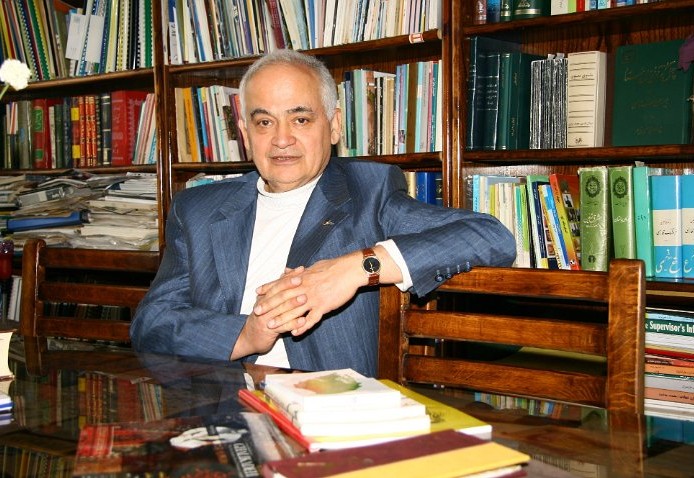
“Sarb, a criminal element in the air! In conversation with Dr. Hossein Bahar/ Siavash Khoramgah”
 Siyavash Khoramgah
Dr. Hossein Bahar, a sociologist, is the founder of the school of behaviorism in Iran and a member of the Academy of Medical Sciences in the field of social health. This retired university professor holds a PhD in economic development and a post-doctorate in philosophy of resource management from Canada.
In this issue of the Peace Line magazine, we had a short conversation with Dr. Bahar and asked her about the relationship between leaded gasoline and the occurrence of violent crimes among members of society…
Experts often view crime and wrongdoing as a widespread disease. Karl Smith, a professor of public and government economics at the University of North Carolina, has proposed a useful rule of thumb for classifying widespread diseases:
If it has spread in communication lines, the reason is “information”; like “Bieber Fever”!
If he travels on main communication routes, the reason is “microbes”; like “influenza”.
If it spreads like a fan, the reason for it is an “insect”; like “malaria”.
4) But if it suddenly becomes widespread, then the reason behind it is “molecule”; like the increase in weight in the 1960s to 1980s in the United States and its decrease after this time period.
But a molecule?! It’s unbelievable! What molecule could be responsible for sudden fluctuations in violent crimes?! Based on this, researchers at Tulane University in Louisiana, USA, have started their efforts to find that molecule.
They even doubted the colors used in the construction of houses and were looking for the impact of the materials used in these colors on children’s behavior. But after not reaching any results in their experiments, they started to doubt gasoline and ultimately came to the conclusion that there is a significant relationship between “lead gasoline” and the occurrence of “violent crimes” among members of society.
After World War II, with the increasing power and production of General Motors (the American car company that celebrated producing 25 million cars in 1940), the number of cars, especially gas-guzzling cars, in America suddenly increased significantly. At the same time, as people were happy and proud of their personal cars, they would joyfully go to gas stations and say “Fill’er up with ethyl!” without realizing that they were setting the stage for a wave of crime and violent behavior in their country for the next two decades.
These researchers, after examining the graph of violent crimes in America and the graph of lead presence in the air (which was caused by the consumption of lead-containing gasoline), found only one different factor in them: “time”. Both graphs were similar to an inverted U shape. The graph of violent crimes had an upward trend between the 1960s and 1980s, and then took a downward trend from the 1990s. Strangely, these two graphs were only 20 years apart. In further and more detailed research on this matter, while confirming the similarities, the researchers increased this time gap from 20 years to 23 years. In fact, the individuals who committed violent crimes between the 1960s and 1980s were the same young children who breathed in this lead in the 1940s and 1950s.
These days, as the issue of air pollution in Tehran has received attention, some news and reports indicate the confirmation of lead presence in the capital’s air, which according to the given explanations, can also have very harmful and dangerous effects on society; because further research in some other countries of the world has also shown similar results.
Dr. Hossein Bahar, a sociologist and founder of the school of behaviorism in Iran, emphasizes that leaded gasoline has undeniable effects on behavioral changes in society, including violent behaviors. He stated in support of peace, “This issue is like giving sewage instead of water to plants!”
Dr. Baher also emphasizes that the issue of air pollution cannot be reduced to purely environmental and mechanical discussions. He says that 25% of this problem and its consequences should be allocated to social issues. In a conversation with Khat-e-Sulh, he mentions that there is a project in this regard being implemented in the Academy of Medical Sciences and quotes a verse from Molana: “My ears heard the story of faith and became intoxicated/Where is the oath of my eyes, the image of my faith?”
He believes that “dealing with air pollution requires a national determination because it is a crisis that affects the economy, culture, society, and politics.”
Note:
For more information, please refer to the report “America’s Big Criminal Element: Lead” on the Mother Jones website and “Racial Crime: Lead and the Cycle of Violence” on the Human Scopers website.
 Created By: Siavash Khoramgah
 January 25, 2016
Tags
Dr. Hossein Bahram Gasoline Mohammad Hossein Bahar Monthly Magazine Issue 57 Soldier Soldier Toulinger University Violence ماهنامه خط صلح