


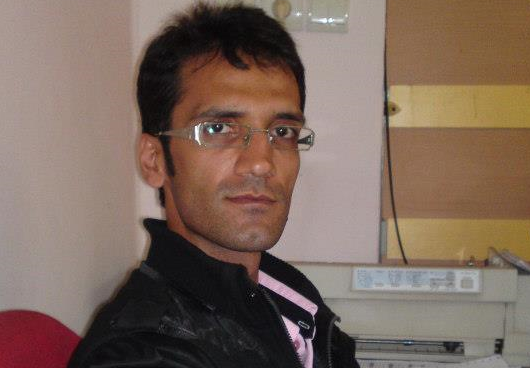
:Mehdi Khodayi: We are witnessing self-censorship in the name of not criticizing the government/ Siavash Khoramgahi:

Conversation with Siavash Khoramgah
Mehdi Khodayi, former secretary of the Islamic Association of Azad University in the city of Rey and a human rights activist. Mr. Khodayi was arrested on February 29, 2010 and spent five and a half years continuously in Evin Prison; he has previously been arrested and imprisoned as well.
During his imprisonment, he wrote a book titled “Multiple Approaches to Human Rights” and at the same time, in addition to publishing numerous articles and notes on human rights or solutions to human rights violations in Iran, he also published the book “World Atlas of Human Rights” with Omid Kokabi, translated and released it to the market.
We have asked questions about the impact of imprisonment on civil activists and the current state of society and civil institutions in Iran from this human rights activist who was released from prison earlier this summer.
As a human rights activist who spent five and a half years continuously imprisoned, what impact do you think the prison has had on your human rights activism?
In fact, prisons were originally intended to be a place for separating individuals from society and reflecting on their behavior and actions, as well as working towards their improvement and rehabilitation. However, over time and in the way we see it in Iran today, prisons have lost their function and have become a place for reproducing what prisoners are deprived of. Even for political prisoners, prisons have become a place for gaining more experience and maturity in this field compared to other political prisoners. This claim is supported by many memories left by past political activists. For me, as a human rights activist, in addition to using the experiences of other friends, the prison environment and the relationships governing it were a practical and field experience of examining the human rights situation in prisons. This is because one of the important factors that shows the commitment of governments to human rights is how they treat prisoners and the conditions in prisons. Prisoners are individuals who have lost their freedom and unlike other members of society, if they become victims of human rights
In fact, the prison was a narrative for me from within that I had not previously had much insight into; a narrative in which I myself played the role of a prisoner. It was a very enriching and valuable experience that greatly helped me understand and comprehend the conditions of prisons and prisoners and their situations.
If we consider this question in a broader context, in your opinion, what effects does prison, especially long-term prison, have on a civil activist?
Allow me to rephrase this question, which is: How does a civil activist – who may have never thought about going to prison before and unlike political activists, their area of activity is not one that would put them in such danger – react when faced with prison? I must say that, in my opinion, this question is more related to the individual’s personality. Many civil activists have turned prison into their own environment for action and continued their path, while others did not. However, long-term imprisonment still has various effects on individuals. If time and place are not managed from the first days and relationships with other prisoners and prison officials are not clearly explained, the prisoner will face many problems in the long run, the most important of which is depression and a feeling of emptiness, which will continue even after leaving prison.
It can be said that the release of an individual from prison is not just a matter in itself, and the return of a prisoner to their family and society is also a separate process. In this process, what responsibilities do you see for other members of society?
In fact, the entire society cannot be held responsible for this matter; because it is not really an issue that should concern the whole community from the beginning. However, the discussion about the process of pre-freedom and preparing individuals for reintegration into society and their acceptance and role in it, is the most important part of prison management. According to the structure of prison organizations and based on their regulations, the social work department is responsible for this task, but unfortunately during the years that I had experience in prison, social work did nothing but deliver letters from prisoners to judicial authorities – which was not even done completely. Even when some of my fellow inmates were transferred to other prisons, there was no change in the performance of the prison social worker, while our initial assumption was that as political prisoners, we would not expect much from the social worker, but the same conditions applied to regular prisoners as well.
Imagine a person who has been in prison for ten years and during this time, for various reasons including inability to pay bail, has not been able to have any furloughs. This person will face a great shock at the moment of their release, and this is in addition to the mental and physical problems that they have undoubtedly faced during these years. In any case, prison, due to its unstable and tense atmosphere, practically deprives a person of any peace, and on top of that, you have no privacy, both mentally and physically, in that environment. With these conditions that I have mentioned, how will this person be able to face a society that they have had no contact with for the past ten years? Even in the best case scenario, if they try to behave according to the standards of ten years ago, they will still be abnormal to society, because society has moved on from those habits and behaviors for more than ten years. That is why in many developed countries, before
In your opinion, to what extent do security risks contribute to the decline of active forces in the field of civil activities? This question is raised because despite the fact that peaceful civil activities are among the least expensive social activities in the world, in Iran these costs are greatly increased due to the pessimism of security forces… If we accept the definition of a civil society as a passing society in which citizens become aware of their rights and social responsibilities, how can we fill this void in the absence of a dynamic civil society in the country?
As I mentioned before and as you also stated in your question, the field of civil activity is not a low-risk area due to the fact that it is in direct competition with the ruling power and aims to achieve power components, in the classical sense. Unfortunately, this is not the case in Iran. As we see in human rights violations, a large number of sentences and detentions are related to active individuals in the civil society, and this is due to the government’s insistence on being present in all fields and fear of losing control and what is known as losing control of these areas. For a long time, we have been witnessing extensive and powerful parallel work in every field in order to suppress the main movement; from literary and cultural associations to educational and charitable activities for orphans and single mothers. But I believe that if there is no vacuum in civil society, it will be the first to take control – as it has done – and managing such a vast space in a directive manner and eliminating any
Considering the past two years of Mr. Rouhani’s government being in office, how do you evaluate the prospects of civil institutions in this government?
In fact, civil society is currently facing very difficult conditions; even more difficult than the time of Mr. Khatami. This is because during that time, the parliament had a moderate presence of reformist forces and the judiciary was also moderate with the presence of Mr. Hashemi Shahroudi. Despite the fact that Mr. Khatami’s administration had a strong focus on improving foreign relations, they never neglected the domestic civil society and even made significant sacrifices in this regard. However, now in addition to the increased activity of opposing forces, which were also active during that time, the structure of the parliament and judiciary has completely changed and we must also consider the regional conditions, where the developments and conflicts have greatly increased the risk of civil activities for other ethnic groups. However, the role of political and civil activists cannot be seen as entirely positive. Unfortunately, after Mr. Rouhani came into power, a particular bipolar atmosphere was created. The first group consisted of individuals who were in favor of
In my opinion, while adhering to principles – avoiding idealism and clarifying real goals based on capabilities – we can make the most of the opportunity to repair the damage done to civil institutions during these years and, with a pragmatic approach, hope to improve the situation while playing a role in bringing about change.
Thank you for the opportunity you have given us.
 Created By: Siavash Khoramgah
 December 27, 2015
Tags
Monthly magazine number 55