


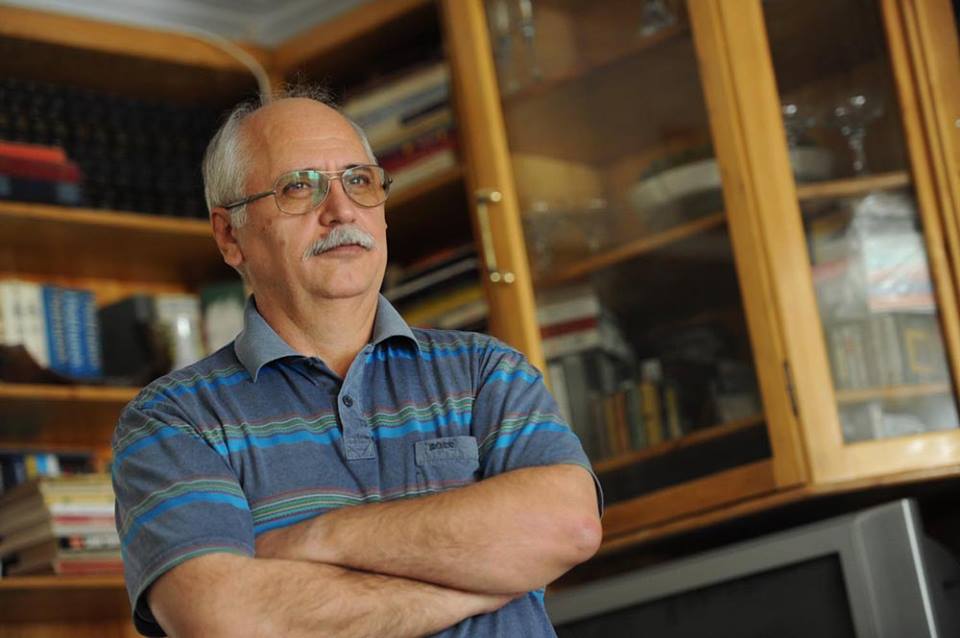
Mohsen Hakimi: Increase in work accidents is one of the consequences of implementing clause 33 of the Sixth Development Plan / Ali Kalaii

Conversation with Ali Kalai
The peace line, in this issue and considering its special case, has gone to Mohsen Hakimi, a labor activist, translator, and member of the Iranian Writers Association. He has translated numerous works in the field of humanities and labor organizations and has entered the book market.
He says in this conversation: “The issue of work safety, like other labor issues, does not have two sides: workers on one side and employers and the government on the other.”
Mr. Hakimi also believes that one of the consequences of implementing Clause 33 of the proposed Sixth Development Plan is an increase in work-related accidents due to the employment of cheaper, unskilled and inexperienced laborers. These unskilled and inexperienced workers, who are forced to work at least two shifts to compensate for their meager wages, will be at a much higher risk of work-related accidents.
As the first question, please explain to what extent the labor laws in Iran consider ensuring safety in the workplace as a necessary matter? For example, to what extent are inspections by the Ministry of Labor, Cooperatives, and Social Welfare implemented in reducing accidents and to what extent do they have a legal and expert aspect?
I refer to some articles from the fourth chapter of the Labor Law titled “Technical Protection and Occupational Health” to determine to what extent this law can guarantee safety in work environments. The responsibility for ensuring safety in work and production centers lies with an institution called the “Supreme Technical Protection Council” which, according to Article 86 of the Labor Law, consists of 15 members: 6 deputy ministers from the ministries of industries, heavy industries, agriculture, oil, mines, and metal industries, and the Jihad of Construction (some of these ministries have now been merged or renamed and no longer exist under these names), the head of the Environmental Protection Organization, two professors in technical fields from universities, two managers from industries, two representatives of workers, the director general of inspection at the Ministry of Labor, and finally the Minister of Labor or his deputy, as the head of this “Council”. This article has 3 notes. According to the first note, the “recommendations of the Council”
What I want to say is that the provisions of Article 86 of the Labor Law have even negated this insignificant role, and it can be said that workers have no legal role in ensuring safety in the workplace and production. This fact is also evident in Article 93 of the Labor Law. It states: “In order to attract the participation of workers and monitor the proper implementation of safety and health regulations in the workplace and prevent accidents and diseases, a technical and occupational health protection committee will be formed in workshops that are deemed necessary by the Ministry of Labor and Social Affairs and the Ministry of Health, Treatment and Medical Education.” As it is clear, the purpose of this article is to “attract the participation of workers” through the creation of a committee in which workers are supposed to have a role. However, this article also has two provisions that show the true intention of the legislator regarding this “participation”. According to the first provision, the duty of two members of this committee,
There are multiple documented cases where employers cut corners in ensuring workplace safety. Do you know the reason for this? In fact, how much can existing laws allow employers to get away with in terms of cutting corners, as they say, to bypass regulations? For example, do municipalities use pressure tactics when issuing permits to ensure the safety of construction sites?
It is clear in response to the first question that the existing laws can only go so far in making employers disregard workplace safety. Municipalities must also refer to labor laws to compel construction employers to comply with safety regulations, and even if municipalities want to enforce this requirement, they are not able to do so when it is not explicitly stated in labor laws. However, the reason why employers cut corners in ensuring workplace safety goes back to the social relationship of capital, which is the buying and selling of labor. In this relationship, the worker is forced to sell their labor for their livelihood, and the employer buys it in order to gain a surplus value; a value that the employer accumulates as profit. In this social relationship, the worker’s existence is only meaningful in producing this surplus value, and therefore, workplace safety and protecting the worker’s life only matter insofar as it guarantees the production of surplus value. For example, if producing surplus value is possible with cheap and low-quality safety equipment (g
I will give a specific and real example that clarifies the issue. Salman Yeganeh was a worker who worked with a concrete machine in the Loushan steel factory, a machine that produces concrete from a combination of cement, sand, and other materials. I knew Salman and his family, and what I am saying here has been conveyed to me through his family and is completely reliable. He had noticed during work that the concrete machine would sometimes get stuck and have problems. Salman had informed his employer about this issue, but the employer had said that repairing or replacing the machine would require a lot of expense and he was not currently in a position to pay for it. Therefore, the employer had put Salman in a dilemma: either he could file a complaint with the labor office, which risked him losing his job, and there was no guarantee that the labor office inspector would take action and his complaint would be ineffective. The second option was to continue working with the broken machine while maintaining vigil
Many workers who are affected by work-related accidents, temporarily refrain from complaining according to the promises and threats of the employer. What is the reason for this phenomenon and behavior of workers?
This case of Salman’s death alone due to an accident in the workplace demonstrates the main reason for workers’ reluctance to complain to the labor office, which is the fear of being fired and losing their job. The employer may not immediately take this action, but considering that most contracts are now temporary and for a maximum of one year, the employer can easily choose not to renew the complaining worker’s contract and use the excuse of not needing their services.
What is your understanding of the role of labor unions in raising awareness among workers about their rights, especially in regards to receiving their wages and insurance benefits, and preventing unemployment?
Independent labor organizations not only can familiarize workers with their rights and benefits, but if they have a council structure and mechanism, they can be based on direct and grassroots democracy and thus embody and crystallize the organized power of workers against the capitalist social relations. They are able to truly and practically force the employer to accept the demands of workers, including unemployment insurance and similar benefits. It is important to emphasize that workers often find in their own experience that complaining to the government about the employer (especially if the employer is the government itself) does not usually result in the desired outcome for workers. This practical awareness leads them to the conclusion that firstly, they cannot rely on the government, and secondly, their demands will not be met unless they stand up for themselves and gain the power to impose their demands on the employer. This is where the necessity for organization arises. Some workers may turn to the labor law due to a misconception, but even resorting to the labor law does not result in anything other
Work experience and worker skills play a significant role in determining their level of fault in work-related accidents. This is especially important considering the high number of unemployed and job-seeking young population in our country. As an example, according to the new government proposal focused on the Management Organization and in line with Article 33 of the Sixth Development Plan, it can be said that the employment of workers under the age of 29 is on the agenda due to their lower minimum wage. On the other hand, we have also witnessed that the issue of obtaining a skills card, as per the Social Security Regulation, has not been very successful. With this background, in your opinion, to what extent can holding workers accountable after work accidents be justified?
You mentioned an important point. The consequence of clause 33 of the proposed sixth development plan is not just a reduction of minimum wage for workers under 29 years old to 75% of the current minimum wage. If this clause is implemented, it will decrease the overall level of wages for the working class, as it will give employers the opportunity to hire unemployed workers under 29 years old instead of more experienced workers over 29 years old. This could lead to many employed workers over 29 years old accepting lower wages in order to keep their jobs, given the weakness, fragmentation, and disorganization of the working class in Iran. Another consequence of implementing this clause, as you mentioned, is an increase in work-related accidents due to the employment of cheaper and inexperienced workers. When skilled workers like Salman Yeganeh suffer accidents due to exhaustion from working long hours, it is obvious that inexperienced workers who are forced to work double shifts to make up for their meager wages are at a much
Officials have announced that the Social Security Organization should not allocate a quota for insurance of construction workers, and this is against the new law and will be dealt with accordingly. The question being raised here is whether there is any possibility for workers to confront such violations by the organization?
The story of workers’ insurance in the construction industry (and of course Ghalibaf) is another chapter of Iran’s capitalist book, which is a lesson if we turn its pages together here. The issue started a few years ago when, after protests by construction workers and the approval of their insurance in parliament, the Ministry of Labor announced that they must complete training courses at the Ministry’s technical and vocational training centers and then go to the Social Security Organization to get a skill card and insure themselves. However, after several years, only 900,000 out of 2 million construction workers have been insured, and a significant portion of them are not even construction workers. As you mentioned in the previous question, this plan was “unsuccessful” and a large number of builders, contractors, craftsmen, exhibition owners, shop owners, and generally self-employed individuals (about 80,000 people) had to pay a higher amount than the workers’ insurance fee to obtain these skill cards, which
Thank you for the opportunity you have given us in the monthly magazine “Khat-e-Solh”.
 Created By: Ali Kalaei
 December 27, 2015
Tags
Magazine Issue 55 Mohsen Hakimi Mohsen Hakimi, Magazine Issue 55