


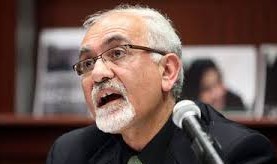
Dr. Mehdi Noorbakhsh: The government cannot fight on three fronts / Ali Kalaii
This is a picture of a beautiful flower.![Ali-Kalei[1]](/wp-content/uploads/2014/08/Ali-Kalei1.jpg)
Conversation with Ali Kalai
The fate of negotiations and the achievement of agreement or final failure is still uncertain, and at this moment in time, the situation of human rights in Iran is a challenging issue for the activists who are involved in it. In this regard, we had a conversation with Dr. Mehdi Noorbakhsh, a professor of international relations at the University of Harrisburg in Pennsylvania, USA.
Dr. Mehdi Noorbakhsh, who disagrees with the combination of human rights violations and negotiations, speaks of peace: “I fundamentally believe that these two phenomena should be separated. As soon as the issue of nuclear energy is resolved and the Rouhani government has a few winning cards in hand, it can make changes in the political landscape of the country. That is when the opposition must exert pressure on the government to address the human rights situation in Iran as a structure…”
As you are aware, Ms. Navieh’s proposal regarding addressing the issue of human rights violations in nuclear negotiations by Mr. Abbas Araghchi, the Deputy Foreign Minister and Head of Iran’s nuclear negotiations, has been rejected. What is your opinion on this matter?
Firstly, it is true that the Ministry of Foreign Affairs is a part of the government, but these issues are related to power structures and the judiciary, and the Ministry of Foreign Affairs does not have much power in these matters. Of course, I do not justify the discussions that Mr. Zarif sometimes brings up, but they are not within the realm of power. Secondly, in my opinion, if the issue of human rights is mixed with the issue of nuclear energy, it will be the end of the matter. The reason is that there are people within Iran who will never back down from this, including Mr. Khamenei. I fundamentally believe that these two phenomena should be separated. As soon as the issue of nuclear energy is resolved and the Rouhani government has a few winning cards in hand, it can make changes in the political landscape of the country. That is when the opposition must put pressure on the government to address the human rights situation in Iran as a structure. If
Why are the officials of the Islamic Republic reluctant to be accountable for human rights violations? For example, Mr. Velayati said a few months ago: “They are gradually bringing up the issue of human rights and asking why you do not give freedom to the Baha’is? Giving freedom to the Baha’is means allowing them to spy for the Zionist regime. Or they say why do you enforce religious laws inside the country and the like…”
If the discussion is about human rights, Iran is a violator of human rights and these discussions that people like Larijani make are a violation of the most fundamental human rights. These individuals are part of the political structure of the country. We all know that Mr. Larijani or Velayati are not in the elected branch of the government and have positions in the non-elected branch. Nevertheless, because they want to defend this part of the government, which in comparison to the elected branch has no real power shifts, they have their own justifications, whether it be in the field of human rights or other issues. It must be said that their thinking is traditional and if the discussion is about human rights in Iran, many questions arise from them and in fact, their non-elected legitimacy is more questionable. This is why they are forced to defend such issues.
This discussion sheds more light on the fact that as soon as the issue of human rights in Iran is brought up and they try to link it to nuclear negotiations, a group of individuals take a stance. This is completely related to the non-elected power sector, which considers itself legitimate and has justifications for violating human rights, and these justifications start from the top. Mr. Khamenei considers himself the Supreme Leader and all of these violations are justified under his umbrella and silence. When under this same umbrella, they justify the corruption of the Ahmadinejad government for 8 years in various forms, what expectations can we have for them to not justify human rights violations.
You say that you do not agree with mixing the issue of human rights violations with negotiations, and well, this issue has also overshadowed the negotiations. How much attention and emphasis do you think this issue will receive from the international community after the end of negotiations?
In any case, Iran is facing global distrust. According to the latest statistics that I had, out of 35 countries in the Middle East, Iran has been evaluated with a very low level of trust. In fact, this level of global distrust not only affects the daily issues that the government deals with, but also has an impact on foreign policy and establishing relationships with other countries. These are very important, especially when a government wants to attract foreign investment and even open its doors to tourists.
I believe that we should give Mr. Rouhani the opportunity to solve this issue before moving on to other matters. The Rouhani government is not my ideal government, but I do not agree with those who constantly criticize him. Rouhani’s government has repeatedly assured us that it is not a non-elected structure, and sometimes he discusses topics that are very interesting to me.
In any case, our society has been struggling with sanctions for years and we cannot expect to find a solution overnight for a long-standing issue (I don’t want to say a hundred-year-old problem). We must give it some time and support this government, while also expecting it to address important issues in our country after resolving this problem. For example, one of the slogans that Mr. Rouhani had was to make our society less insecure; a problem that our society is currently facing…
Mr. Ahmad Shahid has stated that the human rights situation has worsened during the presidency of Hassan Rouhani. As you know, in recent months, the implementation of executions has significantly increased, and Iranian authorities always claim that these punishments are carried out according to Sharia laws. What is your opinion on this matter and how do you evaluate the reason behind it? Do you agree that the government has increased its level of suppression with the confidence gained from positive results of negotiations?
Mr. Rouhani has completely ignored the issue of executions, but the argument here is that Mr. Rouhani is actually fighting on two fronts: one is foreign policy to solve these problems and the other is the opposition front within the country; now if we think that Mr. Rouhani opens another front in the field of human rights violations in Iran, he will clearly be confronted by the judiciary. I do not think that the country’s problems will be solved by opening this front and I believe that in the current political situation it is completely irrational to open another front. In that front, enemies will find more justification to speak and will come to the aid of those who are supposedly desperate. Basically, we should think about how much influence this government has and in the current situation, I do not see such influence in the government that it can fight on such a front.
The Iranian government has shown in the past that in sensitive and crisis situations, it tightens the circle of suppression. If you agree with this view, what guarantee is there that the Iranian government – not just Mr. Rouhani’s government – will not further violate human rights in the country after reaching an agreement in negotiations?
Yes, I completely agree with this opinion, but I think we should separate the discussion of human rights in Iran from the discussion of human rights in other places, because the violation of human rights in Iran is actually based on an ideological basis and in no other place in the world does the violation of human rights have an ideological flavor. The problem we have in Iran is that we do not believe in international standards and use religious justifications. The actions of Mr. Khomeini in 1988 show that he is completely indifferent to these standards and global norms.
Basically, I believe that the violation of human rights in Iran goes beyond the discussion of the government; in the sense that one part of the government says something is right and another part says it is wrong. I think that if in the future we can change the parliament or make the existing political structures more democratic, the situation will change; democratic in the sense that those who are truly sensitive to these issues must become a movement and take action. We must look at it as a political culture and it is more than just the work of the Rouhani government, it must be turned into a movement and a series of institutions must be put in place to condemn the actions that Mr. Khomeini did in 1967 or those that are being done today. If you look at the issue of Baha’ism from the beginning of the revolution until now, you will see that the attitude towards it has changed significantly. In the early years of the revolution, they had almost no defenders, but in
Unfortunately or fortunately, the power structure in Iran is from another fabric, meaning the government, in its general sense, does not believe in any of the international standards – which are completely humane standards – and we cannot expect much from President Rouhani either. For example, Mr. Rafsanjani, whom we are very grateful for his speeches now, at the time when Mr. Khomeini was in power in 1988, did not believe in these statements and did not talk about them, but now he has entered this circle. My argument is that society has a set of values and imposes them on itself, which are very good values. Human rights must be turned into a movement and power must be taken away from those who have religious justification for violating human rights.
I said this to emphasize that this is more than just a clerical government. This is a movement and a social movement that fundamentally does not allow any justification for human rights violations within society. Now, the fact that they themselves have said “Islamic human rights” shows that in reality, their human rights are also separate.
As a final question, please state your prediction regarding the outcome of the negotiations and what impact do you think it will have on the lives of Iranian citizens?
I evaluate the negotiations positively for various reasons. One reason is that the Rouhani government truly stood up, and we all know the challenges they faced. I don’t know if you heard this discussion or not, but when Mr. Rouhani returned from the first round of negotiations from France to Iran, they had prepared a very tense atmosphere to actually end his work and not let him continue, but Mr. Rouhani had told Mr. Khamenei that if he accepts defeat in the negotiations, he will resign from the government. Or last week, he had said that those who talk about the economy don’t know what’s in people’s pockets. All of this shows that the Rouhani government believes that the economic situation of the country is very destructive and is determined to finish the job. Another reason is the Obama administration in America, which I am very optimistic about. They don’t want to get involved in another round of conflicts, because the pressure and problems in the Middle East are currently
Another argument is that if the issue of nuclear energy is resolved and sanctions are lifted, and the country is relieved from economic pressure, our citizens will benefit from a series of opportunities that they can have in the global market. Our citizens have been deprived of access to foreign products, especially at original prices, and this is an important issue.
Although I strongly opposed Iran escalating the issue to this extent and this incident has been detrimental to Iran, we have reached a point in history where I am optimistic about it…
Mr. Doctor, thank you for the opportunity you have given us.
 Created By: Ali Kalaei
 June 27, 2015
Tags
Ali Kala'i Conversation Mehdi Noorbakhsh Monthly Peace Line Magazine ماهنامه خط صلح ماهنامه خط صلح