


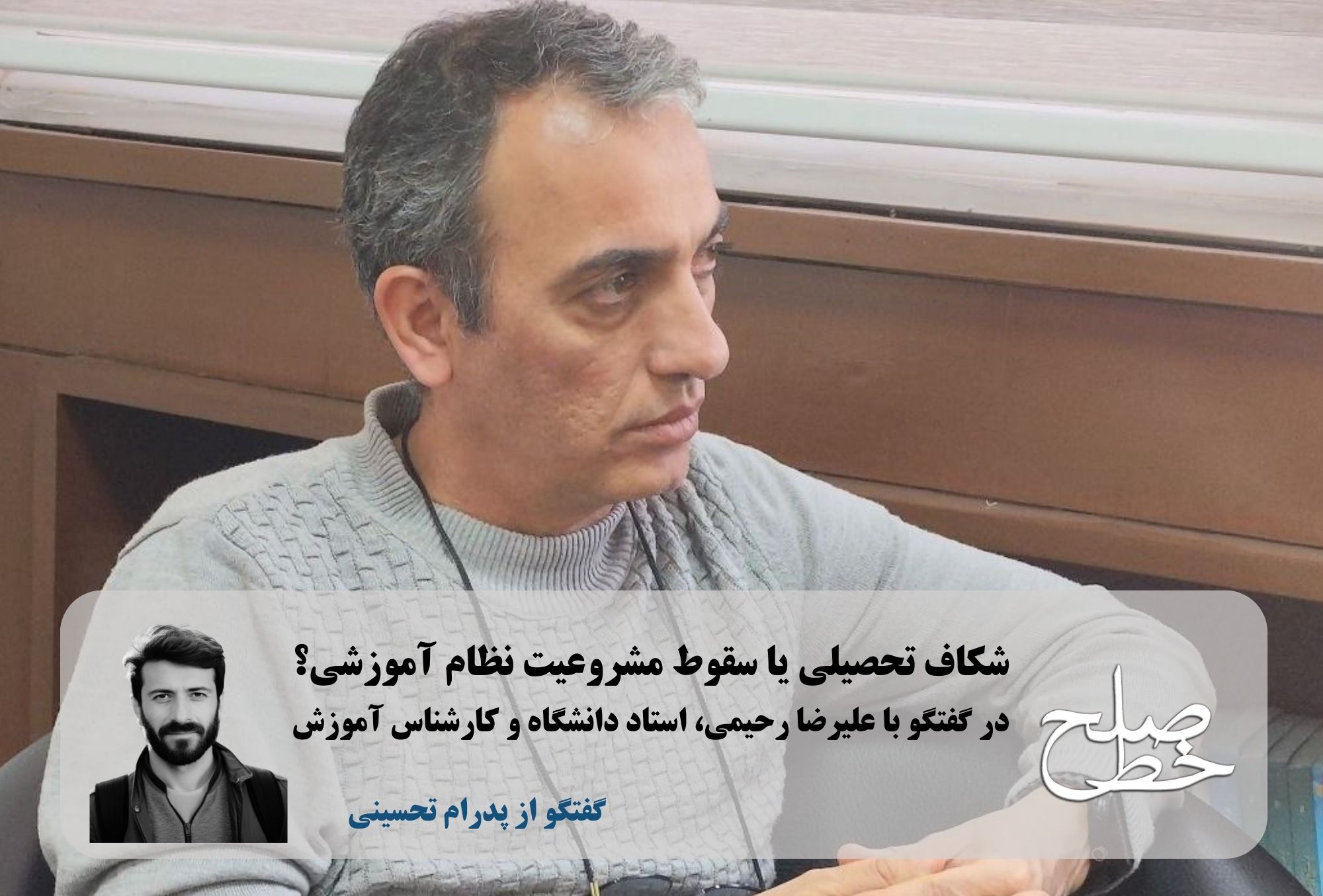
The Educational Gap or the Fall of the Legitimacy of the Educational System?; In Conversation with Alireza Rahimi/Pedram Tahseni
Alireza Rahimi is a university professor and education expert. Since 1986, he has been teaching in schools (from elementary to high school), higher education institutions, universities, and numerous educational courses and workshops. At the same time, he has been engaged in research, writing articles, and authoring books in the field of education. The result of his scientific efforts is more than 60 books and articles. Rahimi is a professor at Al-Mustafa University, founder and lecturer at Refah University, a member of the Specialized Association for Children and Media, and a member of the Scientific Association for Public Culture and Education. Contrary to many popular analyses, he sees the main problem not as a “class divide” but as the erosion of the value and function of education itself; in his words, the education system has become so devoid of meaning and effectiveness that it is neither a ladder of social mobility nor even capable of reproducing inequality. Rahimi speaks of a kind of “educational despair” and believes that until the quality and efficiency of education are restored, the discussion of educational equality or inequality is more misleading than helpful.
You can read the details of the Peace Line’s conversation with this education expert below:
To begin the conversation, please first briefly explain class differences and gaps, what they mean, and how they impact education and access to educational opportunities.
The basis of this discussion is mostly raised in sociology, and its perspective is sociological, not necessarily related to the economics of education or the field of education. In my opinion, these areas should be separated. That is, such questions are mainly based on the views of sociologists such as Max Weber and Pierre Bourdieu. Bourdieu’s theory of cultural capital is also the main basis of this view and emphasizes concepts such as social class and class divide. But in my opinion, looking at this issue only from this perspective is not very correct and is considered a kind of monotony.
Given that the constitution speaks of free education, governments must provide it, but our situation today is different. Do you have water to drink now? Governments must provide water and the Ministry of Energy must provide it, but when there is no water in the dams, there is nothing at all to provide and distribute fairly. The same is true of education; the education budget is limited and has its own problems. We must consider that there are those who have greater abilities, and it is natural that more should be spent on them, because they will be a more valuable asset to the country. The point is that according to the theories I have presented—especially Bourdieu’s theory of cultural capital—we can consider the educational system to be effective in both creating and eliminating educational injustice.
There has been a lot of talk about this: Education can be effective in all three forms that Bourdieu defines as cultural capital: in the area of ownership of cultural objects, in the area of educational qualifications—which promote individuals—and in the area of institutionalized skills. Inequalities can be reduced if targeted reforms are made to the education system, such as creating widespread access to quality education (which I know you want), paying attention to cultural diversity, and strengthening social participation. But in many cases, the education system implicitly and naturally produces inequality itself.
Now, whether this inequality is the result of the existence of the non-governmental sector in education or not is another matter. What matters is what form inequality has taken today and what are its consequences? The result is that classes take on a new form. But in my opinion, it is a more dangerous event than what was discussed here. This means that education does not just lift some people up and bring others down. What I see in my 40 years of experience—both in the practical and research fields—is that unfortunately, “education has lost its value.” And because its value has decreased, it also has less power to create inequality than before.
In other words, I believe that in the field of education economics, the public and private efficiency of education has decreased to such an extent that the so-called “education system is not even worth a penny.” I can explain this in more detail in the next questions.
From a sociological perspective, to what extent has education in Iran been able to play the role of a social ladder? Can education still help improve class status, or is it merely a reflection of existing inequalities?
Your question is an emphasis on what I said. If education maintains private returns and public returns—these are two important terms we discuss in the economics of education—and is highly productive, it can be a kind of social ladder. Now, if you say “Mr. Doctor” in the alley, everyone will turn around, and those who don’t turn around are definitely engineers. That is, when we distribute degrees and our university lacks quality, when you hire a doctor, you see that he does not have the same experience, expertise, and skills as a person with a diploma, the status of this education gradually decreases and it can no longer create a class at all. The devaluation of cultural goods (such as books), the discrediting of educational qualifications, the decline in the public and private efficiency of education, and the existence of ineffective graduates, all of these things mean that class status is no longer created at all. It’s as if we are somehow expanding poverty. It’s as if we’re giving people “nothing.” When you have nothing, whether you have a “nothing” doctorate or a “nothing” diploma, it means nothing in nothing. Therefore, the warning should be given from this perspective. Let’s not think too much about equality in education. We should think about improving the status of education. If we don’t improve the status of education, equality won’t be of any use to us at all, because the weakness of the education system itself automatically means that it will not benefit anyone, no matter how much they try to move up or down their social class.
You mean that promotion to equality is preferable.
Certainly. For example, in France, when you are educated and graduate from university, you find a specialization that has applicants; it’s not like someone gets a PhD but is unemployed. Unemployment, not because there are no jobs, but because there is no supply of work to do and no use for anything. The problem is that education and the university system unfortunately do not produce truly advanced people. You don’t even produce a proper plumber. Plumbers in Iran have not received any specialized training at all and do their work empirically; in fact, they have repaired people’s pipes here and there so much that they have learned nothing. This means that the education system has practically lost its effectiveness. When it loses its effectiveness, it can no longer create class status or not, and it is completely out of our discussion.
You’re right, but one of the indicators of our education is the increasing growth of non-profit schools and specific educational brands that exist now. What message does this have for educational justice? Can it be said that education in Iran has become a commodity that can only be purchased by a certain class, namely the wealthy class?
No. In my opinion, these words are socialist slogans. If education is not a commodity, then what is? What do you think a commodity means? A good is something that I spend money on, or “opportunity cost” is something I spend time on, to obtain. You don’t pay an opportunity cost at a public school? The commodity is what I am trying to achieve. Okay, if education is not a commodity, it is the most worthless thing.
So you confirm the necessity of the existence and presence of non-profit schools and specific educational brands?
This is another discussion. The idea that education should be a “good” and that it should be paid for is useless if it is not; because if it is not a good, private returns on education are meaningless. Why should people pay for their children to study? They pay because they want their child to “become something” and they consider this education valuable. Now, whether it’s called a product or a service, it doesn’t matter.
But let’s move on to non-government schools. Why don’t we talk about universities? Why are only schools being questioned? This is the first point. The second point is that private schools exist everywhere in the world, and everywhere in the world, the quality of public schools is usually higher than private schools. So, incompetent education, why don’t you improve the quality of public schools? Some people have social responsibilities, while others are after money. The problem is the system itself, which allows anyone looking for money to establish a school and charge people as much money as they want. These are the flaws in our education system, which lacks the ability to properly manage and supervise.
I remember the years 1366 and 1367, when non-profit schools were just about to be formed. I was sitting in the Education Department with a few of my fellow teachers, and they kept chanting what would happen and what wouldn’t if a non-profit school came. It’s interesting that the same people who were chanting slogans back then are now the owners of a non-profit school themselves. Who is responsible for this situation? Who is to blame? Who should be held by the collar?
Now, because I consider private education to be highly profitable, I am willing to pay for my child to go to university and study instead of going into business. I’m paying for this too, because I think this person will be more productive later. This is the concept of private efficiency: Some people are willing to pay for upgrades. Well, let them do it; what’s wrong with that? The overall efficiency of education must also increase. But the government is incompetent, the government system is incompetent, and universities, education, higher education, and medical education are also incompetent. Because the private sector sees high returns on education, it spends money. If you close this path, the very people who are seeking education will abandon it.
Now, based on your explanation, does education have the will to regulate or control these problems?
You said “will,” and will means wanting. If that’s what you mean, yes, he wants to. But does he have the knowledge, ability, and possibility? Does it have its supply? Does he have his man? The Education Economics Office in the Ministry was established during the tenure of Mr. Raisi or Mr. Rouhani. What are they doing now? Do the people I’m talking about—I’m not an economist—know the same simple terms I use? Do they understand the difference between private and public efficiency of education, or are they just sitting around and shifting numbers?
Do you even accept education as an investment—whether private or public—that should be made? I would like to say that we have a failed education system that does not have the capacity to manage itself; it does not have enough power and cannot provide services to everyone. Then we say that some people have come to provide service. I have no doubt that amidst them—from the free and non-profit universities to other places—it is full of malicious and self-interested creatures due to the country’s flawed systems. But the essence of the story is not wrong; the essence of the story is true.
You made a very good point in your question: “Regulatory”. What does regulation mean? That means standing on top of the work and managing it. But whenever the Ministry of Education wants to do something, it has only issued a few circulars; and those, so to speak, are the school trash cans. The circulars are not from the Prophet (peace be upon him); some of them are funny and ridiculous. You can’t regulate with a circular. The story of regulation is not a matter of will, it is a matter of ability. How much can our education and higher education do this? If they had paid attention to and benefited from science related to education, like any other technical and scientific field, rest assured that the situation we have now would not have arisen, and regulation would have been implemented.
You mentioned the difference in quality between schools and that even public schools in Europe are much better quality than the private sector. But it really cannot be denied that the quality of these public schools is also The differences between the wealthy and deprived regions of Iran are stark, and this difference deepens year after year. In your view, what could this gap and its consequences be for the future of human capital and especially the social cohesion of the country?
I have never limited deprivation to simply “lack of money.” The issue is not just that people in one region are poorer and people in another region have more opportunities. The issue is more complex and is exactly what Bourdieu explains in his theory of cultural capital: When levels of wealth differ, social classes naturally form and these differences are reproduced.
Bourdieu proposes three forms of cultural capital: Cultural objects (such as books, educational tools, cultural content at home), accredited educational qualifications, and knowledge and skills institutionalized in individuals. In the third form (knowledge and skills), the social environment may help an individual learn more; but in the first two cases, when the level of enjoyment increases, others remain deprived of it.
You see: Most of those who study abroad and have higher academic levels than domestic graduates usually come from well-off families. It’s natural, because the costs are high. In the past, they would select the best and send them to study at the government’s expense, such as Dr. Hesabi, Dr. Ali Shariatmadari, Engineer Bazargan, Dr. Gharib, and others. We don’t have such a selection and dispatch system now.
What happens as a result? A wealthy family pays out of their own pocket and sends their child to the best universities in the world. If he returns, he will effectively serve the same privileged class. This trend naturally deepens the gap, as opportunities that should be available to everyone are only available to those who are already in a better socio-economic position.
What could be the social consequences of this event?
Of course, this is a sociological discussion and I am not an expert on it, but its natural effect is indifference and lack of motivation towards deprived areas. Now you can hardly find a doctor willing to practice medicine in the village. Dr. Gharib did such a great job, but today, someone who has spent money, worked hard, and paid from their own pocket to become a doctor expects to work in the best part of Tehran; it’s natural. Let me give a simple example: Does a veterinarian make more money now or a regular doctor? People in cities have dogs and spend a hundred million a month on them; so the party says I should become a veterinarian and study “small animals.” Because it is harder to read “Big Dam”, it is more troublesome, and he has to go to work in the village. While here in the city, he gets the dog’s nails and makes a better income.
Mr. Doctor, during the Corona period, education was almost completely suspended and there was no in-person training. That means we used digital and virtual systems. There were educational inequalities there too. In your opinion, was this issue not taken seriously in educational policymaking after the coronavirus?
It was abandoned, unfortunately. I remember many associations and charities started providing laptops, phones, and tablets for children, but no one took digital education seriously and abandoned it. While I believe that digital education and its related technologies are extraordinary and unique for creating equality in today’s world.
Let me make a personal point. We have a group called the “International Right to Education Group” or “Education for All.” It is an international group and we have carried out projects in different countries. About 15 years ago, a curriculum plan was developed to teach history equally in several countries; I was the one implementing it in Tehran, and at the same time someone was working in the United States, one in Cameroon, one in India, one in Peru, and one in Italy. We didn’t have any special facilities and used Skype for communication and training. The best thing happened there. What does it mean? That is, digital education tools are tools that can greatly create equality. My best teaching experience was during the Corona period; I provided the best education and truly enjoyed my work. At that time, I was teaching both at school and at university. The big problem was that teachers and education were not prepared for such a phenomenon. If they had, it could be the best form of education.
Of course, I am not against in-person education; in-person education is very valuable. But I wish education had the understanding to attach and link digital education to in-person education and integrate the two in such a way that it becomes part of the essence of education. If such a consolidation were made, many of the problems of educational inequality could be solved.
In tests like the entrance exam that you mentioned, access to resources, classes, and private tuition is practically available to wealthy and affluent families. This process How can it reproduce the cultural capital of different classes? Does this mean that these classes will be redefined?
Again, these are Bourdieuian terms, and based on precisely the same concept of “cultural capital” that says money can reinforce this capital. But the reality of society has shown that this is not always the case. Often, the rank of a college entrance exam comes from a remote city, like a spot in Kurdistan. Students stand on their own two feet and break this perception.
But overall, when you have more money and more resources (expensive books, private tutors, special schools, etc.), it’s natural that you have a better chance of getting into better universities. This has always been and will always be the case.
But the strange thing is this: Now we have a lot of universities with empty seats. The Minister of Science has announced that many universities should be merged or combined because we lack students. So when there is so much empty capacity, what is the purpose of the entrance exam? So that some people can get rich off of it?
A strange and lucrative economy has formed around the entrance exam; from the entrance exam teachers—some of whom are frauds and some of whom are truly experts—to the book, publication, and magazine industry that consumes a huge amount of paper every year. All so that the student can enter a university that happens to have an empty seat and is begging to be filled. On the one hand, families are crushed under the burden of costs, and on the other, universities are empty. This shows that a college entrance exam mafia is taking advantage of this situation and is having a lot of fun with some people.
Now, the very issue you mentioned has caused panic and fear among families. Fear of class decline has led parents to pay exorbitant fees for special schools, language classes, or international skills. Doesn’t this type of “class” education lead to the cultural and mental separation of children from other classes?
Yes, that’s true, but this class doesn’t mean much in our country. Class society and these terms – I emphasize again – are socialist.
However, we have a lower middle class that is involved and feels very deprived.
Yes. But I want to say that these class terms are not very precise and calculated for us. On the other hand, when families still pay for education, it means they are happy that education has private returns; and this in itself is a positive point. At the beginning of my talk, I said that education in general has lost its value and efficiency, but here we see that it apparently hasn’t completely lost it, because people are still paying for it. And that’s a good point.
Isn’t this out of fear? It is unclear what the outcome will be and how valid it is.
It may be an illusion. Because I think that if my child has a bachelor’s degree, it’s better than a diploma, and if he has a master’s degree, it’s better than a bachelor’s degree; with this hope, I send him to study for 10 years and I pay for it. This means the private efficiency of education that I still believe in a little bit.
But the next point is that if I am a conscious person, I will make my choice calculatedly. For example, I would say that instead of studying engineering and taking the entrance exam and having his father come out and get a stomachache, the Azad University would say, “Come on, let’s study fields without the entrance exam; fields where work and business are now more lucrative.” Is financial management more profitable now or mechanical engineering? Definitely financial! Experience has shown—and none of this is scientific—that you don’t need to take a college entrance exam to manage your finances.
The big problem is that when the regulatory system you mentioned doesn’t exist, everyone does whatever they want, and the person who benefits from this situation leads the people, not the person who truly cares about the people. People need to be informed. This is a difficult thing to say. People ask where we can find out? Television and educational networks invite people who take large sums of money from people outside the media. Now, maybe the television itself is taking money from them?
This situation puts people in a position that is even more dangerous than class divides. Let’s not make such a distinction; class does not have a very precise and specific meaning in Iran.
Now can we call it educational inequality?
This is educational frustration. Now, a second-grade elementary school kid says he wants to become a streamer (1). Looking for things that have nothing to do with education, that is, woe to this education system that has not and will not create any interest in anyone. Fear the day when all the children say they don’t want to go to school anymore, whether it’s government or non-profit. Whether in Sistan and Baluchestan or in Zafaraniyeh. It doesn’t matter anymore.
It seems that this disappointment is also the result of educational inequality, which also has long-term effects. Now, what do you think will be the long-term effects of this educational inequality on the structure of society, social justice, and even the legitimacy of the educational system? Are these works taken seriously in the country’s macro-policies?
No, no. No one pays attention to these issues at all, unfortunately. The legitimacy of the education system is under question right now. This means that a second-grade child easily questions the legitimacy of the school. What he’s saying makes perfect sense—I’m not saying it’s right, but it’s understandable.
We should fear the day when the legitimacy of the education system is questioned to the point that children rebel against school, or students never set foot in university at all. When we send an illiterate professor to a university classroom and everyone calls him “professor,” when we send an untrained teacher to a student’s classroom, and when we don’t know how much the Minister of Education understands about education, and when textbooks don’t meet the needs of the new generation, it is natural for the education system to lose its legitimacy.
In other words, such a system no longer has the power to create class or even have a serious impact. This is where you should be afraid.
We are grateful to you for the opportunity you provided to the Peace Line and its audience.
Footnote:
1- A streamer is someone who broadcasts their content online through live streaming or pre-recorded video.
 Created By: Padram Tahsini
 November 22, 2025
Tags
Abandoning education Alireza Rahimi Education and training Educational gap Educational qualification Educational system peace line Peace Line 175 School ماهنامه خط صلح