


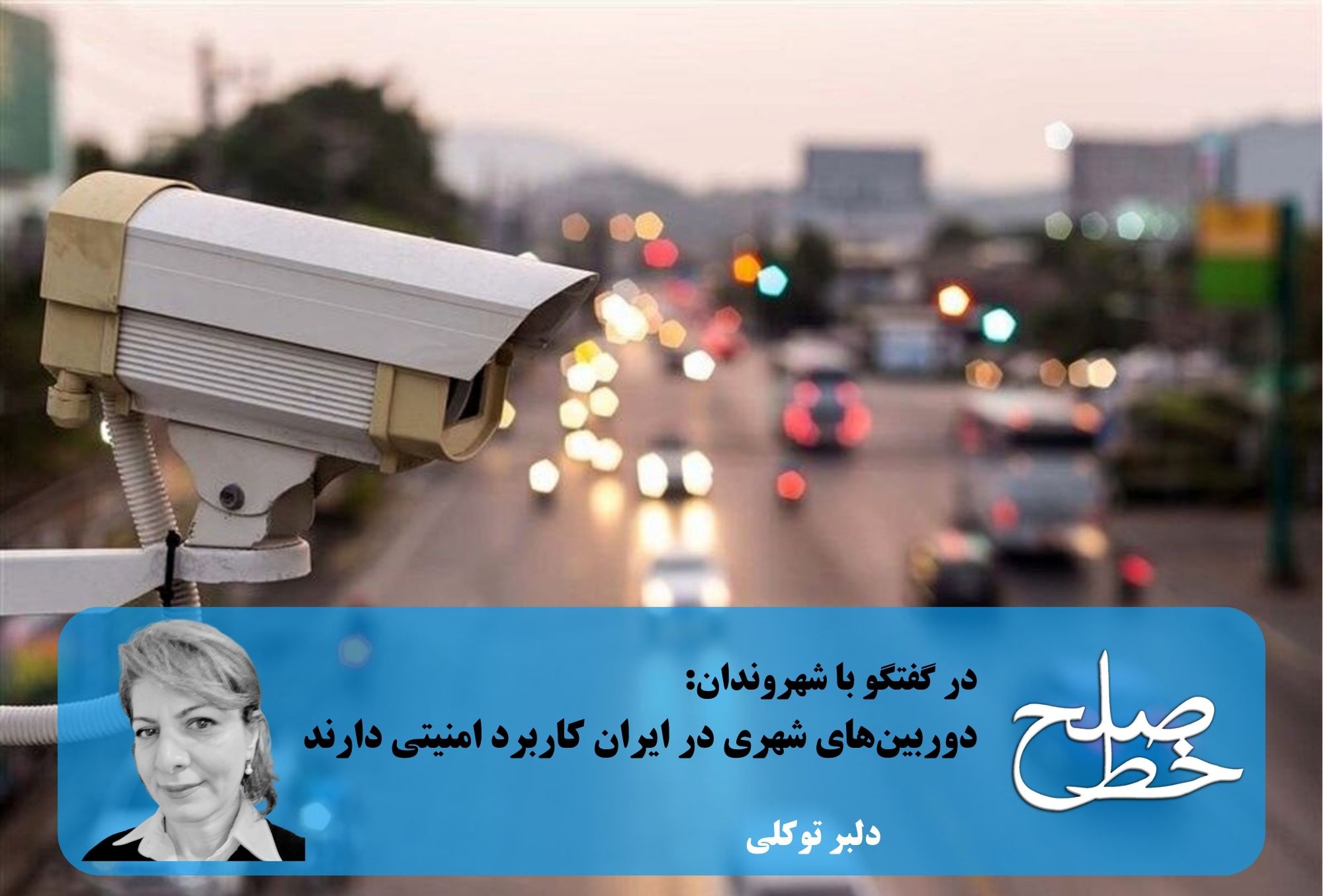
City cameras have security applications in Iran/ Delbar Tavakoli
In recent years, there has been a discussion about the use of surveillance cameras in public spaces in cities, and the Islamic Republic has tried to convince people that these cameras are for identifying and arresting criminals and creating security. In this regard, I spoke with several citizens who live in different cities in Iran and asked them if surveillance cameras in public spaces create security for them or if these cameras serve as a “security” tool for security organizations such as the Revolutionary Guards in the Islamic Republic.
Mina Boroujerdi, a 32-year-old resident of one of the counties in Mazandaran province, stated that these cameras are for tracking people, not for creating security. She said, “In our county, wherever you turn in the streets and alleys, you see a camera, but it’s in those very places where the cameras are present that pickpocketing and robbery occur. No one has been identified or arrested for these crimes. Every day, we hear a new story about someone’s phone being stolen or their purse being snatched.” She continued, “When I leave my house, I take off all my jewelry and I don’t bring any cash or even my bank card with me if I can help it. One of the strangest incidents that happened in our city was the theft of bread from an old woman walking in a deserted alley. A motorcyclist snatched three loaves of bread from the old woman’s hand. Honestly, in a place
Mrs. Boroujerdi, in response to the question of what she means by tracking people through city cameras, said: “Do you think the government has spent all this money and placed cameras in every street and neighborhood for our safety and well-being? No, my dear; these are only to see what is happening in every neighborhood, how many girls without headscarves have left their homes, how many young people are gathering… In the protests of 1401, several young people who had participated in the protests after the killing of Mahsa were identified and arrested in our city through these cameras.”
Abbas Tofiqi is a 22-year-old who lives in Isfahan. Abbas confirms Mrs. Boroujerdi’s words and says, “I still hear Navid Afkari’s voice in my ear saying, ‘Why don’t you show the store’s camera?’ Navid requested multiple times in court to review the footage, but the judge refused. If these cameras were meant to ensure the safety of citizens, they would have reviewed the footage. But these cameras work not for us, but for the Islamic Republic. They go after the footage wherever they want, for example, to attack a young person who takes his dog for a walk in the park. But in places like the day when the horrific crime of killing Dariush Mehrjui and his wife happened, the neighborhood cameras were not working. We are no longer fooled by the government’s words. We know very well that if this government cared about us, the country’s situation, inflation, and the
Abbas Tavakoli continues his conversation and refers to the death of Armita, saying: “There are cameras everywhere in the Tehran metro, even in the carriages, but on the day Armita had a brain hemorrhage, the only camera in that carriage suddenly stopped working!”
Abbas Tofiqi referred to a tragic subject. The way Armita lost her life cannot be forgotten. Armita Gharavand, when she was going from home to school on the morning of October 1st of this year, was feeling well and the security cameras of the metro show her entering. But the scene that is said to have happened, where one of the enforcers of compulsory hijab got into a fight with her in the train car, was never shown; it was just a few seconds that led to her brain injury and later her death. Yes, cameras in the Islamic Republic are turned off or malfunction whenever necessary. But there are also cameras that are turned on and go to the families and force them to give interviews. Just like the interview they took from Armita’s mother.
Abbas speaks so carefully and with such evidence and documents in our conversation that it was admirable. He mentioned the incident of toxic gas being released in girls’ schools and said, “What happened to the perpetrators of the toxic gas attack? Even Khamenei himself came and said they should be identified and arrested (although it was just for show), but nothing was done. Is it not true that these cameras are for security and identifying criminals, so why did not even one of the cameras in the dozens of schools attacked by toxic gas show anything? Does this mean that the gas was automatically released in the middle of the schools? At that time, they even had cameras in the girls’ bathroom.”
He mentions the incident of shooting at protesting farmers in Isfahan and says: “I myself saw security forces shooting rubber bullets at farmers, but none of them were arrested. If the footage from the city’s surveillance cameras of government crackdowns is released, they would have to gather and have nowhere to go.”
Of course, the Islamic Republic tried to say in all the popular protests that shooting at the people was not the work of security forces, but rather that thugs and hooligans had guns and were shooting at the people. However, in the age of technology and in today’s world, with the use of smartphones, people carry cameras with them and record and publish all the events that the government denies. This is also why during the events of November 2019 and the people’s protests against the rise in gas prices, the government cut off the internet and only focused on suppressing and arresting people with the help of city cameras. We saw that when people regained access to the internet after a few days, images of the Islamic Republic’s crimes in the November 2019 massacre were published. Even during the killing of Mahsa Amini, the camera only showed the angles that the security forces ordered and was broadcasted by the state media to convince the public and cover up their crime, which was ultimately
In fact, the Islamic Republic has changed the meaning and purpose of city cameras. These cameras are not for controlling traffic, reducing crime statistics, or helping detectives and police to identify criminals. It is not hidden that the main criminals, as they themselves are in power and the government is in their hands, are known to the people. The part of controlling city traffic remains, in which these cameras have not shown any practical use so far. Tehran has turned into a large parking lot and traffic is rampant, and other major cities do not even compare to Tehran. Crime statistics have also gone out of control, even for the government itself. But the part of identifying thieves remains, which must be said that major thefts worth billions, such as the tea container incident, cannot be dealt with by city cameras and each time the number of zeros in these thefts increases. There are still petty thieves and pickpockets, whose arrest statistics are also very low.
At the end, it should be noted that during the widespread protests and the rise of the “Women’s Freedom Movement”, young people, understanding that the city’s cameras were used for identifying and arresting protesters, began to teach each other how to disable these cameras in the virtual space in order to protect themselves and their friends from the oppressive forces.
 Created By: Delbar Tavakoli
 January 21, 2024
Tags
Beloved Tavakoli City cameras Face recognition Mashhad Metro Peace Line 153 Supervision Surveillance camera Tehran Metro