


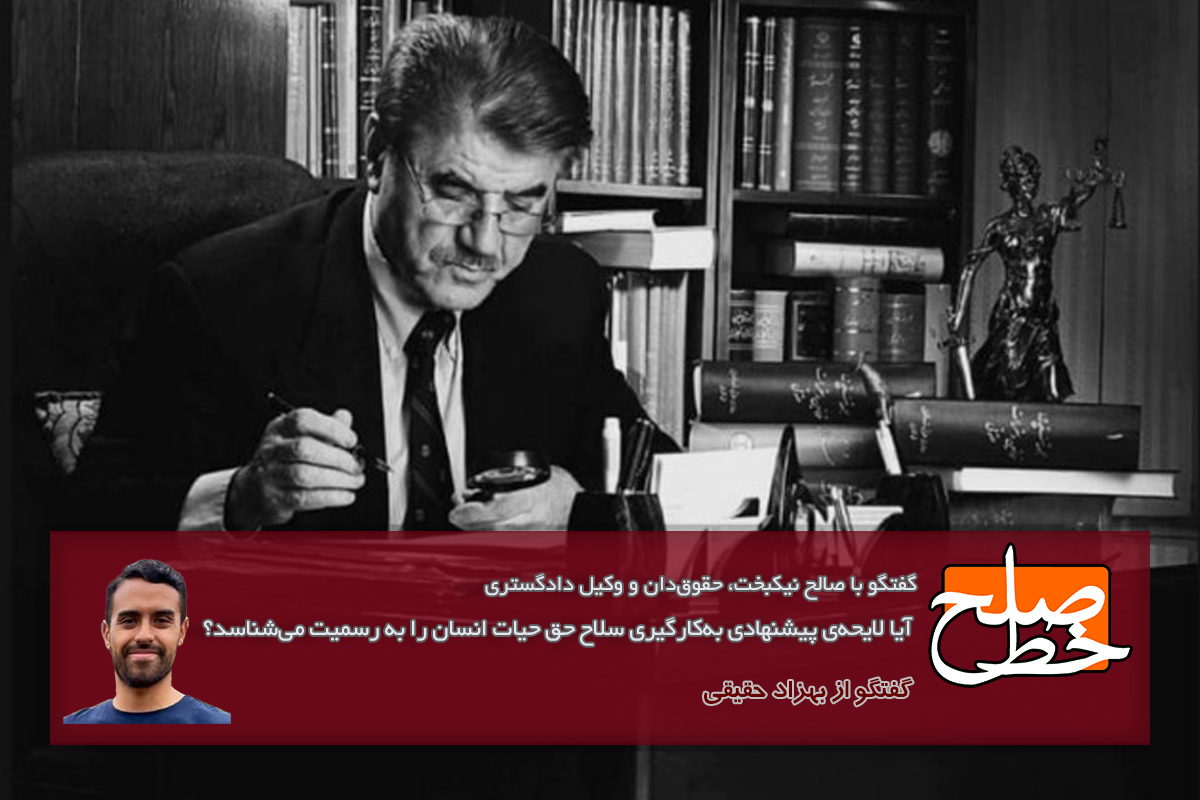
Does the proposed bill recognize the use of lethal weapons as legitimate? In conversation with Saleh Nikbakht/ Behzad Haghighi.
In pursuit of expanding the powers of law enforcement and military personnel in the use of weapons, the proposed amendment to the Arms Use Law, particularly the granting of authority to security and plainclothes officers, has raised the greatest concern among legal experts and human rights activists. This puts one of the most fundamental human rights, the right to life, at risk. If the amendment is passed and becomes law, the permissible cases of weapon use and the authorized individuals to use them will be much broader and more extensive than before, posing a serious threat to the lives of citizens. In this regard, the approach of the relevant laws in Iran towards the right to life of citizens and the potential conflict with the security of the government is such that the security of the government has always been the priority in terms of laws and must be preserved. However, to what extent do the current laws in Iran have the ability to protect the human right to life against the deadly potential of the proposed amendment to the Arms Use Law
We sat down with Saleh Nikbakht, a legal expert and attorney, to discuss this matter and you can read the transcript below.
Expansion of the license to use weapons by security personnel and generally facilitating their use for law enforcement, military, and security personnel poses a direct threat to civil rights, especially the right to life. How are the laws and regulations in Iran regarding the right to life of citizens?
The reality is that the law of using weapons, which dates back to the Qajar era and is in the form of a regulation, has always been a subject of protest by lawyers, legal experts, sociologists, and psychologists, because the presence of weapons in the hands of individuals always creates fear and anxiety that the person may not recognize or intentionally or unintentionally exceed their boundaries and limits of authority. For this reason, when the law on the use of weapons was passed in 1994, the use of weapons by officials always raised the issue that they use weapons not for the protection and security of society, but to take away the right to life of humans.
This issue, especially at a time when issues such as smugglers and fuel smugglers were prevalent, always put their right to life at risk, and the law enforcement forces, who had the right to limited use of weapons (in the current law on the use of weapons, passed in 1994), did not properly exercise this right and were constantly attacking and raiding them, taking their lives with their weapons; while without any doubt, these officials had the opportunity to fight smuggling while adhering to the guidelines of this law, without taking the lives of smugglers and also complying with regulations.
Fifteen years ago, I had a case related to kolbars (cross-border porters) near the city of Baneh. In this case, a young lady and her fiancé were traveling in their car on a route that, according to law enforcement officers, was used for smuggling. The officers, in plain clothes, saw their car parked on the side of the road. They hit the car window with their rifle butt and, because they did not identify themselves, scared the young couple. This was because during that time, there had been several attacks by thieves in Baneh who had introduced themselves as military officers. As a result, the young couple, in order to avoid this situation, without realizing the danger posed by the officers, fled in their car. However, the officers, without following the law, directly fired their weapons into the car, and the 18-year-old girl immediately lost her life. This is while the law states that when using a weapon, the
However, the new proposed draft is a law that will eliminate the regret of the current law, which has been brought about due to the failure of its officers to comply with regulations.
Is it possible for the recent bill to be deemed in serious conflict with human rights and therefore against the Constitution of the Islamic Republic?
First, I must say that in this proposed bill, many verbal amendments have been made, but in it, the use of weapons, which was previously only given to law enforcement officers and armed forces – only in situations specified by law – is now given to personal individuals and others in the new bill. This is a sign that the drafters of this bill have practically created a defensive margin for themselves, so that if cases such as widespread marches like in 1388, 1396, and 1398 occur, all individuals who have the right to carry weapons can use them.
One of the flaws of this bill is the way it deals with the use of weapons. The details mentioned in the 1373 law, instead of ensuring the right to human life, have removed it and given authorities extensive powers to use weapons; meaning that both the forces using weapons and the cases of their use have been expanded; including in this bill there are cases where in previous situations, authorities were only allowed to use weapons in specific circumstances determined by the law, but the new bill has created a situation where the right to human life, which is respected and protected in all current societies, is endangered; in fact, from now on, the use of weapons will not be for the protection of human lives, but rather for the protection of weapon holders and in the name of preserving and supporting the government; as a result, the Guardian Council will not reject the entirety of this law and will not deem the extensive powers against the constitution; although it may request minor amendments.
Ismaeil Kooshaari, a representative of the parliament and a security commander of the Revolutionary Guards who also has a history of commanding the Tharallah Security Base in Tehran, has stated in defense of this bill that ensuring the security of security forces and police is a top priority over ensuring the security of society; how much does this claim correspond with current laws in Iran and principles of citizenship rights?
A topic that exists in Iran – not only during this government, but also during the previous government – is the taboo of human rights and the lack of credibility and importance of discussing human rights. However, in Iran, about three decades ago, the issue of human rights and the widespread massacres that took place in the 1360s were strongly raised, especially with the critical importance that was directed towards the Islamic Republic, and the ground was strongly prepared for the emergence of human rights issues and received attention from the people. In Iran, the issue of human rights is still not recognized as a natural right for all humans regardless of gender, race, color, and religion, because Iranian laws – both the constitution and ordinary laws – discriminate against people in the enjoyment of various rights. Therefore, it should not be expected that human rights will be respected by laws that do not recognize human rights as the right of all and consider it as the right of a specific group of people in Iran.
For this reason, the government has shown such sensitivity towards respecting human rights that journalists, intellectuals, and political and civil activists have relied on citizenship rights to eliminate this sensitivity towards human rights. However, the third chapter of the Iranian Constitution, which is named “The Rights of the Nation” and includes nearly thirty articles of the Constitution, is not essentially respected and currently in Iran, not only non-Muslims do not have equal rights with Muslims, but also the population of ten to fifteen million Sunni Iranians do not have the same rights as Shia followers; as a result, not only citizenship rights are not respected in Iran, but also throughout these forty years, all the rights that may have been created as a result of efforts are also eliminated.
What approach do current laws in Iran take towards potential conflicts between citizens’ rights, particularly the right to life, and the security of the government? In case of a conflict between these two, which one takes precedence in current laws?
Ayatollah Khomeini has a saying that “preserving the Islamic government is one of the most important duties.” In this statement, which is currently being followed and implemented, the answer to the question is that the principle in all cases is to preserve the government and sovereignty. Of course, it is not a problem if a government says that they want to preserve their government; perhaps in Western countries, governments that come to power also say they want to preserve their government, but they do not see preserving the government as trampling on and disregarding the rights of the people. Instead, they strive to create conditions for security and people’s attachment to the government by preserving, expanding, and respecting the rights of the people.
We all know that after the massacre that took place during the protests in Iran in 1398, it became clear that many individuals were targeted and killed by bullets from close range and from behind, without any intention of attacking or threatening anyone. This shows that the current law on the use of weapons, despite some limitations, resulted in the November massacre. Now, in the proposed bill, even those limited restrictions will not be observed and the rights of citizens will never be recognized. And if any conflict arises, the legal interpreters, who are members of the Guardian Council, will interpret it in favor of the government and follow the same path that Ayatollah Khomeini took.
It seems that if the amendment bill is approved, the burden of proof for the legality of using weapons by law enforcement, security, or military personnel will be lifted and the injured citizen will have to prove that the weapon was used by the officer in violation of the law; what impact will this have on protecting the rights of citizens?
In the Constitution of the Islamic Republic, there is a fundamental principle known as the principle of innocence, which means that every individual is innocent until proven guilty, unless the ruling authority, namely the judiciary, accuses them or others demand their prosecution and there is sufficient evidence to prove the crime. After the three stages of investigation, trial, and execution, the current regulations must be followed. This is only possible when both parties have equal access to judicial and trial facilities. However, in Iran, defendants cannot have any lawyer they want, but they must choose from lawyers approved by the head of the judiciary. Therefore, there is never the possibility of a fair trial in the country and in practice, the ruling authority and the prosecutor take the side of the party that has installed the government. As a result, not only in the proposed amendment bill, but also in the root of the trial laws in Iran, the principle of the correctness of the behavior and speech of the officials is emphasized, and the judge also
Thank you for the opportunity you have given us to use the peace line.
 Created By: Bahzad Haghighi
 July 22, 2022
Tags
7 Peace Treaty 1357 Amendment Bill for the Use of Weapons Law Fuel tester Kulbars Law enforcement Modern weapons Monthly Peace Line Magazine peace line Salah Nikbakht Security officers Shooting The law of weapon use Weapon پیمان صلح ماهنامه خط صلح ماهنامه خط صلح