


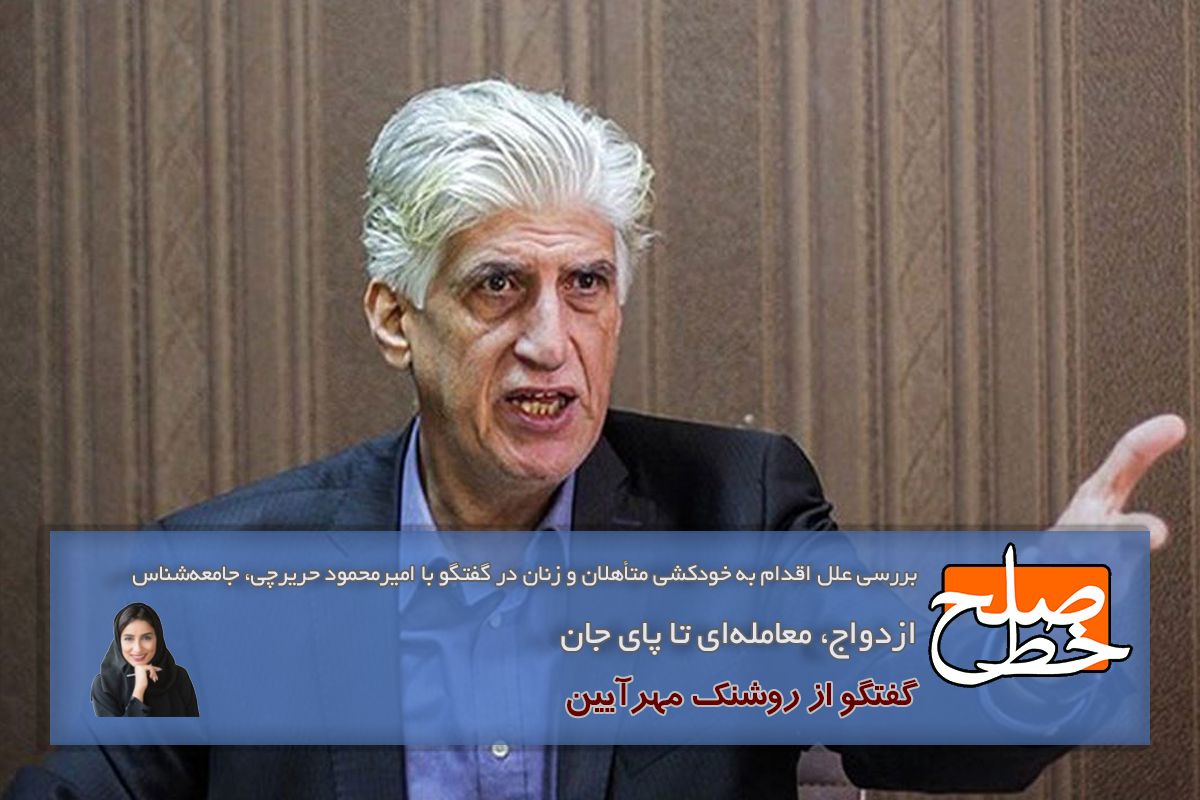
Investigation of the reasons for suicide among married individuals and women in conversation with Amir Mahmoud Harirchi, sociologist/ Roshanak Mehrayin.
Marriage, a transaction until death.
The statistics of suicide and attempted suicide in Iran have not changed significantly; although the statistics published by the Islamic Republic sources are not reliable, according to the statements of government officials and media, the influential factors on suicide have undergone significant changes; for example, suicide among women and young people has increased, and more than fifty percent of suicides are related to marital problems and the issue of marriage. The increase of this phenomenon among married individuals has turned marriage into a social crisis and has affected a large part of Iranian society. We sat down with Amir Mahmoud Harirchi, a sociologist and social worker, to discuss this issue.
A few weeks ago, the ILNA news agency released statistics at the “Examining Suicide in Iran” conference, indicating that about sixty to seventy percent of suicides in the country revolve around marriage and its problems. Why do families and society continue to approach the issue of traditional marriage in a way that puts individuals under so much pressure that they resort to suicide?
We are faced with two issues; one is suicide and the other is death resulting from it. Iran is not far from global statistics. In Iran, for every 120,000 people, about 120 people commit suicide, of which six to seven cases result in death; this data is not significantly different from global statistics. More than half of suicides in Iran are committed by married individuals. On the other hand, suicide in Iran is more common among women and has a high tendency among young people. These suicide issues are important in our country. The age of suicide is low in Iran, and more women commit suicide, while married individuals are more likely to do so. The rate of suicide among women is four times higher than men, even though more men die from suicide. Men are twice as likely to die; meaning that men are more serious about suicide.
Our society’s approach to marriage, even in the affluent and religious classes, is traditional. People in our society do not have the opportunity to get to know each other before marriage; meaning marriage lacks understanding between the two parties. Additionally, the issue of child marriage in lower classes, where people are often marginalized, occurs. These classes sell their children, both boys and girls, due to economic pressure. This is different from the early marriages that existed in the past, as these lower classes are forced to do so out of necessity. About half a century ago, the conditions were different and families supported their daughters and children in early marriages to a great extent. Today, many families are under stress and parents are struggling at home and are unable to support their children as they did before. In the best case scenario, they can provide material resources, but because they are struggling emotionally and mentally, they are not able to be supportive of their children. The structure of today’s family is under the influence of
We are not facing a problem in marriage. When a couple does not have the opportunity to get to know each other and their lives before marriage, and starts a life together, they soon become tense and resort to belittling and insulting each other. They seek attention from others emotionally and something called infidelity arises. Sometimes a person cannot find the root of their problems and these issues cause them mental pressure and ultimately lead to suicide.
In developed countries, marriage is a personal matter. The two parties can live together outside of legal, customary, and religious relationships and get to know each other before deciding to get married. But our traditional society, especially when it comes to girls, does not accept such a thing. Iranian families may appear modern and want to behave modernly, but when it comes to marriage, they cannot let go of their traditions, especially since marriage is seen as a transaction here. When it’s a transaction, there will be no equal rights. In our country, it’s not just the government that doesn’t give equal rights to women. These rights are also ignored by men. An Iranian man, no matter how modern or enlightened he may seem, is still a traditional man at home who does not accept equal rights for his wife, daughter, or sister.
Why do Iranian families still insist on traditional marriage and see women only as a commodity responsible for reproduction? Where does the sustainability of this tradition come from?
This tradition persists because the foundation of our society is still patriarchal. Sons learn in the family that their father is the owner and commander, and when they themselves take on a role in marriage, they take the place of the father; for example, if an Iranian man accompanies his pregnant wife or helps with household chores, he is ridiculed and mocked, and he never learns that women have equal rights. Despite the fact that many women today are employed and have economic participation in the family, patriarchy has benefits for men that they do not want to give up; while pressure on these issues weakens the family, because women today are aware of their rights to a great extent. No matter how much the family suppresses them and the laws do not support them, they are aware of their rights. Unfortunately, we still face honor killings and female infanticide, and there is no legal protection for women to at least preserve their lives. When we criticize the laws, we face the wall of
Women should demand their rights instead of committing suicide. Unfortunately, current women’s rights activists are focusing more on issues like hijab, while the issue is much more complex and profound. If fundamental rights, equality, and freedom of women are taken into consideration, even the issue of hijab will be resolved.
Today, the court announces the marriage of a thirteen-year-old girl or younger with the permission of her adult father. When this girl is placed in inhumane conditions, she commits suicide. Officials want to have the latest model of cars and houses, but they want to follow the laws of traditional and religious society. Responsible and religious men consider modern culture to be lawless, while in fact, traditional marriage is the cause of lawlessness, immorality, and betrayal. We have not become modern culturally, because modernity is accompanied by lawlessness. Modernity means that individuals recognize their rights, demand them, and have access to them. All government plans regarding marriage and childbearing have failed. Currently, two issues, the spread of luxury lifestyles and economic interests, have caused emotional discussions to collapse and in social relationships, people show kindness and love.
If we see suicide as violence against oneself and a reflection of violence in society, why has it become a tool of pressure and is increasing day by day?
Because people, especially young people and women, cannot get their rights. Currently, people are seeking their rights through two violent approaches; one with conflict and verbal violence and the other with suicide. Women seek their rights through suicide or suicide attempts because society, laws, and government have blocked all other ways.
The suicide rate in western Iran is still very high. Self-immolation is a type of suicide that we call a cry for help, and we see it increasing among women in deprived areas of the west. I had a case in a village in the west of the country where a woman set herself on fire in front of her house because of marriage issues and the fact that she didn’t want a divorce but didn’t have the support of her family. She didn’t survive. See how much of a mental crisis she must have been in to not even flinch from her spot. Self-immolation has a protest aspect to it. Women and young people want to use it to cry out for the rights that have been taken away from them.
According to your statement about the emotional and sentimental collapse, has our society suffered from a moral breakdown?
“We have suffered greatly from moral decay. In Iran, we lack innovation and development. If there is comprehensive development in a society, starting with sustainable economic development and followed by political, social, and cultural development, we will achieve moral development; meaning that the foundation of life and relationships will be based on ethics. In such a society, relationships are formed based on ethics and no one’s rights are ignored. In that society, individuals take on social responsibility.”
In my opinion, poverty and greed and wealth accumulation are both corrupting factors. We cannot expect ethical behavior from a poor person who sees the upper layers and leaders of their country engaging in corruption, which only continues to increase day by day. Greed leads humans towards corruption. If we have comprehensive development, then the middle class will grow; because it is the middle class that leads the way in cultural change.
Why does the middle class in Iran currently not have a cultural base and, as you say, is not leading the change in culture?
A large portion of the middle class in Iran is unable to grow due to economic conditions and this class is in decline. This layer is trying its best to maintain its economic base. In such circumstances, they cannot adhere to moral values. When the government announces that it wants to give subsidies to eighty million Iranians, it means that we have eighty million poor people; therefore, there is practically no middle class left to lead culture and ethics.
Do you think the middle class sacrifices its cultural base for economic gain?
The middle class does this so that it does not fall, meaning it no longer feels responsible in terms of culture. One of the groups in the middle class is the university community. Today we see how quiet universities are because they do not want to jeopardize their economic interests.
Has the middle class in Iran become conservative with these interpretations?
Yes, very conservative. Recently, whenever you talk to anyone, they say “I’m not political.” They see everything as political, even though they are completely wrong. This layer, with the passive state it has created for itself, affects all aspects of society. In developed or developing countries, the middle class feels responsible, demands, stands alongside demanders, and behaves according to modern societies, based on ethics, and deals with issues such as rational and up-to-date marriage. The middle class in the West is mostly educated and up-to-date, skilled, and therefore their behavior is in line with values and norms of the day. But in our society, this layer has become conservative and afraid of falling. First, to maintain its economic conditions, it becomes conservative and then complacent; that is, it remains silent against corruption and immorality or becomes complicit with the government; it wants to take its share and then constantly justifies its own immorality and sees the government as
When morals are lost, voluntary activities and social participation also decrease. The average amount of voluntary work in Iran is five to six minutes per day. This means that there is practically no voluntary work; whereas it is the duty of the middle class to spend time for the deprived, to help them and to make them understand that they are not left behind and are still important for society. This is very rare in Iran or not seen at all; just like the low literacy rate.
Why is social participation low in Iran? Is society hindered by traditional ties from engaging in modern social participation? Why does society lack a sense of responsibility towards the community?
Voluntary work and a sense of responsibility occur in a society that has comprehensive development and has reached moral development. In such a society, the government and ruling system provide widespread social security and various benefits to different classes of society. On the other hand, individuals are aware of their rights. This leads to a society that does not constantly rely on the government, but instead takes part in contributing and helping the elderly and disabled individuals. Therefore, it brings together the cultural, social, political, and economic development of individuals, strengthens the moral foundation of society, and increases participation. Additionally, a developed society demands its rights. Students and workers stand together, demanding their rights with solidarity, while we do not recognize our own rights and position. We are underdeveloped. We had economic resources for progress, but we did not use them correctly. Our economic resources have been converted into income, and only a small portion of it has been spent on the people. Therefore, we cannot expect rational, modern,
Thank you for the opportunity you have given us to use the peace line.
 Created By: Roshanak Mehrayin
 May 21, 2022
Tags
"Light of the ceremony" Amir Mahmoud Harirchi Child marriage 2 Marriage Monthly Peace Line Magazine peace line Peace Line 133 Suicide Women's suicide پیمان صلح ماهنامه خط صلح ماهنامه خط صلح