


Masoud Bastani in conversation with Ali Kalai: The diagnosis of social networks should be native.
According to him, there are two important features for social networks. One is the horizontal nature of relationships in social networks and the other is the autonomy of users. Autonomy that he says “can influence the lifestyle of users.”
What is the impact of social networks on the young generation of Iranians and how do experts view it? Masoud Bastani, a journalist, in an interview with Khat-e-Solh magazine, says that the type of criticism from official and intellectual institutions in Iran towards social networks is “biased, non-analytical, confrontational, and denying.” He asks in this interview, “Honestly, in Iran, given the indigenous experience and unique lifestyle, do social networks decrease or increase social activity?” Mr. Bastani tells Khat-e-Solh that definitions in Iran are different and in his belief, compared to all the harms mentioned in the free world, if he puts them “against the benefits of social networks for an Iranian youth, I see that everything that is considered a flaw there, is a virtue here.”
We read below an explanation of the peace talks regarding the diagnosis of social networks and the personal and social life of the Iranian youth with Masoud Bastani, an Iranian journalist.
Media and social media networks have a great power in influencing people’s lifestyles. In your opinion, to what extent has the behavioral pattern of Iranian youth been influenced by social media networks nowadays?
In order to understand why lifestyle is related to social networks, let us begin the discussion with a detailed introduction.
The first half of the 20th century marked the beginning of the era of the intellectual-prophet, meaning that the inhabitants of the world lived in a structure where, for example, Jean-Paul Sartre could speak from Paris, France and lead a movement in the world, or something similar in Iran; a structure was created where Dr. Ali Shariati could lead a movement from the Hosseiniyeh Ershad and influence the youth with his ideas. However, in the first half of the 21st century, a phenomenon emerged to rebel against that structure and the social model of the intellectual-prophet was transformed into the model of the “autonomous citizen”. Manuel Castells defines this autonomous citizen. In fact, the autonomous citizen should be seen in the context of a network society. The autonomous citizen is someone who lives in their geographical location and also has an account in the Google world. In other words, they are a Google citizen. The citizen of the Google
But during the transformation of the intellectual-prophet social model into the self-governing citizen model, a very important event occurred that affected the whole world. That was the information revolution. In my opinion, with every revolution (referring to technological and scientific revolutions), humanity has brought about a transformation in their way of life. The industrial revolution, for example, which began with the invention of the steam engine. The information revolution is no exception to this rule. The information revolution is generally associated with the emergence of the internet, and later its tools such as smartphones, social networks, etc. have also found their way into human life.
On the other hand, just as humans did not use iron oxen after the steam era, or stopped rewriting books after the invention of the printing machine, after the information revolution, users of the Google world also said goodbye to many models of information dissemination. In this new stage, information is seen as a value and capital in human society interactions. When information becomes a substitute for capital, we face a situation called informationalism, as Castells calls it. This means that humans, who in the past could achieve added value through labor or accumulation of capital, can now also achieve added value through information. This new situation has imposed new conditions on humans, one of which is the individualization of work in new conditions. This means that the formation of the production cycle no longer necessarily requires a collective presence. In fact, the production cycle continues in a non-physical form and the product is produced. Another issue is the elimination of interconnected social relations. This means that social relations have weakened or decreased after
My goal in comparing the Industrial Revolution and the Information Revolution is to understand the emergence of social networks and the rise of network media, which serve as the same opposition to capitalist owners as labor protests. Let us not forget that media are powerful tools for presenting both positive and negative models to audiences, and in fact, media act to direct the intellectual and worldview of audiences in line with the goals of capitalist owners or the owner of that media. Media were the wonder of the 20th century and the media war was one of the new events we witnessed in the continuation of this phenomenon. For example, during the US invasion of Iraq in 2003, we witnessed the public display of media war between CNN and Al Jazeera news networks. It was at the peak of the battle that the Americans realized they were weaker in the media front and for the first time, the US army allowed news reporters from news networks to be present on the front lines with soldiers. This was despite the fact that the presence of
If you want to advance this introduction at the level of geography in Iran, what?
Major media outlets in Iran (excluding cinema) have been established, launched, and managed by the government and ruling authorities since the beginning of their formation, i.e. the beginning of the Pahlavi era. However, in this comparison, the role of some non-governmental media outlets that emerged during specific historical periods and gained support from the people, and therefore took on a populist nature, should not be overlooked. Newspapers such as “Mard-e Emrooz” and “Bakhtar-e Emrooz” or magazines like Ferdowsi and Tehran Mosavar are among these exceptions, but unfortunately their lifespan was much shorter compared to the mainstream examples. Apart from these specific cases, we have witnessed citizens playing only the role of audience in relation to these major and influential media outlets in our country. These media outlets, which were government-owned from the beginning and promoted their own value system in line with the policies of the ruling authorities, always had a biased and critical perspective towards their audience
The first look was that when using social networks, these networks provide everything for us. Unaware that social networks have a structure that, although it seems like we are free and active in them and have a user account, unconsciously impose their own format, culture, and attitudes on the user.
Two features that are prevalent in these social networks and include all users. One is the horizontal nature of relationships in social networks, which is in contrast to vertical relationships in classic and traditional media. Classic media, based on its structure, was perfectly suited for the model of the intellectual-prophet. This means that the intellectual would deliver their liberating message through the media and the audience, as the receiver of the message, would take it in a vertical and one-sided relationship. The horizontal nature of social networks has resulted in the emergence of leaderless movements, whereas in the classic and vertical model, the intellectual-prophets would lead the movements. The movements of the social network era lack specific leaders. Another feature is the issue of user autonomy. This user autonomy can also affect the lifestyle of users. In classic media, a set of values was advertised to the audience, but here the audience can have their own set of values and have a personal account and voice according to their own taste. If the
If in the Pahlavi era we only faced censorship in the political arena, or our forbidden territories were more focused on politics or historical tradition, but in the Islamic Republic era and with the formation of a religious government and the introduction of religious guidelines for governing, censorship and prohibitions have expanded. This means that politics and governance have entered the realm of society and from there into the daily life and personal lives of people, beyond just the realm of politics and national administration. The increasing prohibitions over the four decades of the Islamic Republic’s rule have become a burden for Iranian youth, as they are pushed towards a confrontational lifestyle with what is imposed on them by the government as the norm. In the West, hippies or fans of rap and metal have their own alternative lifestyle and music, even their own way of living. But in Iran, everything is confrontational. Even Los Angeles music (which is pop music and not fundamentally alternative) is in conflict with the official music inside the country.
In your opinion, to what extent have Iranian youth embraced this confrontational lifestyle nowadays?
According to statistics from the Ministry of Communications, seventy percent of Iranians have smartphones and sixty percent use the internet regularly and daily. Although the population of Iran is aging rapidly, young people still make up the highest percentage of the population. Therefore, it can be said that the majority of young Iranians use the internet and smartphones. This data and preliminary comparison show that Iranian society has reached the boundaries of a network society. This means that the entry of these young people into the Google world and the transformation of this population into users of social networks has transformed society into a network society in terms of form and structure. As a result, it can be claimed that the majority of young Iranians are interacting with social networks. The characteristic of social networks is their interactive nature, which, as I mentioned, horizontally distributes information. The next important parameter is class. Although the middle class has been weakened since the beginning of the Ahmadinejad government, it can be said that at least after the end of the eight-year war
If we want to take a look at the impact of social networks, especially Instagram, on Iranian youth from a perspective of pathology, what is your approach in this regard?
Instagram is an image-based social network and one of the attractions of the modern era. As I mentioned before, the model of thinker-prophet has been replaced by the model of self-governing citizen, and with social networks, the elite of the world have been eliminated or led to the formation of a phenomenon called hidden elite. The same thing is happening in the field of construction and technology. These changes have progressed to the point where we are gradually witnessing the advancement of communication technology tools. First, words were converted to sound, then sound to images, and now images and videos are being converted. Today, humans eagerly embrace this change, which was passed down to us from the 19th century with the invention of the telephone, which converted sound to images with the arrival of the internet. This means that the messenger used to transfer messages through words, then sound, and now it has been converted to images and videos.
Let me explain the problem with an example. I had a friend in prison who immigrated to America after his release. When I was released, he had just immigrated to America. I was active on Facebook before my arrest and had started limited activity on Instagram during my furloughs. After my release from prison, I started seriously writing on Instagram. Among the people I connected with on Instagram, there was a former cellmate and we would often chat in direct messages about the posts I wrote. One day, I wrote a detailed post about a historical event. I didn’t receive any reaction from him. After a week, I contacted this friend and asked for the reason. He said, “No, Masoud! I read it and even liked it!” I saw that he had liked the post. I told him that if he had read the content of the post, he would have definitely shown a reaction. Because we had discussed the content of this post many times in prison and
It seems that you believe that the social networking scene in Iran requires a specific and local approach to damage assessment. But what does this local approach entail? What is your opinion?
In the latest issue of Mashgh-e No website, a note by Abolfazl Hajizadegan has been published, discussing a thought-provoking issue about Instagram. Usually, when Instagram is brought up, the general perception is that it is a place where young people pursue their desires and wishes, from luxury to dancing, and in fact, Instagram is a place to fill the void of whiskey and bikinis.
Unfortunately, both official and governmental institutions, as well as critical and intellectual institutions, usually look down upon the growth of Instagram in their analysis of this phenomenon. They say that Instagram is the same place where the Tattletale movement was formed, or where its users attacked Lionel Messi’s page and brought shame to Iranians. Or it is a place where a group of despicable people have turned into virtual branches. In other words, we see an unintentional and unexpected alliance where both owners of culture and media attack Instagram as a yellow media, and both the government and intellectuals label its content as vulgar.
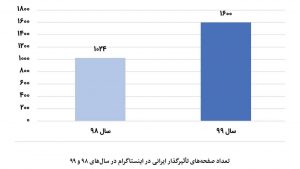
I want to take a look at the status of Instagram in the past year using the information from the article I mentioned. According to the research, the number of influential Persian Instagram pages has grown from 1024 to 1600 pages in the years 1398 to 1399. This means a 56% increase in influential Persian Instagram pages.
What is the criterion for measuring impact?
Number of followers (over five hundred thousand followers) and likes, which these pages receive from their audience.
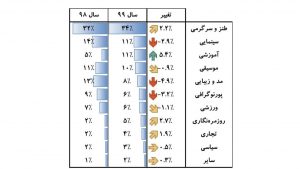
Based on this research, the content of Persian Instagram is also formed by the following categories: humor and entertainment, cinema, educational, music, fashion and beauty, pornography, sports, daily life, commercial and economic, political, etc. According to these categories, the highest changes and growth have been related to humor and entertainment and cinema pages, while pornography and fashion and beauty pages have had the least growth. In fact, the number of influential humor and entertainment pages has tripled compared to other influential pages such as cinema pages. Additionally, out of the top ten influential Iranian Instagram pages, nine of them belong to cinema celebrities and are still on top. Iranian Instagram, in addition to constantly being targeted by some political and media movements and even intellectuals, who claim that it always tends towards sensationalism or is used for insulting certain players, has shown in this one-year growth that Persian Instagram users have shown the most interest in pages related to education, learning, buying and selling, and laughing and making others
Furthermore, according to the mentioned research, the highest level of increase belongs to educational pages. Only five percent of influential Instagram pages are educational, and the share of these pages has increased to eleven percent in 1399 (2020). On the other hand, the highest decrease belongs to fashion, beauty, and pornography pages.
Of course, a part of this share is responsible for educating the issue of the widespread coronavirus.
Yes, you had a very accurate point. It is noteworthy that along with the peak of the pandemic, which led to the growth of the Zoom platform worldwide, the same focus shifted to Instagram in Iran. The mentioned study is related to the years 2019 and 2020. During this period, in addition to education, humor and entertainment also had a growth of about twenty percent. The mentioned education had a growth of five and four-tenths percent. Business had a growth of one and nine-tenths percent, and politics had a growth of half a percent. So it can be concluded that Instagram is practically a lifestyle application and not a political one. I have mentioned this example in another place as well. At one time, the “Bani Film” newspaper and “Film” magazine were the most important media outlets for Iranian cinema, but today, without a doubt, Instagram is our most important cinema media. Just as in the mentioned study, among the influential pages, Instagram
Instagram is the favorite app of young people. Although Instagram itself and social networks in general have negative effects that should be discussed with evidence and caution, at least in the past year, it has been free from the accusations against it. The type of damage that is attributed to it by official institutions and intellectuals is a biased, non-analytical, confrontational and denialistic damage.
Although you claim that these pathologies are biased, we are faced with a reality called influencers and virtual celebrities who promote an idealistic and exaggerated lifestyle. Some believe that these actions lead to the suppression and frustration of young people.
Let me give you an answer about some of the negative effects of social networks. For example, in American society, they have caused a decrease in face-to-face conversations among young people. They have also brought about a change in communication and writing language, and people on social networks communicate with each other using the language of that platform or application. I am also concerned in Iran about the loss of the Persian calligraphy on social networks. Another issue is that social networks lead to a decrease in self-confidence in face-to-face conversations or a decrease in critical thinking in society.
But when I compare all of these and other aspects to the benefits of social networks for an Iranian teenager and youth, I see that everything that is considered a flaw there can be seen as a virtue here. In the traditional culture that says because you are younger in age, you should sit and listen to the unjust words or superstitious beliefs of an individual who is only older than you, social networks have created a space where it can be said that these words are not scientific. It is true that social networks have all these negative effects, but the issue of geography and place of residence is also important. The criticism of social networks should also be indigenous.
Now the problem is that in Iran, social networks are a technology without methodology. No civil institution has enough determination to produce content on these networks. Based on global media and social networks, they can grow with the main element called excitement. Excitement in social networks is divided into these categories: fear, hatred, wonder, sorrow, joy, and anger. These are what give excitement to social network users. Essentially, social networks grow on these three pillars: pornography, fun and entertainment, and politics. Not because Iranian society has become political, but because politics or governance has entered all social spheres of Iranian society. It is the opposite equation. An equation that none of the Iranian intellectuals pay attention to. Iranian intellectuals are eager to say “I am a man!” The era of “I am a man” is over. Social networks have made everyone a man and everyone has the possibility of becoming a man. No longer can an Iranian intellectual use social networks for the model of intellectual-prophet.
Let’s also take a look at the pathology of Persian Instagram. One of these pathologies, for example, is following unknown friends. This means that before being a social media user, teenagers and young adults were exposed to society through classmates, teachers, parents, and older family members. The value structure was also vertical and hierarchical. These teenagers and young adults are now faced with an unknown friend on social media. This unknown friend can be a mixture of those influencers that the teenager and young adult likes. Influencers like Ali Karimi, Arash, or Navid Mohammadzadeh, who the audience wants to play football like, read like, or rebel like. Or they want to live like people who have a luxurious life. In fact, they are influenced by these combinations and choose that unknown friend as a role model. So what is this choice based on? It is partly a conflict, partly a personal vacuum, and partly a family vacuum.
The next point and harm is the added sense of superiority or inferiority. This means that when young people use social media, they often feel superior to others. They feel that there is no one around them who is smarter or more efficient than themselves. Here, this user has fallen into the trap of social media. I call it the “Google trap”. This is because (tolerating the word, of course) it can be said that the greatest prophet of the 21st century is “Google”. You can answer all the questions of the world with a simple search and fill your mouth with answers. When a 15-14 year old user finds a definite and mouth-filling answer from Google in front of a question that everyone in the family is discussing, they slowly distance themselves from that family because their needs are not met by that family, but by Google.
Actually, I wanted to address the issue of younger generations distancing themselves from older ones.
Yes, with the process I mentioned, the information needs of the 15-14 year old user are fulfilled by social networks and hashtags. When the information needs are fulfilled through this environment, emotional and social needs are also fulfilled. Gradually, their emotions become digital emotions. Because they follow Google. This following of Google even makes their worship and salvation digital. This feeling of superiority causes us to consider ourselves as our own elite. This leads to the use of social media and the internet, instead of turning the world into a village, it turns us into a scattered Algerian assembly. Everyone lives in their own pole and sees themselves as a pole; poles that are in conflicting, confrontational, and contradictory positions with each other.
This feeling of superiority that I mentioned has its opposite point. The opposite point is a feeling of overwhelming fear and terror. The same one that you mentioned as frustration and suppression. When one compares their computer, phone, and life’s possibilities with what they see on social media, and sees the dreamy world of influencers – which is not entirely real – they feel overwhelmed. Because they put themselves in a comparison with a huge difference.
In addition, there are also concerns and issues raised regarding the national calligraphy and worries about its potential changes.
Let’s pay attention to what has been said about Instagram and the active youth and teenagers on it.
But let me return to my initial argument. It was often said that social media leads to a decrease in social activity. However, in Iran, based on our native experience and unique way of life, do social media platforms actually decrease or increase social activity? This is where I mentioned that definitions are different in Iran.
Thank you for the time you have given to the peace line.
 Created By: Ali Kalaei
 July 23, 2021
Tags
45 Number 12345 Ali Kala'i Instagram Masoud Bastani Monthly Peace Line Magazine peace line Social networks The daily problems of today's youth. The problems of young people Youth پیمان صلح ماهنامه خط صلح ماهنامه خط صلح