


Right to Life

Execution through the #hashtag window/ Pooyan Khoshhal.
Iran is one of the countries that still widely uses the death penalty. This issue has always been accompanied by protests from human rights organizations. The important question is whether media pressure, including traditional and international media, as well as activism on social networks and launching hashtag campaigns, can be effective in stopping or canceling […]...
Read More Created By: Pooyan Khoshhal
 April 21, 2025
The necessity of educating adolescents and young adults about the harms of capital punishment / Arash Mohammadi
The death penalty, as one of the most severe and irreversible forms of punishment, has always been a subject of serious debate among legal scholars, sociologists, and human rights activists. In the Islamic Republic of Iran, execution has not only been a judicial tool, but also a political and ideological one, used in many cases […]...
Read More
Created By: Arash Mohammadi April 21, 2025
Reproduction of violence in the shadow of law/ Ehsan Haghani
Taking away someone’s life has always been considered a harsh, painful, irreversible, and irreparable punishment, and it is one of the tools that governments use to exert their power and control over members of society, and it continues to be used more and more. Killing humans by the hands of executioners, due to the momentary […]...
Read More
Created By: Ehsan Haghi April 21, 2025
Political executions in Iran, a tool for eliminating and suppressing protesters/ Reza Dehlavi
Execution is considered one of the most controversial forms of punishment in criminal systems around the world. After the advancement of civil society in different countries, the issue of executions has always been subject to moral, legal, and political criticisms. However, what has caused increased concern in recent years is the significant rise in “political […]...
Read More
Created By: Reza Dehlavi April 21, 2025
A Legal Response to the Arguments of Execution Defenders / Sina Yousefi
The death penalty is one of the most controversial topics in contemporary criminal law. Despite the global trend towards limiting and abolishing it, it is still used in some countries – especially in cases of serious crimes. In some countries, it is also used as a political tool not only to combat crime, but also […]...
Read More
Created By: Sina Yousefi April 21, 2025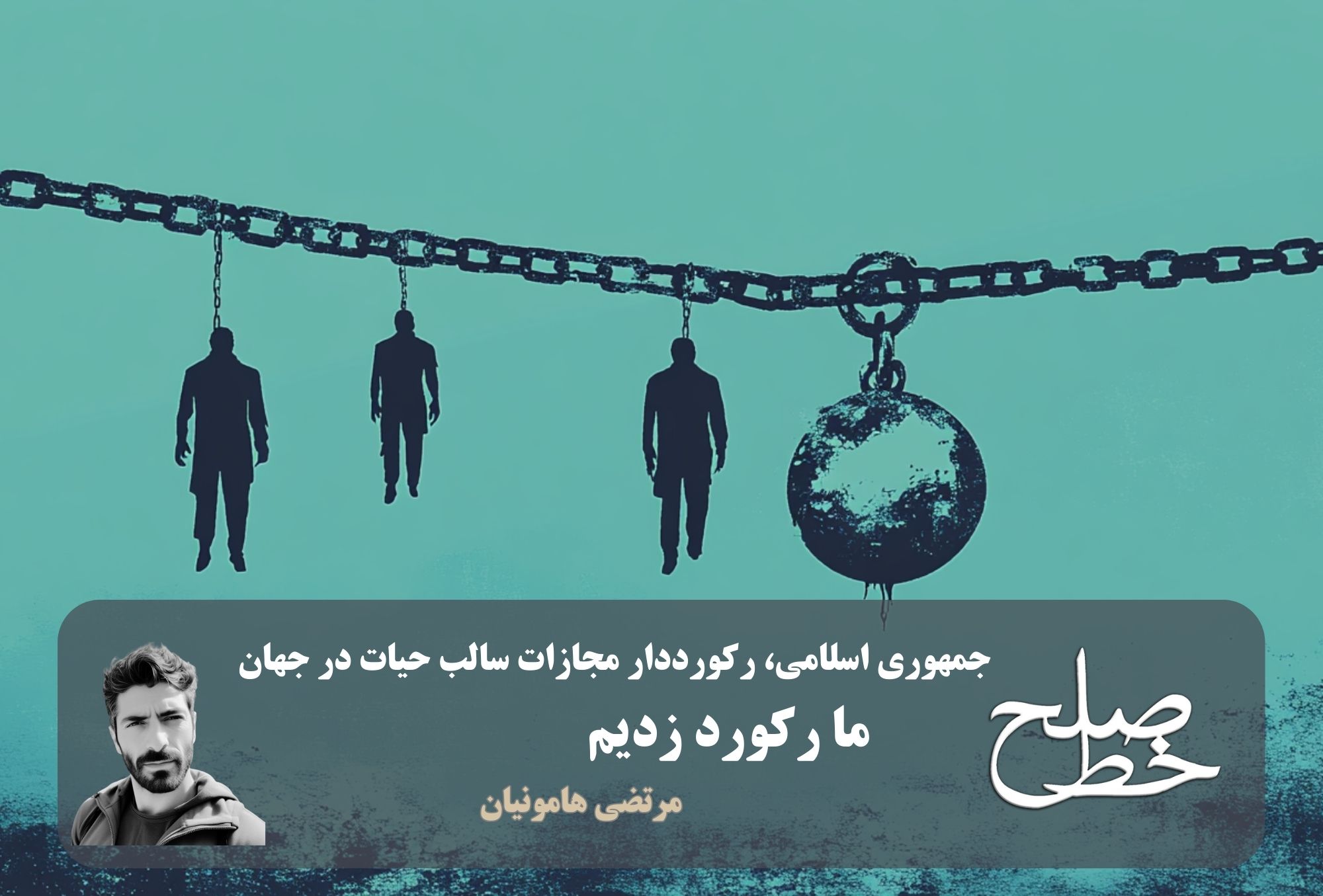
Islamic Republic, record holder of capital punishment in the world / Morteza Hamounian
In the month of Khordad 1391 (June 2012), the leader of the Islamic Republic of Iran said in a ceremony commemorating the anniversary of the establishment of the ruling system in Iran: “We have set a record.” The reality is that he was right; even before that time, the Islamic Republic was one of the […]...
Read More
Created By: Morteza Hamounian April 21, 2025
The execution of parents, a complicated mourning under the shadow of collective unawareness of children’s rights / Hamed Farmand
Usually, from the moment the accusation against a parent becomes clear, or even from the moment of arrest and being charged with a crime, the mourning of the child and the family of the arrested person begins. This mourning, which can take the form of prolonged grief, becomes complicated grief as the trial process drags […]...
Read More Created By: Hamed Farmand April 21, 2025
Execution in Numbers / Alireza Goodarzi
In 2024, Amnesty International recorded a total of 1518 executions in 15 countries, which was 32% higher than in 2023. This statistic does not include the number of executions in China, as the number of executions in China is confidential. Obtaining statistics from other countries such as North Korea and Vietnam has also been difficult, […]...
Read More
Created By: Alireza Goodarzi April 21, 2025
Execution in the Islamic Republic; Symbolic Violence and Reproduction of Power/ Raha Sabat Sarvestani
In recent years, the significant increase in laws and executions in Iran, especially after the recent nationwide protests, has raised deep questions about the social, political, and ideological function of this punishment in the Islamic Republic. This essay seeks to analyze execution not only as a means of criminal punishment, but also as a mechanism […]...
Read More
Created By: Raha Sabet Sarvestani April 21, 2025
Execution as a policy/ Ahmad Alavi
Based on the recent report by Amnesty International (published on April 8, 2025), (1) the Islamic Republic, with a minimum of 972 executions, accounts for more than 64% of all recorded executions in the world. This figure puts the regime ruling over Iran in the first place among the countries carrying out executions in the […]...
Read More
Created By: Ahmad Alavi April 21, 2025
Protecting lives is the duty of the government / Mohammad Hadi Jafarpour
Based on the evidence remaining from ancient times, what has always been a fundamental and eternal question and challenge for humanity is human rights, especially in the form of natural and fundamental rights, namely the “right to life”. The embodiment and tangible manifestation of this right has been the source of other human rights, which […]...
Read More
Created By: Mohammad Hadi Jafarpour April 21, 2025
Historical Evolution and Contemporary Challenges of Qisas in Law/ Mostafa Ahmadian
The essence of qisas (retributive justice) has long been based on a natural law: “You kill, you are killed; an eye for an eye, and a tooth for a tooth.” This well-known principle existed long before the emergence of Abrahamic religions. Historical stone carvings—including the Code of Hammurabi, which dates back to 1800 BCE and […]...
Read More
Created By: Mustafa Ahmadian January 20, 2025
