


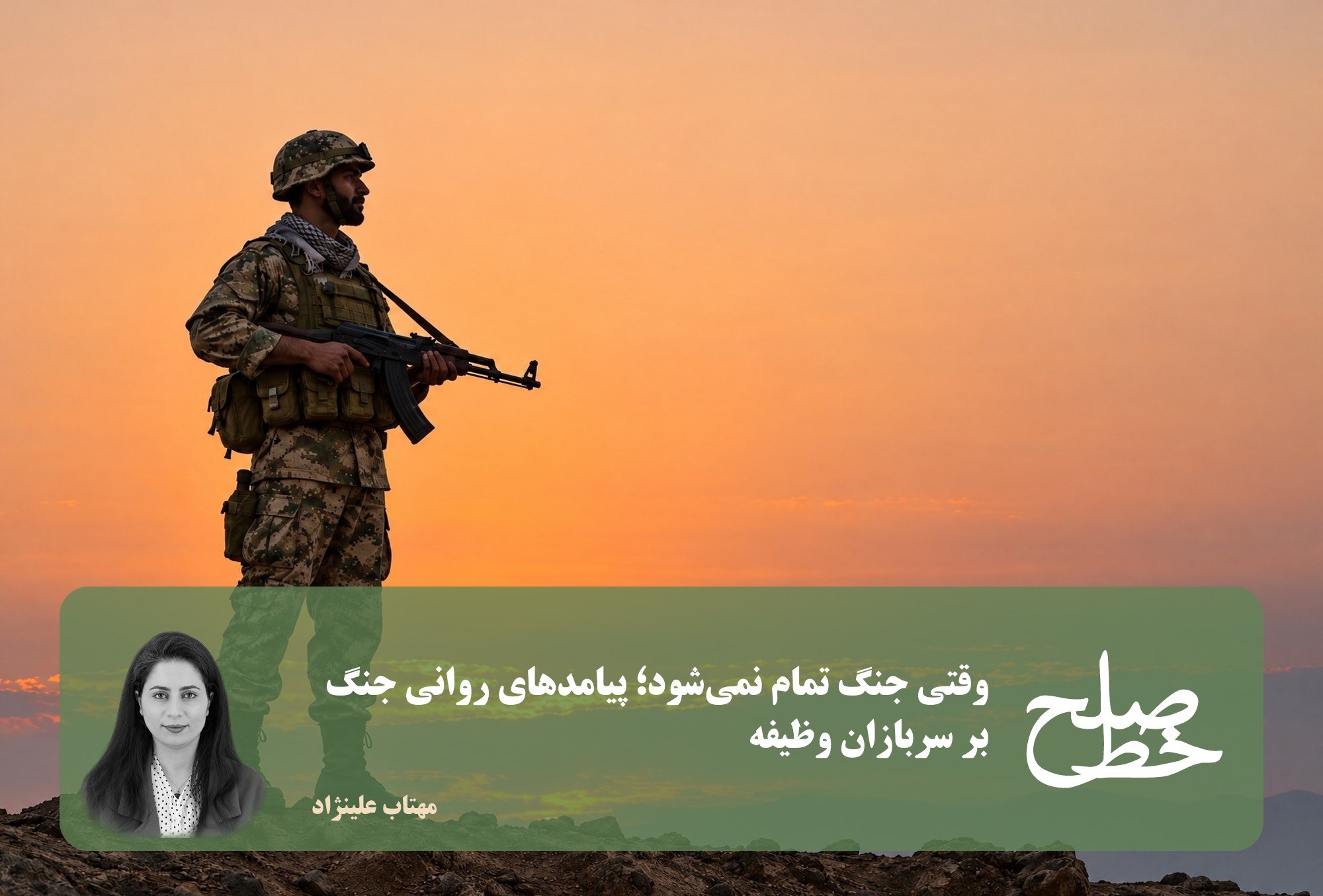
When the War Does Not End: The Psychological Consequences of War for Conscripts / Mahtab Alinejad
In official narratives of war, the focus is usually on victory and defeat, advances and retreats, the dead and the wounded, and military losses. Yet within these accounts there is a human reality that receives less attention: the psychological fate of soldiers who may have gone to the battlefield not by personal choice, but due to legal compulsion, social pressures, or political and military circumstances.
A conscript, before being a military force, is a citizen who places some of the most important years of his life at the disposal of the military structure. In wartime, this can be accompanied by a harrowing experience: exposure to death, witnessing comrades being killed, confronting bodies, fear of capture, injury and disability, and living under conditions that could end at any moment.
But the consequences of such an experience do not necessarily disappear with the end of the war or the completion of military service. For some, the war continues even after returning home: in nightmares, anxieties, intrusive memories, damaged relationships, and a constant sense of insecurity. For this reason, examining the psychological consequences of war for conscripts is not merely a medical matter; it is directly connected to human rights, states’ responsibilities, and people’s right to mental health.
Fear of death is one of the most natural human reactions. However, when a person lives for a long time in an environment where the risk of death is real and unpredictable, this fear can shift from a natural, temporary reaction to an exhausting condition.
For a conscript—especially someone with limited military experience and insufficient psychological readiness to face wartime violence—being on the battlefield can mean living in a state of constant alert. The sound of explosions, witnessing attacks, waiting to be sent to high-risk areas, and not knowing the fate of friends and family keep the nervous system in a state of ongoing tension and arousal. In such circumstances, even when there is no immediate danger, a person may be unable to feel safe. Sleep disturbance, heart palpitations, irritability, fear of sudden noises, and difficulty concentrating are among the reactions that may develop after such an experience.
It should be noted that being afraid in war is not a sign of weak character or a lack of courage. Fear is a natural response to a real threat. Turning this human reaction into something shameful and attaching labels such as “cowardly” or “lacking a soldier’s spirit” only leads to problems being concealed and psychological harm being intensified.
Moreover, war does not only expose the human body to injury; it also places the mind and nervous system under pressure. Prolonged exposure to threat, sleeplessness, insecurity, and lack of control over one’s living conditions can lead to persistent anxiety. This anxiety may manifest as constant worry, restlessness, pessimism about the future, a sense of insecurity, sleep disturbance, and difficulty forming social relationships.
For a conscript, specific conditions such as forced separation from family, limited contact with loved ones, lack of choice over posting and missions, and a sense of powerlessness in controlling one’s personal fate can intensify this situation. Even after returning, problems do not necessarily end. Some people cannot return to ordinary life, education, employment, and their previous relationships. At times, the gap between the harrowing experience of war and society’s expectations of someone who has returned home itself becomes a factor that deepens isolation.
In its 2025 report on mental health in emergencies, the World Health Organization stated that about 22% of people who have experienced war or conflict in the past decade face a mental disorder such as depression, anxiety, or post-traumatic stress disorder. (1) This figure relates to conflict-affected populations and should not be taken as the prevalence of mental disorders among conscripts. Nevertheless, it shows that the psychological effects of war can continue to affect a large share of affected populations for years after the fighting ends.
In examining soldiers’ mental health, there is another point that should not be overlooked: not all psychological problems necessarily arise after entering the military environment or as a result of exposure to war. Some individuals may have faced problems such as depression, anxiety, or other mental disorders before beginning military service—problems that can be exacerbated in the high-stress military setting, especially during wartime.
In a large study of 5,428 nondeployed US Army soldiers, 25.1% of participants met diagnostic criteria for at least one mental disorder in the 30 days prior to assessment. In addition, 76.6% of those who had a mental disorder at the time of assessment reported that at least one of their disorders had begun before entering military service. (2)
This finding highlights the importance of assessing mental health before service begins and providing ongoing support during service. In systems of compulsory conscription, this is even more important, as individuals may enter an environment whose psychological pressures far exceed ordinary life experiences without sufficient psychological readiness and without access to appropriate therapeutic support.
Of course, this study was conducted on nondeployed US Army soldiers and is not directly about conscripts or people on the battlefield. Its relevance to the present discussion is that it demonstrates the need to distinguish pre-existing mental health problems from harms that arise during service or as a result of exposure to war. Identifying these problems and preventing their worsening should be part of the responsibility of military institutions and governments.
One of the most important psychological consequences of exposure to war is post-traumatic stress disorder, or PTSD. This disorder may develop after directly experiencing a threat of death, severe injury, witnessing the death of others, or exposure to violent events. However, not everyone exposed to war necessarily develops PTSD, and experiencing fear, anxiety, or nightmares alone is not sufficient for diagnosis.
This disorder can involve the unwanted return of war memories, nightmares, intrusive mental images, and a sense of reliving the event. Some people avoid places, sounds, people, or even conversations that remind them of the past in order to keep away from painful memories. Constant hypervigilance, sleep disturbance, irritability, and an intense reaction to sudden noises are among its other possible signs. Alongside these, negative changes in mood and thinking, feelings of guilt and shame, distrust, hopelessness, a sense of alienation, and reduced interest in everyday life may also appear.
One important dimension of war-related psychological harm is survivor guilt. A soldier who has witnessed friends being killed and has survived may repeatedly ask why he lived while others died. Some also struggle with guilt and moral conflict due to being unable to save comrades or participating in violent events.
In this context, the concept of “moral injury” (Moral Injury) is also important. Moral injury is raised when a person is exposed to events that conflict with their deep moral beliefs and values—such as witnessing violence against civilians, being unable to prevent harm to others, or feeling betrayed by people they trusted. Such an experience can be accompanied by shame, anger, guilt, and a loss of trust in oneself and others. Moral injury is not necessarily the same as a PTSD diagnosis. (3)
When War Returns to Private Life
One of the less visible consequences of war is its impact on emotional relationships and on the ability of soldiers returning from war to form and maintain relationships with others. Ongoing experiences of fear, violence, loss, and insecurity can affect a person’s emotional capacity and make it difficult to express feelings, trust, and build intimacy with an intimate partner. (4)
Some of these individuals, after returning, face tension in their relationships due to irritability, sudden anger, constant hypervigilance, or nighttime nightmares. Others retreat into isolation and silence, avoiding talking about their experiences or even distancing themselves from emotional closeness. Guilt over surviving, grief over losing friends, and fear of events recurring may also affect the quality of romantic relationships and married life.
In such circumstances, the person’s partner may also face confusion, feelings of rejection, psychological exhaustion, and an inability to understand the changes in their behavior. In this way, the psychological harm of war extends beyond the individual and finds its way into family and emotional relationships as well.
Research on military personnel and veterans has shown that PTSD symptoms—especially emotional avoidance and emotional numbing—can be associated with problems of intimacy and satisfaction in family and marital relationships. These harms may even affect sexual relationships. Reduced sexual desire, difficulty experiencing physical intimacy, anxiety during sex, and an inability to be mentally and emotionally present in the relationship are among the problems reported in some people with a history of trauma.
However, responsibility for an affected person’s psychological recovery should not be placed on the shoulders of their partner or family. The family can be a source of support, but it is not a substitute for specialized treatment. Rebuilding these relationships requires time, psychological safety, nonjudgmental conversation, and in many cases access to individual psychotherapy and couples therapy.
War may remove a soldier from the battlefield, but it can also affect—sometimes for a long time—their ability to love, trust, and experience calm in an intimate relationship.
Another of the most concerning dimensions of the psychological consequences of war is the increased vulnerability of some soldiers and survivors to suicidal thoughts and behaviors. Experiences of severe violence, PTSD, depression, guilt, social isolation, economic problems, and difficulty returning to ordinary life can together increase the risk of suicide.
Of course, war or presence in an operational zone alone does not mean a definite increase in suicide risk for everyone. The type of experience, the intensity of exposure to violence, prior mental health status, social support, and access to treatment services all play a role in the degree of vulnerability.
In a study on factors associated with suicidal ideation among 1,329 Iranian soldiers, it was found that psychological factors, family history and circumstances, environmental and military-duty-related problems, and demographic factors had a significant association with suicidal ideation. (5) This study underscores the importance of paying attention to soldiers’ living conditions and service environment alongside their individual psychological state.
In another study, the relationship between exposure to combat conditions and suicide-related thoughts and behaviors among military personnel and veterans was examined. The results of this systematic review and meta-analysis showed that certain types of exposure to wartime violence—especially experiencing killing and severe violent events—are associated with increased psychological vulnerability. (6)
For conscripts, the issue may be more complex, because they sometimes enter the military structure without sufficient readiness and, after completing service, do not receive sustained psychological support. In some cases, family pressures, unemployment, economic problems, and an inability to explain wartime experiences can intensify vulnerability.
Suicidal thoughts should not be attributed to weak will, ingratitude, or an inability to adapt to life. These thoughts can be a sign of a serious crisis that requires immediate attention, humane support, and specialized intervention.
What We Know About Soldiers—and What We Still Do Not Know
Access to mental health services alone is not sufficient to support soldiers. Many people, even while aware of their mental health problems, avoid seeking treatment for social and organizational reasons. One major barrier in this area is the social stigma associated with mental disorders.
In a study on the mental health status of US military forces after deployment to Iraq and Afghanistan, it was found that only about 23% to 40% of those who showed symptoms of mental disorders in screening had sought mental health services. Concern about social stigma and barriers to receiving care was also higher among those with symptoms of a mental disorder. (7)
This finding shows that fear of being accused of psychological weakness, concern about the impact of seeing a psychologist on one’s military and job position, and distrust in the confidentiality of medical information can be serious barriers to treatment. For conscripts, such concerns may also be accompanied by fear of inappropriate treatment by military officials or administrative consequences. Therefore, providing free treatment services alone is not enough. These services must be confidential, independent, accessible, and free of any discrimination. A soldier must be assured that seeking psychological help is neither a sign of weakness nor a pretext for deprivation of rights or punitive treatment.
Of course, the cited study (7) was conducted among US military forces, and its percentages cannot be directly generalized to conscripts in Iran or other countries. Its importance lies in highlighting one human and organizational barrier to receiving treatment—one that requires independent examination in different conscription systems.
In fact, one major limitation in examining the psychological consequences of war is that a significant portion of well-known international research has focused on professional military forces, deployed soldiers, and veterans in countries such as the United States. (2) and (7)
These studies are scientifically valuable for understanding mechanisms of psychological harm, risk factors, and barriers to treatment; however, their study populations differ from conscripts in Iran and many other countries in terms of military structure, recruitment and deployment conditions, organizational culture, health system, and social characteristics. Therefore, the statistics and percentages obtained from these studies cannot be generalized to conscripts in other countries without comparative research and attention to local conditions.
In Iran, too, studies have been conducted on the mental health of soldiers and the families of people harmed by war; therefore, the claim of an absolute lack of research in this area is not accurate. For example, in a study of the mental health of 930 conscripts during basic military training in Guilan Province, it was found that 35.2% of participants were in the group at probable risk of mental health problems, and symptoms such as anxiety, insomnia, impaired social functioning, and depression were reported. However, this study was not about soldiers on the battlefield, and its results cannot be considered equivalent to the level of war-related psychological harm. (8)
Another study in 2014 examined the mental health of spouses of Iran–Iraq war veterans with PTSD. The results showed that, compared to the control group, spouses of veterans with PTSD had more problems in general health, anxiety, insomnia, and depression. This study highlights the importance of paying attention to families, but its limited sample size—80 people—does not allow broad generalization of the results. (9)
A systematic review on the mental health of Iran’s military forces was also published in 2018. This review indicates a limited number of eligible studies and a lack of research that directly examines the prevalence of mental disorders in military forces. (10)
Therefore, the main issue is not an absolute lack of research, but rather the limitations of available data, the scattered nature of studies, and the absence of comprehensive and sustained assessments. Especially regarding conscripts who are present in contemporary wars, their mental health status before deployment, during war, and after return—as well as the consequences of this experience for spouses, parents, children, and other family members—still requires broader and independent research.
In many cases, reliable public information on the prevalence of PTSD, depression, chronic anxiety, suicidal ideation, and family-relationship problems among conscripts is not available. The absence of transparent statistics and long-term follow-up makes prevention and treatment planning difficult and may keep a large portion of psychological harms hidden from society and responsible institutions. This research gap is itself a human rights issue, because without identifying, recording, and examining harms, the possibility of effective advocacy and holding responsible institutions accountable is also limited.
Despite political, cultural, religious, and social differences among countries, some human psychological reactions to threat, violence, loss, and insecurity are rooted in shared human characteristics. Fear of death, the need for security, grief over losing loved ones, anxiety about an unknown future, loneliness, the need for belonging and affection, and efforts to preserve dignity and personal identity are not experiences that belong to a particular nationality or religion.
Human beings, regardless of which country they live in, need physical and psychological security, emotional connection, social support, and a sense of control over their lives. Exposure to the threat of death, witnessing violence, losing friends, and experiencing powerlessness to change conditions can affect these fundamental needs in any person.
From this perspective, some psychological mechanisms of war can be examined as shared experiences among soldiers in different countries; for example, fear responses to danger, grief from loss, hypervigilance after experiencing threat, the unwanted return of memories, and difficulty trusting and forming intimacy after experiencing violence.
However, shared human mechanisms do not mean that experiences or the consequences of war are the same. The severity of harm, how symptoms manifest, the possibility of speaking about mental health problems, society’s attitudes toward injured soldiers, family structure, cultural beliefs, and access to treatment services can differ across countries. Therefore, shared human characteristics should be the starting point for comparative research, not a substitute for local and scientific study.
A soldier in Iran, Ukraine, the United States, or any other country may feel grief and helplessness when faced with the death of comrades; but whether they can express these feelings, seek help from family, see a psychologist, or receive social support depends on the cultural and structural conditions of the society in which they live.
Attention to these shared human dimensions makes it possible to have a conversation that goes beyond political and national borders. Soldiers’ mental health should not become an issue confined to one nation or one army; rather, it should be regarded as part of a global concern for human dignity, the right to life, and the right to health.
The End of War and the Beginning of Society’s Responsibility
One common mistake in addressing the consequences of war is limiting responsibility for supporting soldiers to the period of their military service. Yet the human and social responsibility for these individuals’ mental health does not end with the end of a mission or discharge from service.
A soldier returning from the battlefield may appear physically healthy, yet live with harms that are not visible in routine medical examinations. For this reason, governments and responsible institutions must regard psychological support for soldiers as part of their obligations—support that should not be limited merely to short-term screenings or the formal registration of harms.
This responsibility begins before service starts and must continue for years after return. Psychological assessment before and after service is necessary both to identify pre-existing vulnerabilities and to examine psychological changes after exposure to war. Soldiers must have access to free and confidential mental health services and be able to speak about their problems without fear of punishment, deprivation, or social stigma.
Alongside these, access to specialized treatment for PTSD and other trauma-related disorders—including evidence-based psychotherapies and psychiatric services when needed—is important. Returning to education, employment, and social life should also be accompanied by support programs, because economic problems, unemployment, and social isolation can make the process of returning to ordinary life more difficult.
On the other hand, establishing independent mechanisms to record and examine harms is essential. Statistics on suicide, mental disorders, and war-related harms should be published transparently while respecting confidentiality. Soldiers’ families should not be excluded from these supports either, because they may face the psychological consequences of war and need training and support to adapt to new conditions.
These supports should not stop with the end of service or a few initial counseling sessions. Some mental disorders may emerge months or even years after the experience of war. For this reason, long-term follow-up of mental health and enabling independent and accessible research in universities and research centers are important. Long-term studies on the mental health of conscripts and their families can help better understand the dimensions of these harms and design preventive and therapeutic programs.
The issue of conscripts’ psychological harms cannot be examined solely within a medical and therapeutic framework. It is directly connected to fundamental human rights. The right to health, personal security, human dignity, and access to treatment services are not rights that disappear when a person enters the military structure. Even in wartime, people are not deprived of their fundamental rights.
In systems where compulsory service exists, the need to attend to conscripts’ vulnerability becomes more important. When a person has limited choice in entering the military structure, their place of service, or the conditions of participation in war, the responsibility of decision-making institutions for their health and security must also be examined more seriously.
Governments cannot, on the one hand, compel citizens to perform military service and, on the other, leave the physical and psychological consequences of that service after it ends to individuals and their families. From a human rights perspective, access to treatment services, protection against humiliating behavior and violence, preservation of human dignity, and effective mechanisms for reporting violations are among the issues that must be considered in policymaking related to soldiers.
It should not be forgotten that a conscript, before being a matter of military planning, is a human being with the right to life, health, choice, security, and a future. War cannot be measured only by the number of the dead and wounded. Part of its costs remain in the lives of those who return alive, yet may never again be the same person they were before the war. The soldier who wakes at night from nightmares, the one who is terrified by the sound of an explosion or even a door slamming, or the person who still cannot speak about what they saw years after service ends—all reveal part of the human reality of war.
The consequences of war are not limited to a soldier’s mind and body; they can spread to emotional relationships, married life, family, education, employment, and a person’s ability to build a secure future. As a result, the cost of war is sometimes paid years after the fighting ends, in the personal and social lives of survivors.
If society mourns only for the dead and asks survivors to remain silent, it has ignored an important part of the truth of war. Paying attention to conscripts’ mental health is neither pity nor a special privilege; it is recognition of human dignity and a social responsibility. No one should be deprived of the right to psychological support and treatment because they performed military duty. Perhaps the most important question is not how a soldier should cope with war, but why society and political and military structures, after exposing people to such experiences, leave responsibility for the consequences to them and their families. War may end on countries’ political calendars, but as long as its victims are left without support and treatment, the human consequences of war continue.
Footnotes:
1. World Health Organization. (2025, May 6). Mental health in emergencies.
2. Kessler, R. C., Heeringa, S. G., Stein, M. B., Colpe, L. J., Fullerton, C. S., Hwang, I., Naifeh, J. A., Nock, M. K., Petukhova, M., Sampson, N. A., Schoenbaum, M., Zaslavsky, A. M., & Ursano, R. J. (2014). Thirty-day prevalence of DSM-IV mental disorders among nondeployed soldiers in the US Army: Results from the Army Study to Assess Risk and Resilience in Servicemembers (Army STARRS). JAMA Psychiatry, 71(5), 504–513.
3. Beech, E. H., Mackey, K. M., Parr, N. J., Baltich Nelson, B., Young, S., & Belsher, B. E. (2024). Moral injury and mental health among US military service members and veterans: A systematic review and evidence overview. U.S. Department of Veterans Affairs.
4. Birkley, E. L., Eckhardt, C. I., & Dykstra, R. E. (2016). Posttraumatic stress disorder symptoms, intimate partner violence, and relationship functioning: A meta-analytic review. Journal of Traumatic Stress, 29(5), 397–405.
5. Anisi, J., Majdian, M., & Mirzamani, S. M. (2010). The factors associated with suicide ideation in Iranian soldiers. Iranian Journal of Psychiatry, 5(3), 97–101.
6. Bryan, C. J., Griffith, J. E., Pace, B. T., Hinkson, K., Bryan, A. O., Clemans, T. A., & Imel, Z. E. (2015). Combat exposure and risk for suicidal thoughts and behaviors among military personnel and veterans: A systematic review and meta-analysis. Suicide and Life-Threatening Behavior, 45(5), 633–649.
7. Hoge, C. W., Castro, C. A., Messer, S. C., McGurk, D., Cotting, D. I., & Koffman, R. L. (2004). Combat duty in Iraq and Afghanistan, mental health problems, and barriers to care. The New England Journal of Medicine, 351(1), 13–22.
8. Kivehee, E., & Jalali, H. (2014). Mental health screening of Iranian conscripts during basic military training in Guilan province. Annals of Military and Health Sciences Research, 12(3), Article e63275.
9. Taghva, A., Dabbaghi, P., Shafighi, S., Mortazaviha, S. M. A., & Donyavi, V. (2014). Mental health in spouses of Iraq-Iran war veterans with PTSD. Journal of Archives in Military Medicine, 2(1), Article e17010.
10. Bourbour, V., Moeeni, F., & Taheri, N. (2018). Mental health assessment in Iranian military forces: A systematic review [Conference abstract].
 By: Mahtab Alinezhad
 November 22, 2026
Tags
Mehrab Alinejad peace line Peace Line Monthly Peace Mark 187