


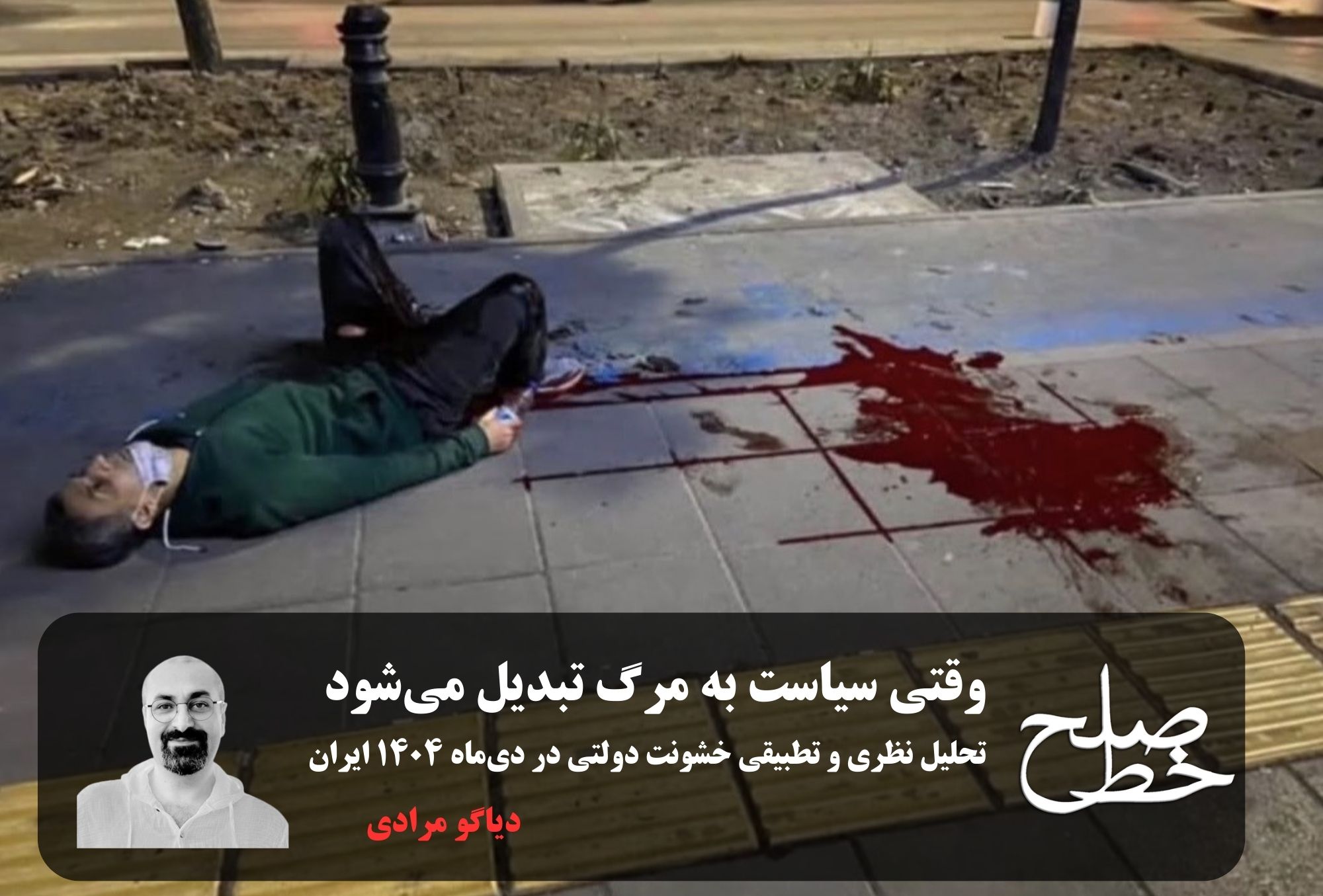
When Politics Turns into Death/Diako Moradi
Introduction: The Problem of State Violence in an Era of Collapsed Legitimacy
In the classical tradition of political science, state violence was often analyzed as an exceptional means of containing crisis and restoring order, something that made sense in the context of Weber’s “legitimate monopoly of violence.” In this view, legitimacy was not only a condition for the possibility of violence, but also a horizon within which violence was to be seen as limited, justifiable, and ultimately “returnable” to the legal order. However, in recent decades, and especially in states facing the erosion of political representation, a crisis of efficacy, and the collapse of social trust capital, the classical model has lost its ability to explain a phenomenon that could be called the “normalization of deadly violence”: violence that no longer functions as a temporary response but as an alternative formulation of politics.
Here the point of entry of theory becomes important. Michel Foucault showed with the concept of biopolitics that modern power does not operate only in the form of law and naked repression; it is exercised through the management of bodies, populations, health and the biological order of society. Rather than simply “killing”, the modern state seeks to “manage”: to produce, regulate, care for, and normalize. But this very logic of life management carries an internal possibility of inversion; for if the state fails to create consent or contain crisis through the “management of life”, the same disciplinary and security networks can become mechanisms for deciding about death.
Giorgio Agamben translates this inversion into more precise legal-political language with the concept of the “state of exception.” Instead of briefly suspending the law in times of emergency, modern states can turn the exception into the rule, in such a way that the boundary between law and lawlessness is blurred. In such a situation, the citizen is reduced to “bare life”: a life that can be killed without the killing necessarily being established as a crime, because violence operates within a legal-security gray area. The “legalization of the suspension of the law” is the point at which the possibility of mass killing is explained not as a deviation but as a logical product of security governance.
Achille Mbembe takes this logic a step further with the concept of Necropolitics: in some regimes and political spaces, the issue is no longer the management of life, but the governance of the distribution of death; deciding who should die, which deaths are “narrable” and “mournable,” and which deaths should be rendered nameless, invisible, and ineffective. Necropolitics elevates violence from the level of a tool to the level of an “art of governance”: it produces fear, consolidates obedience, and transforms politics into silence.
In addition, Hannah Arendt makes a crucial distinction: violence should not be equated with power. Power, for Arendt, is the capacity for collective action based on consent; and violence appears precisely when real power collapses. Thus, widespread recourse to violence is not a sign of authority, but of a crisis of legitimacy and an inability to produce consent. Violence can impose obedience, but it cannot create legitimacy; and this creates a cycle in which the state is forced to resort to more violence to maintain control.
By juxtaposing these four theoretical horizons, contemporary state violence is understood not as a response to a crisis but as a logic of governance in an era of collapsing legitimacy: a governance that relies on suspension, intimidation, death, and the erasure of memory, rather than dialogue and law. In such a logic, the symbolization of killing is decisive: death is not just physical elimination; it is the message. And this message is usually complemented by “postmortem management”: denial, concealment, threats to families, securitization of mourning, and erosion of truth.
The protests and repression of the winter of 2015 in Iran—described in many reports as the most severe wave of state violence in recent decades—can be analyzed in this context. Human rights reports speak of a pattern of lethal shooting. At the same time, official institutions and reputable media outlets have pointed to a serious discrepancy over the number of victims; the government provides much lower figures, while field-investigative reports suggest the possibility of much higher figures—including an investigative report by the Guardian, which relies on a network of testimonies from medical and related personnel and suggests that the death toll could be in the tens of thousands. This statistical contradiction is not an incidental matter in the logic of death politics; it is part of the process itself: “killing” is completed by “making it impossible to register” and “suspending the truth.”
Introduction: From Security Repression to “Murder as Politics” »
This article proceeds with the question of when repression moves beyond the logic of deterrence and approaches the logic of death politics. The answer lies not in a “tipping point” but in a multi-stage process: first, the securitization of protest as an existential threat; then the practical suspension of legal norms and the creation of a state of exception; then the normalization of deadly violence and its extension to areas beyond the street (treatment, burial, mourning); and finally the management of the aftermath through denial and the engineering of memory.
This article, using a qualitative-analytical method and relying on reliable secondary data (human rights institutions, reliable international media, UN documents), attempts to show why what happened in Iran in January 1404 cannot be simply called a “security incident” or “the peak of repression,” but rather should be analyzed within the broader horizon of modern massacres and the politics of denial. Furthermore, by comparing Iran with Srebrenica, Myanmar, and Rojava, the article shows how similar logics (othering, suspension of law, management of death, management of memory) are activated in different contexts—without reducing these cases to simplistic assimilation.
Analytical Framework: From State of Exception to Death Politics and Collective Trauma
The analytical framework of this article is based on three pillars: (1) state of exception, (2) death politics, and (3) collective/cultural trauma. These three concepts, in conjunction with each other, allow us to analyze contemporary state violence not only at the level of the event, but also at the level of the rationality of governance.
First, the state of exception: that gray area in which the use of lethal force is simultaneously “security” and “legal.” Documents and statements from UN institutions show that the repression of the winter of 1404 was characterized by widespread deaths, mass arrests, and allegations of serious human rights violations; to the extent that the UN Human Rights Council in January 2026 spoke of “the deaths of thousands” and the need for urgent investigations that could be used in future legal proceedings, and extended the mandate of investigative mechanisms. This institutional language is precisely the sign of entering a realm in which “suspension of the norm” becomes a mechanism of governance.
Second, death politics: where death becomes not an unintended consequence but a political tool. Human rights organizations have reported a “coordinated increase in the use of lethal force” since mid-January, with patterns such as gunshots to the head and torso. At this level, deadly violence becomes the “language of politics”: defining the boundaries of protest with death, and redefining the state-society relationship through fear.
Third, collective trauma: Deadly violence, when combined with denial and suppression of mourning, intrudes into the realm of collective memory and identity. The Guardian’s investigative report speaks of testimonies related to the concealment of bodies, hasty/mass burials, and fear of going to hospital. These are not just “details”; they are the building blocks of collective trauma, as they deprive society of three possibilities: healing, mourning, and narrative.
January 1404 in Iran: Massacre as a Process; From Information Blinding to Post-Massacre Management
The events of January 1404 cannot be reduced to a few “security incidents.” What is reflected in credible reports is a picture of a multi-layered process: disruption of the flow of information, the use of deadly force on an urban scale, the insecurity of the rescue chain, and then the management of the aftermath through denial and threats to families. Human Rights Watch has spoken frankly of “mass killings” and patterns of the use of deadly force. The Human Rights Council also mentions the deaths of “thousands” of people and the arrests of “thousands” of people following the protests that began on December 28, 2025.
But perhaps the most important sign of the entry into the realm of death politics is not just street violence, but also “postmortem management”: the fight over figures, the cover-up, the pressure on families and the engineering of memory. In an investigative report, the Guardian, relying on testimonies from medical and related staff, speaks of the possibility of a huge gap between official statistics and the reality on the ground, and points to phenomena such as the secret transfer of bodies, hasty burials and removal from official records. This is where death politics comes to fruition: the state does not just kill, but also tries to “neutralize” death; that is, to empty it of mourning, narrative and memory.
The disagreement over the number of victims here is not reducible to a mere methodological issue. In the logic of death politics, the disagreement over numbers is part of politics: the truth must be eroded to make accountability impossible. Credible media reports have pointed to the existence of such a gap (from the official figure of a few thousand to much higher claims in investigative reports and witness networks). The present article, without establishing a definitive figure (which would require field research and independent access), analyzes this gap itself as a “truth-contested arena.”
The scenario of using foreign proxy forces in Iran and the logic of “denial”
Introduction: Why “scenario” and why “denial”?
The discussion of the “foreign proxy scenario” in the context of Iran is not, in the first place, a positive discussion of “certainty,” but rather an analysis of the logic of governance in conditions of legitimacy crisis; that is, the question of what techniques governments (or power blocs within the state) employ to both maintain control and eliminate denial of responsibility at moments when the political cost of direct repression rises and at the same time the need for lethal violence remains. In the literature on politics and security, one of the concepts used precisely for this situation is “denialism”: the ability to construct an operational chain in such a way that, if exposed, higher-ups can deny responsibility or shift it to lower levels/third-party actors.
This logic is not limited to intelligence operations. In many internal crises, dominant states or coalitions use “proxies”—militia, local armed groups, foreign mercenaries, or informal security networks—to inflict violence, reduce its moral and political cost, and, if necessary, obscure the field of accountability. Such a strategy becomes a key tool in the transition from “repression” to “death politics,” especially at moments when the state-society divide deepens.
The Darfur Model: Outsourcing Violence and Formal Separation of Responsibility
Darfur is a classic example of the outsourcing of violence: where UN reports have documented joint attacks by government forces and militias on civilians and widespread human rights abuses. Darfur is significant because it demonstrates that the state can organize violence in a “fluid coalition” between the formal structure and the informal arm, in a way that both increases operational capacity and reinforces deniability. The UN Security Council also specifically called on the Sudanese government in 2004 to disarm the Janjaweed militia—an institutional acknowledgement that a aligned militia force has taken on a central role in the violence.
From a theoretical perspective, Darfur is a “workshop” for understanding the relationship between death politics and denial: killing is not simply the result of “disorder,” but the result of an architecture of power in which the state, by relying on informal arms, both makes violence more effective and grays the boundaries of responsibility. This is precisely where Agamben’s concept of the “state of exception” intersects with Mbombela’s concept of “death politics”: law-accountability is suspended, and death becomes an instrument of governance, but at the operational level, the “agent” is displaceable and sacrificial.
The Libya 2011 Model: Foreign Mercenaries and the Restructuring of the Costs of Repression
In Libya in 2011, one of the prominent topics in credible media reports was the use of foreign mercenaries by the Gaddafi regime to combat protests and civil war. Reuters reports at the time cited accounts from witnesses and human rights groups of the presence of fighters from African countries and the detention of a number of them. Reuters also quoted in September 2011 that officials from the Libyan Transitional Council had said that the Gaddafi regime had “used foreign mercenaries to kill Libyans.”
Regardless of the political conflicts surrounding each civil war, the theoretical significance of this model lies in several points. First, the foreign mercenary reduces the moral-social bond of the perpetrator of violence with the target society and lowers the threshold for committing overt violence. Second, the state can attribute violence to an “external other,” creating a duality in which society confronts not only the state but also the “mercenary alien”—which in turn produces a double sense of fear. Third, mercenaries (or informal forces) allow the state to diffuse responsibility at the diplomatic and legal levels: “arbitrary individuals,” “unknown forces,” “uncontrolled elements.”
In Arendt’s terms, this strategy is often activated in situations where real power is eroded and the state needs more intense violence to maintain control—violence that, if carried out directly and with official forces, increases the cost of legitimacy and internal divisions. Hence, the “mediation of violence” becomes a survival technique.
The Syrian Model: A Network of Aligned Militias and the Multilayering of the Sphere of Responsibility
Syria is an example where reliance on aligned forces—militia networks and external support—became part of the architecture of survival and war. Research analyses and policy studies have repeatedly pointed to the role of aligned militia networks and their organizational and support mechanisms during the war. Media reports on Syria in recent years—even after political upheaval—show how “network economies” and “militia/aligned structures” can persist within a transitional order and complicate the field of responsibility.
The importance of Syria for the Iranian debate is that it shows that “proxy-ization” is not just a military tactic; it is a technique of governance: it multiplies the field of violence, blurs the line between the official and the unofficial, and, most importantly, allows responsibility to be transferred to “the other ring” at any moment. This is what is of vital value in the logic of deniability: a chain of intermediaries that both operationalize violence and fragment truth.
Theoretical formulation: Proxying as a technique of political death
If Foucault’s biopolitics refers to the management of life and population order, proxying in conditions of legitimacy crisis can be one of the paths of transition from biopolitics to death politics: when the state is no longer able to regulate the crisis through “administrative-supervisory” means, it resorts to lethal violence; but to reduce political and legal costs, it implements violence in an “informal shell.”
Here, Agambeni’s state of exception plays a constitutive role: when exception becomes normal, “right” and “accountability” are placed in a gray area, and the space for the action of mediating forces—neither entirely formal nor entirely unrelated—expands. Then the death politics of Mbombé is activated: death becomes an instrument of governance, and the central question shifts to the “distribution of death.” At this moment, collective trauma is also deepened, as vicariousness is often accompanied by several features: unpredictable violence, the suppression of evidence, the threat to families, and the difficulty of truth-finding—all of which are blows to social trust and collective memory.
The Iranian Scenario: Why is this pattern analytically “likely”?
In this section, the emphasis on “scenario” does not mean making a definitive claim about the occurrence, or attributing unproven accusations to specific actors. The question is, if a state-within-state power structure, in the face of widespread protests, moves towards escalating violence, what factors might make the proxying-externalization of violence attractive from the perspective of the rationality of governance?
1. Reducing the cost of legitimacy and internal divisions within official forces: Overt violence by official forces can create attrition, disobedience, or intra-organizational conflict. Mediating violence reduces this cost.
2. Increased deniability: The existence of “unknown-informal” forces allows responsibility to be transferred to lower circles; the same logic of deniability that is generally known in political and security sciences.
3. Intensifying fear through uncontrolled lawlessness: Proxy violence tends to be more erratic and unpredictable; this very characteristic can reinforce the political function of “paralyzing society.”
4. Eliminating legal denial: If the perpetrators cannot be identified or are presented as “unidentified gang members,” the path to truth-finding, documentation, and prosecution becomes more difficult; that is, precisely the “postmortem management” that is crucial in political death.
Consequences: From a crisis of truth-seeking to deepening cultural trauma
The proxying of violence, even if it occurs on a limited scale, has consequences beyond the operational level. First, it complicates truth-finding: not only because of the lack of information, but also because the chain of responsibility is fragmented. Second, it limits the possibility of mourning and public narrative, as families and society are confronted with ambiguous actors and unpredictable threats. Third, it brings collective trauma closer to cultural trauma: a society that not only kills, but is also deprived of the right to know, the right to be named, and the right to mourn—and this deprivation wounds historical memory.
Summary of this section: Proxying as a “political technology of death”
The patterns of Darfur, Libya, and Syria show that the use of foreign proxies is not an accidental aberration, but rather becomes a political technology in many crises: a technology for escalating violence, reducing political costs, and increasing deniability. Darfur shows how the coexistence of government forces and militias can amplify violence and obscure accountability. Libya shows how the use of foreign mercenaries is framed in media and institutional narratives as a tool of repression. Syria shows how militia networks and external connections can multi-layer the field of responsibility and make it difficult to escape the cycle of violence.
In the theoretical horizon of the article, this scenario in Iran—as an analytical possibility—means that if the logic of death politics is activated, one of the key tools to complete the “management of the afterlife” could be vicariousness: violence that is both exercised and rendered deniable; and precisely for this reason, its danger lies not simply in “killing,” but in making truth and mourning impossible.
Comparative Comparison: Iran Alongside Srebrenica, Myanmar, and Rojava: Common Logics, Different Contexts
1. Srebrenica: Establishing the Truth and the Politics of Anti-Denial
Srebrenica (July 1995) has become a landmark case of genocide in the world’s legal and political memory. The UN states that more than 8,000 Bosnian men and boys were killed in a “UN-declared safe area,” and the International Criminal Tribunals (ICTY) and (ICJ) have deemed the event genocide. The comparative significance of Srebrenica is twofold: first, it shows how the death of politics can occur in a brief moment and with clear design; second, it shows how “truth-fixing” (legal naming, documentation, prosecution) can limit the politics of denial and free memory from hostage-taking. In theoretical terms, Srebrenica is an example in which posthumous management was finally challenged—albeit belatedly—by mechanisms of truth-finding and redress.
2. Myanmar: Otherization, Disenfranchisement, and Gradual Violence
In Myanmar, the violence against the Rohingya occurred in a gradual and cumulative process: first, othering and deprivation of rights, then the spread of violence and widespread displacement, and finally, the case entered the international legal arena. In recent years, the case has also been pending at the International Court of Justice (ICJ), and reputable media outlets have pointed to the ongoing legal and political conflict surrounding the genocide charge. Myanmar’s comparative feature for Iran is that it shows that the death of politics is not necessarily limited to a “two days” or “one peak”; it can gradually bring society to the brink of killing and displacement through the “elimination of rights” and the “normalization of discrimination.” Theoretically, Myanmar is an example of the connection between a state of exception and discursive othering: the target group falls outside the circle of citizenship and becomes a life that is costly to defend and inexpensive to eliminate.
3) Rojava: The Death of Multi-Factor Politics; ISIS and the Logic of Destruction
Rojava is particularly important because the politics of death there is often “multi-factorial” and “multi-layered.” On the one hand, ISIS, as a death-oriented project, considers killing not as a tool but as an ideological goal. The report of the UN Commission of Inquiry into ISIS’s crimes against the Yazidis explicitly concludes that ISIS has committed genocide, crimes against humanity, and war crimes. On the other hand, the war and military interventions of Turkey and its country-supported jihadist-terrorist forces from the Caucasus in northern and eastern Syria – Rojava – and its consequences for civilians and patterns of human rights violations have also been outlined in reports by human rights organizations on areas controlled by Turkish-supported forces and allied armed groups. Here, politics of death is not just “direct killing”; systematic displacement, insecurity of daily life, and destruction of the possibility of future living are also among its mechanisms.
Comparative Link to Iran: The Death of Politics Without Formal War and the Role of the Politics of Denial
What makes Iran stand out in this comparison is the possibility of the emergence of political death without formal war; that is, in the heart of the city and everyday life. In Srebrenica, the context of war and the collapse of international protection played a role; in Myanmar, the gradual process of disenfranchisement; and in Rojava, the multiplicity of perpetrators of death. In Iran, according to human rights and media reports, we are faced with a situation in which deadly violence occurs in the context of domestic protests and then “postmortem management” continues with denial, statistical discord, and pressure on the collective narrative.
From a theoretical perspective, this is precisely where Arendt, Foucault, Agamben, and Mbembe converge: the crisis of legitimacy (Arendt) leads the state to intensified securitization and discipline (Foucault); the practical suspension of rights expands the “law/exception” gray area (Agamben); and death becomes an instrument of governance, while at the same time “memory” is targeted (Mbembe). The social result is collective trauma: a society that both kills and is deprived of mourning and narrative.
Truth, Mourning, and Accountability as Fields of Politics
This article has shown that state violence in an era of collapsing legitimacy must be understood as a “process,” not an “event.” For this reason, the main question is not just about the number of victims—although advocacy without numbers, names, and documents is incomplete—but about the logic of governance that turns death into the language of politics. Institutional reports (HRW, Human Rights Council) have spoken of the widespread deaths and the need for investigation, and reputable media outlets have reported on the deep gap between official statistics and field estimates. This gap is itself a sign of the politics of denial; because in the politics of death, controlling the truth is part of controlling death.
The experience of Srebrenica shows that establishing the truth and legal naming can limit the politics of denial and preserve memory. The experience of Myanmar shows that othering and disenfranchisement can lead to gradual violence and the dispute over the truth can continue for years. And the experience of Rojava-ISIS shows that the death of politics can become a project of annihilation, and the UN can formulate it in the form of genocide.
In Iran, if the process of independent fact-finding, victim registration, public mourning protection, and legal accountability is weakened or delayed, collective trauma becomes cultural trauma: a wound to memory, identity, and the imagination of the future. In such a situation, violence will not simply belong to the past; it will become part of the future of politics; a future in which death will continue to be the language of power.
Footnotes:
1- Agamben, G. (2005). State of exception . University of Chicago Press.
2- Arendt, H. (1970). On violence . Harcourt Brace.
3- Foucault, M. (1978). The history of sexuality (Vol. 1). Pantheon.
4- Mbembe, A. (2003). Necropolitics. Public Culture, 15 (1), 11–40.
5- Human Rights Watch. (2026). Iran: Human rights situation spirals deeper .
6- United Nations Human Rights Council. (2026). Reports on Iranian protests .
7- United Nations. (1995–2017). Srebrenica genocide documentation .
8- Reuters. (2011). Libya and foreign mercenaries .
9- Office of the United Nations High Commissioner for Human Rights. (2016). Report on ISIS crimes in Syria .
 Created By: Diako Moradi
 February 20, 2026
Tags
Crime against humanity Criminal Diako Moradi George Agamben Hannah Arendt Massacre 1404 Michel Foucault mourning peace line Peace Line 178 Suppressing protesters Suppression The death of politics The Di 1404 Uprising Uprising of 1404 Violence ماهنامه خط صلح