


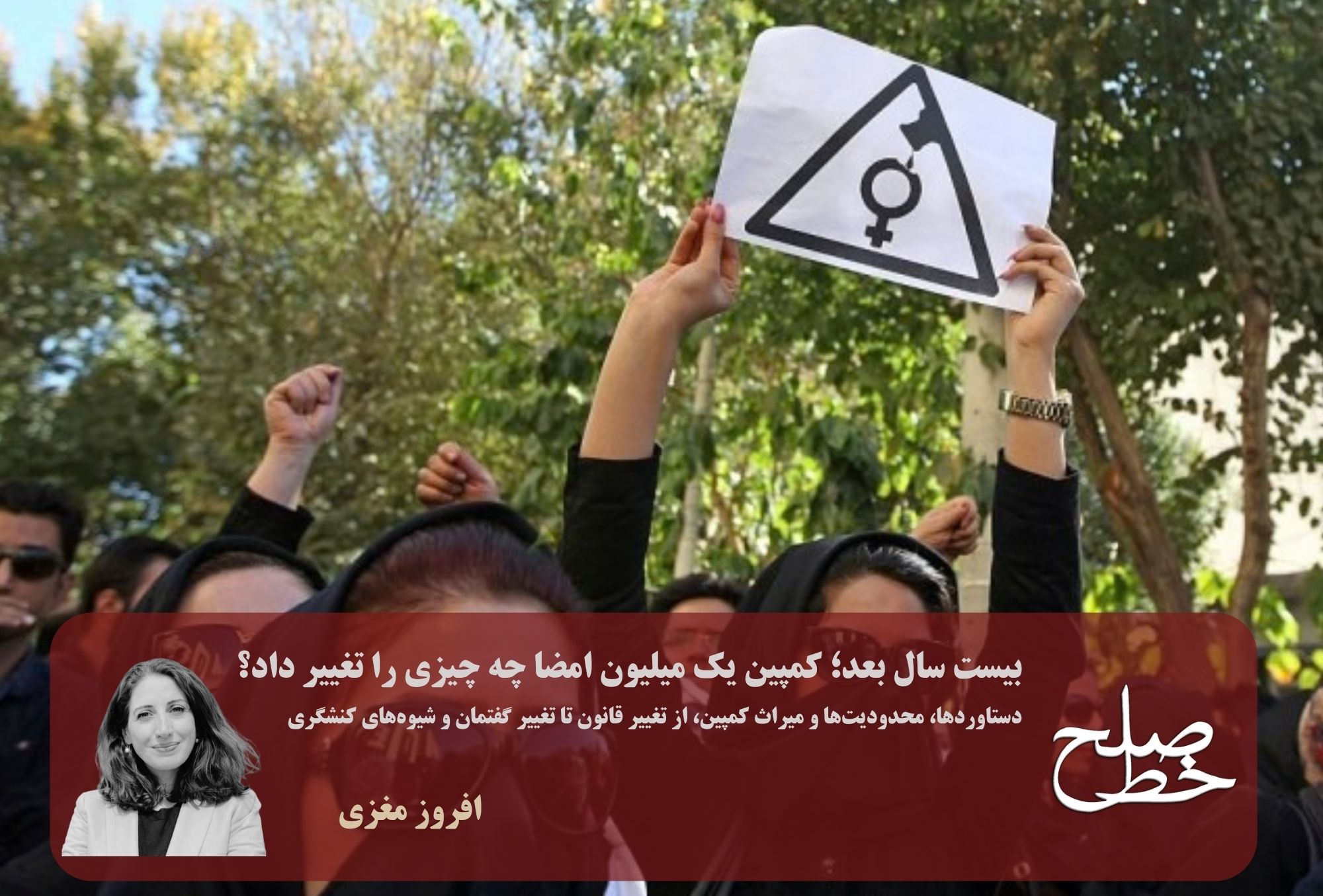
Twenty Years Later: What Did the One Million Signatures Campaign Change?/ Afrouz Maghzi
Question 1: Looking back from a distance of twenty years at August 27, 2006 (5 Shahrivar 1385), and the launch of the “One Million Signatures Campaign,” what is the greatest misconception in evaluating this movement, and where should its real achievement be sought?
The greatest mistake is to measure the campaign’s success or failure solely by the number of signatures collected or the extent to which laws were changed. If we consider only these criteria, repression, the arrest of activists, the restriction of space for civil activity, and the political developments of subsequent years prevented the campaign from achieving its stated objective and continuing its activities in the same form. But the campaign’s impact must be seen beyond this direct outcome. The campaign brought the discussion of legal discrimination and legal equality out of the limited circles of activists and lawyers and into the public sphere. Before that, many women and families encountered the effects of these laws only when they themselves or someone close to them became involved in divorce, child custody, inheritance, polygamy, or similar issues. The campaign helped transform these scattered and individual experiences into a public issue and moved the elimination of legal discrimination beyond a demand made by a group of women activists, turning it into a social demand.
This change could also be seen in subsequent years, both in the more explicit articulation of women’s demands during elections and in protests against discriminatory laws and bills. One important example was the opposition to the Family Protection Bill in 2008 (1387). Pressure from women’s movement activists, alongside opposition from other groups and public figures, played a role in the revision of the bill and the removal of two controversial provisions concerning men’s remarriage and taxation of mahr. This experience demonstrated that, at certain moments, the women’s movement was able to transform a legal demand into a public issue and also influence the legislative process.
Question 2: One of the campaign’s important innovations was the method of “face-to-face dialogue.” What transformation did this approach bring about in Iran’s culture of activism?
One important difference between the campaign and many conventional forms of legal and civil activity was its departure from the one-way relationship between experts and the public. Face-to-face dialogue was not merely a means of explaining the law or collecting signatures; it created a space for exchanging experiences and mutual learning.
Through direct contact with women from different social groups, activists and lawyers saw how laws concerning divorce, child custody, inheritance, polygamy, and other forms of discrimination operated in real life. Conversely, someone who entered into this dialogue was not merely a person signing a petition. She or he could discuss what they had learned with family members, friends, at university, or in the workplace, and could themselves become part of the process of expanding awareness and advocacy.
In this way, activism moved beyond the circle of those who considered themselves political or civil activists. One of the campaign’s important characteristics was precisely that it created opportunities for participation by people who may previously have had no experience of social activism.
Question 3: What impact did the campaign have on the legal profession and on methods of legal advocacy for women?
The One Million Signatures Campaign did not merely change methods of legal advocacy for women; it also shaped a new professional identity for some feminist lawyers.
Before the campaign, the work of feminist lawyers was focused more heavily on defending women in court. Using their legal knowledge and professional position, lawyers pursued their clients’ cases and sometimes, by writing articles, giving interviews, or launching campaigns, drew public attention to discrimination revealed in a particular case. In this way, for example, the case of a woman sentenced to stoning would no longer remain merely her personal issue, but could become a subject of public discussion and protest concerning an unjust law.
The campaign created another form of legal activity alongside this approach. Lawyers were no longer in contact only with their clients; they worked alongside women’s movement activists, students, journalists, researchers, and other volunteers. They participated in training volunteers, preparing legal pamphlets, conducting face-to-face conversations, and collecting signatures, while at the same time defending activists who were arrested or prosecuted because of their campaign activities. This experience gradually created a different kind of professional identity for lawyers active in the campaign.
The experience even changed lawyers’ language and ways of thinking. In speaking with the public, it was no longer possible to rely solely on specialized and complex legal terminology. The law had to be explained in clear language connected to everyday life. At the same time, this relationship was not one-way. Women’s accounts of divorce, custody, inheritance, nationality, violence, and the ways they had found to cope with or resist these laws showed lawyers how the law actually operated in real life. In this sense, lawyers did not merely contribute their legal knowledge to the campaign; they themselves also learned from women’s experiences and from the ways women confronted the law.
This perspective gradually made its way into the legal profession itself. Lawyers who had spent years working on legal discrimination against women increasingly turned their attention to inequalities within the profession and legal institutions themselves. One manifestation of this process was the emergence of demands for equal rights and opportunities for women within bar associations.
From this perspective, the campaign redefined the professional identity of some feminist lawyers. A lawyer was no longer merely an expert who entered from outside and spoke on another person’s behalf. The lawyer was herself part of a collective movement, contributed her legal knowledge to it, worked alongside others, and in the same process learned from society’s experiences.
Question 4: Looking back at the challenges both within and outside the movement, what were the campaign’s failures and weaknesses?
An evaluation of the campaign should not focus solely on its achievements. Security pressure, the arrest of activists, restrictions on the possibility of continuing activities, and the migration of many activists imposed a heavy cost on the campaign. But there were also disagreements and limitations within the campaign itself.
One debate concerned the extent to which the campaign should engage in dialogue with the political structure and official institutions, and the extent to which it should maintain its focus on social work and awareness-raising. On the other hand, the campaign’s principal focus was on changing discriminatory laws, and as a result, some other dimensions of inequality—including class and ethnic differences and the experiences of women in different regions of the country—were not always given equal prominence. The campaign’s horizontal structure also did not mean that differences in influence, disagreements in perspective, or tensions among different groups had entirely disappeared. Nevertheless, these very disagreements and limitations became part of an experience that was later reconsidered in internal discussions within Iran’s women’s movement and civil society.
Question 5: What message does the campaign’s twenty-year legacy hold for today’s generation and current civil movements?
The campaign’s legacy cannot be sought solely in whether an organization continued or ceased to exist. The campaign itself was part of the longer history of women’s struggles for equality in Iran, but at the same time it introduced a change in methods of activism. Legal demands moved out of specialized spaces and limited circles of activists and became subjects of discussion within society. Decentralized work, activity in different cities, cooperation among people and groups from diverse political and social backgrounds, and connecting legal demands to people’s everyday lives were important parts of this experience. Perhaps most importantly, ordinary people could themselves become part of the process of change without belonging to an organization or having a previous history of political or social activism.
Some of these characteristics can also be seen in later forms of women’s activism, from the widespread participation of ordinary people and decentralized networks to the expansion of demands beyond established groups of activists. This, of course, does not mean that these were direct continuations of the campaign. Movements such as “Woman, Life, Freedom” emerged under different historical and political conditions and had their own demands and characteristics.
Perhaps the campaign’s most important legacy is precisely that it demonstrated how a social movement may be prevented by repression from continuing in its original form, while the experience, awareness, and methods of action it has created within society do not necessarily disappear when the campaign itself comes to an end.
 Created By: Afrouz Maghzi
 September 23, 2026
Tags
Custody rights Peace Line 185 The right to divorce. Women's movement Women's rights