


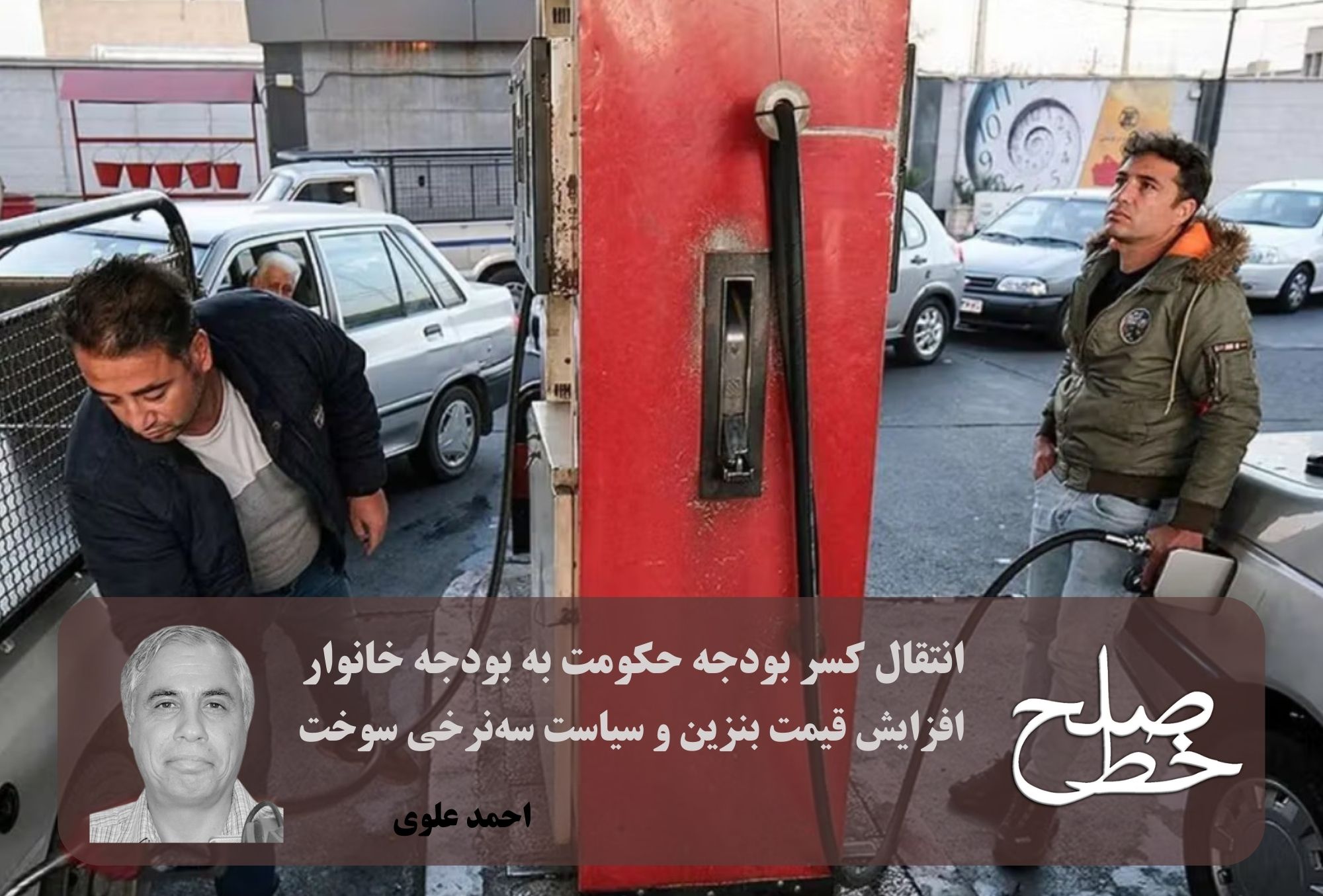
Transferring the government budget deficit to the household budget/Ahmad Alavi
Recent developments in Iran’s energy policy, particularly the triple-price gasoline pricing and price increases, have once again brought the long-standing issue of the relationship between pricing policies, governance structure, and household economics into the spotlight. The government promotes this policy with ostensibly economic goals, including controlling consumption, targeting subsidies, and reducing pressure on the public budget. However, a review of past experiences, the structure of Iran’s political economy, the rentier nature of the governance system, and chronic financial and institutional inefficiencies suggests that the triple-price gasoline pricing mechanism is not a structural reform, but rather a tool to shift government fiscal costs to households.
In practice, this policy has been shaped by a set of historical problems: chronic budget deficits, institutionalized corruption, extensive tax exemptions for dependent and security institutions, increasing costs of proxy war networks, and structural stagnation in the economy. Hence, the increase in gasoline prices in Iran is not a normal political intervention, but a political-economic phenomenon that must be analyzed within the framework of power relations and rent-based mechanisms. Therefore, in this article, with an analytical and critical approach, we will examine the policy of three-price gasoline from the perspective of rent-based political economy, its consequences on household livelihoods and welfare, the failure of official goals, and its role in transferring the government’s budget deficit. The main question is why, in the current structure, fuel price increases do not lead to economic reform, but to the intensification of inequality, increasing poverty, and the reproduction of corruption.
The official government narrative and its limitations
The government justifies the three-tier pricing of gasoline with three main claims: reducing the subsidy burden on the public budget, targeting subsidies through commodity lists and redistribution in favor of the lower deciles, and controlling smuggling and managing consumption. This official narrative deliberately ignores a fundamental issue: that any pricing policy relies on assumptions that have no place in the Iranian economy; such as rent-busting, transparency, healthy competition, an inclusive tax system, effective supervision, and institutional efficiency. In the past decades, and especially in recent years, the increase in the prices of bread, internet, water, electricity, and gas has shown that pricing policies in a rent-based structure, rather than reforming them, merely increase the pressure on households. In the absence of institutional reforms, these policies exacerbate problems rather than solving them. In such a context, the government’s claim of “reform” by increasing gasoline prices is in fact a reproduction of a tried and tested strategy.
The contradiction between the official narrative and the government’s budget-oriented approach
Despite the government’s insistence that the gasoline price hike is not being done to “earn revenue,” the budget structure and economic data suggest that this policy is more than anything a response to budget deficit pressures. The budget deficit in Iran is the product of several structural trends:
– Structural deficits due to corruption and rent-seeking: Iran’s economy has been plagued for years by institutionalized corruption, monopoly networks, and a powerful oligarchy. Countless rents in the fields of energy, foreign trade, and finance have drained public resources.
– The government’s inability to collect taxes from affiliated and security institutions: The government is unable to collect taxes from powerful institutions. Institutions such as foundations, seminaries, and economic headquarters under the leadership of the leader, which control a large part of the Iranian economy, are exempt from paying taxes. These sectors not only devour the budget, but are also immune from any public oversight.
– Restrictions on oil exports and the costs of sanctions: Sanctions have multiplied the cost of selling oil, and clandestine transportation, heavy discounts, numerous intermediaries, and systematic corruption have severely reduced oil revenues.
– Foreign policy deadlock: As long as foreign policy is based on the axis of “resistance” and “strategic depth”, regional spending, support for proxy groups, and security activities will continue to be financed from the public budget.
In such a context, the government resorts to quick and painless price tools to fill its revenue gap. Increasing fuel prices has been a “hidden tax” in all governments, because in the rentier structure, it is the easiest way to transfer financial pressure to the lower and middle deciles of society.
The historical experience of 2019: A failed test that is repeated
The increase in gasoline prices in 2019 was a turning point in Iran’s energy policy. The result of this policy, contrary to promises, showed that the increase in gasoline prices actually led to a return to an upward trend in consumption, the continuation of smuggling rent networks, a jump in the prices of goods and services, a collapse in household purchasing power, an escalation of social discontent, and a significant decline in public trust in the political structure. Since 2019, no institutional, infrastructural, tax, or governance reforms have been implemented to pave the way for the success of the new policy, so repeating the same policy, with the same tools and in the same structure, can only lead to the same results or worse.
The Political Economy of Gasoline Price Hike: The Logic of Power, Not the Logic of Economics
To understand why fuel prices are rising in Iran, one must analyze the economy in relation to the power structure. Energy policy in Iran is not governed by economic calculations, but by security, ideological, and rentier considerations:
– Foreign policy reform is a threat to the hard core of power: accepting the Financial Action Task Force (FATF), reducing external tensions, and limiting support for proxy groups will limit some of the financial, security, and opaque tools of the security institutions and increase the cost of exerting influence. Therefore, the preference of the power core is to maintain the status quo and transfer the costs to the people.
– Economic liberalization is the end of rent: A competitive and transparent economy threatens the very foundation of rentier networks, so any real reform has a high political cost and is met with resistance from the power structure.
– The government in Iran is a “cost government,” not a “development government”: a significant portion of the budget is spent on provincial bodies, government media, security apparatuses, and regional networks. Reducing these expenditures means weakening the pillars of power, so the only option is to increase economic pressure on the people.
– Raising gasoline prices is the least expensive option for the government: Structural reforms are very complex, time-consuming, and costly, but a price shock is quick, feasible, and has no political cost to the establishment. Therefore, the government prefers to lighten its financial burden by raising fuel prices.
Macroeconomic and structural consequences
In an economy plagued by chronic inflation, a weak private sector, low productivity, and widespread rents, triple gasoline pricing has far-reaching consequences:
– Transmission of price shocks to the production chain: Gasoline is the “mother price”, so any price increase is quickly reflected throughout the entire production and service chain.
– Increased transportation and logistics costs: The cost of basic goods, fruit, groceries, and everyday services will increase.
– Greater recession for small businesses: Small businesses with low profit margins are the first victims of price shocks.
– Intensification of inequality and class divide: The effect of rising fuel prices on the lower deciles is much greater and leads to a decrease in their relative well-being.
– Increased inflationary instability: Price shocks activate inflationary expectations and stabilize inflation at higher levels.
The consequences of the three-price policy on the household economy
– Direct increase in transportation costs: Low-income deciles spend a greater share of their income on transportation and use less efficient vehicles.
– Indirect increase in the price of goods and services: The cost of distributing goods, medical services, education, freight, food, and other daily needs increases.
– Intensification of inflation and reduction in purchasing power: Wages do not increase in line with inflation, and the gap between household spending and income increases.
– Increasing inequality and reproduction of poverty: The lower deciles bear the predominant pressure due to their greater dependence on basic goods.
– Social and psychological consequences: Increased family tensions, economic insecurity, livelihood anxiety, and decreased psychological well-being are the natural results of this process.
– Vulnerability of transport-based jobs: The income of taxi drivers, pickup trucks, and motorcycle couriers will decrease and their expenses will increase.
Why are none of the official goals being achieved?
– Consumption does not decrease: The lack of an efficient public transportation network, unavoidable work commutes, and the weakness of the intercity fleet prevent fuel consumption from decreasing significantly.
– Smuggling is not controlled: The organized flow of fuel smuggling is security-based and rent-based. Therefore, increasing consumer prices cannot stop this network.
– Rents increase: By making processes more complex, triple pricing creates space for brokering, illegal buying and selling of quotas, and increased corruption.
delayed
The policy of triple-price gasoline in the absence of fundamental institutional and financial reforms is not a reform strategy, but a mechanism for transferring the costs of rentier governance to society. In the current structure, increasing the prices of energy carriers, instead of a real reform, has become a mere functional tool to compensate for the government’s budget deficit and finance the adventurist foreign policy, without taking practical steps to make the budget transparent or make the government more efficient. The inevitable result of this policy is the simultaneous intensification of stagnation and inflation, the deepening of the class gap, and the spread of structural corruption. In fact, this policy is the continuation of the same pattern that imposes the costs of inefficiencies and corruption directly on the people’s table.
 Created By: Ahmad Alavi
 December 22, 2025
Tags
Ahmad Alavi Budget Economic liberalization expensive Export of oil Gasoline Gasoline prices Inequality Oil money Paragraph peace line Peace Line 176 Rent Single-rate gasoline Swelling ماهنامه خط صلح