


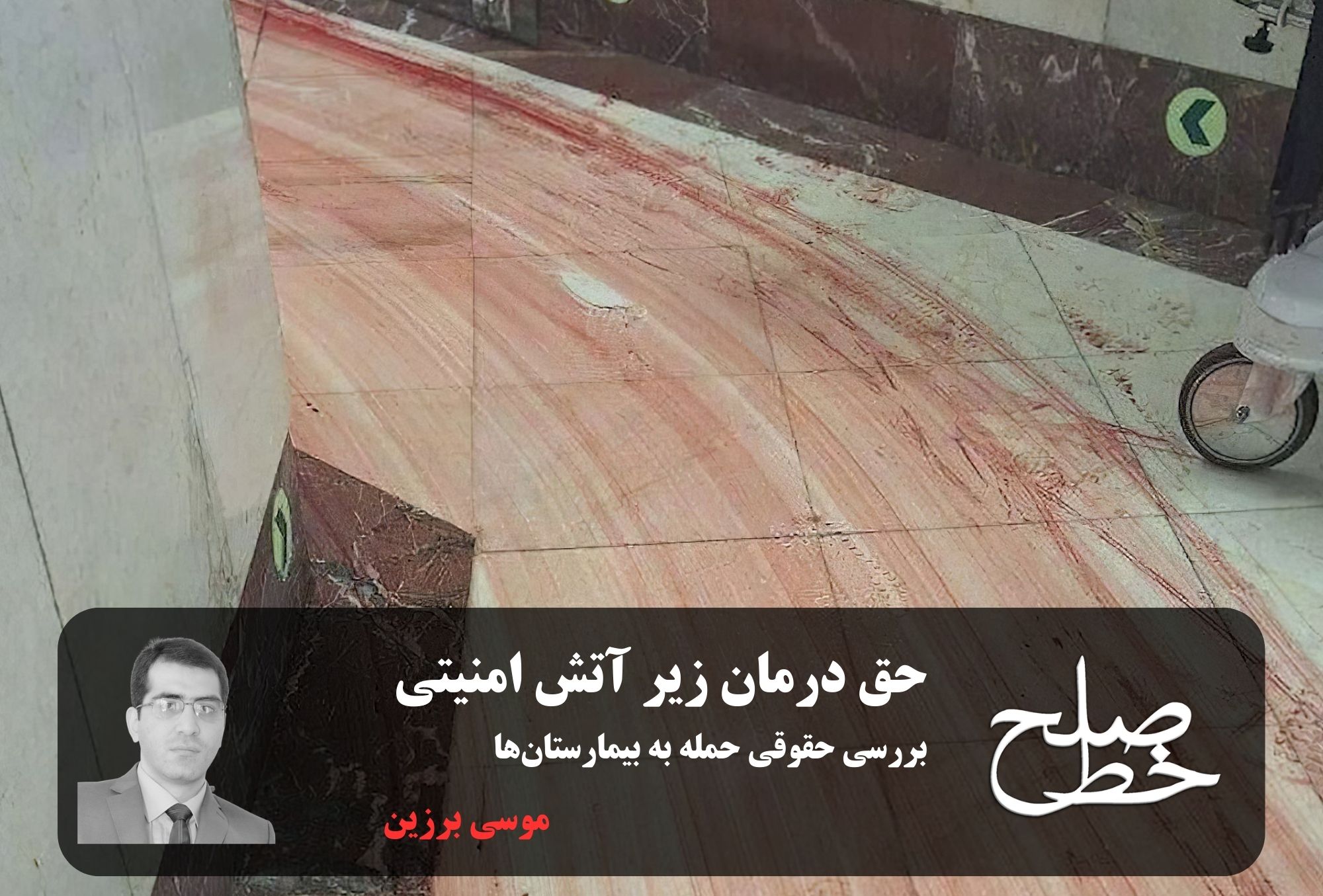
The right to treatment under security fire/Musa Barzin
During the recent protests, we witnessed many bitter incidents and extra-legal actions in Iran. One of these cases was the restriction of treatment for protesters in various forms. According to reports published from the very first days of the protests, police and security forces attacked hospitals where injured protesters had been taken, creating heartbreaking scenes. Amnesty International has confirmed that the injured broke hospital windows and fired tear gas inside some hospitals. Hospital medical staff were threatened not to provide medical services to protesters or, if they did, they must inform the security forces in advance. Pharmacies were told that any citizen who purchased dressings and disinfectants should inform the officers or refrain from selling these items to the injured. In some hospitals, we witnessed officers preventing medical staff from using the blood bank for injured protesters, and in some cases, these officers even attempted to kidnap protesters from hospitals.
There have been significant reports of threats, summons, and arrests of doctors who helped injured protesters. However, all of these measures have been taken to limit and deny citizens the right to medical treatment. While the right to medical treatment is one of the most fundamental rights that cannot be denied or limited under any circumstances, even in times of war. If we compare this right with other rights, we come to the conclusion that the right to medical treatment is not exceptional. For example, the right to freedom of expression always has exceptions, or even the right to life, which may result in the death penalty for very serious crimes. However, none of the international documents foresee any limitations or exceptions to the right to medical treatment. The right to medical treatment has been emphasized in many international documents. The most important of these are the International Covenant on Civil and Political Rights and the International Covenant on Economic, Social, and Cultural Rights. Both of these have been accepted by the Iranian government and are in force. Also, the Geneva Conventions and their protocols, which relate to the laws of war, generally prohibit attacks on hospitals and medical facilities. It is clear from these international documents that no force has the right to attack medical facilities in any way, whether in a state of war or in a state of internal protests and crises. Violation of this can be considered a war crime or a crime against humanity and have legal consequences for the offending state.
If we look at the domestic laws, we find that any threat by medical personnel to not treat the injured is against the law. The Penal Code for Refusing to Help the Injured and Eliminating Life-threatening Dangers explicitly states that every citizen is obligated to help those whose lives are in danger. This law emphasizes that those who are engaged in medical work due to their profession will be punished if they refuse to help the injured. On the other hand, several regulations, including the Regulation for Handling Professional and Trade Violations of Medical Professionals, state that emergency treatment is one of the duties of medical personnel and no one has the right to prevent it. In other words, domestic laws oblige medical personnel to provide medical services to the injured. The origin of the injury is not important at all. That is, it cannot be said that a person who protested and was injured as a result of shooting no longer has the right to treatment, and doctors have no duty to treat him.
What we have witnessed in the recent protests has been both the denial of the right to treatment and the prevention of the duties of medical staff. The actions taken by the police and security forces have no place in the law and are certainly one of the darkest behaviors observed. When two governments are at war, attacking each other’s medical centers is considered so outrageous that international courts are formed to deal with it. The behavior of a government against its own citizens and attacking hospitals within the same country is naturally doubly outrageous.
It should be noted that both the person who ordered the attack on the hospital and the officer who carried out the order will be held criminally and legally liable. This criminal behavior is not subject to the passage of time and can be investigated and prosecuted under criminal law whenever the conditions are met. The victims of this attack, whether they are the injured protesters, medical staff, or other patients who have been affected by this attack, will have the right to file a criminal and legal lawsuit at any time.
From the perspective of international law, the actions of government forces, along with other criminal behaviors, can be considered a gross violation of human rights and a crime against humanity. Because these actions are geographically dispersed and it is clear that they were carried out systematically. That is, we are faced with a series of actions that show that the government intends to take revenge on the injured protesters. This is despite the fact that both domestic laws, such as the Law on the Procedure for Shooting by Armed Forces, and international laws, emphasize that the use of weapons should not be for the purpose of revenge and destruction of protesters. International documents emphasize that if gatherings are formed and the police feel that intervention could lead to harm to the protesters, ambulances should be prepared in advance on the spot to send the injured to the hospital. In any case, these actions by the Iranian government can pave the way for the application of international mechanisms. This could include pressuring governments to limit their political and economic relations with the Iranian government, or persuading the UN Security Council to impose stricter human rights sanctions. There is even the legal possibility of using force with the approval of the Security Council.
 Created By: Mousa Barzin
 February 20, 2026
Tags
Arrow of Fire Crime against humanity Criminal Human rights International Covenant on Civil and Political Rights Massacre 1404 Medical staff Mousa Barzin peace line Peace Line 178 Suppression The Di 1404 Uprising The right to treatment Uprising of 1404 ماهنامه خط صلح