


The phenomenon of subsistence smuggling with a view to the incompetent government/Raha Azadi
A failed state is a state that is unable to perform its functions as a state. Such a state is incapable of establishing social order, monopolizing the use of violence, meeting the basic needs of the people of the society, establishing security and the rule of law, and some of its functions are performed by other institutions or are not performed at all in the society.
If we consider the peak of this to be the collapse of the state institution in Somalia in the early 1990s, when the state completely disappeared and the establishment of basic order in society fell into the hands of anyone with a gun, and the other end of the spectrum is a state that manages all the affairs of its society completely with order, justice, and law (which, of course, has never been seen before), then between these two ends of the spectrum, all the governments in the world can be seen; each one is incapable of establishing a part of order in its society.
For example, the United States government, by its own admission, has problems in protecting its borders or in the production and supply of drugs, the Afghan government cannot control its borders and guarantee the livelihood and health of its citizens, or the Syrian government has been ruling only part of its territory for years. As a result, all governments can be considered weak in some way and from a perspective. But in any case, they have strengths and weaknesses, and a government may be stronger in the fight against organized crime and weaker in social security.
Through this lens, we can examine the phenomenon of subsistence smuggling (such as kolbari and fuel transport). First, the use of smuggling is to indicate the entry or exit of goods across international borders without going through legal formalities, which is different in each society; second, the use of subsistence means its necessity to provide for the livelihood of individuals, not necessarily smuggling for specific purposes. As a result, a kolbar or fuel transporter may work to provide for his or her livelihood, but along with that, he or she may also make a profit for a smuggling gang. This text does not seek to examine the phenomenon of smuggling for that gang, but only examines subsistence smuggling.
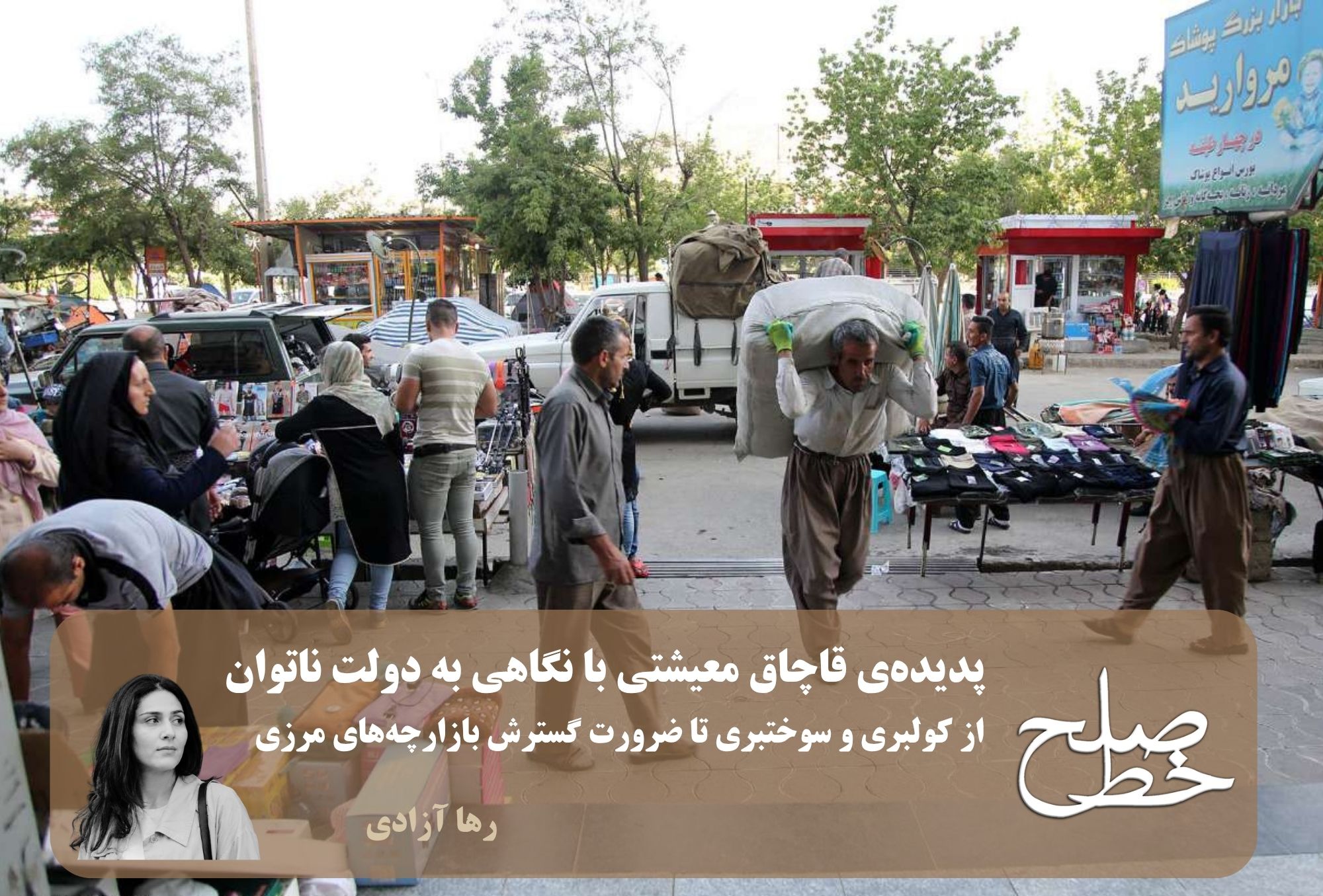
With these details, the first points that come to mind are the Iranian government’s inability to provide for the livelihood of a group of border residents and to protect the borders. This also has its strengths and weaknesses, and it cannot be considered that all border residents and all borders are subject to it. However, in places where subsistence smuggling occurs, one can certainly see the severity of the government’s inability. In recent years, by legalizing forms of importing goods from the borders by border residents, border bazaars were formed, the most famous example of which is in the city of Baneh in Kurdistan Province. The term “tahalanji” that exists on the southern coast is similar. In this case, the government accepts its inability to provide for the livelihood of the group and exercises control over imports through legal means. In these cases, an individual can import televisions, colognes, and second-hand clothes and sell them in the local market, but not prohibited goods. This is the government’s neglect of its customs revenue to solve the livelihood problem. Obviously, if there were no poverty in those areas, the government would not have made such positive discrimination in favor of border residents.
But in some cases, things reach a crisis. That is, either the entry and exit of goods from unofficial sources is prohibited (such as fuel on the eastern and southern borders), or border residents do not have the opportunity to use the “government’s turn a blind eye.” In the case of fuel, the government finds itself faced with a phenomenon that is insoluble: fuel in Iran is heavily subsidized, and this subsidy is reserved for those who consume it in Iran. As a result, delivering cheap fuel to the people of Pakistan means allocating the subsidy of the Iranian people to them, and it is a phenomenon beyond the creation of a border market. On the other hand, transporting fuel by the barrel and gallon is only part of the story, and due to its high profits, a significant share also goes to organized groups (the writer of these lines has interviewed several major smugglers, which will not be published to protect confidentiality). However, the government’s inability to provide for livelihoods and protect borders could mean a waste of subsidies that affects all people, not just border dwellers.
But the situation is different with the western borders and the Kolbars. Despite the construction of border markets in some places, widespread poverty and the lack of access for all border residents to these markets have created the Kolbar phenomenon. Controlling the difficult borders of Kurdistan is not easy, and as a result, it is possible for people and livestock to travel through them with loads. The mountain routes of the western borders become even more difficult to control and escape from control in winter, and in addition to the existing dangers, cold and frost also threaten people’s lives. To these we must add the border guards who, instead of setting up the usual border barriers, resort to direct fire to combat smuggling. A government that is incapable of controlling borders and livelihoods is also deliberately targeting people’s lives.
Eliminating poverty in border areas is certainly the most desirable thing; but given the conditions we know, it does not seem possible in the current situation. Controlling thousands of kilometers of border is also not possible. Neither are the facilities available (just to familiarize the reader with the length of the border, it is stated that from Chabahar to Zabol, there is a relatively smoother road than the border, which a car traveling at normal speed can cover in more than ten hours.), nor do the border residents, who have relatives and legitimate interests beyond the border, take it seriously.
As a result, it seems that the only option at present is for the government to accept its inability and establish border markets in more places. This will, on the one hand, provide a livelihood for border residents, on the other hand, limit the entry or exit of goods to permitted goods, and reduce economic consequences such as the transfer of fuel abroad or security consequences such as the entry of drugs and weapons into the country.
 By: Raha Azadi
 October 23, 2026
Tags
Freedom Fuel smuggling Fuel tester Incompetent Government Kulbar Kulbars Paragraph peace line Peace Line 186 Smuggling goods Sorrow of bread Sukhtabar Uncontrolled shooting Unemployment ماهنامه خط صلح