


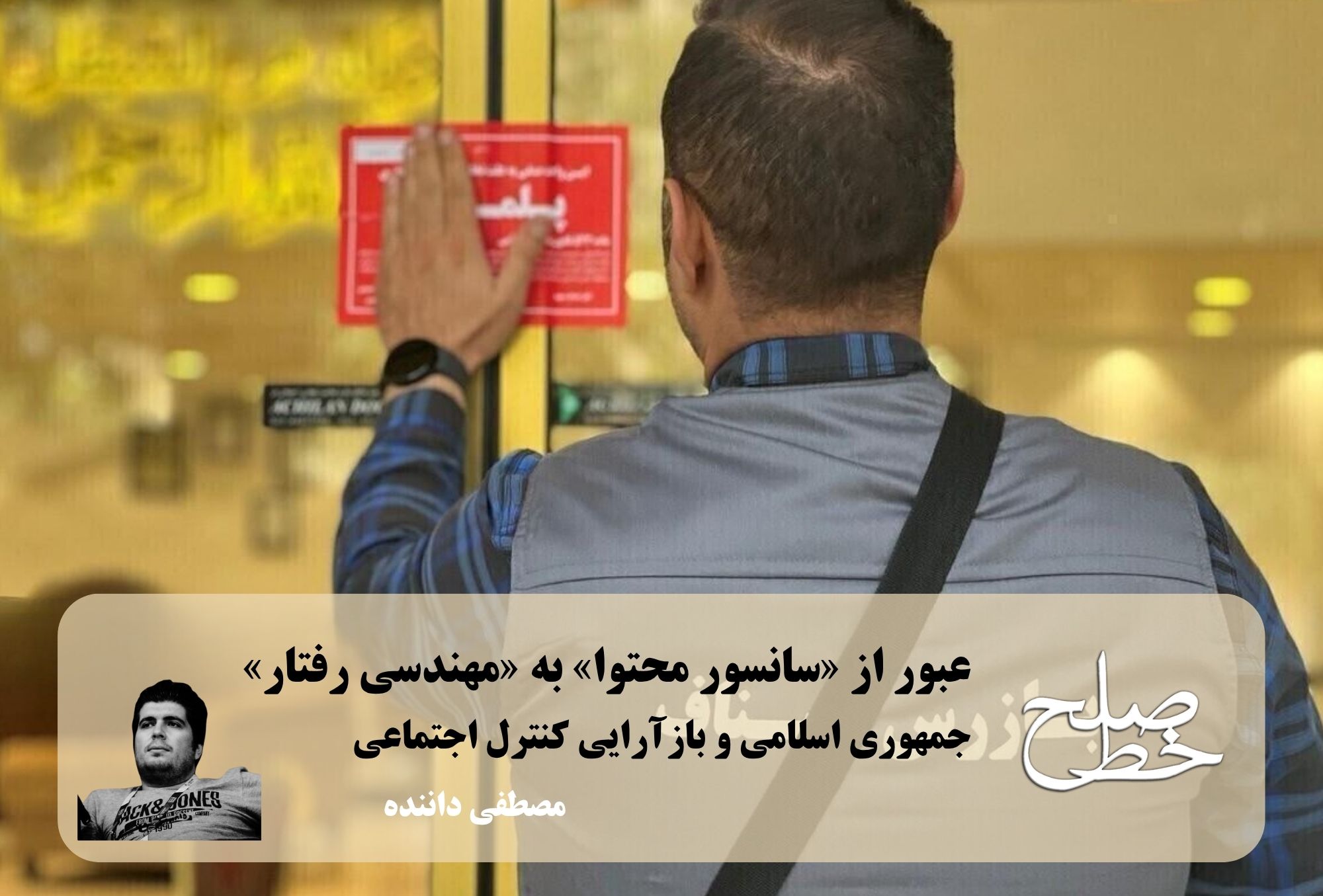
From “Content Censorship” to “Behavioral Engineering”/ Mustafa Danandeh
The issue is not merely the closure of an Instagram page. It is not merely the sealing of a café or the summoning of a blogger. The issue is not even only hijab, music, tourism tours, or the content of an online page. What has been seen in Iran in recent weeks, when viewed together, presents a larger picture: the government does not merely want to control what people say. It also wants to control what people see, create, sell, buy, experience, and do together.
Reports describe a wave of page blockings, content removals, compulsory pledges, summonses of online activists, and the sealing of business establishments. At least 72 identifiable pages and accounts have been blocked or seized, the administrators of 21 pages have been required to publish pledges, and at least 23 business establishments have also been sealed. The scope of these measures does not include only political and media activists; bloggers, online businesses, fashion and beauty activists, athletes, tourists, cafés, and cultural establishments are also among the targets. (1)
This volume of enforcement, especially in a time of war, is strange. If the government’s only problem were with “criminal content,” removing the content would have been sufficient. If the issue were merely an Instagram page, blocking the page would have been enough. If the issue were simply a specific behavior in a café, a warning or judicial action regarding that particular case could have ended the matter.
But when a page is removed, the page owner is summoned, a pledge is taken, and at the same time their place of business is also exposed to the threat of closure, the matter is no longer merely content control. Here, we are faced with an effort to control the “platform for the production and reproduction of social behavior,” which can perhaps be described as the most important change.
For years, the prevailing assumption was that the government opposed the media, so it shut down newspapers, filtered websites, or arrested journalists. But society has changed. Today, a café can be a medium, a blogger can be a medium, a tourism tour can produce a social space, a clothing sales page can present a lifestyle, a restaurant can become a place where social relationships are formed, and even a simple video of everyday life can show millions of people an image of a “possible life.”
Therefore, if the government seeks only to control official media, it has lost control over a large part of society. Media are no longer just television and newspapers; everyday life itself has become media. And this is precisely why action against cafés, bloggers, tourism tours, retail pages, and online businesses cannot be viewed entirely separately from the issue of social control.
The question that arises here is: why now? And has the government changed its policy? In my view, the precise answer is: not in its objective, but one can say that a change has occurred in the field and in the tools. The fundamental objective of social control is nothing new. What has changed is the social environment.
Iranian society is no longer a society that the government can control merely by shutting down a newspaper or banning a television program. Lifestyle, social networks, the digital economy, online businesses, and public spaces have created a parallel network of communication and identity that is far more difficult to control than in the past.
Under such conditions, the government faces a choice: either accept this social transformation and adapt to it, or attempt to contain it. Recent signs more closely resemble the second option.
Another point is also important and cannot simply be overlooked: the subsiding of the discourse of war does not necessarily mean a reduction in the security atmosphere. On the contrary, the end or reduction of an external threat may redirect the attention of the security structure back toward domestic affairs.
During wartime, an external threat can temporarily overshadow many internal issues. But when the intensity of that threat decreases, old issues rise to the surface again: hijab, lifestyle, social networks, public gatherings, cultural activities, and anything the government perceives as being outside its control.
In this sense, perhaps what we are witnessing today is not simply a return to the past, but a restructuring of social control policy after a period of crisis.
Of course, it should also be noted that the available data do not allow us to conclude with certainty that a single secret directive has been issued from the highest level. But understanding the governing policy of a country does not always require a written circular lying on the table.
When different institutions, in different cities, use similar language and similar tools to target different areas, one must ask what common logic lies behind these actions. And perhaps the most important part of the matter is precisely here: the government no longer merely says, “Do not write this.” It says: “Do not publish this, remove this image, close this page, sign a pledge, do not dress like this, do not advertise like this, do not organize this tour, do not run this café under these conditions, do not play this music, and if you do not follow these rules, I will take your business away from you as well.”
This means moving from “content censorship” to “behavioral engineering,” and this stage is far more important and dangerous. Content censorship attempts to hide something from public view, but controlling businesses and public spaces attempts to increase the cost of behaving differently.
Sealing a café is not merely punishment of the café owner; it is a message to the next café owner. Blocking a page is not merely the removal of one account; it is a message to thousands of other pages. Summoning a blogger is not merely action against one individual; it is a message to millions of other content creators that we determine the boundaries, even if those boundaries are vague.
When expressions such as “norm-breaking,” “culturally harmful content,” “contrary to public decency,” or “Islamic proprieties” are used, the precise boundary of prohibition is unclear. The result can be the formation of widespread self-censorship. The individual does not know exactly what is prohibited, but knows there may be a cost, so they become cautious. The business becomes cautious. The blogger becomes cautious. The café owner becomes cautious. And ultimately, society learns to remove something itself before the government removes it.
This is the point at which external control turns into internal control. But there is also a major mistake: one should not assume that such a policy necessarily means greater government power. Sometimes the opposite is true.
A government that constantly resorts to tools of removal and coercion instead of persuasion may in fact be revealing a decline in its persuasive power. When the government cannot make one lifestyle attractive, it may try to make the competing lifestyle costly.
When it cannot persuade people to accept a social value, it may try to increase the cost of rejecting it. These two are fundamentally different.
At the same time, the experience of recent years has also demonstrated an important reality: Iranian society is no longer the same society it was before the emergence of social networks. The new generation does not merely have access to more information; it has more communication networks. It does not merely have a different lifestyle; it also has the ability to display and reproduce it. It does not merely protest against the government; it can place other forms of life before the eyes of others. For this reason, social control today is far more difficult than it was in the past.
Ultimately, the government’s problem is not with an Instagram page; it is with a society that is no longer willing to see everything through the lens determined by the government.
Therefore, perhaps the central question is not, “Has the government once again begun imposing restrictions?” The answer to that question is almost clear. The more important question is: is the Islamic Republic moving from political control toward more comprehensive social control?
From controlling newspapers to controlling Instagram pages, from controlling media to controlling content creators, from controlling content to controlling businesses, from controlling businesses to controlling public spaces, and from controlling visible behavior to producing self-censorship.
If this trend continues, the issue will no longer be only hijab, Instagram, or cafés; the issue will be the redefinition of the boundary between “private life,” “economic activity,” “public space,” and “political power.”
And finally, it must be said that reviewing history reveals an important lesson: the more power attempts to design life from above, the more ways life finds to escape that design.
Footnote:
1- From Blocking Pages to Sealing Cafés: A New Wave of Pressure on Cyberspace and the Public Sphere, HRANA News Agency, August 1, 2026 (10 Mordad 1405).
 Created By: Mustafa Danandeh
 August 23, 2026
Tags
Immorality Social control