


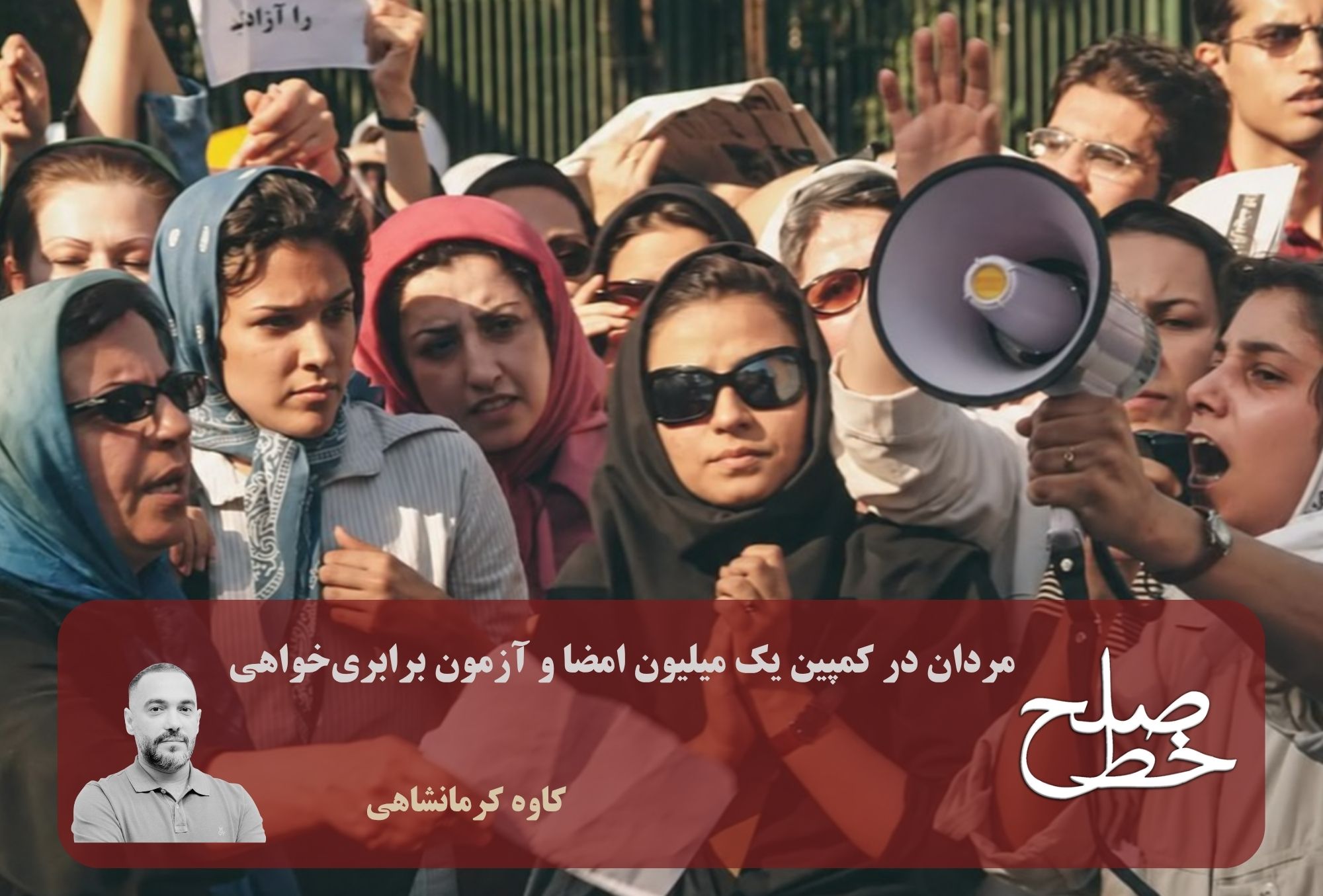
Men in the One Million Signatures Campaign and the Test of Commitment to Equality/ Kaveh Kermanshahi
Twenty years have passed since the launch of the “One Million Signatures Campaign to Change Discriminatory Laws.” The movement was initiated by activists in the women’s movement and, for many young people, became their first experience of social activism and their first close encounter with the struggle for gender equality. Among these young people were men as well. Some already had experience in political and social activism, while others began their first activist experience with the campaign. By participating in the campaign’s educational workshops, they learned about discriminatory laws, collected signatures, and gradually came to see themselves as part of the movement for equality. Their presence was not comparable to that of women in terms of numbers, but it created a successful experience of men participating in a movement initiated by women and raised questions for the campaign that remain important in discussions about men’s participation in the equality movement today.
What motivated men to join this movement, and what role did they play in it? Is supporting women and defending their rights, in itself, enough for a man to consider himself committed to equality? What does a man who campaigns against discriminatory laws do with the privileges that those same laws and patriarchal culture have granted him? These were among the questions I raised several years ago with a number of women and men active in this social movement as part of research on the presence and role of men in the campaign. Returning to those conversations on the campaign’s twentieth anniversary provides an opportunity to examine the achievements and critically assess the shortcomings of an experience of which I myself was also a part.
The quotations and views of the interviewees in this article are drawn from those same research interviews and reflect their experiences and assessments at the time the interviews were conducted. The assessment of whether this experience can continue under today’s conditions is also the author’s interpretation of those conversations.
Men in a Movement Initiated and Led by Women
The campaign began on August 27, 2006 (5 Shahrivar 1385), with the aim of collecting one million signatures in protest against discriminatory laws against women. Face-to-face dialogue with people formed the basis of its activities, and awareness-raising was its initial objective. While explaining the laws and their effects on women’s lives, members asked those they spoke with to sign the statement and, if interested, join the movement. In this way, there was not much distance between an audience member and a volunteer. Someone who became familiar with the campaign’s demands through a conversation could, after participating in an educational workshop, begin collecting signatures themselves.
This method of working also helped expand men’s participation. The campaign created a relatively unprecedented space within Iran’s women’s movement for a group of young men committed to equality to participate in a movement led by women and centered on demands for equality. Although the number of men was far smaller than that of women, the experience was important in terms of the form and context of the collaboration. Of the campaign’s 54 initial members, only 2 were men, while 8 of the 25 individuals introduced as its initial supporters were men. The names of 30 men also appeared on a list of approximately 200 new members who joined the campaign during its first six months. In addition, according to one of the campaign’s internal reports, 50 of the first 370 volunteers attending workshops in Tehran were men. Men also participated in campaign workshops and activities in other cities. These figures indicate the campaign’s success in gradually attracting men, although on their own they are not sufficient to assess the quality and continuity of that participation.
Men had collaborated with the women’s movement before the campaign as well. What distinguished this experience was the opportunity it created for sustained activism and for finding a more clearly defined place within the movement. Parvin Ardalan, a feminist activist and one of the campaign’s founders, describes this change as an expansion of men’s role from “supporter” to “activist.” Men were participating in a movement designed and run by women, whose demands had been determined by women. Accepting such a position in a society that generally regards leadership and decision-making as men’s prerogatives was itself part of the learning experience.
According to Ardalan, at the beginning, the campaign’s attention was focused more on women’s presence and activism, but collecting signatures from both women and men and inviting them to participate led to greater involvement by men. Their presence gradually came to be accepted, although not without difficulties. Holding meetings in homes, security concerns, and disagreements over the extent of men’s role were among the issues campaign activists encountered.
Welcoming Participation and Concern Alongside One Another
Women activists did not respond uniformly to men’s participation. Sussan Tahmasebi, a civil society activist and one of the campaign’s founders, describes three types of responses. One group, including herself, regarded men’s participation positively because they believed that changing gender roles required the presence and cooperation of both women and men. Another group was concerned that men would exercise within the movement the same power they held in society and deprive women of the opportunity to rebuild their self-confidence and independence. Others did not hold a clear position either in favor of or against men’s participation.
The concerns of the second group cannot simply be regarded as distrust of men or opposition to working together. Women who had struggled to create an independent space had every right to be concerned about losing it. Men’s support for women’s rights has not always meant accepting women’s decision-making power. A man may defend women’s demands while still regarding himself as more qualified to speak, determine priorities, or direct activities. Under such circumstances, good intentions alone do not prevent the reproduction of domination.
Tahmasebi nevertheless emphasizes that, overall, these differences of opinion did not become a serious obstacle to men’s participation in the campaign. Ardalan also considers the limited number of men compared with women to have been a factor in preventing male domination. Taken together, these two views show that the acceptance of men took place within a specific context of relationships and balances of power. Under these conditions, the campaign succeeded in creating a practical experience of collaboration that both provided space for men’s participation and preserved women’s central role. Understanding these conditions can help guide the continuation and expansion of such collaborations.
The Men’s Committee and the Question of Their Own Position
Some time after the campaign began its activities, the Men’s Committee was formed. According to members of the committee, the initial reason for this decision was security pressure, particularly moral accusations surrounding joint activities by women and men. Such pressures made it difficult to hold mixed workshops and meetings. Under these circumstances, separating some working spaces became a way to continue the activities, although it itself prompted discussions about reproducing gender segregation.
“A,” one of the members of the campaign’s Men’s Committee, explains that had it been possible to hold mixed workshops, the idea of a men’s group might never have arisen. Yet the experience of separate workshops revealed other needs. Men needed forms of education to understand their own position and behavior that were not necessarily identical to women’s needs. At the same time, some women preferred to share their experiences of violence in women-only spaces. In this way, a decision initially made under security pressure became an opportunity to pay attention to differences in people’s positions.
The committee’s activities were not limited to collecting signatures. Study sessions on women and feminism, preparing written material, and training male volunteers were also part of its work. “K,” another member of the campaign’s Men’s Committee, says that one of the main concerns was to explain the necessity of men’s participation in the struggle for equality in language that was clear and connected to everyday life. Members wanted to understand how changing discriminatory laws against women related to men’s lives and why men should work toward such changes. Some of the foundations for the identity of “feminist men” emerged from these discussions.
There was also no consensus regarding the meaning of establishing this committee. Alongside its potential for attracting men and expanding commitment to equality, Ardalan raises the possibility that, in some cases, an effort to compensate for men’s marginal position within the women’s movement may also have played a role. Tahmasebi offers a different interpretation. She says that women’s power within the campaign was so evident that there was effectively no room for men to display power, and she herself saw no indication that they sought to take women’s place in representing the campaign.
“K” approaches the issue from another angle. In his view, a separate committee both enabled men to find their place and reduced the consequences of the self-confidence that social upbringing had instilled in them. Connections with the broader campaign continued through general meetings and representatives participating in coordinating groups. These differing views are part of the reality of the experience, and paying attention to them helps us better understand the factors behind its success and the areas in which such participation could be improved.
Raising Others’ Awareness and Critiquing Oneself
One critical question that has emerged particularly with the passage of time and the reassessment of that experience concerns the position of men in raising women’s awareness. Many young men entered the campaign with limited knowledge of women’s issues and, by their own accounts, were still learning. Nevertheless, after receiving initial training, they found themselves explaining discrimination to women who lived with its consequences. This does not mean that legal education was useless or that men’s participation should be rejected. The issue is that knowing a few legal provisions should not lead men to imagine that they understand discrimination better than the women who live with it every day.
Being inexperienced, of course, was not unique to men. Many women also began their first experience of social activism in the campaign. But there was an important difference. Men did not view discrimination from the same position in which women experienced it. Even without personally committing acts of violence, they benefited from privileges that family, society, and the law had granted them on the basis of their gender. Participating in the women’s movement did not automatically eliminate that position.
For this reason, criticizing patriarchal culture and discriminatory laws remains incomplete without recognizing one’s own position within them. A man may write against inequality but consider his own decisions more important at home or among friends. He may defend women’s independence while expecting his own wishes to take precedence in a personal relationship. For those of us men who consider ourselves committed to equality, confronting these contradictions is usually more difficult than declaring opposition to a law. Here, we have to answer for our own behavior.
In my view, such privileges were not taken seriously enough in the writings and positions of male activists at the time. Men often spoke alongside women and from an apparently shared position without clearly acknowledging the difference in their own position. The Men’s Committee’s workshops and discussions addressed this issue to some extent and provided space for criticism and reassessment, but merely participating in them cannot be taken as evidence that the problem had been resolved. A commitment to equality must also be visible in methods of collaboration, openness to criticism, and everyday behavior.
At the same time, there are accounts of change. Describing his own experience, “A” says: “At first, my approach was solely an effort to eliminate discrimination against women, but over time I found better answers and began to critique my own thoughts, words, and behavior in my personal and social life and change them, which, of course, was not easy.” The importance of this account lies in the attention it draws to the impact of the women’s movement on men themselves. Such an experience is one of the campaign’s important achievements, although further examination is needed to understand the scope and durability of these changes, and one person’s experience cannot be generalized to everyone.
Women’s Rights and Men’s Interests
Another part of the discussions at the time concerned the question of why men should work to change laws that apparently benefit them. One response was to explain the harms that patriarchy inflicts on men themselves. This perspective sought to reveal the relationship between gender inequality and the pressures in men’s lives and to create an incentive for their participation.
In explaining his personal motivation, “K” speaks of trying to change his attitudes and behavior in his relationships with the women in his life. He regards living according to patriarchal standards as a source of pressure and anxiety for men as well. The expectation that a man must constantly demonstrate his superiority over others imposes an exhausting responsibility and set of expectations upon him. In the same context, one can also point to the pressure of financially supporting the family and the condemnation of certain human qualities in men because they are considered “feminine.”
Noushin Ahmadi Khorasani, in her book The One Million Signatures Movement: An Inside Account, writes about the effects of unequal relations on emotional security and family relationships. From this perspective, men’s legal and social privileges do not necessarily provide them with more satisfying lives. A man who needs a reciprocal and secure relationship is himself harmed by relations that place women in a subordinate position. These discussions could help facilitate dialogue with men who regarded equality as a threat to themselves.
But relying on men’s interests has its limits. If defending women’s rights is always made dependent on the benefits it brings to men, what happens to rights whose realization requires men to give up their privileges? One cannot, on the one hand, regard discrimination as unjust and, on the other, make opposition to it conditional upon personal benefit. The fact that men are also harmed by patriarchy does not mean that their position is the same as women’s. One can be harmed by the norms of a system while simultaneously benefiting from the power that same system provides.
In my view, explaining the harms of patriarchy to men can be a starting point for dialogue, but it is not enough to create a lasting commitment to equality. That commitment is tested when a man accepts that a right he had regarded as self-evident was the result of depriving someone else and that he must relinquish it. Education and joint activism within the campaign created an opportunity to move toward such an understanding, although reaching it was neither uniform nor guaranteed for everyone.
Achievements That Were Not Limited to the Number of Members
Men’s participation helped moderate the perception that pursuing women’s rights was solely women’s responsibility. In his assessment, “K” emphasizes that men’s activism could reduce the artificial opposition between the women’s movement and men and redirect attention toward the patriarchal system. Men who defended the campaign’s demands demonstrated that it was possible to distance oneself from dominant roles and participate in the struggle for equality.
This participation was not without cost. In addition to security pressures, male activists faced ridicule and threats in a patriarchal society. The humiliation and mockery directed at male campaign members by interrogators in detention centers and prisons also demonstrated how their participation in the women’s movement challenged dominant conceptions of masculinity. Ahmadi Khorasani, in The One Million Signatures Movement: An Inside Account, likewise describes the patriarchal system’s response to feminist men by saying that they are regarded as people who have turned their backs on that system.
From this experience emerges a responsibility that remains important for men committed to equality today. Talking to other men about discriminatory behavior should not always remain women’s burden. Men who had been educated through the campaign had the opportunity to take these discussions into their circles of friends and activist environments. The value of such a role lay in broadening responsibility for confronting discrimination without necessarily speaking in women’s place or requiring women to explain their experiences all over again for every objection.
Tahmasebi points to another potential. Some men, after participating in the campaign, moved into student movements, labor movements, or other spheres and could carry their gender awareness into those spaces. In her view, even for those who did not continue organized activism, there remained the possibility of influencing everyday relationships and other men. This assessment emphasizes the potential for the campaign’s achievements to spread, although by itself it does not demonstrate the extent to which this potential was realized.
“K” is more cautious in his assessment of the organizational durability of this experience. In the same interview, he says that they were unable to create the mechanisms necessary to consolidate men’s place within the women’s movement, and that the identity of men committed to equality remained more at the symbolic level than becoming embodied in lasting institutions. This criticism should be held alongside hope. An experience’s impact on individuals and its capacity to build sustainable collective activism are two related but distinct matters.
Twenty Years Later
From the experience of the Men’s Committee to questions about activism today, in my view, despite immense pressure, repression, and restrictions, the women’s movement has accumulated valuable experiences in raising awareness and creating opportunities for men to participate actively in the struggle for gender equality. The One Million Signatures Campaign was one clear example of this experience. Men collected signatures, provided education, produced written material, and participated in collective activities, and some have also spoken about the impact of this participation on their personal attitudes and behavior. In this experience, women, in addition to advancing their own demands, created an opportunity for a group of men to learn and change. The fact that such an opportunity was created twenty years ago under those difficult circumstances adds to its value.
Nevertheless, success in attracting and educating men did not necessarily mean that their activism continued in the same way or that lasting groups were formed. The interviews conducted for this research reveal the women’s movement’s impact on the awareness and activism of a group of men, but assessing the paths all of them have taken up to the present would require new research. What this experience makes clear for activism today is the importance of connecting education with sustained activity and criticism of personal behavior. Responsibility for continuing this path does not necessarily rest with women activists. Men who have learned and gained experience in this space must themselves work to continue and expand it.
Twenty years after the campaign, men’s participation in movements and groups committed to equality remains a necessity. Changing gender relations cannot be left solely to the women who are struggling to free themselves from discrimination. The campaign’s successful experience demonstrates that it is possible to create space for responsible participation by men while preserving women’s independence and central role. Educational workshops, study groups, and joint activities are possibilities that can be continued and strengthened in ways suited to today’s conditions.
Such participation can have a lasting impact when, first and foremost, it changes men themselves. Using the title “feminist man” or having a history of participation in an equality movement, by itself, says nothing about our behavior today. Ardalan warns that patriarchy has a tendency to return and that men’s participation in equality movements requires “feminist vigilance.” I still take this warning seriously today. We must be able to apply what we have learned in our personal and social relationships, question our own privileges, and listen to women’s criticism. A history of activism in movements for equality does not relieve any of us of this responsibility.
It would be better if the primary target group for male activists in these movements were men themselves. Talking with men in circles of friends, workplaces, and families, challenging discriminatory behavior, and trying to change prevailing notions of masculinity are responsibilities that men can assume. Men’s own experiences of change can also provide a basis for these conversations, provided they do not consider themselves beyond criticism or learning. Continuing the campaign’s experience finds meaning in precisely these activities. Men’s role is to move their participation beyond the symbolic and to pursue what they have learned about equality in their own behavior and through sustained work with other men.
 Created By: Kaveh Kermanshahi
 September 23, 2026
Tags
"Million Signature Campaign" Civil society Equality Kaveh Kermanshahi Peace Line 185 Women's rights