


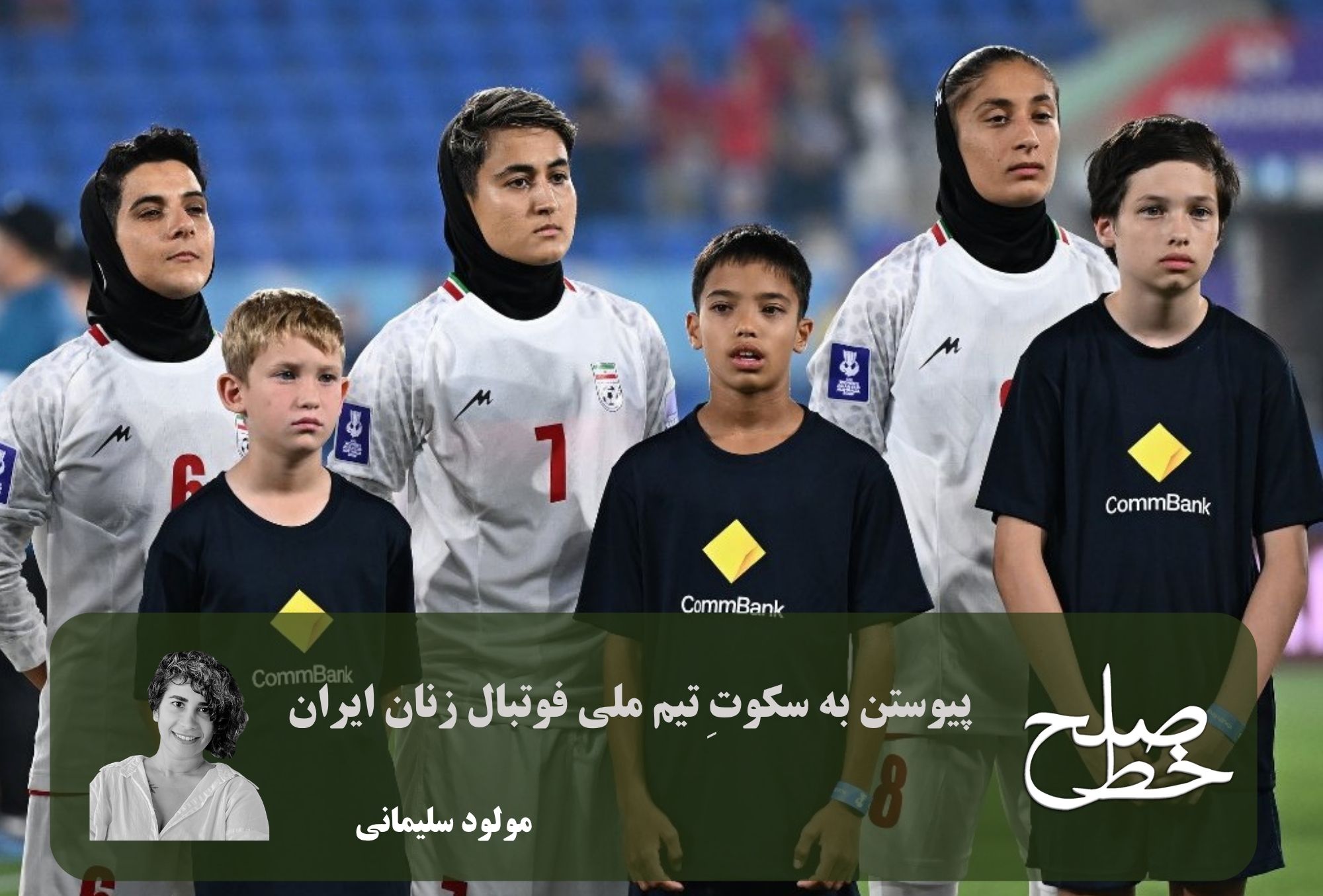
Joining the silence of the Iranian women’s national football team/Moloud Soleimani
The news begins with the act of silence by members of the Iranian women’s national football team in a match against South Korea at the Asian Cup in Australia. At the beginning of the match, the national anthem of the Islamic Republic is played. The camera moves over the faces of the female footballers; over their lips that do not move and their eyes that are staring straight ahead. The national anthem continues, unaccompanied by the women’s voices. The camera pans over the face of Marzieh Jafari, the team’s head coach, who looks at the women with pride. The women stand firm and are still silent. The sound of applause from the spectators comes. The national anthem ends and the women remain silent.
In this text, I intend to address the activism of silence. If the national anthem invites the audience to read the glorious history of nations and takes its credibility from the players and spectators who put words to the background music, silence invites the reading of history and the systematic oppression of nations and the refusal to recognize it. Silence disgraces that glorious background music. Perhaps this is why it exposes the activist to danger. Silence itself is aware of that danger. Silence is not empty, but it wants to resist being translated. Although the media always translates it. In this case, since the members of the national team remain silent against the singing of the national anthem, this translation serves nation-centered narratives in various ways, whether on the part of the Islamic Republic, its opponents, or the governments of Australia and the United States.
The Islamic Republic’s response to this action is predictable. Iranian state broadcaster Mohammad Reza Shahbazi calls those who remain silent traitors to the country, dishonorable, and unpatriotic, and calls for a harsh response to them, a threat that raises concerns about the safety of the national team members. CNN quotes a source close to the team as saying: “The players are under tight security and the authorities are closely monitoring them, including a person who is said to be close to the Revolutionary Guards.” In another statement, the country’s attorney general’s office is urging the team members to return home so that “in addition to addressing their family concerns,” they are not “on the front lines of confronting the country’s enemies’ conspiracy.” Here, silence is immediately recoded as betrayal. The reference to “family concerns” is no coincidence. This reference shows how the regime uses kinship as a mechanism for control. The players are not just athletes; they are women, and it is precisely through this position that pressure is exerted.
In another statement, Ahmad Donyamali, the Islamic Republic’s Minister of Sports and Youth, claims that the Australian government has tried to make the players of the national women’s football team regret returning to the country with “seductive offers.” Mehdi Taj also accuses Australia of “holding Iranian women footballers hostage.” Shortly before these statements, a documentary aired by Australia’s News10 network showed a member of the Ministry of Sports and Youth’s security guard, Mohammad Rahman Salari, following female footballers down the stairs of the hotel where the national team players were staying, preventing them from leaving. Finally, in the next match against the Philippines, the players gave a military salute while singing the anthem, a process that bears many similarities to what we have witnessed in forced confessions by the Islamic Republic; a process that puts the activist back on the Islamic Republic’s turf by creating a contrasting image in the moment of activism.
US President Donald Trump, known for his staunch anti-immigration policies, responded by calling on the Australian government to grant asylum to the players, saying they could face persecution if returned to Iran. The Australian government subsequently granted humanitarian visas to five of the players. Tony Burke attributed the women’s act of silence and asylum to “being in Australia,” saying, “Australians should be proud that it was in our country that these women experienced a country where real options were open to them.” Here again, silence is appropriated, this time in the form of a liberal narrative of salvation and liberation. The players’ actions are interpreted as a sign of the moral superiority of another nation-state. What is omitted in this framework is the unequal global order that shapes both oppression and refuge. The very regimes that claim to protect and protect are often themselves complicit in other forms of violence, exclusion, and marginalization.
Throughout these processes, a group of Iranians outside Iran also tried to support the players. Iranians living in Australia formed a human shield in front of the bus carrying the players to the airport. In a video released that day, people can be heard standing next to the bus and shouting “Girl of the Lion and the Sun”; another symbol of the nation-centered narrative. According to an eyewitness account at Sydney Airport on Instagram, Iranians who gathered at Sydney Airport wandered between gates one and eight of Sydney Airport despite police warnings to find the footballers’ wives. Upon hearing the news that Golnoosh Khosravi’s mother had asked her daughter not to return to Iran, one wrote the message on her white dress, another bought a paper envelope and wrote on it: “Golnoosh, your mother said to stay.” Another bought a speaker to broadcast Golnoosh’s mother’s voice. The eyewitness account ends with the scene where the crowd of Iranians who went to Sydney airport hear the news of Golnoosh’s stay, and then “the flag of the lion and the sun began to dance.”
In this text, I do not intend to impose another meaning on that silence. Rather, I want to address the question: How can one join the protest that takes shape in silence without attaching a meaning or symbol from outside to it, and without considering it an empty act? How can one not deprive the actors of silence of their agency and recognize silence, and only silence, as an act? And how can one care for the actors of silence without speaking for them from a top-down position?
***
Perhaps, contrary to what this text claims, the news did not start with these women remaining silent. The news started with the fact that the Iranian women’s national football team, despite all the structural inequalities against female footballers, managed to become the only team in the Middle East to qualify for these competitions. Or the day that Zahra Ghanbari was at risk of being banned from football because her headscarf fell off while celebrating after a goal. Or the day that Atefeh Ramezanizadeh, at the championship celebration of her team, Khatoon Bam, raised the victory trophy with a sad face in honor of the dead. Or perhaps it was the news that female footballers do not have a training ground; as Golnoosh Khosravi wrote: “Many times they did not even give us a grass field to practice on, like the situation of many of our female footballers.” Or perhaps it was the news that out of a total of 51 active sports federations in Iran, in recent years, only 2 federations have been headed by women. Or that the wrestling, football, taekwondo and weightlifting federations, with the largest share of Iran’s sports budget, have the lowest share of women in management positions. Or that the gap in the annual income of the best female footballer is equal to the income of one-fifth of the lowest contract of a bench player in the men’s league. As Zahra Khajoui, the goalkeeper of the national women’s football team, told the Iranian media: “The salaries of female footballers are not one-tenth of those of male players. Women’s football contracts are in no way comparable to men’s, and many players have to have second jobs.” Or perhaps it was the news that Zahra Azadpour, a Premier League player, was shot dead by Islamic Republic forces. Or that day when her friends and teammates sang a song at her grave at her 40th birthday party.
***
Among the players, Atefeh Ramezani Zadeh and Fatemeh Pasandideh attended the women’s soccer practice “Brizin Rouz” and practiced without the mandatory hijab. Mona Hamidi, Zahra Sarbali, and Mohaddeseh Panahi withdrew their asylum applications. The rest of the women returned to Iran. The Football Federation announced in a statement the arrival of “three Iranian children in Malaysia,” saying that Farideh Shojaei, the federation’s vice president for women, and Marzieh Jafari, the team’s head coach, welcomed them: “Mona Hamoudi, Zahra Sarbali, and Zahra Meshkinkar, three members of the Iranian women’s national soccer team, who in a patriotic decision rejected Australia’s seductive and political offer of asylum, arrived in Malaysia a few minutes ago.”
***
In response, I return to the beginning of the text and join the silence of female footballers while singing the anthem of the Islamic Republic.
 Created By: Moloud Soleimani
 March 21, 2026
Tags
Atefeh Ramezani Zadeh Australia Fatima Pasandideh Moloud Soleimani Not singing the national anthem peace line Peace Line 179 Team Brizin Roz Women's National Team ماهنامه خط صلح