


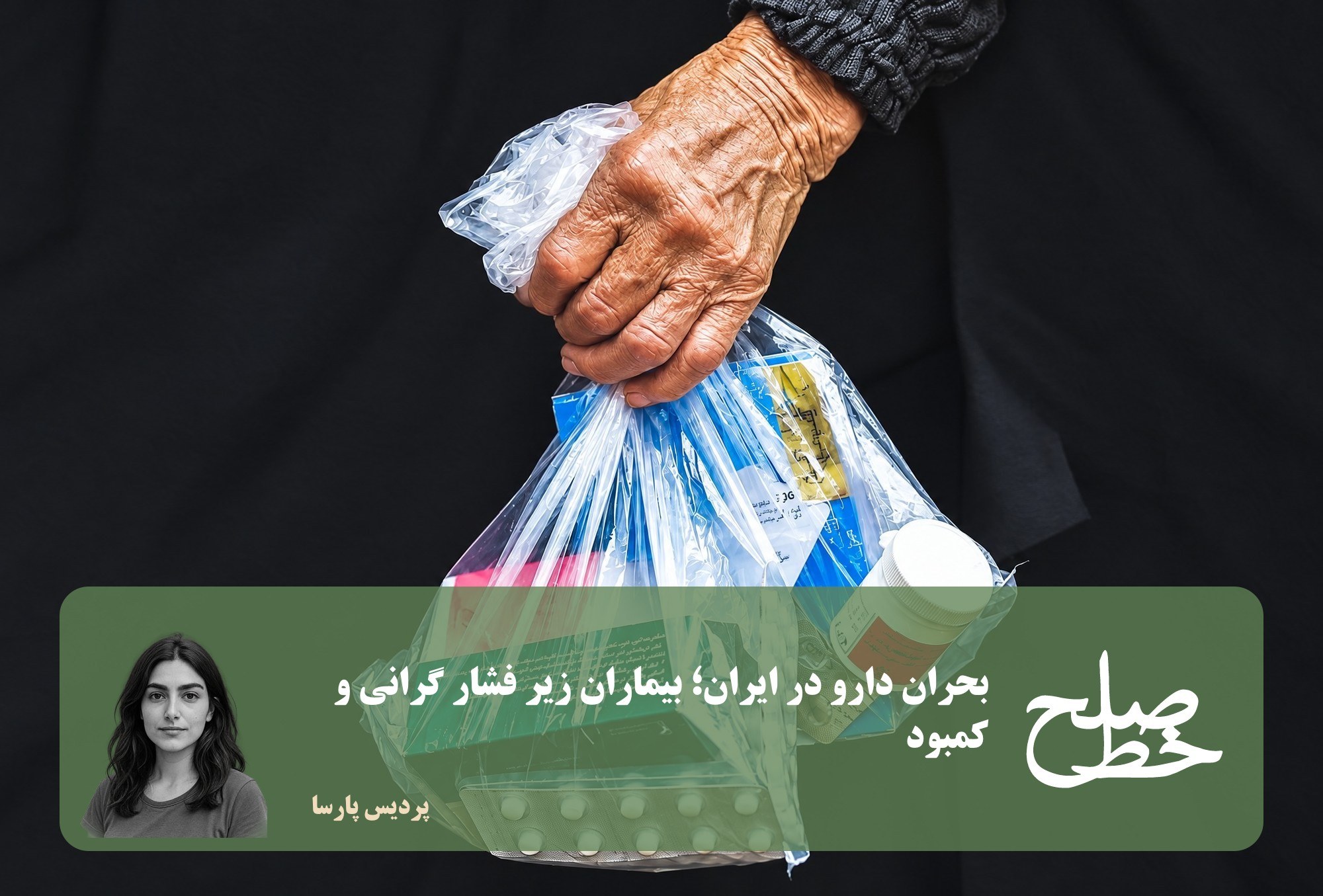
Iran’s Medicine Crisis: Patients Under Pressure from High Prices and Shortages / Pardis Parsa
In recent months, Iran’s pharmaceutical system—following economic developments and the consequences of the 40-day war—has faced multiple challenges. Changes in foreign-currency allocation policies, the accumulation of debts owed by insurance organizations to pharmacies and manufacturers, and rising production costs have led to a significant increase in medicine prices and the emergence of shortages. The direct social consequence of this trend has been severe financial pressure on patients and a shift in household patterns of medicine use, to the point that economic considerations have become one of the determining factors in whether patients continue or discontinue treatment.
Rising prices and medicine shortages
The continued rise in medicine prices and reduced insurance coverage have meant that a significant share of patients, due to inability to pay, cannot afford to purchase all items prescribed on a doctor’s prescription and are forced to omit some items or shorten their course of treatment.
“Ali,” a pharmacist at a pharmacy in Tehran, tells Peace Mark about changes in customers’ purchasing patterns and daily price fluctuations: “When patients hear the final cost of the prescription, they start calculating expenses and take fewer of their medicines. For example, a mother who is a long-time customer of the pharmacy bought only 10 days’ worth of her young child’s medicine so she could buy the rest at the end of the month. Patients with chronic illnesses like diabetes also buy only as much medicine as is covered by insurance; for instance, instead of three packs of tablets, they buy one or two so they do not have to pay the full, out-of-pocket price. Prices have risen dramatically. A blister pack of Gelofen painkillers that cost 30,000 tomans before the war has now reached about 90,000 tomans, and because prices change daily, we have to check the price of each medicine in the system moment by moment.”
Many patients, unable to cover treatment costs, arbitrarily reduce their dosage or stop taking their medicines. “Farzaneh,” 21, who has depression and attention deficit hyperactivity disorder (ADHD), says about the consequences of rising medicine prices: “After the 40-day war ended, I ran out of my medicines, but because they had become more expensive I could not afford to buy them again, and I had to gradually cut back. The cost of my prescription in 1403 was close to 200,000 tomans, but after the war it rose to about 1 million tomans. Reducing and stopping the medicines caused severe sleep problems, to the point that I had to buy melatonin supplements at a discount from a website to be able to sleep. Everything has become very expensive; the cost of each IV vitamin infusion has gone from 100,000–200,000 tomans to 600,000–700,000 tomans. One of my friends who had caught a cold had to spend nearly 2 million tomans just on an IV and antibiotics.”
Pharmacists emphasize that selective use of medicines and failure to complete treatment courses by patients with contagious diseases—who must be present in society to earn a living—increases the risk of disease transmission and threatens public health.
In addition to price increases, many medicines have become scarce or unavailable. “Reza,” who has visited 24-hour pharmacies in Tehran to obtain lisdexamfetamine mesylate capsules under the brand name Vyvanse, tells Peace Mark Monthly about his experience: “The medicine I bought two months ago on the open market for 3 million tomans was quoted yesterday at 6.5 million tomans. I went to the 13 Aban and 29 Farvardin pharmacies, and both said they do not have it in stock. I do not know where I am supposed to find these medicines.”
Patients with chronic non-communicable diseases—including cardiovascular and diabetic patients who require daily, lifelong medication—experience the greatest pressure from rising prices and medicine shortages. “Saeed,” who has heart disease, says about the increase in his treatment costs: “The medicine I have to take regularly cost about 1.3 million tomans up to Tir 1403, and now it has reached 12 million tomans.”
“Ehsan,” whose mother needs continuous medication due to a pacemaker implanted in her heart, tells Peace Mark in response to rising medicine prices: “I have fully felt this situation. For three years I have been getting my mother’s medicines; she has a heart condition and because they implanted a pacemaker in her heart, she must always take these medicines. Three years ago, the total cost of all her pills came to nearly 1.5 million tomans, but now the price of just one blister strip of one of her pills has reached 700,000 tomans. In these conditions, the cost of treatment has become so high that one should not even get sick.”
In addition to higher prices, restrictions imposed on dispensing medicines have also imposed heavy ancillary costs on families. “Parvin,” a 50-year-old citizen who cares for her mother with severe heart disease, says about these problems: “My mother takes about 17 pills a day, and these medicines are both expensive and hard to find. The price of her routine middle-ear liquid medicine, which used to be 100,000 tomans for three blister strips, has now become 80,000 tomans per strip. Doctors used to prescribe three-month prescriptions for heart patients, but now patients are told they will only be given one month’s supply. This decision has meant that elderly patients and their families must each month obtain a new appointment and pay the doctor’s visit fee again. To obtain some scarce medicines, the patient must first go to the doctor for a new prescription, then go to the Red Crescent to have it approved, and finally go to the pharmacy.”
Shortages of vital antiplatelet and anticoagulant medicines such as Plavix and warfarin directly threaten the health of patients with cardiac stents or artificial heart valves. “Nasrin,” who lives in Kermanshah, tells Peace Mark about her husband’s medicine becoming unavailable: “This month, for my husband—who has had five stents placed in his heart—no matter how much we searched in Kermanshah for Plavix tablets, we could not find them, even though last month we bought the same medicine for 1.4 million tomans.” “Hamid,” a patient who needs continuous use of the anticoagulant warfarin, also expresses concern about the risks of changing brands: “I take English warfarin under the brand name Crescent, which cannot be found in any pharmacy. Everywhere I go, there is a different Indian, Iranian, Finnish, or Spanish version. This is an anticoagulant, and you cannot change its brand each time. I am worried that in the end I will not be able to find my medicine.”
Among diabetic patients as well, rising prices of insulin and blood-sugar control tablets have placed additional financial pressure on families. “Sina” tells Peace Mark about his mother’s monthly treatment costs: “Over the past two or three months, each time I bought medicine for my mother, I paid 6 million tomans for the tablets and 4 million tomans for insulin, and this month alone the medicine cost nearly 10 million tomans. In a few days I have to buy insulin again, and it is not clear how much it will cost this time.”
“Naimeh” also adds about the cost of diabetes medicines: “Medicine has become very expensive; if you do not have insurance, for a blood-sugar control tablet that the patient must always have with them, you have to spend 1.8 million tomans per month.”
Insurers’ debts to pharmacies
A large share of current shortages stems from financial blockage and disruptions in cash flow across the production and distribution chain. With 18,300 pharmacies, more than 100 drug-manufacturing plants, and 50 companies producing raw materials and packaging, the country’s pharmaceutical network has the necessary infrastructure to meet a large portion of domestic needs; however, long delays in the return of financial resources by insurance organizations have severely weakened this chain’s financial capacity.
Hadi Ahmadi, spokesperson and board member of the Iranian Pharmacists Association, noting that the prices of some medicines have risen by up to 300%, says about the current state of the medicine market: “At present, 150 to 200 medicine items in Iran are in shortage, and if this trend continues, there is a possibility that shortages will increase.” (1) He also says about the root of pharmacies’ financial problems: “The main problem in the country’s medicine sector is a lack of liquidity, because insurance organizations and the Targeted Subsidies Organization are not fulfilling their legal duties. These organizations owe pharmacies more than 80,000 billion tomans, and over 8,000 billion tomans of pharmacies’ checks nationwide have bounced.” (2) Delays in paying pharmacies’ claims have reduced patients’ access to medicines. “Maryam,” a pharmacist, tells Peace Mark: “For six months, pharmacies’ claims have not been paid. When a pharmacy does not receive payment for medicines it has dispensed to patients for months, while at the same time medicine prices and procurement costs rise day by day, how is the pharmacy supposed to buy medicines again? Some medicines exist in the country, but due to lack of liquidity, the pharmacy cannot afford to purchase and restock them. Ultimately, this problem is not only the pharmacy owner’s issue; if the medicine supply chain is damaged, the patient is harmed as well.”
The crisis of scarce specialty medicines
Supplying medicines for patients with special diseases—including about 80,000 dialysis patients, 23,000 thalassemia patients, and more than 16,000 hemophilia patients—depends directly on currency policies and the performance of insurance companies. A review of the situation of thalassemia patients shows that removing the preferential exchange rate for imported medicines due to the existence of domestic equivalents has created multiple treatment and economic challenges. Younes Arab, CEO of the Iranian Thalassemia Association, says about these patients’ medicines: “The open-market price of each Jadenu iron-chelating tablet is about 800,000 tomans, and a patient who takes 60 tablets a month must pay nearly 50 million tomans per month just for this one medicine item. The Food and Drug Organization had removed its preferential exchange rate due to the existence of a domestic equivalent, while the domestic equivalent has caused side effects for many patients, and recently the Food and Drug Organization has reinstated the preferential exchange rate for Jadenu so it can be offered at an appropriate price. Also regarding the injectable medicine Desferal, with the removal of the preferential exchange rate and insurers’ unwillingness to cover it, a heavy financial burden has been transferred to the patient. In the case of hydroxyurea, which is used in thalassemia and chemotherapy, Indian and Iranian versions do not have a noticeable effect in treatment, but the Food and Drug Organization has cut the preferential exchange rate for the high-quality German version due to domestic production.” (3)
In the area of hemophilia patients as well, banking sanctions and challenges related to quality control of domestic production have disrupted patients’ access to stable treatment. Ahmad Ghoveydel, former CEO and a member of the general assembly of the Iranian Hemophilia Society, says: “Since a year ago, with the sanctioning of the Iran-Europe Commercial Bank, imports of factors 8 and 9 from Germany stopped. Domestic production of recombinant factors 8 and 9 has to some extent compensated for the shortage, but the quality of the medicine differs in each production batch, and the main flaw of domestic products is the lack of precise laboratory and scientific quality control after production by the Food and Drug Organization. Also, about 20% of patients are sensitive to the recombinant product and must use imported plasma-derived medicine, for which delayed currency allocation causes periodic shortages.” (3)
Geographic inequality in the distribution of medicines and equipment
Field evidence indicates a significant gap between the capital and other provinces in access to imported medicines and medical equipment.
“Habibeh,” who lives in Babol and for some time has been taking sertraline (Asentra) on her psychiatrist’s prescription, tells Peace Mark: “In our city, wherever I looked, Asentra tablets were not available, so I had to come to Tehran to buy them. Even in Tehran, every pharmacy I went to did not have the 100 mg dose; only 50 mg was available, and even that has become 680,000 tomans per pack, whereas last year it was three hundred and something.”
Also, according to several patients, while foreign warfarin can be found in some pharmacies in Tehran, patients living in other cities are deprived of access to it. Younes Arab, CEO of the Iranian Thalassemia Association, confirming this geographic imbalance, has stated that despite the presence of about 14,000 thalassemia patients in the south and more than 5,000 patients in the north of the country, high-quality imported medicines are mainly distributed in the central part of the country, and the share of peripheral provinces has been limited to ordinary or domestically produced medicines. (3)
Footnote:
1- 150 to 200 medicine items faced shortages, Tejarat News, Bahman 4, 1404.
2- Insurers’ 80,000-billion-toman debt to pharmacies / 8 “hemats” in bounced checks!, Fararu, Aban 10, 1405.
3- Mirhamidi, Farzad, The plight of hemophilia and thalassemia patients, Shargh Daily, Aban 12, 1405.
 By: Pardis Parsa
 November 22, 2026
Tags
Chronic diseases Drug shortage High medicine prices Insurance Medicine crisis Pardis Parsa Patients peace line Peace Line Monthly Peace Mark 187 pharmacy the 40-day war