


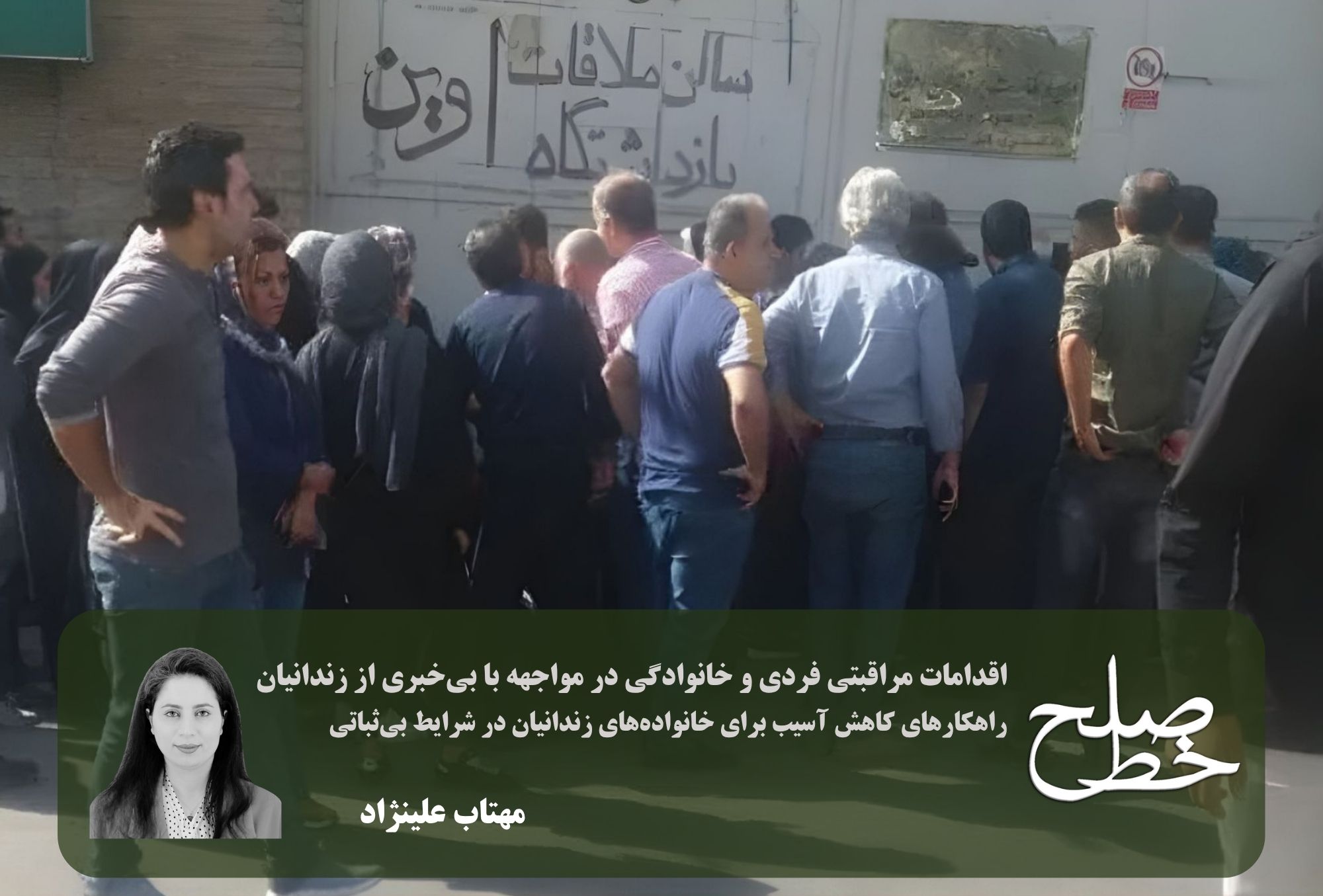
Individual and Family Care Measures in the Face of No News About Prisoners/ Mahtab Alinejad
Nights grow dark earlier than ever; not because of blackout, but because of the weight of something no one can quite name. When the siren sounds, the mother involuntarily places her hand on her chest, the very place where she last heard her son’s voice, over a crackling phone line that was cut off too soon. After that, only silence. No news, no call, not even a believable rumor.
The house is small, but these days it seems larger and emptier. The father sits beside the old radio, slowly turning the dial from one frequency to another. The news is about cities, about explosions, about places that no longer resemble what they once were. But they never say anything about prisons. As if those places lie outside the map, outside the news, outside the world.
When the first missile landed near the neighborhood, the windowpanes trembled. The family’s young daughter woke with a start and asked in a shaking voice, “Can it be heard there too?”
No one answered. Where is “there”? A cell they do not know how far it is from the city? A basement that may not even see the light of day? Or a building that may itself now be a target?
From that night on, each time an explosion is heard, the mother murmurs something under her breath; not a prayer in its usual sense, more like a conversation with no answer: “Don’t be afraid… the sound will pass… it will end…” As if she wants to fill the distance between this house and that unknown prison with words.
The father speaks less. But every day, at a fixed hour, he sits in the same place where they used to put the telephone. As if he is still waiting for it to ring. He even changed the telephone cord once, without anyone asking him to. He said maybe that had been the problem. No one objected.
On the wall, their son’s photograph is still in the same place. His smile belongs to a time when the world was more comprehensible. Sometimes the daughter speaks to him softly, so that her mother and father will not hear. She says simple things: about school, about the friend who no longer comes to class, about the sound of missiles. Once she also asked, “If he gets very scared, can he close his eyes?”
No one knows what is happening on the other side of this silence. Are the prison walls still standing? Are the guards still there? Is there anyone to open the door, or even to explain the sound of the explosions? This not-knowing, like a dense fog, has swallowed everything: images, sounds, even hope.
And yet, every morning they still brew tea. The mother still pours a share for him into a glass too, then quietly empties it after a few minutes. This small act may be the only thing that preserves order; a faint but stubborn sign that life, even amid fear and silence, has not completely fallen apart.
And amid the sound of sirens and the trembling of glass, something invisible has remained alive among them: waiting; a waiting that has neither shape nor time, yet all three of them, without speaking of it, carry it within themselves; like a dim light that has not yet gone out.
In such an atmosphere, somewhere between the sound of sirens and the silence of the telephone, families are confronted not only with the absence of news, but with a gradual, nameless erosion. Although from the outside this condition may look like “waiting,” within it lies a set of psychological pressures, disruption in decision-making, and instability in everyday functioning. It is precisely at this point that individual and family care measures go beyond a simple recommendation and become a necessity for survival and for preserving cohesion.
In conditions of war, political crisis, or social instability, one of the most vulnerable groups is the families of prisoners, especially when contact with the imprisoned person is cut off or their condition is shrouded in uncertainty. This situation not only creates severe psychological pressure, but can also affect the structure of family life, daily decision-making, and even the physical health of family members. In the absence of effective support from civil institutions and support structures, adopting individual and family care strategies becomes doubly important.
Managing the Psychological Crisis: Accepting Uncertainty
Lack of news about the condition of a loved one is one of the most difficult and exhausting forms of psychological stress. In such circumstances, the human mind naturally tries to fill the informational void with the worst possible scenarios; a process that gradually intensifies anxiety and erodes psychological resilience.
The first step in psychological care is accepting “uncertainty” as a temporary but unavoidable reality. This acceptance does not mean surrender or abandoning efforts to seek answers, but rather a way to prevent the continual erosion of the mind and preserve a minimum degree of psychological balance.
Along this path, using simple but effective strategies can be helpful. Writing down thoughts and worries, practicing calming exercises such as meditation or deep breathing, and having honest conversations within the family can help release psychological pressure. The importance of these conversations lies in enabling family members to express their feelings—from fear and anger to hope and confusion—without judgment or suppression.
Creating such a space not only prevents the accumulation of tension, but also helps strengthen empathy and family cohesion in the face of crisis.
Preserving Family Cohesion: Transparent Dialogue and Taking on Roles
In crisis conditions, one of the first harms is disruption in family communication. Families may, because of fear, shock, or an effort to protect one another, move toward secrecy, denial, or partial transmission of information; an approach that can lead, especially for children, to greater anxiety, confusion, and a sense of insecurity.
Transparent, honest, and at the same time thoughtful dialogue plays an important role in preserving the family’s psychological balance. Information should be provided in a way that is appropriate to people’s age, level of understanding, and emotional capacity, especially in the case of children. The goal of such conversations is to create a sense of safety and trust, not to transfer the full burden of adult worries.
Alongside effective communication, redefining roles within the family is also essential. In the absence of one of the principal members—especially if that person had a key role in providing for or managing the family—it is necessary for responsibilities to be distributed flexibly and collaboratively among the other members. This redistribution not only prevents excessive pressure from falling on one individual, but also helps strengthen the sense of cooperation, solidarity, and control in unstable conditions.
Documentation and the Preservation of Information
In conditions of war, political crisis, or widespread instability, access to information is often limited, scattered, or contradictory. Families may confront different accounts, rumors, or incomplete news, and this situation itself can intensify the sense of confusion and helplessness. In such an atmosphere, one important and practical step for families is the accurate recording and documentation of information related to the imprisoned person.
This documentation may include such matters as the date of the last contact, the content of the last conversation, the name or probable address of the place of detention, the dates of any possible transfers, the names of officials or agents who contacted the family, and any information related to the case or the legal status of the imprisoned person. Even details that may seem unimportant at first glance—such as the exact time of a call or the name of the person who answered—may later become important in legal or humanitarian follow-up.
In many crises, the families of disappeared persons or prisoners find themselves in a condition that researchers refer to as “ambiguous loss”; a condition in which the person is physically absent, but emotionally and psychologically still present in the life of the family, and there is no certainty about their fate. This type of loss is considered one of the most difficult forms of psychological pressure for families, because the lack of clear information disrupts the possibility of adaptation and decision-making.
For this reason, keeping physical and digital copies of documents, letters, messages, photographs, or any evidence related to the imprisoned person is of great importance. It is better for these materials to be kept in several safe places, and for a copy of them to be entrusted to a trusted person as well. Such a step is useful not only for possible future follow-up, but also because it gives families a sense of relative control over a situation that otherwise seems entirely beyond their power.
Creating Informal Support Networks
In many crisis situations, civil organizations or support institutions either do not exist or are not capable of responding to the extensive needs of families. In such circumstances, informal support networks can play a vital role in reducing psychological and social pressure.
These networks can emerge through contact with other families of prisoners or disappeared persons; families who have had a similar experience and can share information, experience, and even their limited resources with one another. Such contact not only helps with the exchange of information, but also shows families that they are not alone in this experience.
The feeling of “not being alone” is one of the important factors in strengthening psychological resilience. Many studies on the families of disappeared persons show that isolation and social silence can intensify psychological pressure and even lead to family conflicts. By contrast, contact with others and having a space to talk about a shared experience helps reduce tension and rebuild a sense of solidarity.
These support networks can take different forms: small discussion groups, informal contacts among a few families, or even support circles among friends and relatives. What matters is that families have a space in which to express their experience, and a space where their pain and worry are not denied or minimized.
Caring for Children and Vulnerable Individuals
Children and adolescents are among the most vulnerable family members in such circumstances. They often do not fully understand the political or social complexity of the situation, but they feel very well the emotional changes and anxiety of the adults around them. Prolonged silence, secrecy, or vague answers may take shape in a child’s mind as greater fears and anxiety-laden imaginings.
For this reason, information should be conveyed gradually, honestly, and in a manner appropriate to the child’s age. It is not necessary to tell all the details, but the child should know what has happened and why certain things have changed. Such honesty, even when accompanied by uncertainty, helps create a sense of trust and security.
Likewise, maintaining daily routines is of tremendous importance for children. Activities such as going to school, playing, visiting friends, or having regular daily schedules help them experience a kind of inner stability amid outward chaos.
Alongside these measures, parents should pay attention to signs of anxiety or depression in children: changes in sleep patterns, recurring nightmares, loss of appetite, decline in school performance, withdrawal, or sudden aggression. Paying attention to these signs and providing a safe space for conversation can help prevent short-term anxiety from turning into deeper psychological harm.
Maintaining the Everyday Functions of Life
In times of crisis, one of the first things to suffer is the order of daily life. Constant anxiety, following the news, or trying to find information about the imprisoned person can consume all of a family’s mental energy and disrupt ordinary life activities.
Yet preserving a minimum of everyday functioning, even in its simplest form, plays an important role in maintaining psychological balance. Doing ordinary tasks such as cooking, daily shopping, going to work, or taking care of household matters reminds the mind that life is still continuing.
Psychological research shows that in the face of loss or silence, people adapt better when they are able to strike a balance between confronting pain and continuing everyday activities. This movement between grief and daily life is a natural part of the process of adapting to crisis.
Caution in the Face of False Information
In conditions of war, instability, or the suppression of information, rumors spread with great speed. News circulated through informal networks, cyberspace, or undocumented quotations can quickly create false hope or fear.
For families living in a state of no news, every small piece of information can carry an enormous emotional weight. For this reason, dealing with information requires caution and discernment. It is better for families to trust only sources that can be examined or confirmed to some degree, and to refrain from quickly believing or recirculating unconfirmed reports.
This approach not only prevents heightened anxiety, but also helps avoid exhausting cycles of hope and despair.
Attention to Physical Health
Long-term psychological pressure often manifests itself in the body. Insomnia, persistent headaches, chronic fatigue, a weakened immune system, or heart problems are among the common consequences of chronic stress. In conditions where families remain constantly in a state of worry and waiting, attention to physical health becomes a necessity.
Regular sleep, proper nutrition, and bodily activity—even in the form of a short walk—can help reduce physiological tension. Likewise, having brief moments of mental rest, such as reading, prayer, music, or artistic activities, can mitigate part of the psychological pressure.
Taking care of oneself in such conditions is not a sign of indifference toward the imprisoned person; rather, it is a necessary condition for preserving the family’s strength to continue.
Realistic Hope
One of the most difficult dimensions of living in silence is maintaining a balance between hope and reality. Excessive hope can lead to severe despair, while complete hopelessness destroys the ability to continue living.
Realistic hope means accepting difficulties and uncertainties while preserving the possibility of change. Many families who face ambiguous loss fluctuate between hope and sorrow, and this fluctuation is a natural part of their experience.
Under such conditions, hope may take on smaller forms: hope of hearing some news, hope of preserving the family, or hope of continuing life despite all the uncertainties. These small hopes are sometimes the very force that keeps families standing through long periods of waiting.
Lack of news about the condition of a prisoner places families in an exhausting and suspended state that can leave deep psychological, social, and even physical effects on their lives. This condition, known in psychological literature as “ambiguous loss,” is considered one of the most complex forms of human grief and anxiety.
In circumstances where support from formal or civil institutions is limited, reliance on individual and family care strategies acquires particular importance. Documenting information, creating support networks, caring for children, preserving the daily order of life, managing exposure to news, and paying attention to physical health are all measures that can help reduce harm and strengthen family resilience.
And in the end, life in such a condition neither comes to a halt nor fully continues; it flows in a suspended state between being and not being. Families learn to live with the empty chair beside the dinner table, with the telephone that does not ring, and with a name that is repeated in the house every day but receives no answer. This living is not born of habit, but is a form of quiet resistance, a resistance against forgetting, against collapse, and against the extinguishing of hope.
At the heart of this silence, what remains is a set of small but decisive acts: recording a date, speaking an honest sentence, maintaining a relationship, caring for a child, or even keeping the house light on. At first glance these may seem insignificant, but in reality they are the columns that hold life upright under conditions in which everything else is at risk of collapse.
And perhaps hope, in such an unstable world, is no longer a great and distant dream; rather, it takes shape in these very small and repeated moments. In the persistence to go on, in refusing to accept forgetting, and in the quiet but stubborn belief that says: even in absolute silence, bonds do not disappear.
What enables many of these families to endure through years of waiting and silence is precisely this collection of small yet meaningful acts; acts that allow them to preserve their lives and their human bonds amid the darkness of uncertainty.
 Created By: Mahtab Alinezhad
 March 21, 2026
Tags
Ambiguous absence Iran-US war Mehrab Alinejad peace line Peace Line 179 Political prisoners Prisoners' harassment Trauma War War conditions ماهنامه خط صلح