


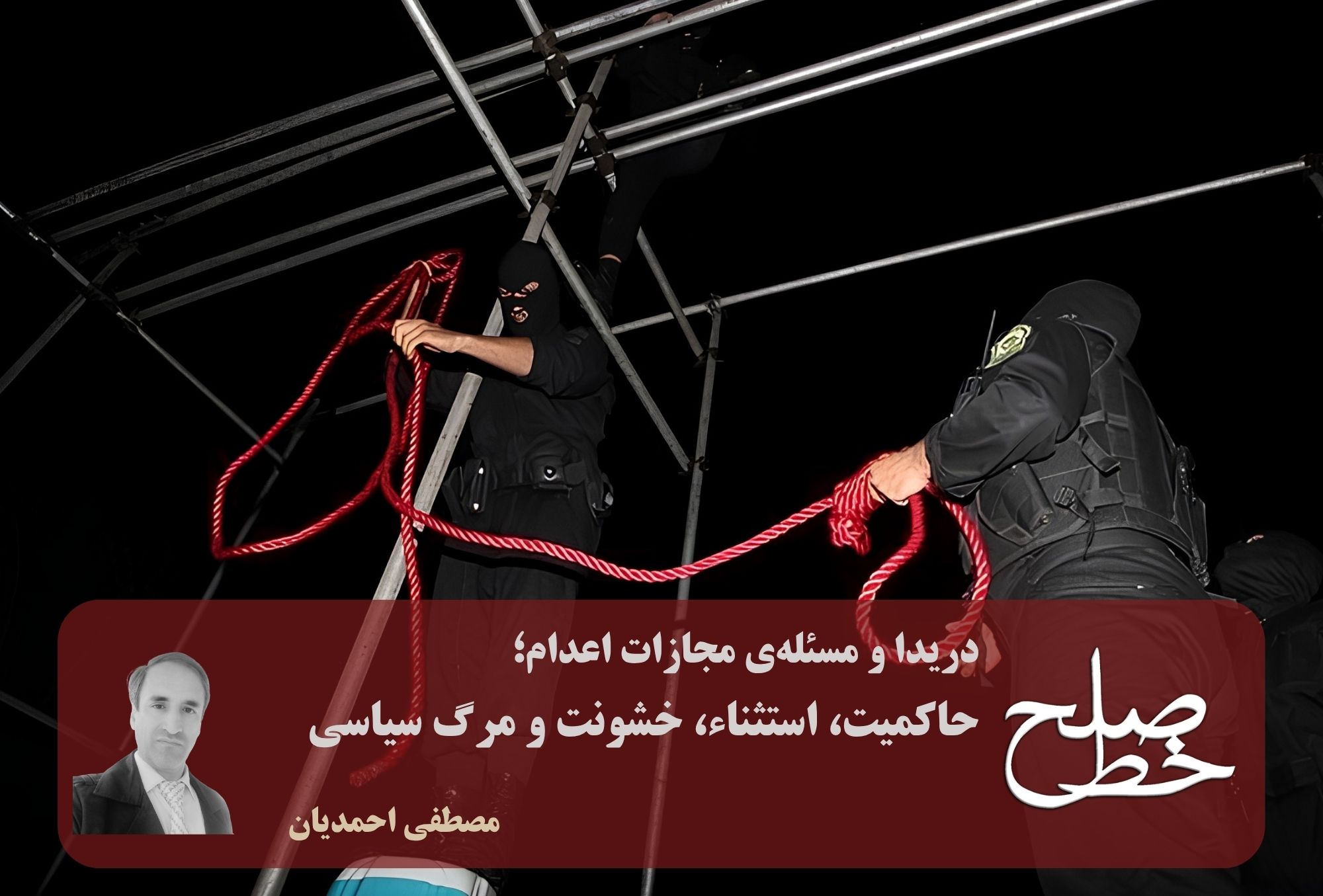
Derrida and the Question of the Death Penalty: Sovereignty, Exception, Violence, and Political Death/ Mustafa Ahmadian
Introduction: When the Law Arrives at Death
Discussions of the death penalty usually begin from a point that the law has already determined: what constitutes a crime, what constitutes punishment, and in which cases the most severe punishment—the deprivation of life—may be applied. For this reason, a large part of the legal literature on the death penalty, whether in its defense or its criticism, operates within boundaries that the law has already drawn. On one side, there is discussion of qisas, hudud, public security, proportionality of punishment, and the necessity of a penal response; on the other, of the right to life, human dignity, judicial error, the ineffectiveness of capital punishment, its social consequences, and the possibility of rehabilitation and the social reintegration of the convicted person.
Yet the question that Jacques Derrida, the French philosopher, raises in his two-year seminar on “The Death Penalty” lies at a point prior to this binary. He does not merely discuss whether a particular punishment is desirable or undesirable; rather, he questions the very legal and political possibility of transforming the killing of a human being into “punishment.” The central question begins here: how does an act that, in relations between individuals, is called murder acquire another designation when carried out by the state within the framework of law and become the “execution of justice”? Here, Derrida approaches one of the deepest points of connection between law and sovereignty: the point at which law not only restricts human freedom, but decides whether life will continue or end.
The Death Penalty seminar was held from 1999 to 2001 at the École des Hautes Études en Sciences Sociales in Paris and was later published in two volumes. In these sessions, Derrida reads Beccaria, Kant, Rousseau, Locke, Hugo, Camus, Genet, Nietzsche, Schmitt, and legal and religious texts alongside one another, taking the question of execution beyond the level of criminal punishment and into the domains of sovereignty, political theology, violence, forgiveness, exception, and the human relationship with death. One of the most ambitious objectives of this project is to formulate a philosophical argument against the death penalty—an argument that must confront Western philosophy’s longstanding complicity with the idea of sovereign authority’s right to take human life.
From this perspective, introducing Derrida into a broader study of executions in Iran does not simply mean adding the name of a philosopher to a list of sources. His significance lies in the fact that, with his help, the question can be shifted from “Who deserves to be executed?” to “What kind of power considers itself to possess the right to decide on a human being’s death?” This shift is of fundamental importance for studying a legal system in which qisas, moharebeh, baghi, efsad-e fel-arz, drug offenses, and other categories leading to deprivation of life exist alongside one another. At this level, we are no longer dealing merely with the number of legal provisions or the variety of criminal classifications, but with a conception of the human being, crime, justice, punishment, and political authority.
Execution and the Sovereign Right over Death
In Derrida’s thought, the question of execution is linked from the outset to the concept of sovereignty. The modern state understands itself as an institution capable of deciding, within the framework of law, on the lives and freedoms of citizens. But execution is the point at which this power reaches its extreme. The state no longer says, “You are not free,” or “You must be separated from society for a period of time”; it says, “Your life must end,” and it brings about that ending not as an unintended event, but as a deliberate, legal, and organized outcome.
Here, the concept of the “right to life” does not stand opposite the concept of a “right to kill,” as though the two were equivalent rights. The deeper question is this: should sovereignty possess such a right at all? Derrida seeks to reveal the historical and philosophical logic through which the state, as sovereign, comes to possess a power whose exercise by an individual would constitute murder. The distinction between murder and execution here is not merely a distinction between two acts; it is a distinction in the position from which the actor speaks. An individual kills, and the law calls that individual a murderer; the state kills, and the law calls the same act the execution of a sentence.
Legally, of course, this distinction is clear. In a system that recognizes it as lawful, execution is not unlawful killing; it is the implementation of a punishment prescribed by law and carried out after a judicial ruling. This distinction must be preserved, because lawful execution cannot, without legal analysis, simply be equated with extrajudicial killing or political killing. But philosophy begins its inquiry at precisely this point: what makes it possible for a legal system to remove the act of killing from the realm of murder and place it within the concept of justice?
This question leads Derrida to the concept of sovereignty. Execution is one of the purest scenes in which sovereignty can reveal itself, because sovereignty here is not merely legislation or the enforcement of law, but the claim to authority over the ultimate possibility of life. Analyses of Derrida’s seminar have likewise emphasized that he connects execution to the “sovereign right over life and death” and to the theological-political structure of sovereignty.
For this reason, in a Derridean reading, the abolition of the death penalty is not merely the removal of a cruel punishment from criminal law. In its deepest political sense, abolition means limiting sovereignty at the point where power seeks to establish its right to end human life.
Beccaria, Kant, and the Difficulty of Arguing Against the Death Penalty
It is here that the importance of Beccaria becomes clear. Beccaria was among the first in the modern era to question the necessity of capital punishment with unprecedented explicitness. His argument can be understood along two principal lines: first, that the state cannot take from human freedom more than is necessary to preserve order; and second, that punishment must be assessed in relation to its social necessity. From this perspective, if capital punishment is not genuinely necessary for the preservation of society, its justification becomes difficult.
This tradition was later continued in various forms within utilitarian thought. Here, the central question is whether execution actually produces results in terms of crime prevention, defense of society, or reduction of social harm that other punishments do not. More precisely, the debate concerns the “deterrent or non-deterrent” effect of capital punishment.
But Derrida is not satisfied even with these arguments. Beccaria’s importance for him lies precisely in the fact that opposition to the death penalty can remain within the logic of calculation: if execution is wrong because it serves no useful purpose, what would we say if its usefulness were demonstrated? In other words, if capital punishment is condemned because its deterrent effect has not been proven, would proof of deterrence once again render the death penalty legitimate?!
It is here that Derrida moves from a utilitarian opposition to execution toward a more principled opposition. The issue is not that execution fails to produce desirable results in every case; the issue is whether one can accept that the state, regardless of the degree of social benefit or harm involved, should in principle possess the right deliberately to end a human life.
Kant stands on the other side of this debate, which is precisely why his presence in Derrida’s seminar is particularly important. Kant defends the death penalty not merely because society needs it, but from the standpoint of justice and deserved punishment. Punishment must not merely be a means to some other end; a human being must not be punished merely as a means of intimidating others. If a grave crime has been committed, justice requires that the perpetrator receive a response proportionate to the act.
Derrida does not respond to this argument with an emotional defense of the convicted person. He seeks to show how the concept of justice, when tied to the logic of retribution, reaches a point at which the death of a human being is presented as a necessary, even indispensable, response. The issue here is not merely whether “life for life” is just; one must ask whether human life and death can be converted into equivalent units at all, such that they can be balanced against one another in a moral and legal reckoning.
In this respect, one of Derrida’s interventions in confronting the philosophical tradition of capital punishment is to deconstruct the logic of “equivalence.” If a crime has caused suffering, can that suffering truly be made equivalent by producing another suffering? If a life has been taken, does taking another life restore anything that has been lost? Punishment can declare criminal responsibility, separate the offender from society, and constitute a legal response to crime; but turning death into a unit of settlement contains a philosophical assumption that requires proof rather than something that can simply be inferred from the concept of “proportionality.”
Exception, Emergency, and Sovereignty
One of the most important concepts in Derrida’s seminar is exception. Indeed, specialized scholarship on the seminar has identified “exception” as one of its two principal axes.
Execution is ordinarily not a punishment for all crimes. It is always restricted to particular crimes, particular circumstances, and persons bearing particular designations. This very “particularity” has philosophical significance. Here, the law determines the boundary between life and the deprivation of life. In this sense, exception is not outside the law; rather, it is the place within the law where the law reveals its own limits.
In this context, Derrida approaches Carl Schmitt, the Catholic jurist and philosopher—not in order to accept his theory, but to demonstrate the relationship between decision, exception, and sovereignty. Schmitt defines the sovereign through the capacity to decide on the state of exception. Derrida’s concern is how this decision is situated within the structure of law and power, and how what appears to be an exception becomes the hidden foundation of the legal order.
In Derrida’s seminar, execution itself is also a kind of exception within the right to life. In a system where the general rule is the prohibition of killing, the law identifies a point at which killing becomes permissible. Derrida shows that this exception is not merely a legal margin; the exception helps us understand the law itself. Scholarship on the relationship between Derrida and Schmitt similarly emphasizes that, in Derrida’s discussion, the exception is neither wholly outside the law nor wholly within it, but is rather a “limit concept” that reveals the boundary of law.
Giorgio Agamben enters from this same point, although his path is not identical to Derrida’s. In Homo Sacer, Agamben’s concern is more closely related to a condition in which a human being may be exposed to killing without that killing constituting sacrifice in the ordinary sense of religious sacrifice—a human being placed in a zone where the law both includes them and places them outside its ordinary protection. For Agamben, the “state of exception” leads to a structural analysis of modern power and the production of “bare life.” Derrida, by contrast, works more with the contradictions and internal instabilities of the concepts of sovereignty, law, forgiveness, death, and exception themselves, and is less concerned with constructing a closed model of the state of exception. The distinction between the two is important for the present study: Agamben provides a useful tool for understanding how a human being can simultaneously be placed both outside and inside the law, whereas Derrida goes further in destabilizing the very claim of law and sovereignty to possess the right to decide on death.
Political Execution: When the Criminal Becomes the Enemy
In political execution, the issue appears in another form. Here, a human being may be subjected to death not merely because of a criminal act, but because of their political position, beliefs, affiliation, or the sovereign’s perception of the degree of threat they pose. Here, the distinction between “punishing conduct” and “eliminating an enemy” becomes fundamental.
Under ordinary conditions, the state claims that it has criminalized a specific act and applies punishment after that act has been proven. But when an individual is understood as an “enemy,” another logic can enter the picture. Here, the enemy is no longer merely someone who has violated the law; they are someone who threatens the political or security existence of the ruling order. In this way, the logic of emergency can replace the logic of punishment, and the “necessity of defense” can become a language legitimizing violence.
This is precisely where the concept of the “sovereign” and the sovereign’s decision become important. If the sovereign can define the situation in such a way that the individual is positioned as a threat, then the boundary between punishment and political elimination can collapse. This is also the principal danger: in a criminal justice system, the subject must be proven conduct; in the logic of political elimination, the person’s political existence itself may become the issue.
From this perspective, political executions cannot simply be regarded as more severe versions of ordinary executions. They have a different legal and political character. Qisas, executions resulting from certain ordinary crimes, or executions for drug offenses are, at least where the process is lawful, based on the claim of responding to a crime. But in political violence, the objective may no longer be to respond to an act, but rather to eliminate a person regarded as a “threat.”
This distinction becomes particularly important in the case of executions following political protests. When protest, opposition, or political participation in a protest movement is connected to extremely serious criminal charges, the question is no longer merely whether the correct legal classification has been selected. It must also be determined whether a genuine and proven relationship exists between the act attributed to the accused and the most severe punishment, or whether the individual’s “political identity” has gradually taken the place of their “criminal conduct.”
It is here that the principle of a fair trial acquires a meaning beyond a collection of procedural formalities. Access to a lawyer, the right to be informed of the charges and the contents of the case file, the opportunity to mount a defense, judicial independence, the possibility of appeal, the prohibition of torture, and the prohibition of forced confessions are no longer secondary procedural matters; they are barriers against the transformation of a human being from the “subject of judicial proceedings” into the “subject of political elimination.”
From Lawful Execution to Extrajudicial Killing
Alongside judicial execution, another form of lethal violence exists that must be distinguished from it both philosophically and legally: a situation in which an individual is not involved in a judicial process culminating in a death sentence at all, or has moved beyond the reach of the court and a shoot-to-kill order or killing order is issued against them, after which officers gain access to them and kill them in the street or elsewhere.
Even if described in the language of power with terms such as “escape,” “resistance,” “security threat,” or “shoot-to-kill order,” this act is structurally and fundamentally different from judicial execution. In judicial execution, the state claims to implement a punishment after trial and sentencing; in extrajudicial killing, the judicial process itself is set aside and the decision over death is transferred to the operational field.
Here, even the legal covering that lawful execution provides for itself no longer exists. If lawful execution can be called “killing authorized by law,” then here we encounter a form of “killing in the name of necessity”: necessity replaces judgment, and the executive power itself becomes the arbiter of death. This form of violence cannot be attributed to Derrida; but if we extend his logic to this point, an important distinction emerges. In lawful execution, sovereignty seeks to establish the right to kill within the language of law; in extrajudicial killing, the same power distances itself from the law and arrives at a direct decision over death.
At this point, the phrase “the animalization of the logic of power” must be used cautiously. The point is not that animals are inherently violent or devoid of morality; such an interpretation would also be inconsistent with Derrida’s complex discussion of “the beast and the sovereign.” Rather, the point is that when the legal relationship and the possibility of adjudication give way to direct reaction, hunting, pursuit, and elimination, power distances itself from legal logic and approaches a logic of sheer domination: the other is no longer someone who must be judged, but a being who must be eliminated before being reached or before returning.
In such cases, the distance between the “sovereign” and the “hunter” becomes a question for political philosophy. Sovereignty limits itself through law when it subjects even its enemy to trial; when the other is understood merely as a being available for destruction, something of that limitation collapses.
Foucault: Hidden Execution and Public Execution
Michel Foucault enters the discussion naturally at this point. In Discipline and Punish, the issue is not merely the severity of punishment; it is the form in which power is organized. Foucault shows how modern penal power moves from the open display of violence toward surveillance, discipline, classification, record-making, and the production of docile bodies. Punishment no longer necessarily exists so that power can display itself in the public square; power can operate in the prison, in the judicial file, in the medical record, in the interrogation room, and through institutional classification.
Public execution, however, constitutes an important exception to this trajectory. When a government carries out an execution before the eyes of the public, it is no longer merely seeking to end the life of a convicted person; it creates a scene of the relationship between power and that person’s body. The body of the condemned becomes a medium through which the message of power is transmitted.
In Iran, this issue is particularly noteworthy. Public execution is not merely the implementation of a sentence; “seeing” is itself part of the exercise of power. Society must see power and witness its materialization. Here, the public square is not merely the location of the execution; it is part of the mechanism through which punishment is given meaning.
From this perspective, hidden and public executions are not entirely opposite forms. In both, power must regulate its relationship with the gaze of society. A hidden execution may be removed from public view so that the violence of power is less visible; a public execution, by contrast, summons the public gaze. In his seminar, Derrida emphasizes the performative and public dimension of the structure of execution even in cases carried out inside prisons, because when the state takes a citizen’s life pursuant to law, the law itself and the authority of the state are represented in that scene.
In Iran, however, this issue must also be considered alongside Foucault’s analysis of the spectacle of punishment. Public execution, contrary to the historical trajectory by which punishment has been hidden from public view, returns the body of the condemned to the center of the scene. The gallows, the crowd, the officers, the media, and public space come together in a single scene, and the individual’s body becomes the bearer of a disciplinary and political message.
At the opposite end, we sometimes encounter situations in which even the official announcement of an execution occurs only after a prolonged period without information. The family, the public, and sometimes even the lawyer lack clear information about the status of the case and the individual’s fate, and then it is suddenly announced that the sentence has been carried out. Here, secrecy itself becomes part of power. “Not seeing” can have a political function just as “seeing” does. If public execution says, “Power can kill before your eyes,” a hidden execution followed by its sudden announcement may convey another message: “Power can also remove the time, information, and moment of death from your reach.”
In such circumstances, access to a lawyer and genuine communication between the accused and the defense acquire even greater importance. If an accused person is detained for a prolonged period, hears promises concerning the future of the case, pardon, or commutation, and ultimately the sentence is carried out without the possibility of an effective defense or transparent notification, the process of producing acquiescence, hope, and false expectation must itself be investigated. A promise that keeps the accused in a particular state and then ends with the sudden execution of the sentence can itself form part of the experience of institutional violence.
The Judge and Subjugation
Here, a bridge can be established between Derrida and Foucault that is highly important for understanding judicial structures. Foucault demonstrates that subjugation does not always begin with overt force. Power becomes sedimented in institutions, professions, hierarchies, files, training, and professional habits. The desk, the file, the form, the order, administrative rank, and organizational position can all carry power.
The judge, too, does not stand outside this institutional structure. The judge is a person trained within a professional, organizational, and legal structure, whose decisions take shape within a network of laws, directives, procedures, hierarchies, and institutional expectations. From this perspective, “domination” does not necessarily begin at the moment a judgment is issued; it may have begun at the very desk where a human being is turned into a case file, their name reduced to a case number, and their life entered into the judicial apparatus in the form of several charges, several reports, and several pages of minutes.
This point can be connected to Derrida’s discussion. Rather than focusing solely on the personality of the individual judge, Derrida leads us toward a structure in which a lethal decision can appear in the form of law, procedure, and official language. This is precisely where the danger lies: the more violence is absorbed into legal and administrative language, the less it may appear as violence.
Execution is ultimately carried out with a noose, but before that, it has passed across desks: the desks of the investigator, prosecutor, expert, judge, judicial branch, office, archive, and enforcement authority. In this sense, if we speak in Foucauldian terms, the instrument of subjugation is not merely the means by which the sentence is carried out; it is a network that gradually brings a human being to a position in which their death becomes, for the administrative apparatus, a “closed case.”
Execution, Technology, and Violence
In his discussion of the history of methods of execution, Derrida draws attention to an issue that might be called the “logic of desensitization”: a tendency to reduce the visible pain and violence of execution through technology. Within this logic, it is as though execution can be made increasingly technical so that its violence becomes less visible.
But this discussion cannot be transferred directly to Iran. Execution in Iran is at times carried out through methods whose violence is not concealed, and in public executions the body of the condemned and the moment of death are deliberately placed in public space. Thus, if in some systems the principal issue is the “concealment of violence behind technology” and through medical means, here we sometimes encounter the reverse situation: violence is not only left unconcealed but is brought onto the public stage.
This difference is philosophically significant. In both cases, power has decided upon death; but in one, it seeks to turn death into a technical and unobtrusive event, while in the other, it transforms it into a public scene for observation and influence. Derrida does not ultimately restrict the question to the method of execution; his fundamental question concerns the very act of “causing death” or “putting to death.” From its outset, Derrida’s inquiry distinguishes among “causing death,” “seeing someone die,” and “seeing someone punished,” and considers this chain important for understanding the structure of execution.
From this perspective, visible violence and technical violence are two forms of the same problem, rather than two entirely separate problems.
Execution, Time, and the Possibility of Reversal
One important aspect of capital punishment is that it transforms death from an unknown possibility into a date determined by someone else. All human beings die; but a person sentenced to death confronts a death whose time and circumstances have been determined by law and the state.
This difference is not merely the distinction between “natural death” and “judicial death.” The remaining time of the condemned person also becomes part of the punishment. They not only know that they will die; they know that a power external to them has decided upon this ending.
Here, the question of judicial error also acquires another meaning. Error can occur in any judicial system, but reversible punishments allow for the possibility of correction. With execution, error ends in death. If the person’s innocence is later established, rehabilitation can never restore their life.
Opposition to the death penalty, therefore, should not be reduced solely to the proposition that “a judge may make a mistake.” Derrida’s question is that even if we assume that the judicial apparatus is entirely certain in a particular case, the question still remains: can judicial certainty, however complete, create a right to kill?
Forgiveness and Pardon: The Other Side of the Power to Kill
The question of pardon and forgiveness also belongs within this same structure. A power capable of killing a human being can also refrain from killing them. At first glance, pardon represents the humane and ethical face of power; but at the level of political philosophy, it is the other side of the same authority.
If the state or sovereign can say, “This human being must die,” and then say, “I will not kill them,” both decisions rest on a shared presupposition: the life of the condemned has, to some extent, entered the domain of sovereign decision.
In this sense, forgiveness is not simply the opposite of punishment; it can reveal how power understands itself as possessing authority over life and death. Derrida, who had worked on “perjury and forgiveness” before the death penalty seminar, is not inattentive to the complexity of forgiveness. Forgiveness is not a right that can simply be explained through a legal formula. But when forgiveness is situated within the structure of penal power, one must ask whether it truly removes life from the domination of power, or merely transforms the decision to kill into a decision not to kill.
This question can also be examined in relation to annual pardons and sentence commutations in Iran. Pardon can be the most humane possibility within a penal system, but at the same time it should not cause the original question to be forgotten: why should sovereignty occupy a position in which a human life is first placed under the threat of death and then rescued from death through another decision?
Political Execution, Secrecy, and the Announcement of Death
In political cases, this issue assumes a sharper form. At times, society remains without clear information for months or years about the status of the case of a person detained on political or security charges. Access to a lawyer is restricted or effectively denied, the family is kept uninformed about the proceedings, and no official information is released. Then suddenly, through a statement or remarks by an official spokesperson, it is announced that the death sentence has been carried out.
Here, the “announcement” itself becomes part of the structure of power.
Death is no longer merely an event of which society becomes aware; its official announcement is the moment at which power also demonstrates its ownership over the narrative of the event. Before the announcement, society does not know what has happened to the individual; after the announcement, it is no longer possible to question that individual.
This situation must be examined alongside the fundamental right of access to a lawyer and the process of a fair trial. If the accused has been deprived of effective access to a lawyer for a prolonged period, if their defense has not genuinely been heard, if no possibility of appeal or independent review has existed, and the death sentence is then carried out, the issue is no longer merely the “correctness of the judgment”; the very course of the proceedings and the issuance of the sentence are themselves cast into utter disgrace.
Even if, in some cases, the accused has been given promises concerning pardon, commutation, a change in status, or the appointment of a lawyer of their choice, it must be asked whether such promises have become instruments for controlling their conduct and expectations during the judicial process. A human being who is kept waiting for relief and then suddenly confronted with the execution of a death sentence has had not only a punishment imposed upon them, but also their time, hope, and possibility of objection placed under the control of the power structure.
From Law to Justice: A Conclusion for Iran
If we follow this path from Beccaria to Kant, from Foucault to Derrida, and from Schmitt to Agamben, it becomes clear that the question of execution cannot be reduced merely to counting legal provisions. Execution is a legal institution, but at the same time it is also a political and historical institution. Behind every death sentence lies a conception of crime and justice; behind every execution, a conception of authority; and behind every decision concerning exception, a conception of those human beings who may be placed outside the ordinary protection of law.
Beccaria reminds us that punishment must be necessary and that penal power cannot be granted authority beyond what is required. The utilitarian school asks what demonstrable benefit execution provides to society and whether it can be justified by its actual consequences. Kant introduces the question of desert and justice and demonstrates that a defense of capital punishment can emerge from a highly serious moral and legal philosophy. Foucault shows how punishment is organized within networks of discipline, surveillance, and the production of docile bodies. Schmitt confronts us with the sovereign decision and the state of exception. Agamben shows how exception can place a human being in a condition in which they are both inside the legal order and excluded from its ordinary protection. And Derrida brings all these questions together at another point: in the question of sovereignty’s right to “put a human being to death,” and in the attempt to think about the abolition of capital punishment as an unconditional limitation on the power to kill.
Derrida ultimately takes a clear position against the death penalty: its abolition must be principled and unconditional, and we should not demand its abolition merely because in some cases it is not deterrent, because in some countries it is applied unjustly, or because judicial errors may occur. These reasons are important, but for him they are insufficient. The more fundamental issue is sovereignty’s very claim to possess the right to kill. Interpretive scholarship on the seminar has likewise emphasized that Derrida’s project moves toward a critique of the “sovereign right over life and death” and toward a principled renunciation of this sovereign right at this point.
This question has particular importance in Iran because, within the Iranian legal system, execution is not an exceptionally rare punishment, but is present across a diverse range of criminal categories and appears in different forms in areas ranging from qisas and hudud to drug offenses and political and security cases. In addition, public execution can still be used as a method of carrying out punishment, while in political cases the issues of trial procedures, access to a lawyer, forced confessions, transparency, and information concerning the case acquire particular importance.
Under these circumstances, criticism of execution can no longer be merely a criticism of the “gallows” or the “death sentence.” One must see the entire cycle that takes a human being from arrest to interrogation, from interrogation to a case file, from the case file to an accusation, from the accusation to a criminal classification, from the criminal classification to a sentence, and from the sentence to death. At each stage, an apparently administrative decision may be made; but the final result of all these small decisions is the irreversible deprivation of a human life.
In this respect, a philosophical analysis of execution can serve as an entry point into a broader study of the “philosophical foundations of execution and the political philosophy of capital punishment.”
And perhaps, ultimately, the central question is this: if justice must be distinguished from power, can it remain justice at the point where power decides permanently to deprive a human being of the possibility of continuing to live?
Derrida does not answer this question by rejecting the possibility of punishment altogether. His answer is directed at a specific point: the state should not retain the right to kill human beings as one of the ordinary rights of sovereignty. From this perspective, abolishing the death penalty is not a defense of one human being against society or sovereignty; it is a defense of society against the expansion of a power that, once it establishes the right to kill for itself, can always find new exceptions, necessities, enemies, and justifications for that right.
Perhaps the principal difference between a society that places justice before power and a society that presents power in the guise of justice becomes visible precisely at this boundary—a boundary at which it is still possible to say that a human being, even when called an accused person, a convict, an opponent, or an enemy, remains, before any other designation, a human being.
And the question of what mechanism has allowed power to turn the death of a human being into the final outcome of a legal, political, or security process.
In this sense, the question of execution is ultimately a question about the limits of power: about how far the law may go and from what point onward, even if the language of law continues to govern it, something in the nature of the relationship between the human being and power changes.
Derrida searches for this boundary in capital punishment, and his fundamental conclusion is clear: where the state takes its right to kill for granted, the issue is no longer merely the punishment of a human being; it is the limits of sovereignty itself.
 Created By: Mustafa Ahmadian
 September 23, 2026
Tags
Drug offenses Execution Murder Mustafa Ahmadian peace line Peace Line 185 Punishment Right to life State violence Violence ماهنامه خط صلح