


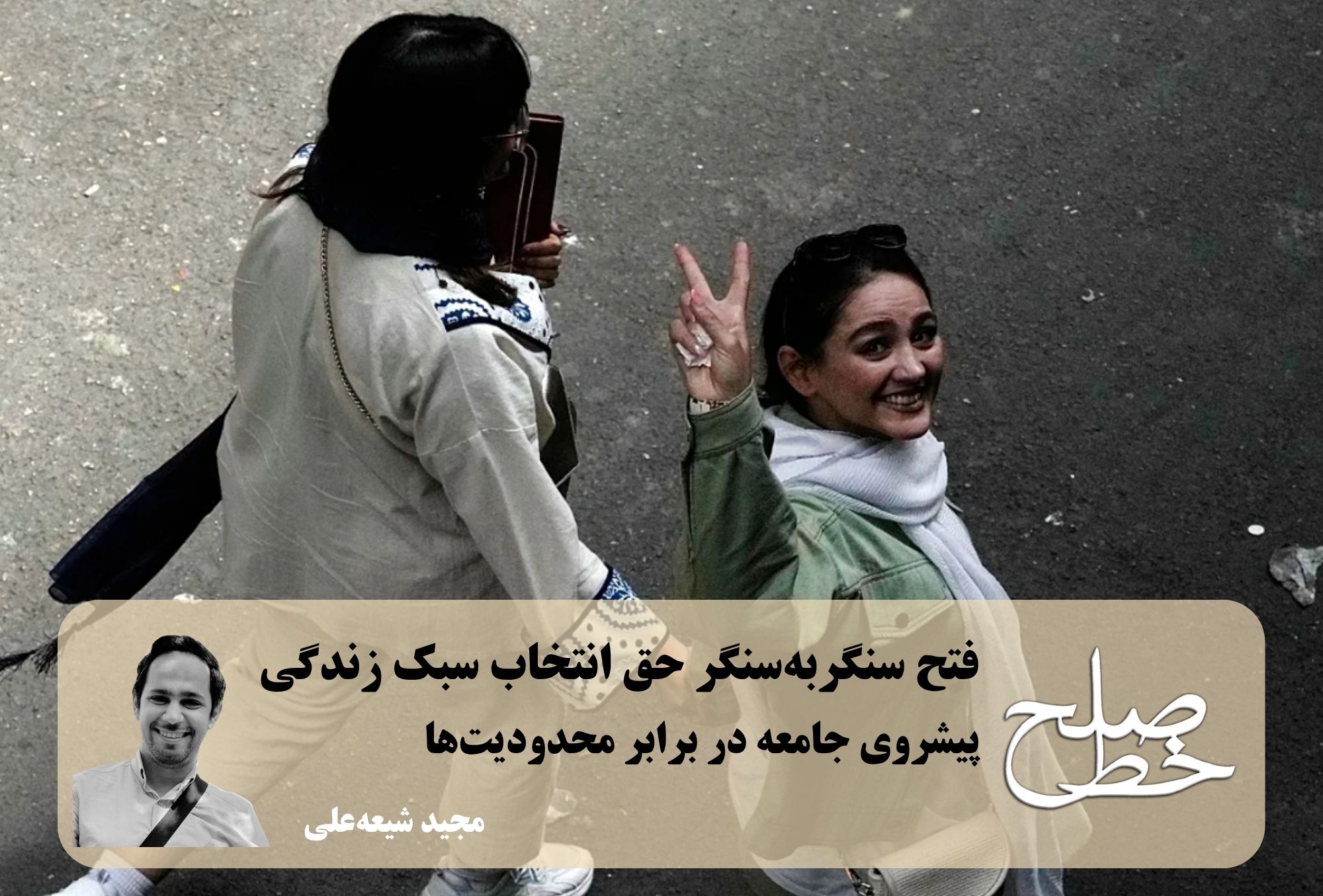
The Step-by-Step Conquest of the Right to Choose One’s Lifestyle/ Majid Shia’ali
From the very first days of the 1979 Revolution, when groups among the revolutionaries sought to restrict citizens’ lifestyles to one particular preference, resistance to this tendency also emerged. This resistance ranged broadly, from figures among the revolution’s leaders such as Ayatollah Taleghani to the large women’s gathering on March 8. The forms of resistance also differed. There was everything from bargaining by decision-makers with forces inside the ruling establishment to widespread civil disobedience. The more the country’s political space closed under the influence of foreign war and armed action by domestic organizations, the greater the opportunity became to suppress diversity in lifestyles.
It was as though these two were interconnected projects. The purification and homogenization of the political sphere and the elimination of all pluralism of opinion were accompanied by an effort to homogenize citizens’ lifestyles; meaning that, with the establishment of a new authoritarianism after the relatively open post-revolutionary atmosphere, rulers needed to send citizens the message that they must also experience and accept the homogenization of society in their everyday lives. As Václav Havel described it, for such a system to endure, it was not necessary for citizens to believe in these constraints; mere compliance and the entrapment of the individual within the web of lies were enough to satisfy the needs of authoritarian rule.
This new model of lifestyle had no coherent intellectual foundation. Many of its directives did not arise from Islamic jurisprudence. For example, restrictions on short sleeves or neckties for men had no jurisprudential basis, while conversely the revolutionization of music gave an Islamic baptism to ghena, which is forbidden in jurisprudence. Nor did it have roots in tradition. Local and colorful forms of clothing had traditionally been common among women of different Iranian ethnic groups, and traditionally not all women in Iran had strictly observed religious hijab. Clothing such as manteaus, maghnaehs, and the like were constructs of the new order. Many of these restrictions were not even compatible with ideologies such as Marxism. For example, drinking alcohol is not restricted in Marxist governments.
It appears that the criterion for setting the rules was the frustration of a broad social class that had not participated in the revolution but had taken control of affairs afterward. The economic and social transformations of the 1960s and 1970s (1340s and 1350s) led to extensive migration from villages to major cities and the creation of widespread marginal settlements and shantytowns. This geographical displacement, together with a vast economic divide and major differences in lifestyle, generated widespread resentment toward all manifestations associated with higher social strata. Neckties, music, alcohol consumption, even grooming and the use of perfume were turned into symbols of a Western lifestyle, and these groups became a broad social base for the clergy after the revolution: to restrict lifestyle, fill the battlefronts, and suppress other political currents.
The end of the war, increased economic growth, efforts by political and cultural elites, social resistance, the impact of new media tools such as video, and other factors created broad social pressure for the gradual easing of lifestyle restrictions. One outlet for this pressure was the change of government on May 23, 1997 (2 Khordad 1376), which also raised slogans in this regard. But what brought about change more effectively than any other method of struggle was citizens’ civil disobedience.
Civil disobedience and the presence of moderates within the establishment, globalization, and many other factors gradually pushed back, trench by trench, the lifestyle restrictions favored by the government. By the period before 2022 (1401), everything from short sleeves for men to home video players and television satellite receivers had been liberalized. In the final step, with the beginning of the Mahsa protest campaign, civil disobedience entered a new phase of struggle. Iranian women, in a symbolic act, burned their headscarves and ceased complying with the mandatory hijab law.
Although the street protests ended after several months because of widespread repression, and the demand for structural political change that had been added to the demand to abolish the mandatory hijab law receded, civil disobedience continued and appears, in a years-long pursuit, to have captured many trenches. In fact, in the Mahsa campaign, civil disobedience prevailed while civil resistance was defeated. What is the difference between the two?
By civil disobedience, what is meant is that citizens consider a law unjust and, in order to create pressure for change, refuse to comply with that law. Civil disobedience is an action based on legalism. This means that those who engage in civil disobedience accept the constitution, laws, and the existing legal order as a whole and resist only that unjust law. For example, when citizens in the United States in the first half of the nineteenth century decided that if they encountered an African American who had escaped slavery, they would not return that person to the government and slaveholders as required by law, or when African Americans in that country a century later decided to use facilities reserved for white people, they were engaging in civil disobedience.
Civil resistance, however, is a collective action in which citizens seek, through nonviolent protest, to change the country’s political structure. Unlike civil disobedience, which can be carried out individually, civil resistance is a collective action. Another difference is that civil resistance does not necessarily violate the law, although forms of civil disobedience can be used to advance civil resistance. There are entirely legal forms of collective protest. For example, when women in Chile banged spoons on pots and filled the city with noise, they were not committing an illegal act, but they were engaging in civil resistance. The most fundamental difference is that the objective is entirely different. While civil disobedience targets a particular law, civil resistance seeks to change the political structure and for that reason rulers are in practice threatened with a limitation or loss of power. Successful civil resistance can produce revolutionary results or reformist ones. In our country, revolutionary structural change through civil resistance occurred in the 1979 Revolution, while reformist change occurred in the first wave of the Constitutional Revolution and in the July 21 uprising in support of Dr. Mossadegh’s proposed reforms.
For this reason, traces of both projects can be found in the efforts of our society in recent years. Civil resistance aimed at changing the political structure has repeatedly emerged, and civil disobedience aimed at changing laws that violate freedom of lifestyle has become an everyday struggle. But what is visible here is a clear difference in outcomes. Civil resistance was repressed in successive waves: July 9, 1999 (18 Tir), the Green Movement, December 2017-January 2018 (Dey 1396), November 2019 (Aban 1398), January 2020 (Dey 1398), the Mahsa campaign, and Dey 1404. Civil disobedience, however, although it has not reached a final and definitive victory, has advanced step by step.
Although many factors can be cited to explain the success of one and the failure of the other, three differences are particularly significant. The first is the difference in objectives. The last thing an authoritarian government is willing to relinquish is power. It will therefore retreat more easily in the face of other demands. Second is the ability to effectively carry out the protest. Civil disobedience in the age of social media and the internet does not require extensive organization; simply seeing others participate in the disobedience through social media encourages individuals to join, while such action can also be carried out individually. Third is the greater emphasis of newer generations on lifestyle rather than ideals such as democratization. This shift in priorities makes them more willing to bear greater costs for freedom in lifestyle.
This widespread demand for freedom of lifestyle is met with everyday resistance from the government and its social base. In recent months, after turning the wartime atmosphere into a chronic condition, the government in Iran has also launched a new wave of repression against lifestyle freedoms. It has targeted everything from café-going lifestyles to women riding motorcycles. These acts of repression appear clearly to be attempts already doomed to failure. Although they impose heavy costs on citizens, the diversity and plurality of lifestyles in Iran have reached a stage where they cannot be suppressed through restrictive government measures. Therefore, what must be placed firmly on the government’s agenda is recognition of differences in lifestyles across the country. One may guess that rulers believe that, just as cultural and political homogenization were imposed together on our society, reversing that homogenization and formally accepting pluralism in the cultural sphere will inevitably be repeated in the political and economic spheres as well, and for that reason they continue resisting to the last trench.
 Created By: Majid Shia’ali
 August 23, 2026
Tags
Social control