


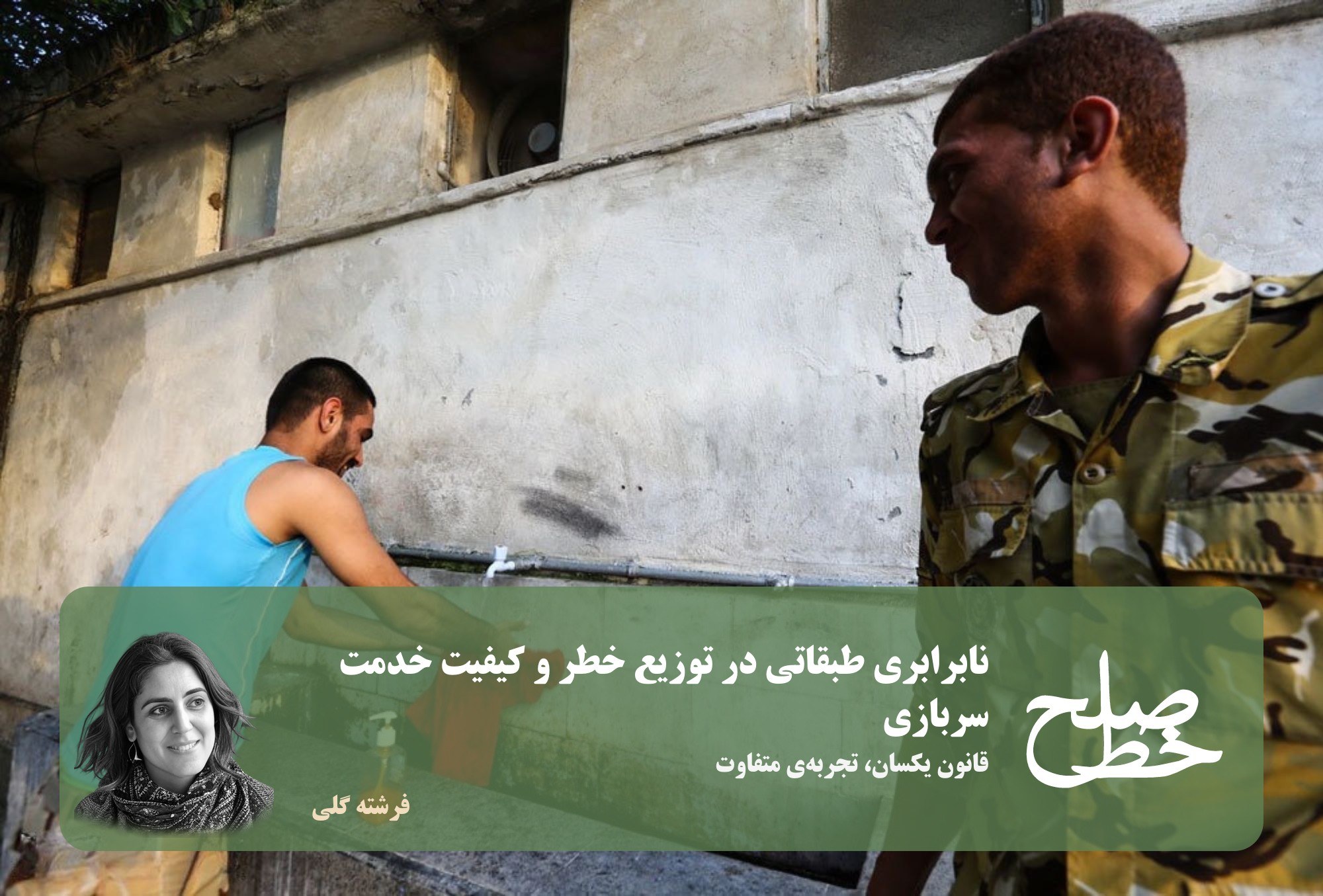
Class Inequality in the Distribution of Risk and the Quality of Military Service / Fereshteh Goli
In Iran, compulsory military service is not merely a legal obligation, but an arena where social inequalities are reproduced. The official image of this institution rests on equality: all conscripts, regardless of family background or socioeconomic status, must complete a term of service in the armed forces, and the law applies equally to all. However, ground realities and available evidence paint a starkly different picture. While some conscripts spend their service terms in urban barracks close to home and in administrative roles, others are deployed to remote border outposts, guard towers, and high-risk zones. This raises the fundamental question: are these discrepancies merely the outcome of statutory regulations and operational demands, or do social class and family connections also influence duty station assignments and exposure to danger? The premise is that alongside formal criteria, informal mechanisms—including social capital and nepotism or connections—can distribute risk and service conditions in a profoundly unequal manner.
To address this question, three analytical layers must be distinguished. First, the official regulations and declared criteria for allocating service locations and durations are examined to clarify what the legal framework permits or prohibits. Second, the gap between law and practice is assessed based on academic evidence and available reports—the domain where variables such as social status and connections come into play. Third, the consequences of this gap for privileged versus underprivileged conscripts are analyzed, demonstrating how patriotism—ostensibly a common denominator among all conscripts—carries two very different costs in practice: for some, a low-risk desk job, and for others, peril and separation from family. Consequently, this study explores whether these disparities stem merely from individual misconduct and administrative shortcomings, or if they can be understood within structural mechanisms of unequal risk and opportunity distribution.
Official statistics on the social class of conscripts have not been published. Nonetheless, existing sources suggest that certain mechanisms facilitate this inequality. Hence, raising the question of fairness in conscription is both valid and imperative. The objective, however, is not to establish definitive causal certainty, but rather to illuminate the institutional and social logic that makes the conscription experience—in terms of duty station, risk level, and quality of life—diverge so sharply across individuals.
Official Criteria Declared for Determining Duty Station and Duration of Service
According to a 2020 announcement by the Human Resources Directorate of Conscription of the General Staff of the Armed Forces of the Islamic Republic of Iran, a conscript’s local or non-local status is determined by the distance between their place of residence and their assigned duty station. (1) For non-local conscripts, the service term is set at 21 months in ordinary regions and 18 months in non-combat operational and security zones, underprivileged areas, border posts, and islands; for local conscripts, it is 24 months in ordinary regions and 21 months in the aforementioned regions. Other reports have cited corresponding figures as follows: 21 months for ordinary regions, 18 months for non-combat security and operational zones, deprived and climatically harsh areas, border regions, and Persian Gulf islands, and 14 months for active combat security zones and the Naze’at islands. (2) It should be noted that service durations for border and arduous regions vary depending on the source and the year of announcement. For instance, in an interview with media outlets in 2024, the head of the Public Conscription Organization stated that service duration was 15 months in border areas and 14 months in arduous or operational zones. (3) The rationale behind this system is that the more remote or demanding the posting, the shorter the service term—with this reduction intended as a form of compensation.
Nevertheless, this formal compensation relies solely on a geographical metric and does not define the standards by which hardship and risk are appraised. If duty station assignments are shaped by social status and network connections, shortening the duration of service does not eradicate inequality; rather, it rationalizes it. Physical and psychological peril cannot be traded for time, and a reduced term of service cannot redress irreversible harm. Furthermore, when an individual lacks any genuine option to decline a perilous posting, a reduced duration resembles coercion rather than a privilege. Therefore, until deployment criteria are made transparent and contestable, and public data is made accessible, it remains impossible to assess the extent to which this system mitigates or reinforces existing inequalities.
The Gap Between Law and Practice: Connections as a Latent Variable
The clearest academic evidence currently available is a study indicating that in the allocation of conscripts among various garrisons and cities, individuals with higher social standing are predominantly stationed in preferable locations, whereas those from lower social backgrounds are assigned to more arduous duties. (4) The same study notes that even within garrisons, during the assignment of conscripts to different units, the rights of certain soldiers are disregarded, and meritocracy is largely set aside. Although this assertion lacks comprehensive quantitative data, it originates from an academic, citable source and confirms the presence of inequality predicated on social standing.
This finding does not exist in a vacuum. Historical accounts and research suggest that the mechanism of connections and patronage has historical roots; during the Pahlavi era, conscription likewise fell disproportionately on those who lacked both wealth and influence. It should be clarified that this assertion relies on broad historical accounts and requires formal citations to specific research for rigorous verification. In the contemporary era, the commodification of conscription and the presence of rent-seeking conscripts have been identified as factors distorting military service policies—a claim that similarly warrants citation to targeted research. The consequences of these dynamics are also reflected in the unequal distribution of financial burdens. According to news reports, Abbasali Mansouri Arani, a member of parliament at the time, stated at a 2015 conference on the economic dimensions of military service that approximately 80% of draft-evading soldiers come from the lowest income deciles. (5) This figure represents a political claim rather than the empirical finding of an academic study or official data, and it should be interpreted with appropriate caution. Such evidence strengthens the likelihood of class-based disparities in the conscription experience, yet it remains insufficient to definitively prove a systematic distribution of risk along class lines.
Nonetheless, this evidence alone does not prove that all soldiers from lower socioeconomic classes are routinely deployed to hazardous areas. What it demonstrates is the reality of inequality based on social status, the historical roots of patronage, and the asymmetric distribution of costs. The relationship between social class and physical risk must therefore be considered a compelling and plausible hypothesis rather than an established conclusion. Converting this hypothesis into a fully documented finding demands transparent data regarding conscript distribution by social class, posting, and degree of risk—data that remains inaccessible to the public, thereby impeding any definitive assessment.
The aforementioned study contends that localizing military service could mitigate some of these injustices, as conscripts sharing similar cultural backgrounds integrate more readily, and localization could alleviate challenges linked to geographic displacement and cultural friction. This argument affirms the prevailing inequality while seeking a solution in reforming the distribution mechanism—meaning the research does not merely describe the problem, but advances a proposal for structural reform. Nonetheless, regarding two specific assertions—disparities in guard duty assignments based on educational attainment and monetary payments to purchase guard-duty substitutes—no verifiable documentation was found in reliable sources.
In conclusion, the cited research both acknowledges inequality and proposes a structural reform, yet remains silent on those two specific allegations. The analytical conclusion must therefore align strictly with this evidentiary standard: the confirmation of inequality based on social status and the proposal of localization as a remedy are documented, whereas the differential allocation of guard posts by education level and the practice of paying for guard substitutes remain unproven hypotheses pending citable evidence. This distinction allows us both to refrain from denying systemic inequality and to avoid endorsing unverified assertions as established fact.
Service Duration as Official Compensation for High-Risk Areas
Iran’s official conscription system attempts to compensate for service in remote or hazardous areas by reducing the term of service. The key factor is that this framework appears equitable on the surface: the higher the risk, the shorter the service. However, if the primary hypothesis holds true—that conscripts from lower socioeconomic backgrounds are disproportionately assigned to hazardous areas—this compensatory model generates a paradox. Those who endure the greatest physical danger are rewarded with an earlier discharge. While seemingly advantageous to soldiers from lower-income classes, it essentially assumes bodily and psychological risk as a baseline and barters it for time. In other words, reducing the duration of service does not eliminate danger; it merely makes it more tolerable or justifiable by shortening its timeframe.
This mechanism itself warrants critical examination: who genuinely benefits from this reduction, and does it obscure inequality in risk allocation? It must be recognized that physical and mental harm cannot be exchanged for time, and a shorter tour of duty cannot remediate irreversible trauma. Furthermore, when an individual possesses no real choice to refuse a dangerous deployment, the incentive of a shortened term borders on coercion rather than privilege, ultimately serving to legitimize systemic inequity. Rather than subjecting risk allocation to scrutiny, it is justified under the guise of compensation. Consequently, the core question of justice is not merely whether service terms are shortened, but whether the initial allocation of risk is conducted fairly. So long as assignment criteria lack transparency, mechanisms for appeal, and verifiable public data, reducing the service duration serves more as a veneer over inequality than a genuine solution.
Verifiable evidence indicates that official regulations operate on the basis of geographic distance and marital status, and a citable academic document confirms the existence of social-status disparities in duty station assignments. However, no reliable documentation currently proves that conscripts from lower socioeconomic classes are systematically assigned to higher-risk areas. Based on available evidence, the link between class and physical risk remains a viable hypothesis rather than an established fact. Furthermore, regarding the buyout of military service (draft exemption purchases), existing evidence and the official stance confirm that no directive has been issued on this matter through 2026, and related rumors have been refuted at the parliamentary committee level. (6)
Footnotes:
1. “Military Service Extended to 24 Months / Service Reduced for Conscripts in Non-Native Areas,” Hamnava, October 7, 2020.
2. “How Many Months Is Military Service in 2026? Details on Eligibility Age, Service Regions, and Reductions,” Jam-e Jam Online, November 7, 2026.
3. “Details on Military Service Reductions Clarified,” ILNA, August 19, 2024.
4. Hedayati Chenani, Rahman, “An Investigation into Strategies for Controlling and Reducing the Crime of Intentional Assault and Battery in the Armed Forces,” International Conference on Law, Psychology, Educational and Behavioral Sciences (retrieved from Elmnet), 2020.
5. “80 Percent of Absentee Soldiers Belong to Lower Deciles of Society,” Payam-e Ma, December 15, 2016.
6. “Extension of Exemption for Fathers of Three and Four Children Through the End of 2028,” Defa Press, October 6, 2026.
 By: Fereshteh Goli
 November 22, 2026
Tags
Angel flower Border Regions Class Inequality Duty Station Justice in Conscription Military Non-Native Conscripts Party peace line Peace Line Monthly Peace Mark 187