


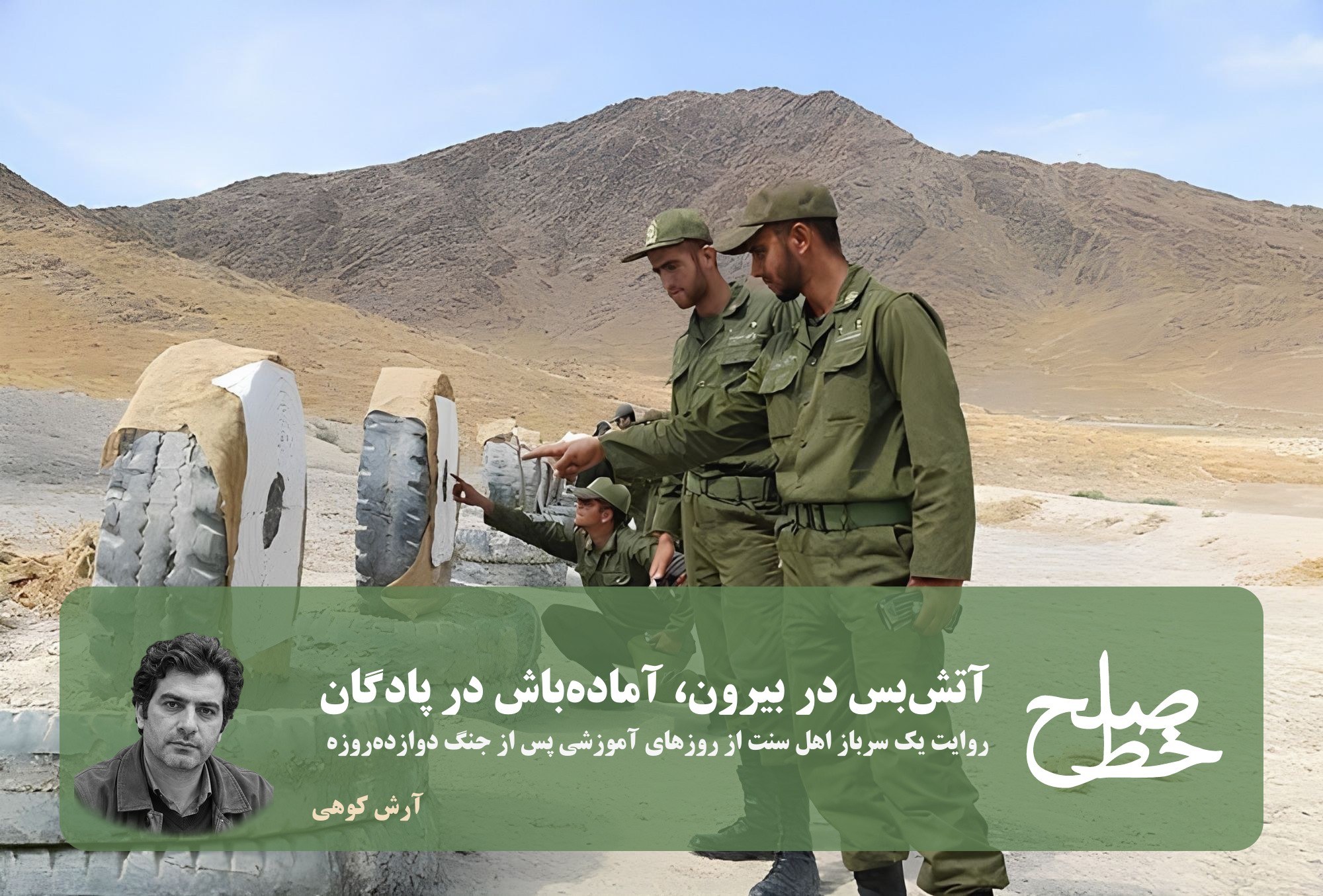
Ceasefire Outside, Standby in the Barracks / Arash Kouhi
Two days had passed since the ceasefire was announced when the deployment text message arrived. He was scheduled to report for military service on June 22, but the war had disrupted the plans. The initial text message instructed him not to report for now and to wait for a new date. On June 29, another message came: “Report on July 1.” The war had apparently ended, but he was heading to the barracks at a time when the traces of conflict had not yet disappeared from people’s daily lives. The previous training facility had sustained damage, and the recruits had been transferred to a different location. No one knew what would happen if fighting broke out again. It was a long journey. They traveled part of the way by bus and changed vehicles several times to reach their destination. They reached the training site in the middle of the night—exhausted from travel, unaware of the schedule for the coming days, and not knowing how long they would remain there. The first few days were spent waiting. They had to wait for the remaining recruits to arrive. The duration of the training period was also unclear from the outset. Initially, there was talk of twenty days, then twenty-five days, and finally it was announced that training would be split into two periods, with a ten-day leave in between. In days when everything could shift with a single decision, even the end date of military service remained uncertain.
Classes in the Sun, Meals on the Dirt
The compound was vast—so large that walking its length took several hours. The buildings were old, and the barracks served as sleeping quarters for the soldiers at night. During the day, however, they were barred from entering the buildings. Due to wartime conditions, gatherings in enclosed spaces had been banned. Classes and dining were moved to the open grounds. The recruits sat on the ground—without desks or chairs, directly under the sun. Classes were held there, and meals were eaten in the very same yard. He recalls a scene that epitomizes those training days: “The colonel sat in the shade, and we sat on the ground under the sun, silent and listening.” The day began with reveille around 3:30 AM, half an hour before the morning call to prayer. The schedule included five fifty-minute classes, interspersed with physical and military drills. Lights out was around nine at night. They also had some free time during the day, which they spent walking around the grounds, waiting, and passing the hours. Life in the barracks was not easy either. During the first twenty days, they had no access to showers. To reach a shower facility required walking a considerable distance; instead, they sometimes washed themselves with cold water in the latrines. They also washed their clothes there. Showers eventually became available, but the large number of soldiers created long lines. Drinking water was also limited, and recruits sometimes went to the restrooms to drink water. Even so, he recalls the food as one of the positive aspects of the training. Three meals a day were provided, and he considered the quality decent. His experience was not merely one of deprivation and austerity; alongside adequate food and occasional hours of rest, there were days spent enduring the blistering sun, water shortages, limited sanitation, and the endless wait for news that never arrived.
Two A.M.: The Siren
From late July onward, the nights took on a different form. Around two in the morning, a sound resembling an air-raid siren would blare. The soldiers had to wake up and sprint toward the earthen revetment. Later, they learned that the sound was broadcast from an ambulance used for drills. It was not an actual attack siren; it was part of an exercise. Yet in a garrison where the recruits had arrived just days after a ceasefire, and whose previous training facility had been damaged, a midnight alarm could never feel routine. They had little information about conditions outside. They did not know what was unfolding in the cities or whether the declared calm would hold. Upon hearing the siren, they had to rush out of the barracks in total darkness and scramble to the embankment. They had been told that if the war resumed, they might be sent home. In practice, however, all that remained for them was waiting—waiting for the next siren, for the next piece of news, and for clarity regarding their fate. Another contradiction was apparent: despite the shelter drills, practical military training was minimal. Familiarization with weapons, disassembling and assembling rifles, and target practice constituted the core of their military instruction. According to him, they were not even taught practical drills like low-crawling under combat conditions. At night, they ran to the earthen berms anticipating potential strikes, yet during the day, they received no practical training commensurate with such a threat.
The War Continued in the Classrooms
A major portion of the instruction consisted of ideological and political indoctrination. Three out of five daily sessions were dedicated to these subjects. Lecturers spoke about the twelve-day war, the ceasefire, and Iran’s military prowess. The dominant narrative was one of Iranian triumph and the defeat of Israel and the United States. Speakers highlighted the country’s missile capabilities and its capacity to confront adversaries—occasionally even boasting of an ability to strike New York with missiles. According to the recruit, one theme was reiterated incessantly: Iran prevailed through faith, not merely through weaponry. The classes also covered the Iran-Iraq War, Islamic and moral issues, Lebanon, and Hezbollah. The United States was framed as a perennial enemy, and the ceasefire was portrayed as evidence of the defeat of Iran’s adversaries. For him, these sessions were not merely lectures on wartime history or religious topics. All the soldiers in that unit were Sunni and served separately from other conscripts. According to him, they had little contact with Shiite recruits. Facilities were provided for Sunni congregational prayers, whereas Shiite soldiers attended prayer services in a husseiniya. He perceived that part of the curriculum was designed to align the recruits’ beliefs with the official state narrative. Occasionally, their opinions were solicited, but if an answer diverged from the lecturers’ views, efforts were made to sway their thinking. In his view, the soldiers were not merely expected to receive military training; they were intended to leave the barracks equipped with a specific set of narratives and convictions to disseminate to others. The commanders’ conduct was not uniform either. At times they enforced strict discipline, while at other times they acted more collegially toward the recruits. He viewed this dual approach as a balancing act: on one hand, obedience had to be instilled; on the other, because the conscripts were Sunni, interactions could not become excessively hostile. He noted that younger recruits were subjected to more humiliation and punishment, with age and education level influencing how soldiers were treated.
Three Minutes for News
Throughout those days, their sole connection to the outside world was restricted to a brief phone call. Soldiers stood in line, and if their turn arrived, they had approximately three minutes per day to speak with their families. They had no television, and outside news failed to reach them. They were unaware of what was happening in the cities and whether the war had genuinely ended. Three minutes had to suffice for everything: inquiring about their families’ well-being, reassuring them of their own safety, and attempting to glean any updates about conditions outside. Then the call was cut off, and they returned to the same compound—to classes, formations, the barracks, and days that gradually blurred into one another. He says that during the first week, recruits were mostly absorbed in adjusting to the conditions. By the second week, they had gradually grown accustomed to the routine, and by the third week, the days were virtually indistinguishable. Their only wish was for the training cycle to end.
Two days before the end of the period, they were instructed to finalize their paperwork and collect the necessary sign-offs. Until that day, no one had told them exactly when they would be discharged. A training period that had begun with a text message postponing deployment was now concluding with a few signatures and administrative directives. Yet what remains most vivid in his memory from those days is neither the classes nor even the scorching sun beneath which they sat for hours; it is the nights. Two o’clock in the morning, the sound of the siren, waking from sleep, and running toward the embankment. Then, come dawn, returning to the very same yard and the very same classes—oblivious to what was taking place outside. The war was over, at least on paper. But every night, with the wail of the siren, they were drawn right back into it.
 By: Arash Kouhi
 November 22, 2026
Tags
12-Day War Arash Kouhi Barracks Barracks Conditions Ceasefire Military Basic Training peace line Peace Line Monthly Peace Mark 187 Sunni Soldier