


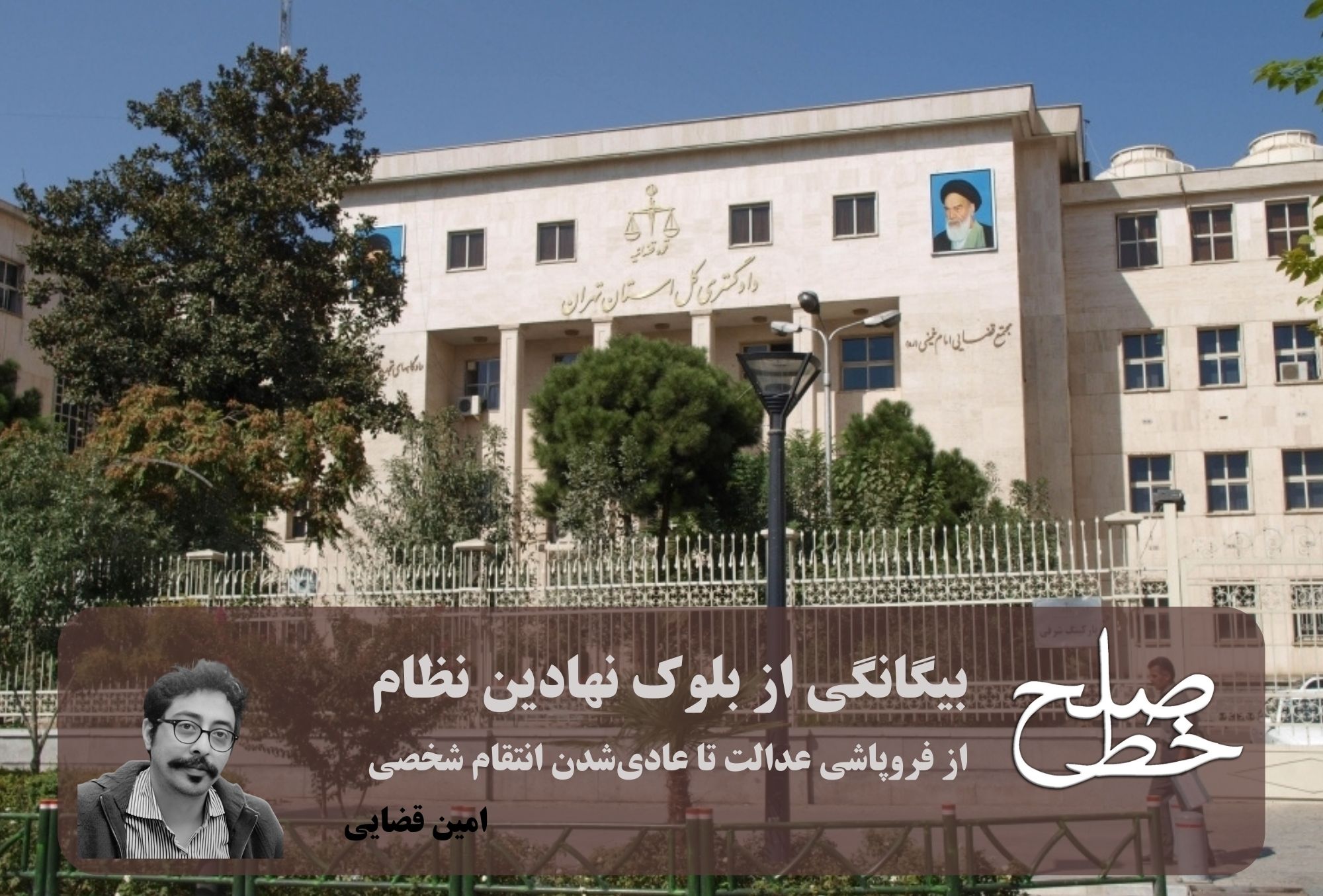
Alienation from the institutional bloc of the system/Judicial trustee
Administrative corruption is usually defined as the abuse of power and authority for personal gain. In the case of the judiciary, clients who witness such corruption distrust law enforcement institutions (police and judiciary) and may, as a result, engage in personal vigilantism in response to attacks on their lives and property. Simply put, when people do not see judicial institutions as capable or willing to defend their lives and property, their natural reaction will be to resort to personal vengeful actions.
What was said above takes on a completely different nature in the case of the judicial system and all institutions of the Iranian system. This definition of corruption cannot be applied to the institutions of the Iranian system, because from the very beginning, these institutions have functioned to protect the interests of the system. In fact, institutional power is not initially aimed at providing social services to citizens, nor even at the personal interests of the appointed individuals (which is considered corruption), but rather at pursuing the institutional interests of the system itself as a unified bloc. The problem for individuals holding positions in this system is how to advance their personal interests while maintaining the obligations and requirements of the Islamic Republic system. Even when these institutions ostensibly provide services to the people, these services are in essence justified by security and benefit to protect the system. For example, the Iranian judicial system does not take action to defend victims of fraudulent companies; Unless, due to the scope of the protests, this becomes a security threat to the system, or these companies outside the institutional bloc threaten the system and economic activities within the bloc. In short, the main goal of institutions and appointees – even in the smallest management actions and social services – is, first and foremost, to maintain the security and interests of the system.
But what is worse is that the Iranian judicial system is not a modern judicial system at all. The terminology of a modern judicial system is used, but the principles of this system are never followed. There is no room in this article to address this issue, but as an important point, in a modern judicial system, the courts should be a set of institutions that are completely independent of each other. In the Iranian judicial system, the courts are even connected to the security institutions and form a completely integrated and interdependent system. Unfortunately, even the use of words such as court, judiciary, bar, and Supreme Court normalizes this system.
For this institutional bloc, which has no goal other than preserving the power and interests of the system and its security integrity, terms such as social services, citizens, “service provision,” or calling appointed individuals “responsible or responsible” are merely empty discourse that they use in their exclusive literature and media.
So what people experience is not just anecdotal corruption but a unified institutional bloc that, although seemingly chaotic from within, forms an impenetrable wall in front of citizens. Faced with this institutional bloc, people may have two opposing reactions:
1- People try to take precautionary or retaliatory measures to protect their security and property. These precautionary measures can be observed even in the smallest and simplest economic and social transactions, such as taking large promissory notes in the simplest transactions, taking large deposits in renting a house, and exorbitant dowries in marriage and marriage. Many may resort to hiring a prostitute to obtain money or resort to force themselves, which leads to crime and financial strife.
2- Some try to establish contact with individuals or institutions from this institutional block in some way (through friendship or bribery) in order to enjoy the umbrella of support of the regime’s institutions. The result is an increasing dependence of enterprises and economic activities (including commerce) on the IRGC and other organs of the regime. Also, this translates into the social influence of individuals within the so-called “institutional system”. Many of these individuals, due to their influence in the body of the regime and its institutions, receive all kinds of bribes, bribes, and privileges from the people.
Even the most important service institutions, such as schools and hospitals, are being swallowed up by this institutional bloc. For example, government hospitals with poor quality services are making way for private hospitals owned by the IRGC and other institutions of the regime. It is well known that medical services should be accompanied by sympathy, compassion, and empathy, and the human aspects of such services cannot be ignored. However, the business model of these hospitals is completely profit-oriented, and they look at the patient as a bag of money by cutting costs. This dichotomy of poor quality government medical services versus profitable private medical services threatens the lives and health of people. Many people have to choose between death or financial bankruptcy of the entire family.
Also, as mentioned, hospitals under the guidance of the institutional bloc benefit from the support of the medical system and are therefore immune to any medical malpractice (which the for-profit private model makes more likely).
In short, the experience of the people in front of this integrated bloc is “alienation” from this bloc and the expectation of social services from this bloc is decreasing day by day. The groups that are basically more dependent on social services, such as retirees, patients with specific diseases and low-income groups, have a more disappointing experience in front of this institutional bloc. The decrease in expectations and hopes for receiving social services and legal protection normalizes this alienation, in such a way that the sensory receptors of society become numb to this indifference and “responsibility” and “accountability” are reduced to empty and gibberish words of the authorities of the system and the function of the law changes from protecting the system from the people to protecting the system from the people.
 Created By: Amin Ghazaie
 December 22, 2025
Tags
Administrative corruption Amin Ghazaei Complaint Court Judiciary Judiciary 2 Justice in humanity peace line Peace Line 176 Revenge Social pessimism Social services Vigilantism فساد ماهنامه خط صلح