


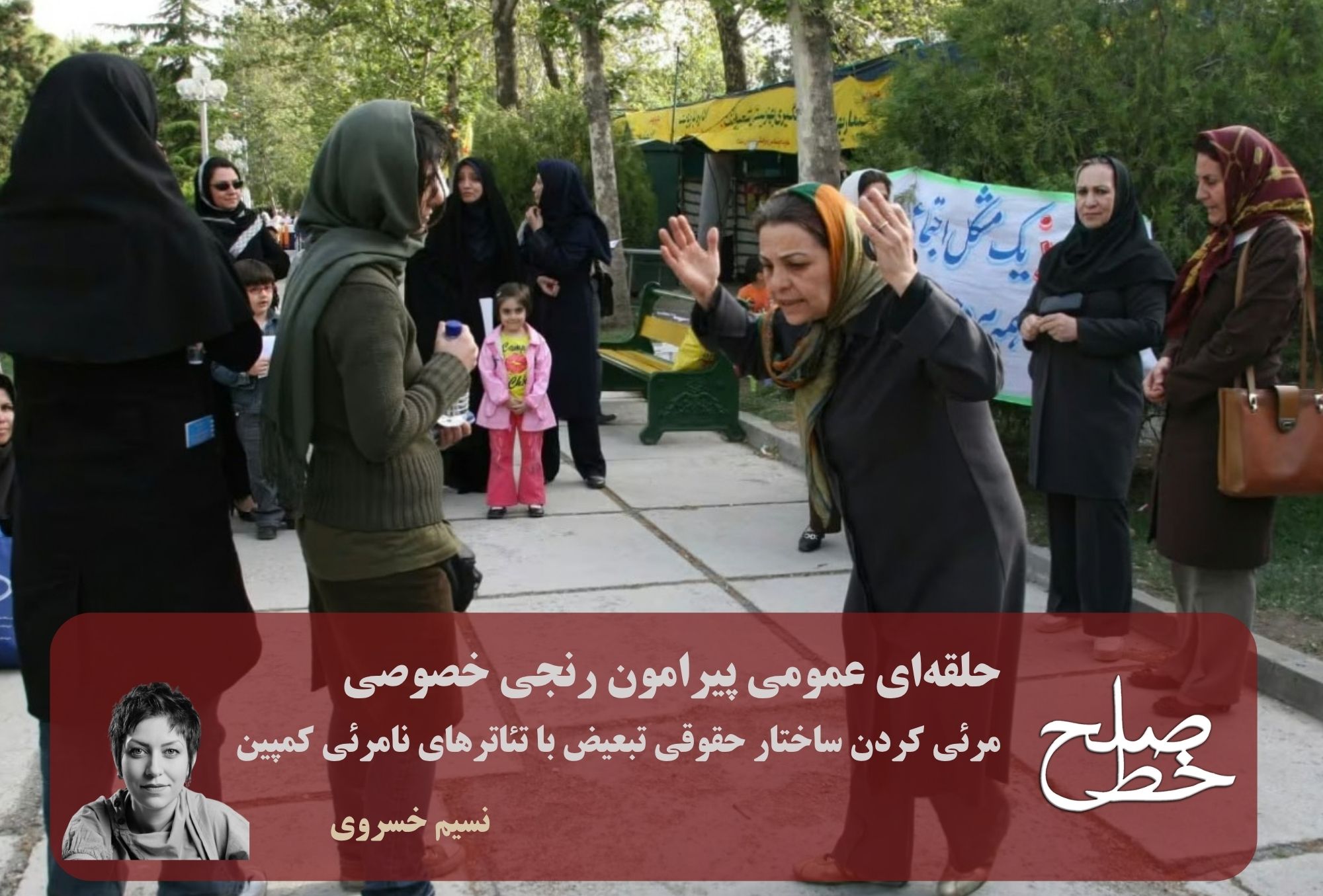
A Public Circle Around a Private Suffering/ Nasim Khosravi
It is a hot afternoon in June 2008 (Khordad 1387), at the entrance of a hospital in central Tehran. A distressed woman asks passersby for help contacting her child’s paternal uncle. The child must undergo surgery as soon as possible, and her signature on the consent form is not acceptable. The father, who separated from the woman years ago, is in another city, and she has been told that since the father and paternal grandfather are unavailable, the child’s paternal uncle or even a male paternal cousin can sign—but the mother cannot. People have gathered in a circle around the woman. As one or two of those present try to locate the men in the child’s family, the question of the legal prohibition preventing the mother from signing the consent form quickly arises. Many of the passersby had been unaware that such a law existed. Some do not believe it, some condemn it, and some, despite their disbelief, consider it deeply unjust. Even a cleric who joins the circle of conversation does not regard the law as consistent with fairness. It is a law that grants the mother the right to care for the child (custody), but not the right of guardianship over the child. That sudden incident outside the hospital had revealed a part of the discriminatory legal structure through the observation of the woman’s predicament and the conversation surrounding it. The woman who made this private suffering and anxiety visible before the public was an actor in one of the One Million Signatures Campaign’s invisible theatre performances, and the passersby who formed a circle around her did not know that they were witnessing a street performance.
September 2026 (Shahrivar 1405) marks twenty years since the birth of the One Million Signatures Campaign to Change Discriminatory Laws and eighteen years since its invisible theatre performances—eleven performances that, in different parts of Tehran, broke down the boundaries between stage and street, spectator and intervener, theatrical action and real reaction, the private sphere and public challenge. In this text, from the perspective of the designer and director of those eleven performances (1), and by revisiting observations from the group experience (2), I return to the question of how invisible theatre, by making the consequences of discriminatory laws tangible in women’s lives, made visible in public space the connection between seemingly personal suffering and the legal structure that contributes to creating and ensuring the continuation of that oppression.
Making the Law Visible
Law is not experienced only through official texts and institutions such as courts; people also encounter and interpret law and legal meanings in the course of everyday life. Patricia Ewick and Susan Silbey use the concept of “legal consciousness” to examine precisely these everyday ways of understanding and experiencing law. Such consciousness does not necessarily mean having precise knowledge of legal provisions. People may live with the consequences of a legal rule without knowing that rule or even regarding their situation as a legal issue at all (3). In our performances, this very gap between experiencing the consequences of an unequal law and recognizing its legal source was important, because passersby might encounter a woman’s suffering without initially thinking about its legal source or knowing which legal rule had made such a situation possible.
In presenting the law publicly through performance, we also encountered a multilayered complexity. On the one hand, unlike laws such as traffic regulations, whose presence in everyday life is obvious, many laws regulating family relations and women’s legal status may remain unknown to people until the moment they personally and directly encounter their consequences. On the other hand, according to our field observations, the distance between experiencing the consequences of a particular law and recognizing its legal source became even more complex in the case of unequal laws. This complexity arose because, particularly when dealing with issues concerning women, public understanding generally could not draw a clear boundary between the formal requirements of law, interpretations—or presumed interpretations—of religious rulings, family traditions, social customs, and moral judgments concerning concepts such as rights and fairness. Thus, for example, when passersby encountered a woman deprived of the right to make decisions about her child’s medical treatment, they did not necessarily identify the legal source of the situation. At first glance, the issue might be regarded as a family problem resulting from the woman’s misconduct, the father’s irresponsibility, an administrative problem or corruption, or the malicious behavior of an employee. Invisible theatre intervened precisely within this gap: first, it placed the consequences of the law before passersby in the form of a tangible event, and then, through conversations between supporting actors and the assembled passersby, it introduced the legal source into the discussion. To make this relationship visible, simply recounting the content of the law to people was not enough; we had to construct a moment before the public in which the law became an obstacle, a source of anxiety, and a deprivation of basic authority in a woman’s personal life.
Our goal in the campaign’s invisible theatre group was to bring the painful consequences of laws to life before people who sometimes lived with these legal inequalities without generally being aware of the invisible presence of such laws in their lives. We performed these plays in busy public spaces, and passersby, unaware that they were encountering a performance and believing they were witnessing a street confrontation, interacted at different levels with the story and the characters in this event-performance. For each performance, one provision among the legal inequalities challenged by the campaign was selected according to the urgency of the moment and the group’s available resources, including the availability of actors suited to the roles. Through a group process, a story was developed around that legal provision—a story that was generally born from real accounts of people’s everyday lives. Every element of the theatrical situation was designed to fit the location in which the story was performed so closely that the event would appear unexpected yet consistent with the everyday life of that space. In such a situation, the performance of the law’s consequences immediately became believable and tangible to passersby.
In one performance, in order to raise awareness and create the possibility of protesting the passage of a bill facilitating polygamy, we used the constant movement and presence of passengers, drivers, and passersby at the Beyhaghi Terminal to stage a performance that exposed a personal and family dispute to broad public judgment. Faced with the suffering imposed on the first wife as a result of her husband’s remarriage, even male drivers at the terminal initially became angry with their fellow man to the point of threatening violence, and subsequently described passage of the bill facilitating a second marriage as wrong and as an act of “dishonor and lack of manliness.” The completely believable design and execution of these performances was the first condition for making this legal oppression visible.
Making Suffering Visible
Believability, in addition to being necessary for protecting the group against the risk of arrest, was a prerequisite for genuinely involving passersby in the event. If the theatrical nature of the event became apparent, people would move from the position of witness, judge, or intervener back into that of spectator. But when the event was perceived as real, the first people who stopped became part of the mechanism that caused other passersby to stop as well. The crowd gradually grew, whispers began, information circulated among newcomers, and the issue shifted from a personal dispute or challenge involving one or more women and other individuals into a subject of collective listening, questioning, judgment, and sometimes intervention by a group of people. Thus, the issue was not merely about making private suffering into a spectacle; it was about creating conditions for conversation and questioning why that suffering existed. During the performance in Saei Park on a busy summer evening, for the first time multiple circles of public discussion formed and continued debating this “why” for hours after the performance had ended.
Although believability was essential for stopping and engaging passersby, it was not sufficient to generate genuine intervention; we had to reach another layer of the spectator-passersby’s emotions. For this reason, all theatrical situations intended to demonstrate legal inequality and oppression had to reveal that inequality through the woman’s position as the oppressed party. The emotional logic of being oppressed, within society’s cultural and religious memory, could evoke the empathy of passersby and make the event comprehensible within the familiar moral framework of oppressor and oppressed. In a culture in which the necessity of standing alongside the oppressed is one of the familiar languages of moral judgment, this framework possessed a particular capacity to call people to intervene. The familiar logic of oppression was consciously incorporated into the design of the performances—not to reproduce the stereotype of women as passive victims, but to turn the deprivation of a woman’s rights into an issue that would be morally difficult for those present at the scene to ignore. Nevertheless, empathy with the oppressed still did not mean that the legal source of the oppression had become visible. A passerby could defend the woman, condemn the man in the story, or attempt to resolve that particular crisis without questioning the legal rule underlying the situation.
The experience of the first performance demonstrated that witnessing suffering and intervening in the event did not automatically lead conversations among passersby toward the legal source of discrimination. In the natural course of events, instead of focusing on the structural and legal dimensions of the problem, most witnesses to the performance tended toward finding an immediate solution, judging and condemning one of the people involved, recounting their own experiences and memories, offering traditional advice, or expressing regret about what they regarded as an unchangeable and natural fate. Yet our intention in exposing private suffering was to make the discriminatory legal structure visible. This was where the most important difference between our work and Augusto Boal’s invisible theatre (4) emerged. The supporting actors, whose role in the first performance had been to help draw public attention toward the main actors and the theatrical event, now had to appear as passersby who naturally entered the circles of public discussion and redirected the conversation away from an immediate solution to the crisis and toward the legal rule behind it.
In the hospital performance, for example, when some passersby blamed the hospital employee, one supporting actor said, “What he’s doing is illegal.” Another said, “No, it isn’t illegal—it’s the law.” A passerby said, “But she has custody of her child!” and another actor responded, “Don’t you know that custody and guardianship are different, and that a mother doesn’t have the right of guardianship over her child?” From that moment onward, the discussion was solely about the law.
From the Circle of Suffering to the Circle of Law
Eleven performances meant that eleven times, during the busiest hours and in some of Tehran’s most heavily frequented locations, we confronted numerous passersby with the consequences of unequal laws against women. Many of these passersby stopped amid Tehran’s crowds and congestion, many became involved in the event-performance, and many, through conversations about an apparently familial crisis, arrived at an exchange of views about the law that had made that predicament possible. But how many continued thinking about what had happened after leaving the scene? Did the change in the attitudes of some of these spectator-interveners remain confined to the intensity of that moment of crisis, or did this emotional jolt create a new questioning perspective toward the structure of discrimination? Naturally, we do not know the answers to these questions. But based on our observations, we do know that some passersby sometimes moved from witnessing or intervening in a temporary crisis to hours of highly challenging discussion about the law and the structure producing the oppression.
Revisiting this experience eighteen years later shows that making suffering visible did not, by itself, make its legal source visible. Invisible theatre first placed the consequences of the law before passersby in a living and believable event. The familiar logic of oppression could sometimes call upon them to stop and assume the role of spectator-intervener; but for the conversation to move beyond helping the woman in the story—or humiliating her—and beyond blaming and judging individuals or finding a temporary solution, another intervention was necessary. Supporting actors therefore sought to connect the crowd’s emotional reaction to questions about the legal rule underlying the distressing event.
From this perspective, the work of the campaign’s invisible theatre performances was not merely to raise awareness about a few legal provisions or to make women’s suffering public. These performances created situations in which the connection between apparently private suffering and the unequal, public distribution of rights and authority under the law could become recognizable before a group and turn into a subject of conversation. The circle that initially formed around the predicament of one or more women could become circles in which the seeds of protest against the law and the discriminatory structure were planted.
The experience of these performances also reveals a dimension of the campaign’s demand for legal reform in which lawmakers and official institutions were not its only audience; the public, too, was an audience and part of the process through which the demand was formed in face-to-face dialogue. Invisible theatre was one form of this dialogue, with the difference that before passersby heard an explanation of the law, they were confronted with its living effects. For brief moments, the invisible theatre performances changed the place of law within public experience: law moved from articles and clauses into an observable event, and from a subject belonging to experts and official institutions into an issue for public conversation and judgment in the street.
Footnotes:
Khosravi, Nasim, “A Small Intervention in Everyday Life: Revisiting the Design and Performance of the One Million Signatures Campaign’s Invisible Theatre Performances, Eighteen Years Later,” online collection, “Twentieth Anniversary of the One Million Signatures Campaign.”
With thanks to M. Z., N. F., F. A., J. A., Gh. M., Amir Rashidi, Sussan Tahmasebi, S. F., Y. G., S. Kh., and everyone whose creativity, courage, and support made the development and performance of this experience possible.
Ewick, Patricia, and Susan S. Silbey, The Common Place of Law: Stories from Everyday Life, University of Chicago Press, 1998.
Augusto Boal (1931–2009) was a Brazilian director and theorist and the founder of the “Theatre of the Oppressed.” He formulated invisible theatre as one of the methods within this theatrical system—a method performed in public spaces without the audience being aware that the event is theatrical. For an explanation of this method, see: Boal, Augusto, Theatre of the Oppressed, translated into Persian by Javad Zolfaghari and Maryam Ghasemi, Tehran: Nowruz Honar Publishing, 2003 (1382).
 Created By: Nasim Khosravi
 September 23, 2026
Tags
"Million Signature Campaign" Custody rights Invisible Theater Nasim Khosravi Peace Line 185 Street theater Women's rights