


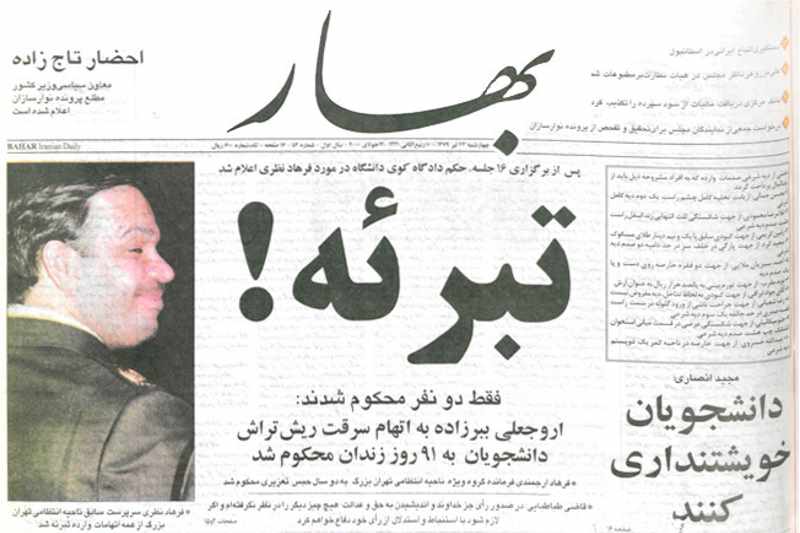
“Arrogant Babarzadeh, a symbol of the unjust hierarchical system in totalitarian regimes / Mohammad Mohabi”
This is a caption.
Mohammad Mohabbai
During the incident of the attack on Tehran University on July 9, 1999, many names were mentioned; from Ezzatollah Ebrahimnejad and Saeed Zeinali, to Ahmad Batbi and Akbar Mohammadi, from Hedayatollah Lefian and Farhad Nazari, to Hossein Allahkaram and Masoud Dehnamaki. However, this incident also had a famous and somewhat tragic name; Arujali Babrazadeh, a conscript who was sentenced to 91 days in prison for stealing a student’s razor during the attack on the university. It was tragic because he and another person were the only defendants in the major case of the university attack who were not acquitted and received a ridiculous sentence from the judge, and also because the judge and court did not consider the seriousness of the crimes and only issued a sentence for the theft of a razor by a conscript from a small town.
Since the year 1379 when the sentence of condemnation was issued for this conscript, there hasn’t been much news about him. However, his name and conviction remained as a salt on the wounds of the victims of the July 18th incident, still remembered. Until recently, news was released that in the year 1397, Erujali Babarzadeh, with the rank of colonel, is in charge of the 157 Masoudieh Police Station in Tehran. This astonishing promotion, reaching the rank of colonel in just 18 years from being a conscript, is unbelievable for any sane mind. How did he manage to go through these ranks in such a short period of time? If he was employed by the law enforcement after completing his sentence and military service, and started from the rank of private, there is a 9-rank difference between the rank of private first class and colonel. Usually, those who enter the armed forces through the

This extraordinary promotion and elevation to the rank of kilowi by Aruj Ali Babarzadeh once again exposed the unjust hierarchical system in totalitarian governments. Since totalitarian systems are not based on political and economic pragmatism and legal order, but rather on ideology, the acquisition of positions and the rise in the hierarchy are not due to efficiency and merit, nor for the progress of the nation and homeland, but rather for the sake of the ruling ideology’s agenda.
This extraordinary progress has been made with the will of the ruling ideology, not with the will and ability of the mentioned individual. One of the messages that the ruling ideology wants to convey to society through this action is the message of the strength of authority and its disregard for protest movements. It wants to say that since the 1999 protest movement with all its glory and grandeur, it has brought its duty-bound servant to this rank and has either killed, imprisoned, forced into exile, or silenced the students and intellectuals active in that movement.
This ideological coercion will continue as long as the ruling power feels empowered by civil society, because such behaviors are inherent in totalitarian systems. This system only pays attention to a small part of the reality of society that is compatible with its ideology, and only gives importance to those segments of society that have been attracted to the ideology for whatever reason, and elevates them. It does not care about the rest of the realities and ultimately fights against them. As Stalin said, “Woe to the realities that are not compatible with our ideology!” It is clear that this method and this characteristic are violent and breed hatred. Hannah Arendt writes in her book Totalitarianism about this characteristic of behavior in totalitarian governments: “Totalitarian coercion usually focuses on a historical reality that plays a central role in their ideology, on the same thing that is the center of their imagination… Every totalitarian ideology focuses on a limited and specific part of reality and makes it the center of organizing their ideal society. Of course, the
There are various examples of Arujali Babarzadeh in the Iranian military and army. One of the high-ranking commanders of the police force, whose notoriety for violence is well-known, even reached the rank of lieutenant general, despite starting from a lower rank according to his own testimony. This person’s promotion to the rank of lieutenant general is dozens of times more unbelievable than Arujali Babarzadeh’s promotion to the rank of colonel. Many of the officials in the Islamic Republic who hold the title of “doctor” do not even have a high school diploma. This practice became common from the early days of the revolution. The first judge appointed by the revolution was Sheikh Sadegh Khalkhali, whose knowledge of jurisprudence was not even at the level of a second-year seminary student, and he did not have the qualifications to judge even simple cases. However, he was entrusted with judging important and sensitive cases, resulting in harsh sentences. There
The ideology governing Iran in the past four decades has put all its efforts and struggles into fulfilling its own utopia and destroying the “society” by assimilating it into itself, melting the “citizen,” “homeland,” and “nation” within itself, and using every legitimate and illegitimate, moral and immoral, rational and foolish means to achieve this goal. One of the necessities for advancing the ruling ideology’s agenda is the presence of figures like Ebrahim Babaei.
 Created By: Mohammad Mohebi
 September 23, 2018
Tags
Arjoo Ali Babarzadeh Mohammad Mohabbey Monthly Peace Line Magazine peace line Totaliter University Street