


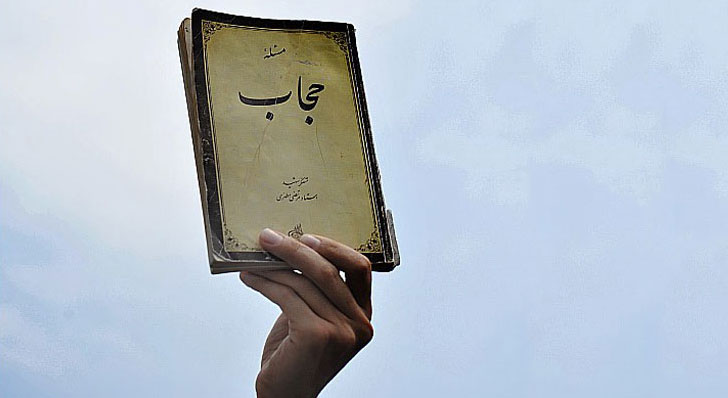
The Hijab Issue / Abu Dzar Nasrollahi
“این عکس یک پرنده است”
“This picture is a bird.”
Abuzar Nasrollahi
The issue of hijab and its mandatory nature has been a subject of controversy since before the victory of the revolution; to the extent that some revolutionaries such as Ali Shariati and Morteza Motahhari have given speeches on this matter, the texts of which are available to everyone as books.
Perhaps the most initial signs of the obligation to wear hijab can be found in the works of the late Morteza Motahhari. He, by using the analogy of the fact that even in European countries there are restrictions on clothing, and for example, men cannot leave their homes in pajamas, in response to the criticism that hijab is against civil liberties, writes: “Once again, it is necessary to remind that there is a difference between imprisoning a woman at home and obligating her to cover when she wants to interact with a stranger man. In Islam, there is no imprisonment or enslavement of women. Hijab in Islam is a duty placed on women, and in their interactions and dealings with men, they must observe a special quality in their clothing.”
It is noted that the vocabulary used by them is authoritarian and dictatorial, and it may have been predictable that they were seeking to propose a model for enforcing the hijab.
Although these debates were not taken seriously by the majority of women at the beginning of the revolution, the issue was of great concern to many journalists, women’s rights activists, and even revolutionary women who paid special attention to this issue and predicted the negative consequences of mandatory hijab. Their attention was such that in many press conferences with Ayatollah Khomeini, alongside discussions about the design of the new regime in Iran, the issue of hijab was asked as a minor topic. However, he never explicitly spoke about the mandatory nature of hijab in the context of the revolution. For example, on January 27, 1979, in response to a question about whether some Islamic customs, such as mandatory hijab, have been abandoned, and whether it will be mandatory in the Islamic Republic, he said, “Hijab, in the common sense among us, which is called Islamic hijab, does not oppose freedom; Islam opposes anything that goes against chastity, and we invite
They also denied forcing young girls to wear hijab in an interview with famous Italian journalist Oriana Fallaci on October 24, 1979. They said, “First of all, it is a choice for them, they chose it themselves. What right do you have to take that choice away from them? We declare to women that whoever wants to wear a chador or any Islamic covering, come out. Out of our 35 million population, 33 million come out. What right do you have to stop them? What kind of dictatorship do you have towards women? And secondly, we are not talking about a specific covering. There is nothing for women who have reached your age, but for young women who put on makeup and come out, we are following them with a battalion, we are stopping them. Don’t you feel ashamed?”
Even they, in response to an inquiry on the behavior of some individuals towards unveiled women on 4th of July 1980, wrote: “It is possible that the harassment of women in the streets and markets is from deviants and enemies of the revolution. In this regard, no one has the right to harass and such interventions are forbidden for Muslims, and the police and committees should prevent such incidents.”
Their only words in the chaos of the revolution, which smell of coercion, were delivered on February 4, 1979, among a group of students, criticizing the presence of unveiled women in government offices: “In Islamic government offices, women should not come naked. They can come, but they must be veiled. There is no problem with them coming, but they must act with the proper Islamic dress, preserving the principles of Sharia.”
Although Iran Farda magazine in issue 38 quotes Professor Hakimi as saying: “When I asked Ayatollah Khomeini about the reason for his statement, Mr. Motahari said that Imam said I am not in favor of compulsory hijab, but they pressured me so much that I said, hijab must be observed in offices.” It seems that there may be serious doubts about the validity of such statements. Anyone who has the slightest familiarity with Mr. Khomeini knows that he was not a person who would say such things under pressure; especially since he was openly supported by the people during the revolution and it would have been impossible to pressure him. Furthermore, according to previous reports, the late Mr. Motahari, as a theorist of the Islamic Republic, was in favor of compulsory hijab and it does not seem accidental that he did not explicitly mention the issue of compulsory hijab at the beginning of the revolution and its gradual implementation; rather, it was for
Barry, in every direction these words were enough for Banisadr to be the first person in Tir month of 1359 to issue a decree prohibiting unveiled women from entering government offices. However, until the late Sadegh Ghotbzadeh became the head of the judiciary, changing dress code in the judiciary was not considered a matter of authority. It wasn’t until 1362 when the then National Consultative Assembly approved an amendment to Article 102 of the Penal Code, considering failure to observe Islamic hijab as a crime and stipulating: “Women who appear in public without proper hijab will be punished with up to 74 lashes.”
This legal clause, which contradicts the principle of legality of crimes and punishments, as well as the rules of Sharia and even the fatwas stating the obligation of head covering, has been established so far in the form of Article 638 of the Iranian Penal Code and has always led to the personal preferences of governments and judges who are influenced by different cultures, seriously jeopardizing women’s freedom.
This clause does not clarify the concept of the Islamic veil and has placed it in a veil of ambiguity, as there is still no unified theory in the Sharia regarding the limits of the veil. The late Ahmad Qabel believes that the definition of the obligatory limits of the Islamic veil is covering the body and covering the hair, and in his book he cites various opinions of early jurists as evidence and proves that this issue is not unanimously agreed upon in the Sharia. The late Mullah Ahmad Naraghi, in his book “Mastand al-Shi’a”, does not consider covering the part of the hair that is raised and covers the face, ears, and neck as obligatory, although he is cautious about covering the ears and neck. Similarly, jurists such as Ayatollah Khomeini, Makarem Shirazi, Sistani, and others consider covering the hair and body sufficient for the purpose of covering, and do not impose any restrictions on the color or tightness of clothing,
Another important point is that the scholars who believe in the inclusion of head covering for the realization of hijab, exempt prepubescent girls and menopausal women from this rule, and their reason for this fatwa is verse 60 of Surah An-Nur which states: “And women who have no hope of marriage, it is no sin on them if they put aside their (outer) garments, without displaying their adornment. But to refrain (from that) is better for them. And Allah is All-Hearing, All-Knowing. And for women who are unable to marry, it is not a sin for them to remove their clothing without displaying their adornment, and it is better for them to maintain their modesty. And Allah is All-Hearing, All-Knowing.”
All of this is happening while, contrary to these fatwas, there are strict rules for hijab. Although in jurisprudence and sharia, obligations that are part of the pillars of religion are referred to as branches of religion and hijab is not included in any of the old and new sources, there is insistence that this non-consensual jurisprudential ruling be considered as part of the necessities of religion and in its implementation, the boundaries of Islamic law be exceeded. You see young girls in schools forced to wear hijab, menopausal women and religious minorities who are not subject to the ruling of hijab, may be prosecuted if they do not comply with the defined regulations, or even though according to the aforementioned fatwas, wearing a blouse and pants or a blouse and skirt is sufficient for fulfilling the requirements of Islamic hijab, the morality police have strict measures or sometimes even use violence against individuals who wear clothing other than the mandated mantou and pants according to the personal tastes
 Created By: Admin
 August 23, 2018
Tags
Abuzar Nasrullahi Compulsory hijab Hijab Monthly Peace Line Magazine Morteza Motahari peace line ماهنامه خط صلح