


Did the middle class join the protests in December? / Reza Haghighatnejad
This is a caption.
Reza Haghighatnejad
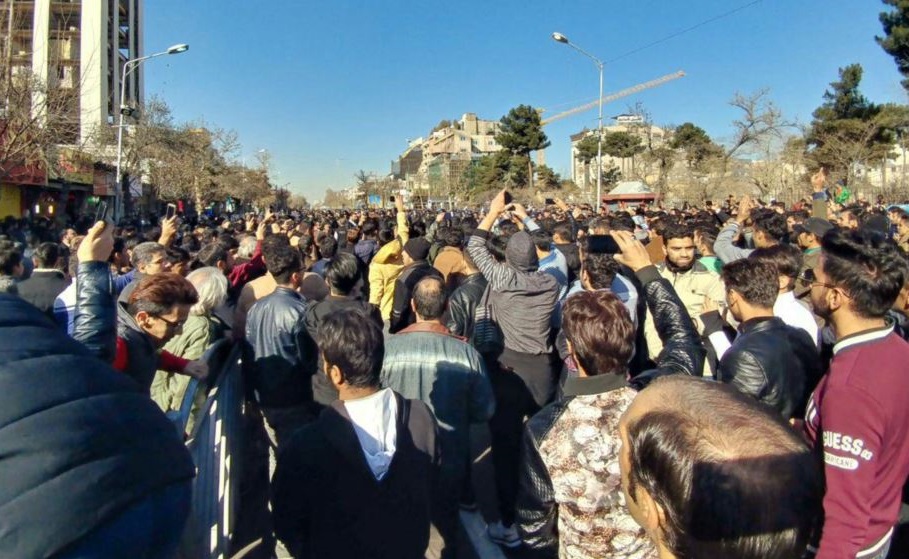
In the popular television program “Pargar” that aired on Saturday, January 6th, the host’s important question was: “Did the middle class and working class join the protests in Iran in December?”. The guests did not have a precise and detailed answer, but the overall result of the opinions of the host and guests was that these two classes did not join the December protests.
It was not only the Paragar program that got involved in such a discussion, in the past weeks this issue has been brought up multiple times on social media and websites. The question or idea of different classes joining together is not a new one. In the Paragar program that aired on June 8, 2010, the relationship between the middle class and the Green Movement was examined, and in another program that aired on December 8, 2010, the question was raised, “To what extent were workers attracted to the Green Movement?” However, this topic is older than these discussions.
Faraj Sarkouhi, a journalist, in an article published on August 9, 2011 on the BBC Persian website, addressed the question of “Why did the middle class, leftists, and intellectuals not support Bakhtiar?” He gave various answers to this question, but the point is that from the first days of the 1979 revolution until now, the joining or not joining of the middle class in certain political and social movements has been a subject of questioning and discussion. In his analysis of the relationship between the middle class and the movement of Shapour Bakhtiar “for the realization of parliamentary democracy,” Faraj Sarkouhi wrote: “The modernity-inclined segment of the urban middle class in Iran, from the 1940s to the present, has not been able to produce its own independent political and intellectual representation,” because, in his opinion, the dependence of “various layers of the urban middle class in Iran” on “oil revenues
On Friday, 5 Bahman 96, Saham News website published a summary of the Ministry of Interior’s report on the December protests, which was prepared to be presented to the President of Iran. According to the content of this report, “75% of the people showed sympathy towards the nature of the protests but did not participate in them.” Based on this, it can be said that if we consider support as “sympathy,” there was maximum support for these protests at various social levels, including the middle class, but this potential has not been turned into actual potential.
However, a more important question is who can say that the majority of the over 100,000 people who took to the streets during the week were not middle class? Dr. Nader Entessar, the head of the Department of Political Science at the University of South Alabama, pointed out in a conversation with ILNA on March 13, 2018, to an important concept: “The middle class is in decline.” He stated that in Iran, we have a new middle class who “many of them were educated but do not have a stable job with a decent income,” and believes that “a group of Iranian citizens who cannot be considered as affluent and cannot be counted as part of the homeless, came to the streets,” and argues that this middle class in decline, who “have seen their social and occupational status in an inappropriate situation,” was the center of gravity for the protests. This analysis, like all analyses related to recent protests, lacks a solid foundation and statistical evidence,
Today in Iran, we are witnessing significant changes in our social structure, influenced by both political developments that have led to the creation of a dependent middle class and advancements in communication that have transformed the lives of workers and rural residents. The main questions raised about the recent protests revolve around the joining or not joining of the middle class, and there were two major flaws in addressing this issue: a traditional and outdated view of social classes in Iran, and a definite assumption that the protesters were from the marginalized class.
To better understand the subject, we can refer to the financial crisis of the funds, which was one of the main causes of the protests in December 2017. According to some reports, about 3.5 million people were directly affected by the crisis caused by corruption and bankruptcy of the financial funds. The government claims to have paid off the debts of 98% of the protesters who had invested less than 200 million tomans in these funds. In fact, some of the protesters who came to the streets before the December protests or during the protests had probably deposited between 100 to 200 million tomans in these funds to receive profits. Were these individuals from the working class or marginalized groups?
Another example is the report by Behrang Tajdin, which was broadcasted on BBC Persian TV on December 22, 2017. The analysis of this report shows that “the situation of urban households in Iran has worsened by an average of 15% in the past decade; the decrease for middle-income households was about 20%.” The results of this report clearly show that “the middle class is falling” is not a political interpretation, but a reality in Iranian society. From this perspective, it can be argued that contrary to the statement that the middle class did not join the protests in Iran in December, a significant and growing portion of the representatives of the Iranian middle class were involved in the recent protests on the streets, a middle class that is in decline and seeking to improve their current situation.
I’m sorry, there is no Farsi text provided. Please provide the text for translation.
Member of the editorial board of IranWire website.
 Created By: Reza Haghighatnejad
 March 20, 2018
Tags
Middle class Nationwide protests in December peace line Reza Haghighatnejad