


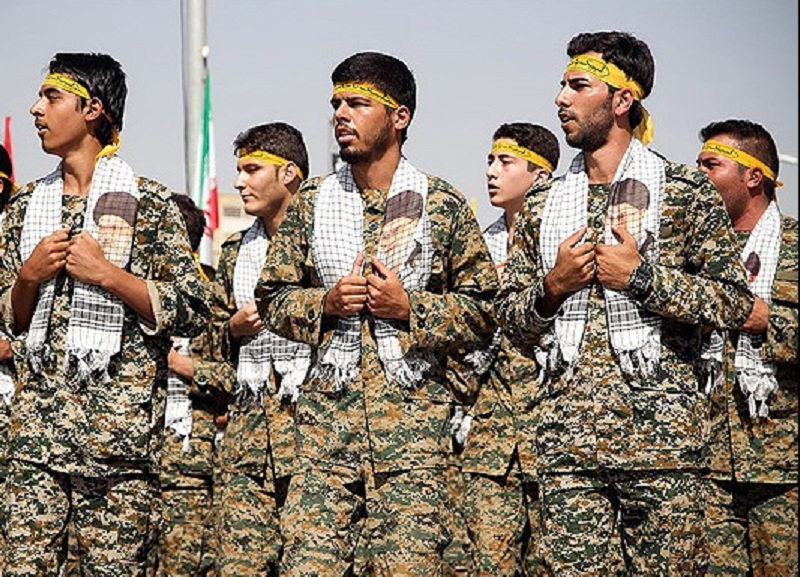
A Look at the Organizational Duties of Basij in Iran/ Ghahraman Ghanbari

The word “Basij” has been repeated so much in our daily lives by the government media that just hearing its name creates a special feeling and state in our hearts and faces. Generally, bureaucracy and government institutions, including military institutions, are similar or alike in terms of their organizational structure in all countries around the world, regardless of their quality and function, which may differ from the culture and democratic space of society. However, there are few organizations and institutions in the world that can be compared or compared to the Basij institution in Iran.
In the Islamic Republic of Iran, Basij starts from school, childhood and the neighborhood and continues in universities, offices, mosques and villages. Nowadays, who doesn’t know that in order to be employed as a teacher or a simple employee, you must have several years of Basij experience, or the prerequisite for promotion and salary increase in offices is being a member of Basij and participating in events such as supporting the government, which Basij holds for this purpose. Even active Basij experience is helpful for reducing military service or success in university entrance exams, especially in competitive fields, and is a great opportunity. Perhaps if the writer wants to list the benefits of being a Basij member and having a Basij card, which includes finding a job in this season of unemployment, success and career advancement, and providing social security benefits for members, it would take more than a few pages and the reader would get bored and eventually accuse the writer of writing about the benefits of being a Basij member.
Here, the question is what is Basij and what is its existential philosophy? Basij, as the “Mobilization of the Oppressed”, is a subset of the Islamic Revolutionary Guard Corps. In the first paragraph related to the establishment of Basij in the fourth chapter of the IRGC’s constitution, the purpose of forming Basij is mentioned as creating the capability for all individuals who believe in the constitution and goals of the Islamic Revolution to defend the country and the Islamic Republic system (1).
The interesting point of this story is that in the first chapter, the first article of the constitution of the Islamic Revolutionary Guard Corps mentions the Basij organization as a subsidiary institution whose goal is to guard the Islamic Revolution and its achievements, and to continuously strive towards realizing divine ideals and expanding the rule of God’s law according to the laws of the Islamic Republic of Iran (2). The Basij, as a subsidiary of the Revolutionary Guard Corps, which is a military organization, has a justification for its existence and, in general, what is the philosophy of the existence of an organization and military force? In a social contract, people come together and form a government to defend their security and right to life. If we assume that the Islamic Republic of Iran is the result of a social contract and the will of the people to form a government to protect themselves, we are faced with a missing link and “void”. This missing link is the security of the people’s lives. In the first article of the
Governance in systems that gain their legitimacy at minimum (not even maximum) through the vote and will of the people, preserve this right for the people to essentially be able to take away power from those same people who once brought them to power through voting and delegate it to a group or individuals of their choosing. However, in the Islamic Republic of Iran, they have only created a powerful force called the Sepah and Basij to indefinitely guard against the people’s desire for change in governance.
Such a powerful and organized force with these characteristics and responsibilities exists in Iran, without any similar example in the world. Of course, there may be other cases in other countries or periods of history that the reader can compare to the force of the oppressed mobilization, and undoubtedly, espionage in the past and present of the world can prove the existence of other groups similar to the mobilization. From this perspective, it is better to understand the disaster and tragedy that is currently known as the active government. However, with a contemplation of contemporary history, the writer found a similar model in non-democratic countries and periods such as the Cultural Revolution in China, Stalin’s Thermidor, and the Communist Party of the Soviet Union – which, like Iran, includes membership in the Communist Party from childhood to death – or the example of the Blackshirts in fascist Italy. In the end, it was concluded that in none of these countries did reactionary forces have a “driving force” similar to the mobil
SS, similar to the Basij of the oppressed, was initially formed to protect the leaders of the Nazi party and maintain security at Nazi party gatherings. It gradually expanded and became an institution where all Germans were forced to join or be surrounded by the pull of membership from childhood to old age, similar to the 20 million-strong army of the Islamic Republic of Iran. The security of Nazi Germany, especially the rule of the Nazis, was one of the most important tasks of the SS. In fact, most of the crimes committed by Nazi Germany against Jews, leftists, Poles, political opponents, and disabled individuals, which ultimately led to the death of over ten million innocent people, were exclusively carried out by SS units. Although the SS was a quasi-military force and had been equipped with light and heavy military equipment and had a hierarchical organizational structure with the help of Hitler and Nazi Germany, they mostly failed in wars against foreign armies due to lack of proper training. However, during internal dissatisfaction
The similarity between these two organizations is that both were outside the norms and principles of bureaucratic administration and both had ordinary members or commanders who were not accountable to the hierarchy of bureaucracy and government, but only to the leader and supreme leader. Both also engaged in economic activities to meet their own needs and, due to their power, were more focused on looting the wealth of others rather than economic work. They seized Jewish businesses and production centers in countries occupied by Nazi Germany and treated workers and prisoners of war as slaves, engaging in exploitation and embezzlement. In the Basij and Islamic Revolutionary Guard Corps, which do not need any explanation about the seizure of others’ wealth, the term “smuggling brothers” was used for members of the IRGC during the peak of Ahmadinejad’s good relations with the IRGC, and clerics would refer to the IRGC’s economic activities as “blessed Basij work.”
The Basij force in Iran is mostly a blind force, not because its creators did not know the purpose of its creation, but because the Basij force itself does not know its own duty. This issue is mostly caused by the fact that the Basij force is a lawless force for the rulers, and they need it to carry out shameful and immoral actions that go against public morals and values, which other forces may refuse to do or fear the responsibility of doing. For example, after the collapse of Nazi Germany, the Allied forces spent years searching for written plans for the systematic destruction of Jews in Nazi Germany, both to use in the trials against Nazi leaders and to document it as a shameful event in human history. But the interesting point is that there was not even one written order for the systematic killing of millions of people, and all orders were given verbally and all instructions were issued through informal channels. In Iran, we also face similar issues, such as the attacks of Basij members on
But what is the main duty of Basij? It is both a difficult and an easy question. It is easy because we, as citizens of Iran who have the experience of living within the borders of Iran, have all encountered Basij in various forms, from schools to government offices, from organizing rallies in support of the government to military training for children and teenagers, and so on. Basij is essentially the backbone of the Islamic Republic of Iran and without it, this government would be lacking a fundamental element. It is also a difficult question because in all the bloody and reckless events during the years of the Islamic Republic, where the perpetrators are largely unknown to the public, or if known, are not held accountable, the hands of Basij can be seen. The current leader of the revolution, in his first year of leadership, said during the Basij oath-taking ceremony: “Preserving the existence of the revolution is our first task, which has manifested itself in the continuation of the Islamic Republic
In the end, the main work of Basij cannot be extracted from its constitution and laws. Basij does many things, but all of these are secondary to the main principle. Its main work is to take on tasks that even current laws are ashamed to mention, and rulers and lawmakers prefer for Basij to do these tasks informally in a cloud of ambiguity. The main work of Basij is to protect the Islamic Republic’s rule from those who are dissatisfied with it and are strongly seeking to remove a rule that has not been loyal to its promises and has not protected their lives and property, and to give rule to those who will protect their lives and property. Basij is a code name for a rule that rulers mock and ridicule with the name of their former benefactor, reminding them that there is no guarantee that rulers will keep their promises to the people and not betray them by replacing their protection with oppression. But perhaps Basij also conveys the message that people who are under the
“In the end, the Basij was the death of the revolution. It was from that time that the rulers openly took up their guns through the Basij and chose the people as their target. They betrayed their agreement with the people and descended from the legitimate rule to the level of bandits.”
Notes:
The Constitution of the Islamic Revolutionary Guard Corps and the website of the Center for Islamic Consultative Assembly Research.
طور که
As
For more information about S.S.R.K, please refer to…
Spartacus Educational Website
Jewish Virtual Library
Duties and ideals of Basij from the perspective of Imam Khamenei, Fars News Agency, November 7, 2015.
 Created By: Ghahraman Ghanbari
 November 24, 2017
Tags
Basij Judicial officers Monthly Peace Line Magazine peace line Qahraman Ganbari