


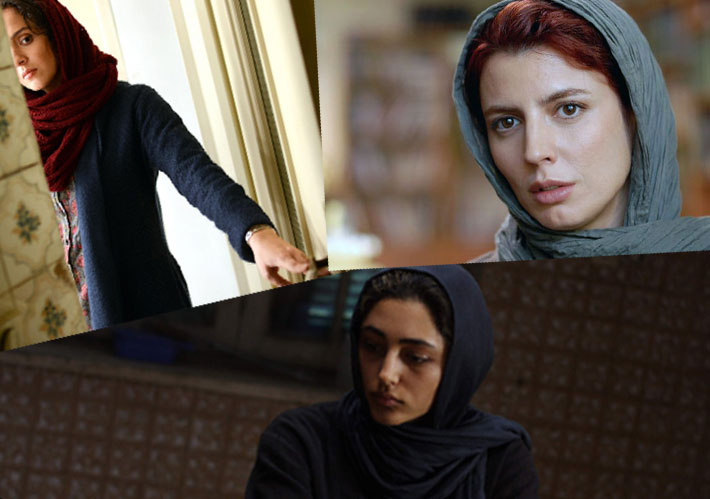
Three Women of Farhadi/ Mostafa Azizi
This is not a complete sentence, so it cannot be accurately translated. Please provide the full text for an accurate translation.
Mostafa Azizi
Women in Farhadi’s cinema are always the subject of the story, without being the main character. The deepest issues of women are narrated from the perspective of the male character, who is the main character. A man who, despite all his flaws, always has the final say and imposes his will on events, and in a way, he is the one who has the right on his side.
Sepideh in “About Elly”, Simin in “A Separation”, and Ra’na in “The Salesman” all want to solve their problems through compromise, by not revealing the whole truth and by avoiding the situation with tolerance and leniency. However, the men in these three stories are determined to solve the problem through direct and sometimes harsh confrontation without any compromise. The men are traditionalists while the women are pragmatic and action-oriented.
In “About Eli”, the issue is why Sepideh did not tell the truth; whether Sepideh stayed silent only to save Eli or did not fully disclose the truth and now must make amends. In “The Salesman”, Rana also just wants to forget the incident and is not seeking revenge, nor does she expect Emad to pursue the attacker. And when Emad does, she is not supportive. In all three cases, if the connection is broken and the relationship falls apart, the female characters are seen as the guilty party in various ways and their bravery is questioned.
Another point is that in these three works – which can perhaps be considered a trilogy – the main subject is always pushed to the sidelines and the less important topic becomes the main focus; the main subject is a feminine issue that is pushed to the sidelines, while the secondary topic that comes to the forefront is a masculine issue.
There is no Farsi text provided to translate. Please provide the text to be translated.
Golshifteh Farahani in the role of Sepideh – About Eli (2008)
In “About Elly”, a woman dies but all the worries revolve around “truth and lies” and the main issue that is human death, is the death of a woman who wants to leave her fiancé in hopes of a better life, is pushed to the sidelines and forgotten. In “A Separation”, the main subject and issue, which is the woman in the story who is concerned about emigration and raising her daughter in a more fair and favorable environment for women, is silenced and with a mouthful of slogans, the issue of taking care of a father with Alzheimer’s, and if he is being taken care of, it is by the woman, not the man, is pushed to the sidelines. The future of the “daughter” must be denied for the forgotten past of the “father”. In “The Salesman”, an important issue such as assault or harassment towards Rana is pushed to the sidelines and is not discussed or revealed. The suffering that the woman endures
But the artistic style of Farhadi in “A Separation” reaches its peak and completely flows on his subconscious, remaining in a Socratic dialogue style, causing Farhadi to go to places he may not even want to go. In “A Separation,” Termeh, a girl who will one day become a mature woman, realizes that her father’s principles only apply when others are expected to pay the price. For example, he pressures her to go and collect a few extra tomans from the gas station worker to take back their extra money.
Tara is a girl on the verge of adolescence. Her father is a source of values and principles for her, and her mother is a symbol of sacrifice and realism. She loves her family and suffers and watches as they go through a crisis. At first, she can’t understand what the conflict between her parents is about. It seems that her mother is the cause of the separation. It appears that her leaving has caused the problems, but as more events and tests come their way, she begins to understand the situation. Is her mother a fearful woman who runs away from problems? Is her father a strong and steadfast man who stands by his principles and ideals? The first blow comes when she realizes that her father has been lying.
Terme: Did you lie?
Nader: Do you know what would have happened if I had known? Huh? It took me a year and a half to three years in prison. I thought to myself during that time, what would you become, who would you stay with, and I said I didn’t know.
Nader: Dad, the law doesn’t care about these things. Either you knew or you didn’t know.
This is a caption for an image.
Leila Hatami as Simin – Separation of Nader and Simin (1389)
He had heard it from his father before. That one should not judge and give a grade to someone and pay the cost of honesty; but now he sees that when it comes to himself, he is not willing to pay the cost and makes excuses; while he knows that if his father goes to prison, his mother would take care of him. Just as she is taking care of him now, she is also fighting tooth and nail to take him to a place where he can have a better future.
Terme sees that his father is also lying to Mrs. Ghahrayi (Marila Zarei) and giving false testimony, putting himself in danger. He also goes to the neighbors and possibly helps create a favorable environment for the statement he wants to make to the investigating authorities.
Nader claims that he wants his daughter to be resilient and principled, but in reality he encourages her to lie. When the interrogator (Babak Karimi) asks Nader about the incident with the doctor’s number, Nader lies and says he heard about it from his daughter. Why? Because he is sure that his daughter will also lie to protect him. And she does, and breaks down. In the next scene, she is sitting in the back seat, crying and looking at her father with tears in her eyes. Finally, she seeks refuge in her mother’s arms and cries.
However, it seems that in “The Salesman,” this duality of conscious/unconscious has turned into a deliberate construction by the author to attract more audience. The incident that happened in “A Separation” was that many of the grown-up audience members, in the patriarchal atmosphere dominant in Iran, believed that the son should choose his father, and many of the audience members outside of Iran had received the message that the son should choose his mother. From this perspective, all the audience members were satisfied when leaving the cinema; whether they had a patriarchal view or a humanistic and fair view. However, in “The Salesman,” this is not a necessary element of the story, but rather a subconscious manifestation of the author, which seems to have been planned based on the experience of “A Separation.”
If we are faced with the honesty of the film, the message of the film is clear. For example, “Qeysar” is a film of honesty. It is clear that it is defending “honor” and “manliness” against betrayal. The settled householder is criticized and Qeysar is praised for his honorable and active behavior. We may not agree with the message of the film, but there is no disagreement that “Qeysar” intends to praise “honor”. One person may say that “Qeysar” promotes honor, while another may say it promotes dishonor! But “The Salesman” is not like this. “A Separation” is not like this either. In “A Separation”, the choice of the term gives the main message of the film; whether the term chooses the nostalgic, traditional and combative or the modern, adaptable and future-oriented. If the term had chosen his father, some of the audience
No text provided. Please provide the Farsi text to be translated.
The song “Alidousti” in the role of Ra’na – the seller (1394).
The whole art of this technique lies in the fact that the story ends, but the conversation remains unfinished. If we see Emad’s regret in “The Salesman”, this thesis is confirmed: “Personal revenge and excessive punishment are not the right actions” and it brings about a change in perspective for some people. It means that the group who initially wanted to witness a severe revenge, with empathy for the main character, accept that they were wrong and must learn to be forgiving and not have a desire for harsh punishment. However, there were also some who did not agree with the film’s conclusion and said it was a ridiculous film that promoted “dishonor”. But “The Salesman” is not like that; because it ends in ambiguity. It is not clear if Emad regrets his actions or not. Some film critics may say that in the mimicking of facial expressions or certain gestures, it is evident that Emad regrets his actions and Rana will not forgive him for his behavior;
We must see if the day will come when Farhadi makes a film where the main character is a woman and women’s issues are addressed from their own perspective, not just as a side issue while the main focus remains on men. Farhadi is much younger than the point where he cannot change and separate himself from patriarchal mindsets and step into the human world. We hope to witness such a day, if the big awards do not diminish his filmmaking.
 Created By: Mustafa Azizi
 March 27, 2017
Tags
"Nader's Separation from Simin" About Elly Actors of life Asghar Farhadi Caesar Honor or dignity Leadership Manliness Monthly Peace Line Magazine Mustafa Azizi peace line Salesperson ماهنامه خط صلح