


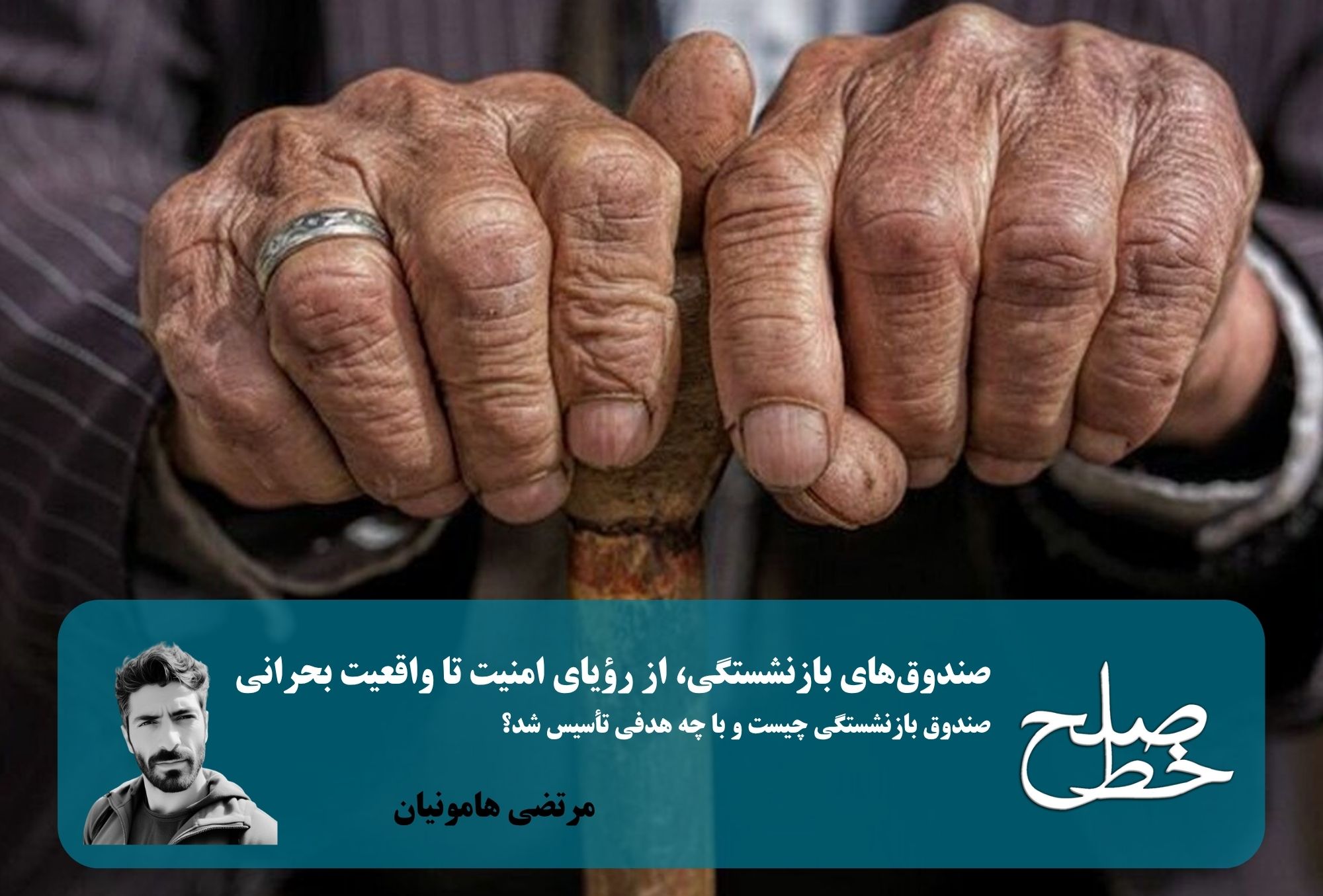
Pension Funds: From the Dream of Security to the Crisis of Reality/ Morteza Hamounian
During the Roman Empire, soldiers received money or land after completing their service. That is, when a soldier ended his military duty and was to be discharged with honor, he was granted a payment and sometimes a plot of land. A similar system existed in ancient China and Greece. Later, during the Middle Ages, guilds and churches supported their elderly members. In the mid-1800s, U.S. government employees began receiving pensions, providing them with financial independence in old age and after employment. This inspired American Express to establish the first private retirement insurance company in 1875. Across the Atlantic, however, it was the great German Chancellor Bismarck who declared that individuals over 65 years old could stop working and receive pensions—an initiative that marked a significant leap in the development of pension funds in the modern world. (1)
In Iran, until the final years of the Qajar era, there was no formal pension system. Only some government officials received bonuses or pensions from the Shah at the end of their service. Around the early post-Constitutional Revolution era, specifically in 1908 (1287), the first Iranian Parliament passed a law titled The Duties Law, under which pensions were established for the heirs of civil servants—meaning the families of deceased government employees. However, this law made no provisions for the employees themselves during old age or disability. Eventually, the first legislation regarding social security for government employees—as part of employment rights and with the aim of supporting them and their heirs against aging, disability, and death—was passed in 1922 (1301). This law was amended in 1929, 1930, and again in 1945, until in 1958 (1337), the Civil Service Employment Act was passed, with Chapter 8 dedicated to pension regulations. This law has been amended several times since 1966 (1345). (2) The year 1966 marked a major turning point in the establishment of Iran’s pension system, with the Civil Service Employment Act being approved in June of that year. According to Article 70 of this law, the General Directorate of Retirement, along with all assets, the capital of the pension fund, documents, securities, budgets, and obligations, was separated from the Ministry of Finance and placed under the Administrative and Employment Affairs Organization. Based on the amendment to this article, starting in 1975 (1354), the Civil Servants Pension Fund was established as an independent institution affiliated with the Administrative and Employment Affairs Organization. (2) In light of this historical trajectory and the founding philosophy behind these funds, the critical question remains: Why were such institutions created in the first place, and what role are they supposed to play in the social structure?
The Nature and Purpose of Pension Funds
As the workforce ages and becomes incapacitated, the concern of covering family expenses becomes one of the most pressing issues for household heads. In the past, families aimed to secure future income for old age and incapacity by having many children. In traditional family structures, children were considered the support system for their aging parents, and their labor helped meet the needs of elderly household heads. Traditional family culture reinforced this practice and passed it down through generations. However, as societies modernized, urbanization expanded, and job diversity increased, the responsibility of covering post-retirement expenses for employees and workers shifted to governments and corporations. Thus, gradually, with the enactment of labor laws and regulations related to the workforce, pension funds were established. (3) In fact, pension funds in Iran play a fundamental role in ensuring financial security during old age and disability for workers and employees. They are considered key pillars of the country’s social security system and are intended to play a critical role in maintaining retirees’ economic welfare.
In this structure, pension funds are financial institutions created to collect specific contributions from employees and workers in order to pay retirement and disability benefits. These funds are established by the government, professional associations, or private companies. Their members include employees, civil servants, and laborers who make periodic or monthly contributions. These contributions are pooled and invested across various sectors, and the returns are paid as pensions to retirees. Typically, part of the contributions comes from employers and part from employees or workers—meaning both employers and workers participate and invest jointly to help cover retirees’ living expenses. Moreover, since managing these assets requires specialized knowledge, organizations and institutions often entrust the management of their pension funds to external asset management experts or institutions. (4)
Pension funds are especially important for ensuring retirees’ livelihoods, and thus understanding them is essential. Each pension fund has its own rules, conditions, benefits, and drawbacks, and ignorance of these differences can result in the violation of legal rights or difficulties in receiving pensions. According to a report by the Social Affairs Committee of Parliament in January 2023 (Dey 1401), titled Assessment of the Challenging Aspects of Pension Funds and the Performance of Related Executive Bodies (prepared for the 2023 budget bill), there are 18 pension funds in Iran. (5) The names of these funds are as follows:
Social Security Organization
Social Insurance Fund for Farmers, Villagers, and Nomads
Civil Servants Pension Fund
Armed Forces Social Security Organization
Pension Fund of Ministry of Intelligence Staff
Steel Workers Pension Fund
Savings, Welfare, and Pension Fund of the Oil Industry Employees
Central Bank Pension Fund
Central Insurance Pension Fund
Iran Insurance Pension Fund
Ports and Maritime Organization Pension Fund
Tehran Municipality Pension Fund
Iran Air (Homa) Pension Fund
National Iranian Copper Industries Pension Fund
IRIB (Islamic Republic of Iran Broadcasting) Employees Pension Fund
Bank Employees Pension Fund
Ayandehsaz Pension Support Fund
Legal Practitioners and Court Advocates Support and Pension Fund (6)
However, there have been reports regarding the dissolution or merger of three of these eighteen funds. In November 2024 (Aban 1403), Tasnim News Agency reported that according to provisions in the 2025 (1404) budget bill, with the government assuming the expenditures of three civil pension funds, the assets of these funds—including related companies—would be directly taken over by the government. (7) This report was denied by the spokesperson of the 2025 Budget Committee, who attributed the claim to a “misinterpretation” of paragraph “Ayn” in note 2 of the budget bill. (8) However, shortly after these remarks, Alireza Heidari, a social affairs expert, told ILNA News Agency that the commitments of funds such as the Civil Servants and Steel Workers Pension Funds—covering current contributors and pensioners—are to be transferred to the national treasury, and “these funds will essentially be dismantled, with the government assuming their obligations.” (9)
Despite their central role in financing retirees, Iran’s pension funds face deep structural challenges, including:
severe resource deficits
declining support ratios (number of premium-payers to pensioners)
non-transparent asset management
inefficient corporate ownership
increasing dependence on the public budget
erosion of public trust
These crises indicate that Iran’s pension funds need structural reform to fulfill their founding mission: protecting aging and incapacitated workers.
Before the concept of retirement became institutionalized, people worked until the end of their lives. In that model, as individuals aged and their physical strength declined, they merely transitioned from heavy labor to lighter tasks—but never exited the workforce entirely. The emergence of retirement, however, introduced a new social class: citizens who, in exchange for a lifetime of labor, were to enjoy financial security and leisure in old age. As a result of establishing the pension system and its corresponding funds, a stage of life—old age—that once inspired fear was transformed into a period people looked forward to. In many countries today, retirement is even congratulated. But in Iran, as the condition of the very funds meant to guarantee security in old age has deteriorated into crisis, retirement has turned into a nightmare for a vast portion of the workforce—a nightmare in which workers know they must continue looking for new jobs after retiring, because their pensions will not cover the cost of living. In a country where unbridled inflation has worn people down, the pension fund crisis has become a “crisis on top of a crisis”—a compounded calamity that has not only plunged the livelihoods of today’s citizens into hardship but has also cast the future of retirees into uncertainty and deepening difficulty.
Footnotes:
1- Ideas That Changed the World: How the Pension System Was Created and Where It Stands Today, Rouydad 24, May 3, 2021 (14 Ordibehesht 1400).
2- History of Retirement in Iran, Civil Servants Pension Fund, Ministry of Cooperatives, Labor, and Social Welfare.
3- What Is a Pension Fund?, Amoozein, February 21, 2024 (2 Esfand 1402).
4- What Is a Pension Fund?, Gold, Coin and Currency Information Network, June 10, 2024 (21 Khordad 1403).
5- Parliament’s Report on Challenges of 18 Pension Funds: From Retirement Calculation Methods to Government Liabilities, Tasnim News Agency, January 10, 2023 (20 Dey 1401).
6- List and Comparison of Pension Funds in Iran, Iran Estekhdam.
7- Are Three Government Pension Funds Being Dissolved?, Tasnim News Agency, November 8, 2024 (18 Aban 1403).
8- Interview with the Spokesperson of the Planning and Budget Organization, Eghtesad News, November 9, 2024 (19 Aban 1403).
9- Pension Fund Mergers Not on the Table; Dissolution of Some Funds Under Review, ILNA, January 8, 2025 (18 Dey 1403).
 Created By: Morteza Hamounian
 October 23, 2025
Tags
Armed forces Insurance Morteza Hamounian peace line Retirees Retirement Retirement boxes Retirement fund Social Security Organization Unemployment ماهنامه خط صلح