


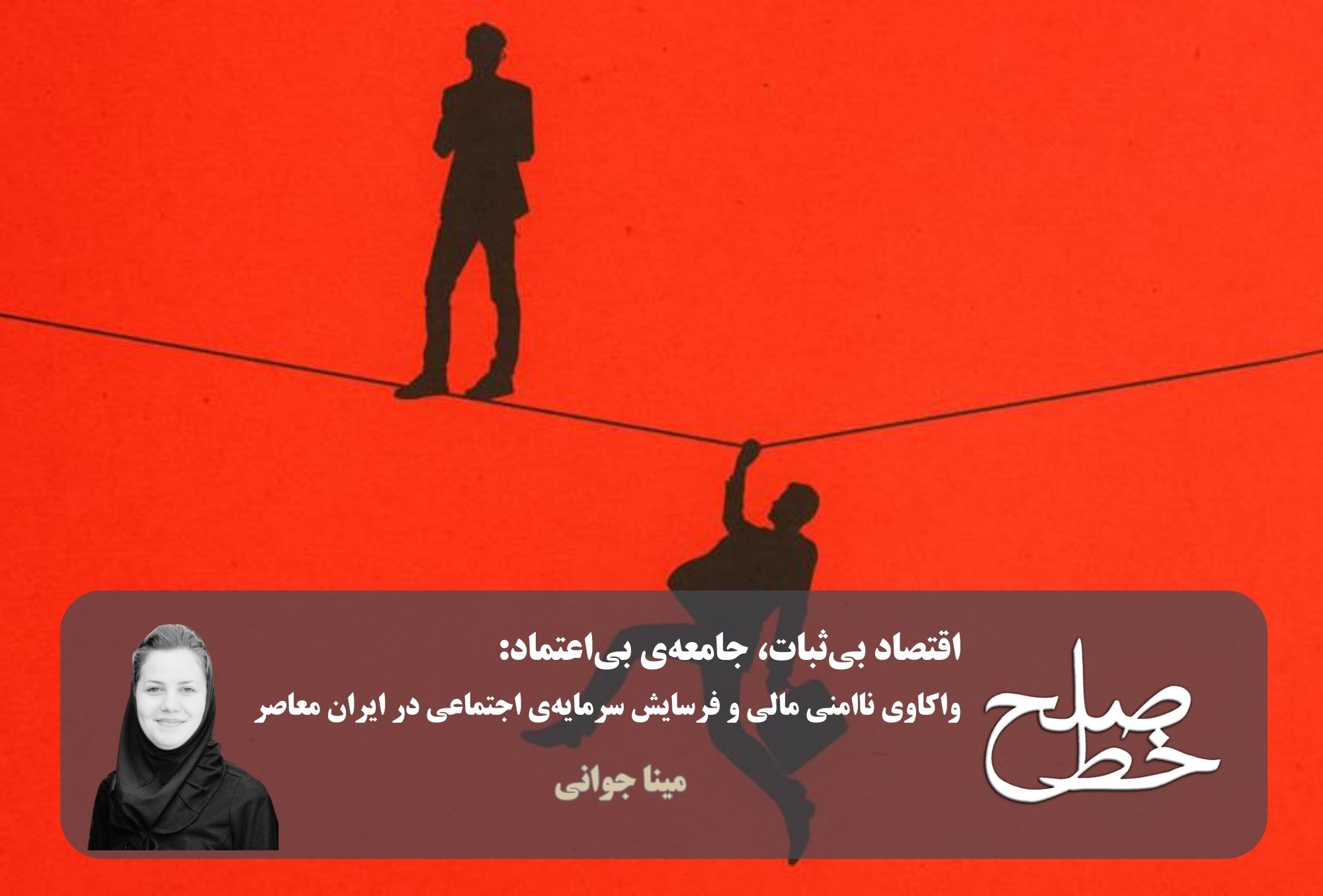
“Exploring Financial Insecurity and Erosion of Social Capital in Contemporary Iran / Mina Javani”
In the midst of the recent years’ intense transformations and chronic instabilities, Iranian society has been faced with a multifaceted erosion of social fabric; a situation that is not only observable in economic and political indicators, but also in the lived experiences of citizens. Among the key components of this multi-layered crisis, three phenomena stand out more prominently than others: financial and economic insecurity, decline in social capital, and erosion of future-oriented horizons. These three variables, in a complex interplay with each other, have affected the structures of social cohesion and transformed individual and collective patterns of behavior.
Financial insecurity, perceived as a stable perception of economic instability, inability to plan for the long term, and concerns about access to basic needs, have become universal experiences in recent years. Rampant inflation, devaluation of national currency, weakening of the redistribution system, and shrinking job opportunities have not only had material and livelihood consequences, but have also created deep psychological and social repercussions. In these conditions, individuals are deprived of the ability to imagine and achieve a predictable life, and daily life is governed by the logic of survival, isolation, and defensive reactions.
The result of the combination of these two processes is the formation of a type of structural anxiety; a situation in which the future is not only uncertain but also terrifying. In the absence of economic security and social capital, individuals lose their ability to imagine and plan for a better tomorrow. Instead of being a horizon for development, meaning, and planning, the future becomes a source of anxiety, fragmentation, and passivity. As a result, financial insecurity is not just an economic issue, but a sociological and cultural one that weakens the ability to rebuild society and politics at a macro level.
This article aims to provide an analytical overview of the social situation in Iran in recent decades by examining the correlation between financial insecurity, erosion of social capital, and future anxiety. The central question is how unstable economic mechanisms have not only affected livelihoods, but also challenged collective opportunities for trust, belonging, and change.
Economic insecurity: Theoretical concepts and indicators.
Economic insecurity is a multidimensional concept in social sciences that refers to an individual or group’s perception of instability, lack of control, and vulnerability to economic conditions. This insecurity is not solely caused by absolute poverty or unemployment, but rather points to a combination of mental and objective conditions in which an individual feels threatened in regards to their economic future. In theoretical literature, economic insecurity can be analyzed in connection with concepts such as “social risk,” “livelihood insecurity,” and “economic anxiety,” which are not only influenced by market conditions, but also result from a certain psychological and social state.
From the perspective of theorists like Guy Standing, economic insecurity is one of the prominent characteristics of neoliberal economy in the era of globalization, which has given rise to a new class known as the “precariat”; a class without job security, social insurance, and predictable prospects for livelihood. In Iran, in recent years, with the expansion of temporary contracts, increase in informal employment, and decrease in job security, we can also observe the formation of a similar vulnerable class.
Economic insecurity is usually characterized by indicators such as a stable unemployment rate, chronic inflation, a decrease in household purchasing power, an increase in essential living expenses (such as housing, education, and healthcare), and a decrease in social support and insurance. In Iran, double-digit inflation, a decline in the value of the national currency, and a growing gap between expenses and income have led to a significant portion of the middle class also facing economic insecurity. The inability to save, the inability to purchase housing, and reliance on unstable jobs are all prominent signs of this situation.
In addition to objective indicators, examining perceptual indicators is also important in understanding economic insecurity. Field studies in Iran show that a high percentage of people, even if employed and with relative income, feel uncertain and worried about their economic future. These concerns are often related to fear of falling into poverty, inability to provide education for their children, price instability, and lack of confidence in economic policies.
Furthermore, economic insecurity in Iran is often intertwined with institutional mistrust. Frequent sudden decision-making, instability in financial and currency laws, and lack of transparency in macro policies have all contributed to a decline in public trust in economic institutions. In such circumstances, people not only lose confidence in the current situation, but also in the government’s ability to control economic crises.
In total, economic insecurity in Iran not only functions as an economic indicator, but also as an emotional, cultural, and social structure; a structure that increasingly affects the quality of life, collective actions, and future prospects of society. This connection between lived financial experiences and sociological processes is the starting point for a deeper understanding of the contemporary social situation in Iran.
Social Capital in the Shadow of Insecurity: From Distrust to Isolation.
Social capital is a concept that refers to networks of communication, mutual trust, and norms of cooperation in societies. This capital can manifest itself at different levels – from individual interactions to institutional and social relationships. In stable economic and social conditions, social capital leads to a sense of belonging and solidarity, and strengthens political and social participation. However, when economic and social insecurity increases, this capital is severely damaged.
Financial insecurity is one of the key factors in weakening social capital. When individuals feel economically threatened, they are less likely to participate in collective activities, political participation, and social interactions. Distrust in economic, political, and social institutions also directly affects the decline of social capital. In such circumstances, individuals prefer to act alone and live in their own individual world instead of collaborating with others and participating in collective projects.
In Iran, the increase in mistrust towards government institutions, weakness of support systems, and erosion of social relationships following economic crises have led to individuals having less trust not only in government institutions, but also in their fellow citizens. This decrease in trust, especially in urban communities and among lower and middle classes, has resulted in the promotion of passive, self-centered, and even informal behaviors (such as corruption or circumventing laws). Such behaviors not only hinder social and economic progress, but also have a negative impact on social cohesion.
In addition, in situations where economic pressures increase, individuals tend to become more socially isolated. This isolation, which sometimes takes the form of isolation from social institutions and other times takes the form of isolation from collective activities and social participation, can lead to the creation of closed loops of mistrust and insecurity. On one hand, this can result in a decrease in social capacities, and on the other hand, it can pose a threat to social stability.
In Iran, factors such as economic crises, inflation and currency fluctuations, devaluation of the national currency, and ineffective policies towards economic issues have caused many people to lose hope in the possibility of cooperation and social solidarity. This situation has increasingly weakened social capital and reduced the level of social participation in major national issues.
In conclusion, it can be said that economic insecurity and decline in social capital have a close relationship. Economic insecurity not only leads to individual crises, but also weakens social norms, public trust, and willingness to participate in society. This process can lead to a vicious cycle where the more social capital decreases, the more economic insecurity intensifies, and vice versa.
The impact of economic insecurity on political and social behaviors.
Economic insecurity, especially in transitional or continuously struggling societies, is one of the most important factors that affects the political and social behaviors of individuals. In such conditions, not only do the individual’s economic autonomy and security undergo significant changes, but social and political processes are also influenced. When individuals are faced with economic crises, their inclination to participate in collective and political activities decreases and in some cases, society becomes isolated and distrustful.
In the first place, economic insecurity directly affects the level of political participation. Individuals who struggle with financial problems are less likely to invest their time and energy in political issues. In fact, in situations where basic needs are not met, political priorities change drastically and economic concerns become more important than social and political issues. This leads individuals to focus more on their personal and family problems instead of actively participating in democratic processes such as elections. As a result, this situation leads to a decrease in public trust in political institutions and ultimately weakens the functioning of democracy.
However, the economic consequences of insecurity go beyond political disengagement. This economic crisis can lead to a decrease in social capital and deep social divisions. In societies where individuals are unable to meet their basic needs, social relationships are based more on conflict and competition rather than cooperation and solidarity. This situation can lead to the spread of self-centeredness, corruption, and distrust among individuals and institutions. When individuals feel insecure about their economic future, they tend to pursue individual and short-term solutions instead of participating in collective projects, which naturally affects social relationships and public trust.
In another aspect, economic insecurity manifests itself in various forms of social protests and crises. When people feel that government institutions are unable to provide them with economic security, it can lead to public dissatisfaction and even the formation of protest movements. In such conditions, government institutions face serious political challenges that can result in political instability and structural crises at a macro level. Recent experiences in Iran have shown that economic insecurity, along with corruption and managerial inefficiencies, sometimes leads to social movements and street protests in which people not only protest against government economic policies, but also against political and social structures.
On the other hand, economic insecurity leads to weakening of social solidarity and increasing social divisions. In these circumstances, social gaps based on economic and social classes become deeper and different groups in society may distance themselves from each other. These gaps, in addition to creating dissatisfaction, can lead to political and cultural dichotomies in which different groups, instead of cooperation and solidarity, engage in more competition and conflict with each other.
This situation can lead to fundamental changes in public and economic policies. Governments, under social and economic pressures, are forced to review their policies and economic strategies in order to gain public trust. In situations where the economic crisis has reached a point where social and political divides have become a threat to the stability of the country, governments are compelled to take a more serious approach to addressing economic and social issues and to use restorative policies to rebuild social capital and public trust.
The consequences of economic instability on social institutions.
Economic insecurity, especially in developing societies or in times of ongoing crises, has wide-ranging consequences on social institutions. These consequences not only affect the economic and individual aspects of human life, but also directly impact social structures and processes. In this regard, social institutions such as the family, education system, and healthcare system are among the structures that are directly affected by these crises, and these effects are reflected at both individual and societal levels. Analyzing these consequences requires attention to structural and cultural dimensions, as well as their links to policies and social actions taken in response to the economic crisis.
1. The impact of economic insecurity on the institution of family.
As one of the most important social institutions, families are under heavy pressure in times of economic insecurity. In societies where there are constant and widespread economic crises, families, especially those in the middle and lower classes, face serious challenges in meeting their basic needs. Decreased income and increased expenses weaken the economic capacity of families, and this situation has negative effects on the quality of life, family relationships, and mental security of family members.
In these circumstances, family members may resort to strategies to cope with economic crises that may seem effective in the short term, but can create more social damage in the long term. For example, reducing educational and healthcare expenses to deal with financial pressures can lead to physical and mental health problems for family members, and in the future, this situation will lead to the reproduction of social inequalities. Moreover, changes in gender roles within the family, especially in societies where women are traditionally responsible for providing for the household, can result in structural changes in individual and social identities, with cultural and social consequences that can lead to dissatisfaction and identity crises.
2. The impact of economic insecurity on the education system.
The educational system, as one of the key institutions in the process of socialization and individual and collective development, undergoes significant changes in the face of economic crises. In societies that constantly struggle with economic crises, the reduction of government resources for educational infrastructure and the increase in education costs lead to a decrease in access to quality education. This situation creates numerous problems, especially for low-income and vulnerable groups who have limited financial resources to cover educational expenses.
In addition, economic insecurity can lead to changes in cultural attitudes towards education. In situations where the economic future is uncertain, education may no longer be considered a top priority and especially in low-income families, children may focus on immediate job opportunities instead of continuing their education. This phenomenon can result in dropping out of school or a decrease in the quality of education, ultimately contributing to the perpetuation and widening of social and economic inequalities.
3. The impact of economic insecurity on the healthcare system.
The healthcare system is faced with serious challenges in the face of economic crises, the consequences of which not only affect access to medical services, but also the quality of these services. In societies that are facing reduced financial resources and economic pressures, governments will not be able to effectively provide the necessary budget for healthcare services. This situation particularly affects vulnerable segments of society who do not have the financial means to access private healthcare services.
On the other hand, economic pressures lead to increased psychological stress and anxieties among individuals, which in turn exacerbates health and mental health issues. In such circumstances, individuals are more likely to seek informal or sometimes unscientific treatments, which not only have less effectiveness but may also have negative impacts on the overall health of the community. Furthermore, reduced access to preventive and treatment health services leads to the spread of diseases, especially in impoverished areas, which will ultimately lead to major health and social crises.
4. Long-term social and cultural impacts.
Economic insecurity has a widespread impact on the cultural and social dimensions of society. In communities where there is a sustained economic crisis, individuals, especially those in low-income classes, may resort to adopting social and cultural strategies to cope with the situation. These strategies often manifest in individualism, a decrease in social solidarity, and an increase in deviant behaviors such as corruption and taking advantage of opportunities. These phenomena not only weaken social institutions, but also directly affect the social and cultural identity of the community.
In the long term, an increase in social dissatisfaction, class divisions, and protests in response to economic crises can lead to major changes in the social structure of society. As economic insecurity leads to a decrease in public trust in government and social institutions, this situation can potentially lead to the growth of social movements, street protests, and cultural changes that ultimately impact social and economic policies and can redefine the collective identity of society.
Buttocks.
In the analysis of the economic crisis and financial insecurity in Iran, it can be observed that this phenomenon is not limited to economic dimensions alone, but it deeply affects the social and psychological structure of society. The combination of economic insecurity with the decline of social capital and loss of future prospects has created a climate of mistrust and isolation at both individual and societal levels, which contributes to the exacerbation of crisis complexities. In this process, citizens have turned to individual and short-term reactions instead of active participation and social solidarity, which has intensified social and economic divides and increasingly reduced the society’s capacity to confront political and social crises.
The fear of the future, which arises as a natural result of financial insecurity and decrease in social capital, weakens the ability of society to envision and achieve sustainable and better futures. In the absence of public trust in government and economic institutions, the possibility of rebuilding social cohesion and repairing collective relationships, especially on a large scale, is seriously limited. This situation can greatly lead to political and social crises that ultimately result in increased public dissatisfaction and protest movements.
Therefore, fundamental solutions to this crisis require fundamental reconsideration of economic and social policies. Improving transparency in economic policies, strengthening social support systems, and creating sustainable job opportunities are among the actions that can help reduce economic insecurity and restore social capital. In addition, building public trust and increasing social participation must be a top priority in order to rebuild social cohesion and restore hope in society. Combating this crisis requires coordination and synergy among policymakers, economic and social institutions. Only in such circumstances can we hope to overcome structural crises and improve the long-term social and economic situation in Iran.
Notes:
Bayat, A. (2010).
The text translates to: “Life as politics: How ordinary people change the Middle East.”
دانشگاه استنفورد پرس.
Stanford University Press.
Harris, K. (2017).
A social revolution: Politics and the welfare state in Iran.
دانشگاه کالیفرنیا پرس
University of California Press-
بانک جهانی. (۲۰۲۳).
World Bank. (2023).
Iran’s economic monitor: Reducing the impact of inflation.
There is no Farsi text provided to translate. Please provide the text so it can be translated.
Iran Economic Monitor is a publication by the World Bank that provides information and analysis on the economic situation in Iran.
 Created By: Mina Javani
 April 21, 2025
Tags
Economic crisis Future Hope for the future Mina Youth peace line Peace Treaty 168 Political participation Social capital Swelling اقتصاد ماهنامه خط صلح