


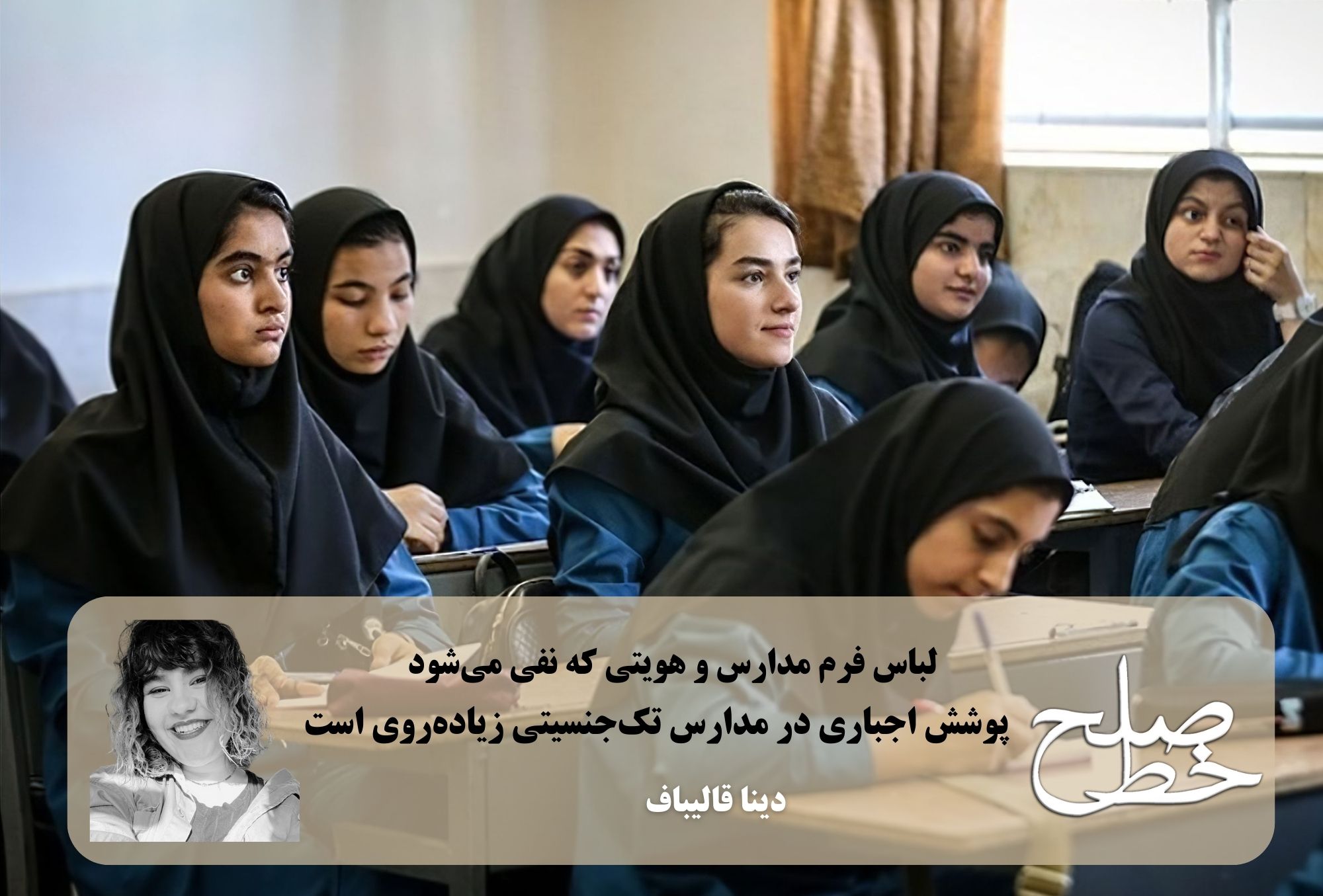
Compulsory Attire in Single-Sex Schools Is an Excess/ Dina Ghalibaf
The time spent in school is often described by those who have experienced it as one of the most beautiful and, in many ways, the golden era of life. Making new friends and beginning the process of socialization in school shapes a person’s life. When we revisit the memories of our school days, many of us likely recall field trips as highlights—moments when, alongside classmates, we savored a taste of independence and distance from family.
For me, a school trip to Mashhad brings back memories of its famous water park and getting lost in the crowds at the shrine. Or the time we played water games in a park during a school outing. On field trip days, school bags were filled with snacks instead of books and notebooks. Even the typically stern school principals would show a rare moment of kindness, sharing their snacks with students. But the day after the trip was always tough. Unlike the carefree day before, with lessons skipped and rules relaxed, students were forced back into a monotonous routine.
The tragic death of Arezu Khavari, a student who committed suicide after facing harsh criticism from her school principal over her attire the day after a trip, feels like that hard day after a field trip but multiplied indefinitely. Today, as schools remain bustling with students and traffic from parents picking up and dropping off their children, the image of a student standing on the top floor of a building preparing to leap comes to mind.
When I see stern school principals standing by the school gates, I wonder about the cause of this tragedy: “The day before, my daughter went on a school trip. She wore jeans and danced with friends on the way. It seems this angered the principal. The next day, she wore her school uniform but wasn’t allowed into class. I was told she wore jeans on the trip and danced.”
The tragedies at the all-girls Kosar High School, and another incident involving Aynaz Karimi, demand a critical look at how female students’ attire is managed in schools. This report, aimed at identifying underlying issues, includes interviews with female students across different grades. To maintain consistency, the same set of questions was asked during these interviews. The goal was to determine whether the pressure on students regarding their attire is greater in public schools or private institutions.
Below are interviews conducted with female students. Their real names are withheld by Peace Mark Monthly Magazine, and all names used in the report are pseudonyms.
“We’re Grown-Ups Now”
Atena is a student at a private vocational school. She believes that private schools generally provide a healthier environment and explains that, depending on the field trip location, students are sometimes allowed to wear clothing other than their uniforms:
“I think it’s a natural right to wear what we like on trips because we’re old enough to choose our clothes freely. We won’t lose ourselves over it.”
Atena recounts an incident at her former school that was similar to what happened to Arezu Khavari:
“A similar thing happened at my previous school. A student’s parents were called because she wore non-uniform pants, and she was even denied entry to class. I don’t think there’s any logic behind not allowing us into school for something as trivial as wearing non-uniform pants. Of course, everywhere has its own rules, and school rules should be respected, but some things are just too petty.”
When asked how she feels about her school uniform, she responds:
“Uniforms exist in schools all over the world; it’s not unique to our country. But as you can tell just by looking at ours, they aren’t exactly exciting. I think they could’ve been designed much better and more beautifully.”
Atena believes that unnecessary strictness prevents students from bonding with school staff. She explains that such strictness varies across schools:
“For example, my middle school was much stricter, but the vocational school I attend now is much more relaxed. It doesn’t necessarily depend on whether the school is public or private; it’s more about the mindset of the staff.”
Atena adds:
“Overly strict schools kill students’ enthusiasm. If there’s an inspection or a photo for school records, we know we must follow certain rules. But some schools overdo it. They take away students’ joy, making them want to break the rules even more.”
“Our Uniform Feels Like It’s Meant for a Morgue”
Mina, a student at a public school in Pardis, says her school is extremely strict about attire:
“At the start of the year, students who hadn’t yet received their uniforms could come to school in their own clothes, but they had to wear something similar to the uniform.”
Mina has never participated in school trips:
“The farthest the school goes for trips is places like Rahian Noor or the Khomeini Shrine. That’s why I’ve never gone, so I wouldn’t know if students are allowed to wear anything other than their uniforms on these trips.”
Describing her feelings about her school uniform, she says:
“I absolutely hate it. The color, the design, being forced to wear it—it all makes me feel awful. Our uniforms feel like they’re meant for a morgue. They’re made too long, and if anyone has them altered to be shorter, they’re told to change it back.”
Mina believes that schools differ in how strictly they enforce dress codes:
“The staff at my school always tell us, ‘If you want to dress like this, go to a private school. You don’t belong here.’ In my opinion, solidarity among students and refusing to back down makes a difference. For instance, one good thing about my school is that students stand their ground, which limits how badly staff can treat us.”
Opposed to disciplinary actions over attire, Mina says:
“No one pays attention to the catastrophic issues happening in schools. No one notices how many teachers are unqualified or how dysfunctional school staff are. No one considers the mental health challenges students face or the quality of education we’re getting. The only thing they care about is how we dress. It’s as if if one scarf falls off, the whole school will collapse.”
“This Is Too Much for a Single-Sex School”
Maryam, a student in Karaj at a top-performing public school, contrasts her current experience with that of her former public school. She explains:
“When students don’t wear their uniform, the principal gives warnings. Even if we wear a loose-fitting outfit, we get reprimanded. Hardly anyone loves their school uniform. In winter, it’s easier to deal with, but in summer, the dark colors and fabric make it unbearable and itchy.”
Maryam finds the uniform particularly uncomfortable during sports periods:
“Changing clothes isn’t allowed, and the loose uniforms have caused several students to trip and fall.”
She observes that public schools are stricter about attire:
“In my former public school, I saw how much pressure they put on students over their clothes. In my new school, it’s less extreme. If a student is caught without a scarf during recess, they’re taken to the office and warned, but in my previous school, they would deduct points from our discipline grade.”
Maryam concludes:
“In single-sex schools, there shouldn’t be a requirement to wear a scarf. If the point of covering is to shield us from male strangers, what’s the need for it in an all-female environment? This level of enforcement is excessive for single-sex schools.”
Findings and Concerns
Interviews reveal that public schools exert more pressure over student attire than private institutions. Additionally, students overwhelmingly feel that their school uniforms do not align with their identities, and many wear them reluctantly.
Coupled with statistics showing that 31 students have committed suicide since the start of the academic year, these findings highlight the urgent need to question the policies of the Ministry of Education and the management of schools across the country.
 Created By: Dina Ghalibaf
 November 21, 2024
Tags
Dina Ghaleibaf Eastern Wish Identity Jeans Mandatory coverage Mask peace line Peace Treaty 163 School Students Suicide Uniform رسه School ماهنامه خط صلح