


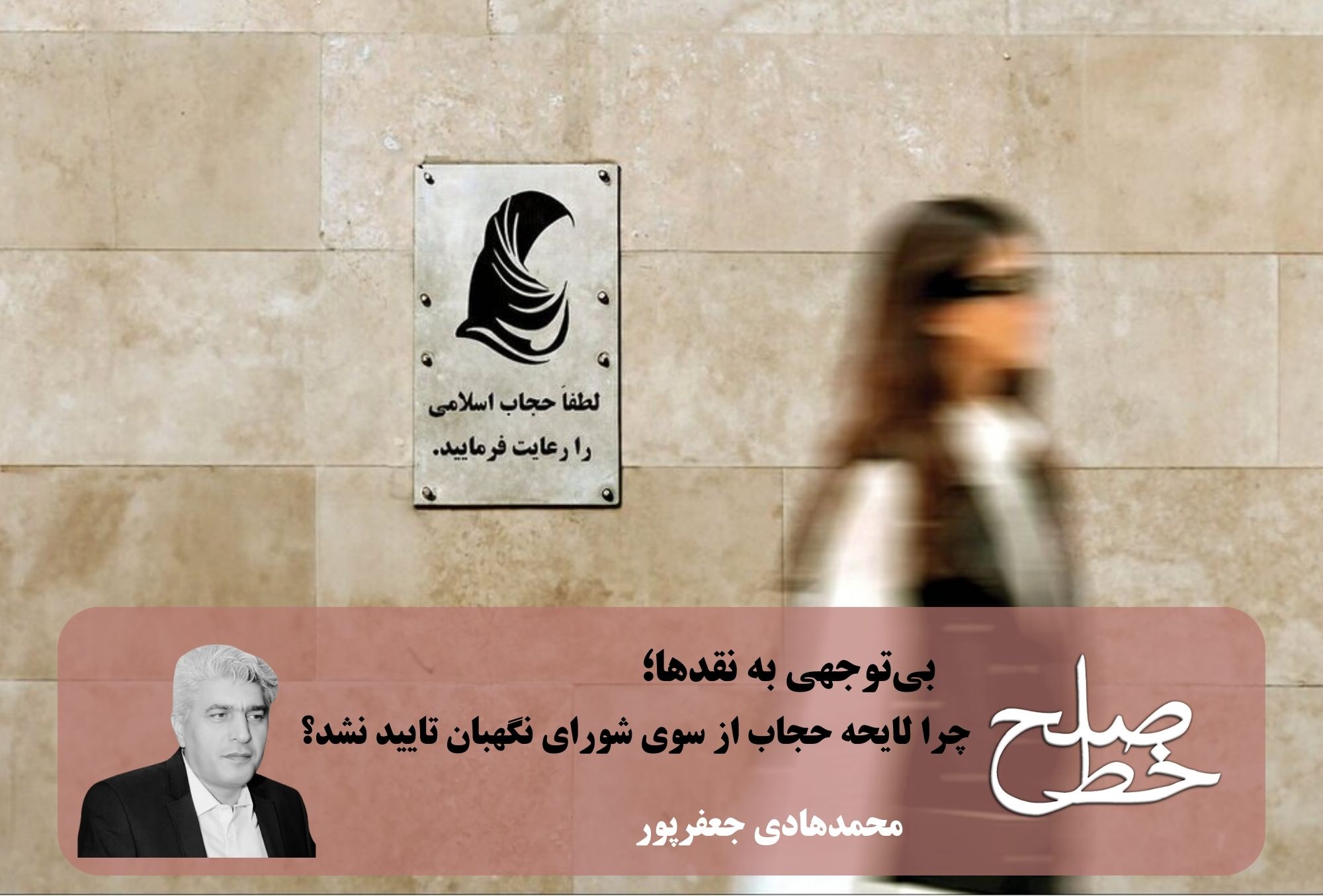
Ignoring criticisms; why was the hijab bill not approved by the Guardian Council?/ Mohammad Hadi Jafarpour
According to the principles of the Constitution and the rules governing the creation of laws, the implementation of the decisions of the Islamic Consultative Assembly requires adherence to certain conditions; including presenting the issue in the open session of the parliament and obtaining the votes of the representatives present in the House of Representatives. This rule, based on Article 85 of the Constitution, does have exceptions that the Guardian Council, with the principle of necessity, refers to in interpreting this article and the cases covered by this exception. The examination of the “Chastity and Veil Bill” under the principle of Article 85 did not comply with any of the interpretive provisions of the Guardian Council, and this was the first flaw in this bill.
The philosophy of existence of Article 85 of the Constitution, which considers the approval of certain bills outside the parliament and within the jurisdiction of the parliament’s commissions, is based on specific conditions and regulations. One of the main reasons for referring to the provisions of Article 85 is to save time based on specific and urgent circumstances that justify the need for law approval. With this description, the question arises as to what is the nature and function of the mentioned bill on chastity and hijab that justifies the use of the powers of Article 85? Which of the problems prevailing in society does the approval of this bill solve, that the parliament wants to review it outside the chamber against the rule and based on an exception?
The Guardian Council, in interpreting Article 85 and justifying the disregard of customary formalities in the approval of laws, refers to the principle of necessity; meaning that before the members of parliament assign a bill to the parliamentary committees under this principle, it is necessary to discuss the necessity of such a decision in the parliament chamber so that the necessity of such an action is established during the negotiations. In confirmation of this matter, Article 168 of the internal regulations of the parliament also, in addition to mentioning the inherent duty of the parliament in drafting regulations, indicates that Article 85 and the content of Article 168 of the internal regulations of the parliament are a duty for the representatives who cannot easily deviate from these principles and customary formalities of legislation, but rather it is necessary to establish the necessity in order to disregard the customary formalities of legislation.
The Guardian Council emphasizes that the necessity arises in cases where there are requirements in the legal system of the country, such as a legal vacuum. This simple phrase of “legal vacuum” is the best reason why it is not possible to justify the process of assigning the approval of the modesty and hijab bill to the commissions based on any reason, and by testing laws, to act against principles, in accordance with Article 85 of the Constitution. The reason for this is that currently there is no legal vacuum regarding the issue of hijab.
In addition to this, in the interpretations of the Guardian Council, we come across Article 85 which states that if a law is passed that imposes a financial burden on the country, it is against the principle of necessity to bring up that proposal in committees. Based on this interpretation and the predictions made in the Hijab and Chastity Bill, the mentioned proposal should be brought up in the parliament’s chamber; because the regulations outlined in this proposal require a significant financial burden which would require budget allocation and impose a financial burden on the government.
Following such criticisms, at the same time as the introduction of the modesty and hijab bill in parliament, the majority of lawyers and civil activists have expressed their criticism and pointed out its flaws in various ways. What has been mentioned by the Guardian Council and the Expediency Discernment Council as flaws in the bill are nothing but the same issues that have been repeatedly raised by critics in the media; including the fact that some terms in this bill are ambiguous and therefore the definition of behavior for criminalization is a subject of criticism.
Article 47, paragraph 2 of the Hijab Law, which pertains to men’s clothing, is problematic in that the terminology used is ambiguous and applies to all public places, including squares and sports clubs, where it is necessary to use specific clothing. Therefore, members of parliament have referred to a vague definition of men’s immodesty. In paragraph 2 of this law, men’s immodesty is defined as wearing revealing clothing or clothing that exposes any part of the body below the chest or above the shoulders. This even led to the censorship of sports broadcasts on television.
Or in a section of the draft, it has been stipulated that the circle of authority of regulators and enforcers of the law should be left open for interpretation, which leads to confusion and conflict of powers between the executive and legislative branches.
Another issue raised by the Guardian Council is the lack of definition for certain terms and phrases that require interpretation. For example, in Article 6 of this law, which considers items related to chastity and hijab as “cultural goods”, the Guardian Council has pointed out that since this term is not clearly defined in laws, it is not clear what the consequences and provisions of considering items related to chastity and hijab as “cultural goods” would be. Therefore, the Guardian Council has deemed this section of the draft to be problematic.
With these characteristics, we can summarize the main reasons for the shortcomings in a few cases:
1- Lack of clarity and ambiguity of some phrases
2- Expansion of the scope of criminal behavior with a broad interpretation contrary to the narrow interpretation of criminal laws.
3- Conflict of delegated powers to law executors.
4- Neglecting the principle of personal nature of criminal laws.
5- Violation of privacy principles
6- Being comprehensive and non-discriminatory is not against the fundamental nature of the law, which should be comprehensive for all individuals and non-discriminatory against any particular group.
7- Using general concepts instead of explicitly mentioning specific instances.
8- The possibility of interpreting it according to the established regulations, even conflicting interpretations.
9- Contradiction of some regulations with the principles governing legislation and criminal law.
10- Lack of explicit and clear definition of terms such as “coverage” and “uncoverage”.
At the end, it should be noted that what has been mentioned as criticisms towards the draft of chastity and hijab by the Guardian Council and the Assembly, is a clear example of the chaos in the legislative procedures of the eleventh parliament, where no attention was paid to the objections and criticisms raised by media and legal experts – which were brought up in various forms during the several months that the draft was being discussed in the government and parliament. From the beginning of the review of this draft, it was predictable, due to the parliament’s negligence towards criticisms in line with legal principles and legislative techniques, that the draft would not reach a conclusion in the Guardian Council and would be returned for amendments. These actions towards the mentioned criticisms demonstrate the disregard of some representatives towards legal knowledge and expertise in legislation, and result in imposing costs on the country, for which those responsible must be held accountable.
 Created By: Mohammad Hadi Jafarpour
 November 22, 2023
Tags
Compulsory hijab Coverless Guardian Council Hijab Islamic Consultative Assembly Mohammad Hadi Jafarpour Monthly Peace Line Magazine peace line Peace Line 151 The bill of chastity and hijab