


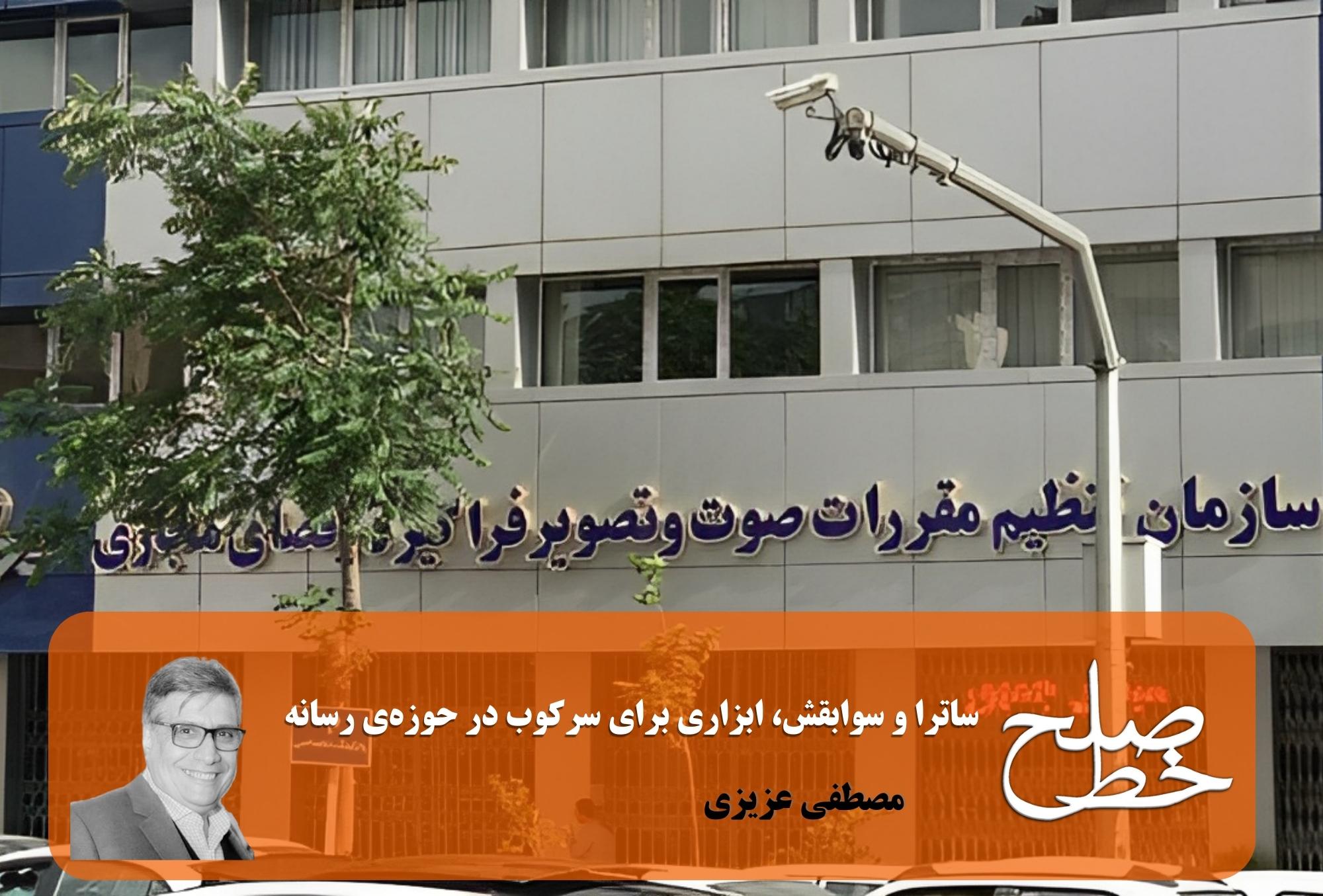
“Satra and its history, a tool for suppression in the media sphere/ Mostafa Azizi”
To suppress visual media, the Islamic Republic has taken different approaches. They used to think that their control over the radio and television would be permanent and all they needed was to have control over it and exercise complete supervision, and even if they loosened restrictions in cinemas, suppression would still be carried out. At one point, owning a VHS tape was considered more dangerous than having a few packages of illegal drugs. But the video market became lucrative and there was good money in it, and gradually, from the early years of the rule of Ayatollah Khomeini’s supporters over all branches of the system, which had passed and money had taken the place of religion and ideology, the fight against the distribution and dissemination of videos also became a new business alongside the distribution and distribution of drugs. On one hand, they themselves distributed VHS tapes or extorted from distributors, and on the other hand, they collected and punished themselves. Then the satellites came and a new business began. Satellite networks allowed
On one hand, technology is advancing and now every mobile phone has become a visual media, and no one, at least from the new generation, watches news continuously from one channel, but rather selectively listens to news from various channels. With the arrival of VODs, they also choose their own movies. This is where the Islamic Republic cannot give out income like North Korea does from cultural and artistic activities to suppress and expand advertisements, nor can it rule without suppressing the nation. In the midst of this flawed cycle, it becomes more and more fragmented day by day.
The Organization for Regulation of Audiovisual Media in the Virtual Space, also known as SATRA, is one of the many institutions affiliated with the Islamic Republic of Iran Broadcasting. This institution, responsible for regulating audiovisual media in the virtual space of Iran, is only an agent of oppression for home entertainment platforms and, contrary to its grandiose name, does not contribute to the improvement of these platforms.
Despite the start of home entertainment, this institution, which presented popular films and series on CD and later on DVD, and now on VOD platforms, was under the supervision of the Ministry of Guidance. Unlike the state-run IRIB, which is under the supervision of Ali Khamenei, the Ministry of Guidance was under the supervision of the government, and the government, in order to gain popularity among a certain segment of the population, tried to impose a more open atmosphere. IRIB, which was losing its audience day by day, and now no serious artist is willing to collaborate with television, nor are even the small number of supporters of the Islamic Republic willing to watch it, have come up with a solution. Don’t think that the solution lies in opening up television programs; as always, think about how to suppress the competition.
It was from here that Sātrā took shape, and although the supreme leader’s government is completely in charge, the war between the power and the efforts of security and economic mafias is not something that Ali Khamenei can control or forget that power is divided among major mafia gangs in the Islamic Republic, and Khamenei and the hard core of power control one of these gangs, not all of them. In fact, mafia gangs are not under the command of a single leader.
In any case, now the war between media outlets such as Namava and Satra has escalated. With the rise of the revolutionary movement “Women, Freedom of Life” with the code name Mahsa (Jina) Amini, these disputes subsided and were put back on display platforms for people to watch TV shows and programs instead of protesting; unaware that the people who were coming to the streets and the hand-held flowers that were being waved were not the target audience of these display platforms, and if some of them were watching some of the popular programs on these platforms, it did not contradict their coming to the streets. In any case, with the subsiding of street protests, the disputes between Satra and home display platforms rose again. Although home display platforms have taken a step back, the system generally does not want to lose this remaining competition.
The people of Iran have endured this government, which was formed through deceit, trickery, and oppressive force. But now, it no longer has the power to deceive or oppress the people. Its oppression has even caused a rift between its own supporters and oppressors, and it has no escape and is so consumed by its own delusions that it is like a disease that has taken over its entire being and is content with its own destruction. It is like a dying patient who has accepted their fate and is only waiting for their last breath.
 Created By: Mustafa Azizi
 July 23, 2023
Tags
"Seda va Sima" translates to "Voice and Vision" in English. Censorship Cinema Home display network Monthly Peace Line Magazine Mustafa Azizi peace line Peace Line 147 Satrap Suppression Television