


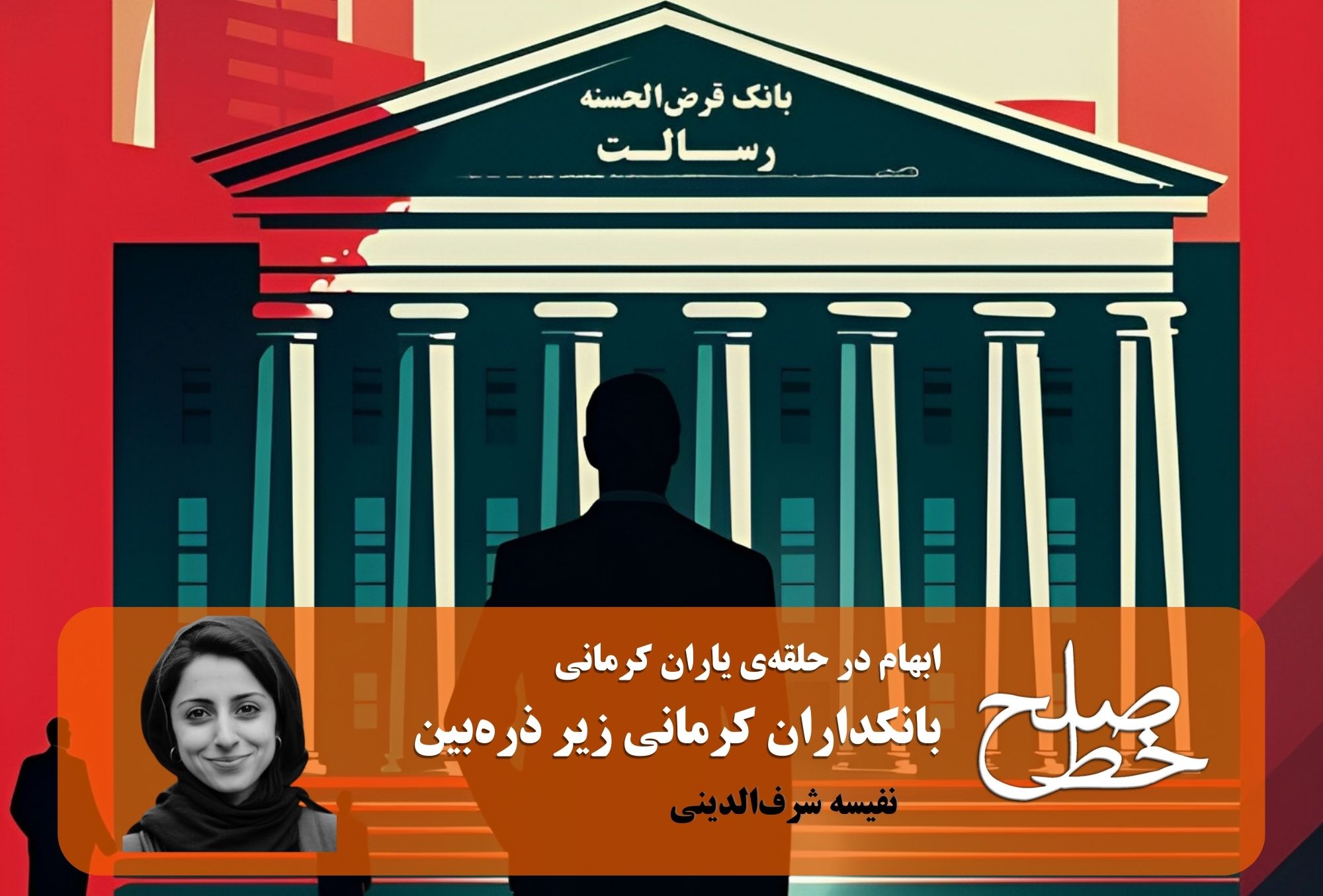
Ambiguity in the circle of Kermani friends; Kermani bankers under scrutiny/ Nafiseh Sharafaldini
The Resalat Qarz al-Hasaneh Bank emphasizes its role in providing interest-free loans and receiving a two percent profit in its advertisements. These advertisements have led to long lines in some provinces of the country to receive these facilities, but this is not entirely true. The use of cheap money and depositing with a rate of 18 percent or more in other banks, or buying participation papers, has enabled this bank to also profit from inflation like other banks. On the other hand, examining the shareholders and financial statements of this bank in recent years reveals new dimensions of the institution’s behind-the-scenes activities. Issues such as economic activities in the form of charities and public offerings, lack of timely and accurate financial statements, ambiguity about the criminal convictions of some members of the board of directors, failure to determine the fate of debts to credit funds, ambiguity in the transactions of individuals and affiliated companies, failure to determine the fate of the central bank’s claims and low capital adequacy ratio have
The Public Institution Mission.
The Bank of Resalat is just one of the branches of the “Resalat Public Institution”. On the official website of this institution, Resalat Public Institution is defined as a collection of people, consisting of thousands of social support centers, thousands of supporters, and social activists, all of whom are seeking to create a better work and life style for themselves and their surroundings. The support centers have been formed in mosques, neighborhoods, and cities to establish a model of social banking. Considering the diverse cultural and political activities of these centers, their formation cannot be justified solely for economic purposes. However, no further explanation has been provided regarding their activities, membership, and financial support, and the details remain unclear.
History.
The Qarz-al-Hasaneh Fund of Resalat was established in April 1376 with the aim of promoting and developing the culture of Qarz-al-Hasaneh and addressing the problems of various groups, including veterans. In the first national event of the Resistance Economy activists on August 30, 1401, Hossein Amberestani presented an unofficial account of the establishment of this institution: “After the era of the Sacred Defense, a movement was formed with the leadership of martyr Haj Qasem to support the livelihood of veterans. In those years, the Resalat Qarz-al-Hasaneh Fund was established to support these activities, and martyr Haj Qasem was its first real member.” (2).
After approximately 15 years of activity as a credit fund, Resalat Qarz al-Hasaneh Bank received its license on August 17, 2012 in order to regulate the activities of Qarz al-Hasaneh funds in Kerman, Tehran, and Mazandaran. Two days later, the central branch of this bank was opened. In addition, 36 Qarz al-Hasaneh funds were transferred to this bank based on the decision of the Supreme National Security Council on October 9, 2012, in order to organize Qarz al-Hasaneh funds and according to separate agreements.
Affiliated companies.
Bank Resalat is one of the seven subsidiaries of the “Resalat Public Institution”. Pars Information Processing Company, the Association of Supporters of Cultural Qard al-Hasanah and Social Entrepreneurship, Samin Entrepreneurship Development Group, Resalat University, Daneshbonyan Fardap (Fardatose’e Farda Pardaz Samin), and Resalat Heavenly Charity Institute are all part of the institutions affiliated with this organization. The Bank Resalat website only mentions the names of the companies affiliated with the Resalat Public Institution and does not provide any further information about their activities or financial accounts.
In section 2-47, the financial statements for the sixth six-month period of 1401 (2022) have been provided regarding transactions with related parties during the period. Accordingly, transactions with related parties during the period amounted to 6,286 billion rials and are detailed in “Table 1”. According to the report of the legal inspector, these transactions have been carried out in previous years without following the tender procedures and based on special relationships between the parties involved.
Based on this, the Society of Supporters of Cultural Qard-al-Hasanah and Entrepreneurship has signed agreements worth 4,128 billion rials with Bank Resalat in order to implement social banking. Puyesh Aks Information and Communication Technology Company has received 413 billion rials for providing electronic services through four separate contracts. Pars Part Financial Information Processing Company, responsible for customer validation and leasing of POS devices, has received 340 billion rials for providing these services. Faratose’eh Fardapardaz Thamin has also received 226 billion rials for providing medical and welfare services to the bank’s employees. Gonbad Kavir Kariman Company and Pouyesh Thamin Entrepreneurship Development Group have received 428 and 241 billion rials respectively for lease agreements. Pouya Mandegar Mana Company is responsible for the bank’s stock brokerage with a value of 8.4 billion rials, and Sana Novin Dadfar Mehr has

Unclear performance.
The Good Loan Bank of Resalat is striving to increase its affordable resources by promoting the tradition of good loans and claims to have been successful in this regard. According to the CEO of Resalat Good Loan Bank, in the past year, one million and 286,000 loans were paid to the bank’s customers and the number of depositors in this bank has reached over five million. However, due to more than three months passing since the end of the fiscal year and the lack of publication of financial statements ending on March 20, 2023, it is not possible to comment on this matter.
Since this bank does not pay interest on investment deposits, it has much lower money costs compared to other banks. However, this bank invests a portion of its cheap resources in participation papers and other markets and earns a relatively good profit. According to Note 9 of the financial statements, this bank had a revenue of over 9,192 billion rials from debt securities and over 8,092 billion rials from deposits with other banks in the first six months of last year. This is while the bank’s fee income during this period was equivalent to 6,350 billion rials.
Based on the latest audited financial statements, the operating profit of this bank in the past six months was equivalent to 11,398 billion rials, showing a growth of 127% compared to the six months of 1400. Some experts believe that the bank’s operations in the real estate market were the main reason for this growth, while others attribute the bank’s high returns to its proper investment in equity securities. The question here is how can a bank that claims to only earn income from a 2% commission on interest-free loans have a 127% increase in profit?
The stock price of this bank also had a significant growth during a short period of time in the over-the-counter market, reaching 24,250 tomans in July 2021 and 9,350 tomans in November 2021 from 110 tomans in December 2020. This increase occurred while the market was going through recession days and suspicions of price manipulation were strengthening among market participants.
20% interest rate.
Bank Resalat is trying to encourage middle and lower classes to deposit their money in this bank through continuous and targeted advertising. Some people, due to lack of fair access to banking facilities and out of necessity, transfer their savings to this bank. Although the facilities of this bank are paid with a two percent commission, a simple calculation shows that the interest rate of this bank is around 20 percent or higher. To receive 100 million tomans from this bank, an equivalent amount must be deposited for five to six months. Considering the nature of Bank Resalat’s benevolent loans, no interest is paid on deposits, but the bank’s financial statements show that these cheap resources are invested in participation bonds (with a rate of 18 percent or higher) or converted into deposits in other banks. In fact, the bank earns a profit equal to the interest it does not pay on deposits plus a two percent commission (a total of 20 percent or higher), but in its advertising, it
Buying and selling loans.
On the other hand, the loan score in this bank is transferable to others. In other banks, this score is only transferable to first-degree relatives. This has led to an increase in the buying and selling of loans in this bank and a lot of advertising in this regard. Therefore, the current selling rate of every one million tomans of interest-free loans in this bank is 165,000 tomans. In other words, the cost of receiving a score for every one hundred million tomans is sixteen and a half million tomans. In some cases, it is said that there is no limit for selling loan scores and they transfer the money within an hour. Although Bank Resalat claims that these individuals have no connection with this institution, it cannot be accepted that all of these individuals have previously deposited unlimited amounts in this bank and earned scores, and the bank must dispel this suspicion. Furthermore, even if these brokers have no connection with the bank, the responsibility for this chaos
Activity within the framework of the People’s Organization.
According to the information published in section 5-1 of the financial statements of this bank, in the first seven months of the year 1400, it has collected 91 branches and a total of 282 branches in the past five years. The number of bank employees has also decreased from 3,532 in 1396 to 1,241 in 1400. However, this decrease in personnel has not led to a decrease in expenses; because since the beginning of December 1400, 2,100 employees of the bank have been transferred to the “Supporters Association of Qard al-Hasanah Culture and Social Entrepreneurship”.
Based on the information provided in the official newspaper, the Association of Supporters of Qard al-Hasanah and Social Entrepreneurship has been established as a non-governmental, non-political, non-commercial and voluntary organization with registration number 34451 on August 17, 2014 with a capital of 100 million rials, with the focus on promoting and strengthening the culture of Qard al-Hasanah.
It is said that branch employees are working as guides in social assistance offices. These offices have taken the place of bank branches in mainly residential areas and appear to provide investment advice. On the other hand, in bank announcements, this organization is introduced as a non-governmental organization and it is not clear whether the purpose of these offices is economic or voluntary activities.
On the other hand, the examination of the bank’s financial statements shows that the expenses of this association are included in the service expenses section (Note 2-2-15 of the financial statements), but it is not clear why a bank should pay for the salaries of employees in a non-profit and non-commercial association.
The examination of the founders and board members of this association strengthens the suspicion of hidden financial connections with Resalat Bank. Based on the latest changes in the board of directors, Hamzeh Zareazadeh Mehrizi is now the CEO (Deputy CEO at the bank), Hossein Amberestani is the chairman of the board (HR development manager at the bank), Masoud Shafiei is a board member and treasurer (shareholder of the bank), Seyed Reza Tahamipour is a board member, and Masoud Sa’eed Zarehndi is the vice chairman of the board (shareholder of the bank) working in this association.
b) Shareholders.
The Qarzol-Hasaneh Resalat Bank introduces itself as a private bank in its promotions and advertisements. However, a significant portion of the bank’s shareholders are affiliated with financial institutions and seemingly active charities in Kerman province. Shareholders in this bank are in the form of chains of individuals with special connections, and management seats are divided among a few specific individuals. These collaborations are not limited to shareholding and are also expanded in other forms, such as entering into service contracts with the bank.
According to the financial information published, Pouyesh Salehin Investment Company is the largest shareholder of this bank, owning approximately 6.54% of the total shares. Other shareholders of this bank are listed in “Table 2”. This information is based on the report published by this company from the extraordinary general meeting on February 25, 2023. The following will examine the shareholders whose information has been available in the official newspaper.

Salheen Investment Initiative (Private Joint Stock Company).
Regarding the details of the activities of this institution, there is no information available, but unofficial speculations link it to one of the military institutions. The main field of activity of this company is investment in commercial, industrial, production, construction, cultural affairs, and buying and selling shares of companies and institutions. According to official newspaper reports, this company was established in Kerman in 1383 with registration number 6584. In addition to Bank Resalat, it has subsidiaries such as Noor Paydar Development Company, Faratoseh Farapardaz Samin, Zarinerad Daryab Drilling Company, Mohammadian Oil and Gas Engineering and Development Company, Pouyesh Samin Entrepreneurship Group, Ahram Sakhtpeikar Company, and Makran Development and Construction Company. Currently, Hamid Askari with national ID number 30506930, Mohammad Hossein Hosseinzadeh (CEO of Bank Resalat) with national ID number
Mohammad Hossein Hosseinzadeh.
Mohammad Hossein Hosseinzadeh, the current CEO of Ghazal Hassanah Bank and the board of directors of Pouyesh Salehin Investment, was born in Golbaf, Kerman province. His profile on the Resalat Bank website introduces him as a “military science expert,” while Tasnim News Agency (7) refers to him as a “commander,” and Fars News Agency (8) and Qasem Soleimani’s website (9) introduce him as a “comrade of Commander Qasem Soleimani.” A search of his name with his national ID number (3189671…) on the official newspaper website shows that he has been a member of the board of directors in more than 20 companies during the 1390s decade. In addition to being a member of the board of directors of Pouyesh Salehin Investment, Hosseinzadeh has a history of serving on the boards of directors of companies such
Alireza Akafzadeh.
Born in Kerman with national ID number 2992120…, the former CEO of Meshiz Bordseer Steel Complex is the sole owner of one percent of Resalat Bank’s shares. A search of his name on the official newspaper website shows that he has been a member of the board of directors or an inspector in 22 companies over the past decade. Some of these companies include: Fath Yaran Amin Mining Industry, Basit Kerman, Petro Industry Development, Arg-e Kavir Rapid Builders, Kavir Development and Trade, and Maham Tekin Saba Noor Iranian.
Haj Ali Akbar Industrial Foundation.
According to the website, this foundation was established in 1295 by Haj Ali Akbar Sanatizadeh for the care of orphaned children in Kerman, but there is no information available about its activities. This foundation owns 1.2% of the shares of Bank Resalat. Seyyed Mohammad Reza Mostafavi Dehzooyi (national ID number 3091148939) is the representative of this charity and also the chairman of the board of directors of Ax Technology and Communications Development (a party to the contract with the bank).
Charity.
The return of the righteous.
This charity organization was registered in Kerman in 1381 with registration number 416 and owns 0.98% of the shares of Bank Resalat. Currently, Ali Ahmadi Jupari, Mohammad Reza Varzandeh, Mahmoud Latifi Rayeni, Alireza Abdolinsab, and Abbas Farmatini are members of the board of directors of this organization. No other information about the charity and commercial activities of this organization is available. The question is, from what sources has a charity organization, which was founded with a humanitarian purpose, bought shares of Bank Resalat? Abutaleb Eshaghi, the manager of the Bank Resalat management department and representative of this organization in the extraordinary general meeting of Bank Resalat, has also been the representative of 2.47% of the shareholders with the power of attorney from 191 shareholders.
Charity of the Monotheists.
The Mollialmohedin Charity was registered in Kerman in 1366. This organization owns over 30 holdings, 100% of the shares of Mahan Airlines, 50% of Kerman Motor, Joopar Train, New Bam Citadel, Arian Mahtab Gostar, and others. In recent years, there have been numerous reports and controversies about the international activities of this charity, especially in neighboring countries. Ali Mostafavi, born in 1335 in Zarrin, Kerman, is a member of the Board of Trustees of Mollialmohedin Charity and a representative of this company in Resalat Bank. He is also the CEO of Golabzahra, affiliated with the Cultural and Industrial Education Foundation.
Mohammad Reza winner.
Born in Kerman with national ID number 299353…, a search of his name on the official newspaper website shows that he has been a member, chairman, vice chairman of the board, or inspector in 24 companies over the past decade. These include: Kerman Province Martyrs’ Assistance, Resalat Housing, Resalat Qard al-Hasanah Fund in Tehran, Samin Entrepreneurship Development Group, Kerman Steel and Rolling Mill, Sahba Industry in Tehran, Ita’at Resalat Charity, Pouyan Rahparand, and Kerman Steel Industries. He has also acted as a proxy for 12 shareholders, owning 4.75% of Resalat Bank’s shares in an extraordinary general meeting.
Mustafa Askaripour Arjaz.
Born in Kerman, whose national ID number 298036… shows on the official newspaper website, he has been a member of the board of directors, vice chairman or inspector in six member companies over the past decade. At Aria Orast Machine, he was a member of the board of directors, at Kerman Diesel Bootia, Sirjan Part Gostar Bootia, Amir Caravan Transport and Rahro Machine Kavir Trading as the main inspector, and at Asker Transport Bootia, he was the vice chairman of the board of directors. In the extraordinary general meeting, Askaripour acted as a proxy for 284 shareholders, who owned 4.46% of the shares of Resalat Bank.
Seyed Mohammad Sadegh Mahdavi.
Born in Kerman with national ID number 2991362…, during the years 1397 to 1398, he was a member of the board of directors of the Association of Supporters of Qard al-Hasanah Culture and Social Entrepreneurship and a representative of Novid Salamat Razi Group. A search for his name on the official newspaper website shows that he has been a member, vice-chairman of the board, or inspector of 20 companies from 1396 until now. These include Mehrsam Farmad, Mehrsam Daroo, Rahrovan Dourandish, Mahan Ideh Hirad, and Tose’e Ertabat Tabba. He acted as a proxy for 68 shareholders, owning 4.11% of the shares of Resalat Bank in the extraordinary general meeting.
Mohammad Reza Eslami Zarnandi
Born in Zarend with national ID number 30907150…, was a member of the board of directors at Golzar Golsa Golshid Company, a member of the purification board at Resalat Salihin Kerman Charity Fund, and a primary member of the board of directors at Setareh Derakhshan Yeganeh in entrepreneurship and electronic services. He represented 244 shareholders, owning 3.67% of the shares of Resalat Bank, at the extraordinary general meeting.
In addition to the mentioned individuals, Reza Toiserkani, Alireza Khatib, and Hamid Arabnejad were influential figures in this bank during the 1390s, and their backgrounds require further investigation.
c)
Benefits of the Board of Directors and their Relatives.
Although Bank Resalat claims in its advertisements to promote the culture of Qard al-Hasanah (interest-free loans) and disregard for profit, it has acted like a commercial bank by providing benefits, bonuses, and facilities to its board members and their relatives. According to Note 1-47 of the financial statements, two members of the board of directors and the managing director received a total of 5,938 million rials for salaries, benefits, Eid bonuses, and rewards in the first six months of 1401. This amount was 11,037 million rials for three non-executive board members and 250 million rials for members of committees related to the board of directors. In total, the payments to bank managers during the period under review amounted to 17,225 million rials (Table 3). However, these figures do not include the shares paid to these individuals.
In addition to receiving salaries, bonuses, and rewards, the members of the board of directors of Resalat Bank have also benefited from other advantages. According to section 2-1-47 of the financial statements, in order to provide housing for 4 members of the board of directors, amounts have been paid under the title of rental deposit based on the contract between the lessor and the lessee (Resalat Qarz al-Hasaneh Bank). However, information about the details and exact amounts of these rental contracts is not available. Also, there has been no information provided about the facilities received by the members of the board of directors and their relatives in this period, but based on the financial statements of this bank in previous years, the relatives of the board members have received Qarz al-Hasaneh facilities from this bank.

According to clause 34 of the financial statements ending on March 20, 2017, Fatemeh and Mohammad Hosseinzadeh, the children of the CEO of Bank Resalat, have received 5 loans totaling 392 and 600 million rials in the years 2014 and 2016 from this bank, the details of which are described in “Table 4”. Using the Central Bank’s inflation calculator, the current price of the loans received by the two children of the CEO of Bank Resalat exceeds 6 billion and 500 million rials. The granting of these loans is in violation of Article 132 of the Commercial Law Amendment and Article 39 of the Articles of Association, which prohibit the granting of loans to members of the board of directors and shareholders with more than 1% of the shares. In addition, Article 35 of the Bank’s Establishment Guidelines regarding the prohibition of granting a maximum of 150 million rials in loans to

d) Negligence and shortcomings.
In recent years, the name of Bank Resalat has been mentioned in several important cases of corruption and embezzlement, but so far no explanation has been provided by the bank’s managers and board of directors regarding these issues. In the following, three of these violations will be examined.
Embezzlement at Kerman branch of Bank-e-Tajarat.
The name of Mohammad Hossein Hosseinzadeh was mentioned in the 1397 court session regarding the charges against former head of the Kerman branch of Bank Tejarat, Ali Akbar Amartaz. He played a significant role in providing financial resources for the Resalat Fund through interbank checks (12). Mohammad Hossein Hosseinzadeh was sentenced to approximately 32 years in prison, which was the harshest punishment, as he could have received up to 15 years. During the past years, Hosseinzadeh had relied on his position as CEO of Resalat Bank, and there has been no news about any restrictions on him.
Tasnim News Agency reports (13) that in the indictment of Ali Akbar Amartaz in relation to his actions in favor of the Qarz-al-Hasaneh Resalat Fund (which later became a bank), it writes: This fund, which had ambitious plans to become a bank and expand its branches, has faced capital shortages at times. Its managers have resorted to issuing checks without sufficient backing, and they are accused of converting these checks into interbank checks at the Kerman branch of Bank Tejarat for the benefit of Bank Resalat.
The indictment states that the accused had removed three zeros from bank documents belonging to the Resalat Fund and issued 24 checks before the privatization of Bank Tejarat and 256 checks after the privatization in favor of the Resalat Fund. At that time, Azizollah Vaziri, the other defendant in this case, was the CEO of Resalat Bank. Azizollah Vaziri, with national ID number 318987…, has been sentenced to 22 years in prison, 15 of which are executable. According to official newspaper reports, Azizollah Vaziri is also from Kerman and his family is involved in economic activities in this province.
Corruption in Mobarakeh Steel Company.
The name of Bank Resalat was also mentioned in the 92 trillion tomans corruption case of Foolad Mobarakeh. In the detailed report of the Parliament’s investigation and inspection committee on Foolad Mobarakeh company, prepared in Azar month of 1400, the name of this bank is mentioned as one of the institutions that had connections with the former CEO of Foolad Mobarakeh and the Mobarakeh Sepah region.
On page 74 of this report, it is mentioned: “According to the agreement signed between Mobarakeh Steel Company, Qarz Al-Hasaneh Resalat Bank, and Mobarakeh District Sepah, it has been decided that the cash resources of Mobarakeh Steel Company will be invested in Resalat Bank and an amount of 150 million rials with a 2% commission will be paid to individuals referred by Mobarakeh District Sepah from the mentioned deposit credit. In accordance with the above agreement, an amount of 430 billion rials has been deposited and transferred to the Qarz Al-Hasaneh Resalat account through accounting documents 1211218 and 3301002.”
On page 236, this report states: “Based on the decision made by the CEO of Mobarakeh Steel and in line with his interactions with some individuals in the province, an amount of 400 billion rials has been deposited in the Qarz Al-Hasaneh Resalat Bank. In this regard, and according to the referral certificate through the employment charity, facilities are provided to the referred individuals.” (14).
Kerman Steel Company
Based on the report of the bank’s legal inspector for the fiscal year 1394 and previous years, an unspecified portion of the bank’s financial resources have been allocated to individuals outside of normal procedures for granting facilities, and the repayment of these facilities has been guaranteed by Pouyesh Samin Company (a joint shareholder with the bank). The recipients of these facilities have also placed the funds received at the disposal of Kerman Steel Company (a joint shareholder with the bank) based on contracts for the purchase of steel products.
h) Financial statement analysis.
In this section, the financial statements of the Qarz Al-Hasaneh Bank are examined. However, due to the delayed publication of financial statements, the latest financial statements of this bank for the six-month period of 1401 have been used. Although information related to the financial statements of the ninth month of 1401 has also been published, it is not usable because it has not been audited.
Delay in publishing financial statements.
The last published financial statement of Bank Resalat relates to the ninth month of last year, and the latest audited financial statements of this bank relate to the sixth month of the year 1401. According to stock market regulations, this bank is obligated to publish monthly performance reports on the Codal system, but these figures have not been published since last Bahman. In addition, the publication of the end-of-year financial statements for 1401, which should have been done within 60 days after the end of the period, has been delayed. The lack of accurate and timely publication of statistics and information jeopardizes the interests of small shareholders and reinforces the lack of transparency in this organization.
Audit opinion of the legal auditor.
Generally, the positive opinion of the statutory auditor on the financial statements can provide assurance to shareholders, other stakeholders, and researchers regarding the accuracy of procedures, requirements, and accounting standards. In previous years, the opinions of different auditing institutions on the financial statements of this bank have been either qualified or unqualified. In its latest report, the auditing institution, Arya Financial Analyst, as the statutory auditor of the bank, stated under section 2 of the six-month financial statements of 1401, “This institution cannot ensure that it is aware of all significant matters that are usually identifiable in auditing and therefore does not provide an opinion.” Usually, the auditor refrains from giving an opinion when the financial statements are ambiguous and it is not possible to detect their existence. The financial statements of the bank for 1400 were also audited by another auditing institution and in its report on 28 Tir 1401, that institution also provided a “qualified opinion” on the financial statements.
Financial ambiguities.
Auditors’ statements can reveal some of the ambiguities in financial statements. The statutory auditor refers to Note 3 of the financial statements, which states that the requirements of accounting standards regarding sufficient and appropriate disclosure of risks in the banking industry, including credit, liquidity, and market risks, have not been met. The statutory auditor states in Note 4 that this bank has not disclosed its unaudited semi-annual, semi-annual, and annual financial statements within the specified time. Other matters reported by the statutory auditor include:
1- Documents regarding the qualification approval of two members of the board of directors have not been provided to the auditing institution.
2- The financial statements and confirmation of the managers have not been signed by two members of the board of directors.
3- According to the provisions of the 5 disciplinary guidelines for over-the-counter publishers, the payment of dividends approved by the general meeting has not been made within the legal deadline.
4- Disclosure of reasons for more than 30% change in profitability has not been included in the interim financial statements and information.
Low capital adequacy rate.
The capital adequacy ratio is one of the indicators used to measure the performance of financial institutions, and it is calculated by dividing the base capital by the total assets (weighted by risk). This ratio shows how much banks can cover their existing risks with their capital and prevent bankruptcy. According to Article 3 of the Capital Adequacy Regulations, this ratio has been set at a minimum of 8% for banks and financial institutions. According to the standards of the Basel Committee, this figure is between 12% and 14% globally. A review of notes 3-5-45 of financial statements shows that this ratio was only 4.88 at the end of the first six months of last year, which is much lower than 8%.
Of course, the board of directors has proposed an increase in capital from retained earnings since last September to improve this ratio. In this regard, an extraordinary general meeting was held on February 25th of last year to increase capital from retained earnings, but as of the writing of this report, this increase has not occurred for unknown reasons. However, in its latest announcement on the Codal system, Bank Resalat has stated that this increase will take place before the general meeting (end of July).
Possible debt to the central bank.
Based on Note 1-2-41 of the financial statements, the General Accounting Department of the Central Bank has calculated a total obligation of 5,364 billion rials for Bank Resalat, which not only remains unpaid but also has not been recorded as reserves in the financial statements. According to the regulations of the Central Bank, excessive withdrawals by banks – which is one of the factors contributing to high inflation in the Iranian economy – results in a 34% penalty from the Central Bank for the bank. The current account of Bank Resalat at the Central Bank has had excessive withdrawals since July 1, 2013, and the Central Bank is demanding the mentioned amount for this matter. This amount has been allocated for the purpose of organizing and managing the crisis of transfer funds (payment of investors’ funds in the mentioned funds) to this bank.
The auditor’s note indicates that the bank’s board of directors does not believe in allocating reserves for the mentioned penalty in the accounts due to its uncertain nature. Additionally, the board believes that since the profits received from customers in this bank are in the form of Qard al-Hasanah (interest-free loans) and equivalent to two percent, a 34 percent penalty for this bank is not justified and therefore no reserves are recorded for it. Accordingly, correspondence has been conducted in this regard and based on the Central Bank’s announcement of opinions on banks and credit institutions, the issue of penalty forgiveness has been reflected to the Money and Credit Council in February 2014, but the result has not been announced yet. This matter has been reported by various legal auditors in all audited financial statements during the years 2013 to 2021, but this legal dispute has not been resolved after a decade.
This potential debt must be clarified by the board of directors of the bank. It is not acceptable that the board of directors does not believe in reserving for this debt, as if the Monetary and Credit Council does not approve, this amount must be reflected in the financial statements and will affect the bank’s operations. In fact, not considering this amount in the debt section has artificially increased the bank’s profits. To understand the magnitude of this amount, it is enough to know that 5,364 billion rials, equivalent to 47% of the bank’s achieved profits in the first six months of 1401.
Another important point in this section is that in the financial statements, an amount of 490 billion rials has been recorded for claims from the central bank, which has not been confirmed by the central bank as of the date of the audit report.
Accumulated fund debts.
After more than a decade since the merger of 34 funds into Bank Resalat, the accounts between 17 funds and the bank are still open and these funds are indebted to the bank. According to Note 28 of the financial statements of Bank Resalat’s interest-free loans, the total of these debts reached over 15,609 billion rials at the end of September last year. These receivables, which are listed in the Other Assets section of the balance sheet, are eight times the capital of this bank.
Notes:
1- For more information, refer to: .
Website.
“Public Institution of Mission”
2- The better way of work and life; a gift from the mission of humanity.
Fars News Agency.
August 21st, 2022.
3- Including the benevolent loan funds of Mehr Vatan, Mehr Mihan, Milad Makarian, Resalat Shafamehr Tabriz, Pashtiban Ayande, Karimeh Karamat, Tawhid Kerman, Nasr Bonab, Mehr Aria, Basharat Iman, Baqer al-Alum Shush, Mobin Azar Tabriz, Imam Khomeini Sabzevar, Ershad Kerman, Be’sat Rafsanjan, Fajr Bandar Turkmen, Nedaye Sepahre Iran, Vali Asr Surk, and others.
4- The source of “Table 1” is the financial statements of Bank Resalat for the six-month period ending on 1401.6.31.
5- Payment of one million and two hundred and eighty thousand loans at Qarz Al-Hasanah Resalat Bank.
The website of Qarz Al-Hasaneh Resalat Bank..
6- The source of “Table No. 2” is the information published by Resalat Bank in the Codal system.
7- Martyr Soleimani, according to a comrade’s account, was always the commander in the middle of the field.
Tasnim News Agency.
January 1, 2021.
8- Joon fada; Manesh Hajj Qasem az zaban rafiqash; Hame lashkar-e mareed-e Hajj Qasem boodand/ Ba did-e mohabbat be khatakaran negah mikard.
8- Sacrifice my life; Manesh Hajj Qasem from the words of his companion; All of Hajj Qasem’s followers were present/ He looked at the wrongdoers with a loving gaze.
Fars News Agency.
January 1st, 2023.
Website.
Qasem Soleimani.
10- Source “Table No. 3” is the financial statements of Bank Resalat for the six-month period ending 1401.6.31.
11- The source of “Table No. 4” is the financial statements of the bank in 1395/ Central Bank’s inflation calculator.
12- Interesting claim of money laundering by the accused in court.
Online economy.
“3 Dey month 1397.”
13- The indictment for the 6 trillion tomans charges against Ali Akbar Amarat-Saz.
Tasnim News Agency.
“3 Dey month 1397”
14- Detailed report of the investigation and examination of Mobarakeh Steel Company by the Islamic Consultative Assembly, 11th term, Executive Steering Group, Azar month 1400.
 Created By: Nafiseh Sharafaldini
 July 23, 2023
Tags
فساد corruption Embezzlement Entrepreneurship Goodwill Loan Bank Mission Bank Mohammad Hossein Hosseinzadeh Monthly Peace Line Magazine Nafiseh Sharafaldini 2 peace line Peace Line 147 Public Institution Mission Qasem Soleimani فساد ماهنامه خط صلح