


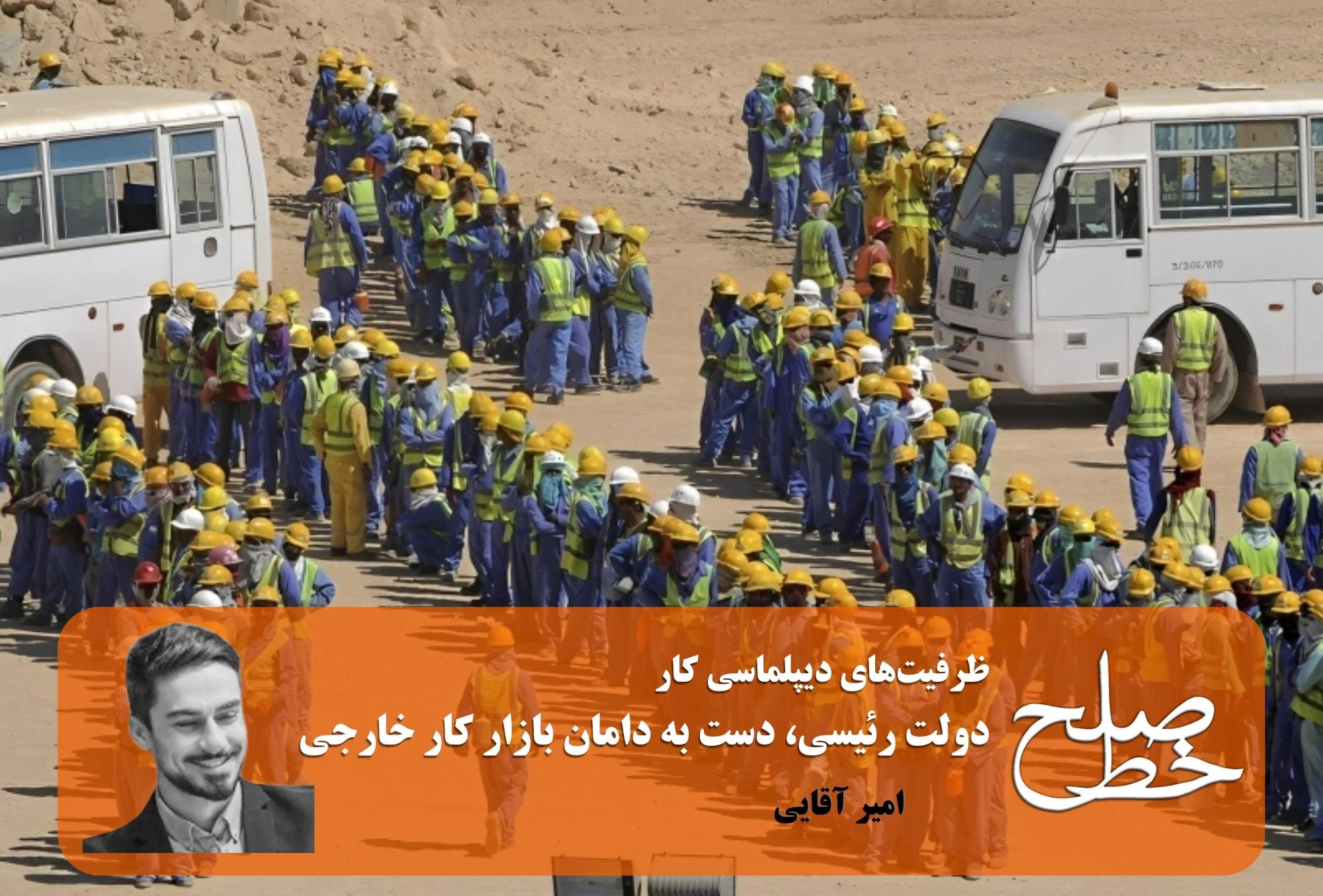
The government is trying to open up the foreign job market/ Amir Aghaei.
The Deputy Minister of Employment of the Ministry of Cooperation, Labor, and Social Welfare announced the launch of “Labor Market Diplomacy” for the deployment of skilled workforce to Qatar. He added, “In the past six months, Qatar has issued 500 work visas for Iranians and negotiations between the two sides are ongoing.” According to the Director General of the Employment Development and Workforce Guidance Office of the Ministry of Labor, the necessary preparations have been made for the deployment of workforce to neighboring countries and the Persian Gulf region. Based on this, with the cooperation of the Ministry of Foreign Affairs and relevant agencies, and as a result of negotiations with the destination countries, Qatar, Armenia, Iraq, and Oman will host the surplus Iranian workforce.
Although the policy of sending surplus labor has always been approved by various governments, there has not been a serious and organized plan in this regard. According to the Deputy of Entrepreneurship and Employment Development of the Ministry of Labor, Ibrahim Raeisi, activating labor market diplomacy is the main policy of this ministry and the thirteenth government.
In the past, there has been discussion about activating economic sectors and establishing economic offices in embassies, but it has not resulted in the official deployment of personnel. Today, if the Ministry of Labor achieves this goal, it will be considered a positive step for the country and job seekers.
Sending workers abroad is a traditional and old practice that is also explicitly mentioned in labor laws. This law allows us to bring in skilled labor in specific sectors where we need it, and in return, we can send excess labor to countries in need. By doing this, we can reduce the harm and crisis of unemployment, which not only exacerbates abnormalities and social problems but also undermines public security and trust, and also harms the workforce.
The government is currently making efforts to send workers to Qatar, while starting their work with the promise of creating one million jobs per year.
Given the critical economic situation and severe inflation crisis in the Islamic Republic, many experts assess the promise of creating one million jobs annually as empty and the evidence also confirms this reality.
The Khorasan newspaper reported in the final days of the month of Farvardin, citing data from the Iranian Statistical Center, that only 262,000 net jobs were created last year. The newspaper writes that, considering the increase in the working-age population, the ratio of employed to potential workers has not changed significantly in the past two years.
The Iranian Statistics Center has announced in its latest report that the unemployment rate of last year has decreased by two-tenths of a percent compared to 1400, to about 9 percent. However, labor market experts believe that what is happening in the Iranian labor market does not match the numbers announced by government centers and institutions, to the point that the unemployment rate for three groups, namely women, graduates, and youth, is in the double digits, at approximately 40 percent.
Official deployment of young and educated individuals abroad, considering the statistics and unemployment rates of different social classes, is a desirable policy in the thirteenth government. As long as employment opportunities are limited and development is not possible within the country, this can be an effective solution for reducing unemployment rates and providing a suitable platform for transferring experience and knowledge, earning foreign currency, and promoting economic and social development in the country.
Here, the question arises that in a situation where unemployment crisis is one of the most fundamental issues and challenges facing politicians and officials in the country, does sending workforce abroad have a significant impact on reducing unemployment rates? And is the presence of skilled and experienced workforce abroad considered a threat to domestic capital and damaging to the country’s economy, or does it contribute to the economic cycle of the country by increasing production?
Migration is not equivalent to sending a workforce.
According to the 2020 report of the International Organization for Migration (IOM), there are nearly 272 million international migrants in the world, two-thirds of whom are migrant workers.
Migration has become a major issue in today’s world and in some cases, it has turned into a problem. The issue of migration is managed in many developed countries and organizations or ministries have been created specifically for this purpose.
As some people believe, migration is not necessarily a condemnable and shameful act, and managing migration and sending excess Iranian workforce abroad can have a positive impact on the job market and economy of the country. If migration is aimed at accessing job markets and better job opportunities, and is planned and targeted, it will practically turn from a threat into an opportunity for both sending and receiving countries.
Experts consider the imbalance between supply and demand in the job market as a major factor in unemployment. Migration of individuals abroad does not necessarily mean sending workforce, and sending workforce requires preliminary arrangements that fall under the jurisdiction of the Ministry of Foreign Affairs and our relations with other countries.
The imbalance between labor supply and demand has become a permanent problem in the Iranian job market, and there is no specific plan to effectively reduce unemployment rates and create employment opportunities that can prevent the growth of unemployment rates.
Currently, in many economic enterprises, the issue of surplus labor is being discussed and the topic of workforce adjustment is being raised, which indicates that the situation of these enterprises is not very desirable.
Unofficial activities in the field of labor migration are more active than official ones. The migrations that take place in our country and the human resources that have sometimes been educated and leave the country, pursuing immigration for the purpose of residency, show that cross-border employment is emerging and the export of labor has occurred in an unofficial manner.
Individuals who leave the country in this informal manner, it is not called workforce deployment but rather the export of human resources. This means that some people make the decision to migrate out of the country and also try to obtain residency, but such an exit is considered permanent and its benefits do not return to the country.
When we talk about sending workforce, it means a worker will be employed in a foreign country, create a job there, and after a while, bring back resources and income from employment to their own country and also return to their country themselves.
Many countries, such as India, are actively involved in the field of IT and focus on exporting their workforce and supplying their products. This process becomes a source of income and has an impact on the economic growth and gross domestic product of these countries.
There is no successful statistics in the field of sending workers. The history of sending workers dates back many decades. In order to send workers in current conditions, prerequisites and preliminaries are needed, mainly related to the Ministry of Foreign Affairs and some of our interactions with other countries, for them to accept our workers.
Should the government encourage migration of workforce?
The situation of two indicators, “unemployment rate” and “labor force participation rate” in Iran has reached concerning levels. On the other hand, the government aims to have approximately 532 trillion tomans in tax revenue in the year 1402, with a significant portion of it expected to come from the workforce. In such a situation where finding employment is difficult, the Iranian government must take action and encourage labor migration. But why?
The economy of Iran is facing so many problems and crises that focusing on one takes attention away from the others. From the currency crisis and high inflation rates to the shortage of medicine and crises in banks and pension funds, there is hardly any sector that does not require fundamental and structural reforms.
One of the less explored areas is the field of employment (or perhaps it would be better to say unemployment), which will act as a fuel in the fire of other social crises. But how deep is this crisis and what interpretation can be drawn from it through numbers and figures?
The data from the Statistical Center of Iran shows that in the summer of 2019 and among the population aged 15 and above, the “economic participation rate” was approximately 44.9% (almost 45%) and among the population aged 10 and above, it was approximately 40.8%.
The “Labor Force Participation Rate” indicates the proportion of the total population aged 15 years and above (or 10 years and above) in a country who are involved in economic activities.
Based on this, the statistics for this group of individuals, which includes both employed and job seekers, is divided over the total population of adults in the country. Therefore, according to this data, in the summer of 2019, only about 45% of Iranians who were able to work were actually employed, and 55% were not even looking for work.
It should be noted that “unemployment” and “labor force participation rate” are different. According to the definitions in this field, someone who is actively seeking work but unable to find a job is considered “unemployed”, while a low “labor force participation rate” means that the individual is not working and not actively seeking employment.
It cannot be said with certainty how much the situation has improved or worsened since that year. Economists say that with the decrease in workers’ wages (an incident that has occurred in Iran, with the decrease in wages compared to other company expenses), there may be an increase in demand for labor.
For example, an exporting company that had an annual export of $2 million and paid its workers a salary of 4 million tomans with a dollar rate of 10,000 tomans, with the same $2 million export and a dollar rate of 30,000 tomans, had a three-fold increase in income, but still pays its workers the same 4 million tomans salary; therefore (at least on paper), this company can hire more workers.
On the other hand, the situation may have become even worse: with the bankruptcy of companies, many job opportunities are lost and in recent years, the factor of capital and investor migration abroad has also been added to the situation.
Where does unemployment or low participation rate end?
But why should we be concerned about the economic participation rate or unemployment statistics in Iran? Even if we look at it from the perspective of the most irresponsible governments in the world (governments that are not concerned about the living conditions of their citizens), the low economic participation rate is concerning.
When people are not working or their work is not reflected in the statistics, it means that the government cannot have tax revenue from the activities of its citizens. The examination of the 1402 budget law shows that the 13th government expects to have more than 838 trillion tomans in tax revenue this year.
In the heart of the above amount, the taxes of legal entities (approximately 296 trillion tomans); income taxes (122 trillion tomans); taxes on goods and services (252 trillion tomans); and value added tax (approximately 160 trillion tomans) directly and indirectly depend on the people’s pockets. (2)
If you don’t have an income, you can’t pay taxes either. Therefore, simply put, the government’s calculations in next year’s budget will be disrupted and a budget deficit will be created. This budget deficit will later come back to haunt us in the form of inflation.
Furthermore, if you do not have an income, your purchasing power decreases, which in turn leads to a decrease in consumption (overall demand) and the result will be an exacerbation of economic recession. In the Iranian economy, which in addition to recession, also has high inflation, the result of this situation is “stagflation”, which is a disease with a very difficult treatment in the economy.
Is migration a good solution for the workforce?
But Iran is not the only country that has faced this problem and naturally, solutions have been tried elsewhere before. Migration of labor force is one of the simplest solutions and of course, it only includes that part of the workforce that has skills (Skilled Worker).
As an example, it was just a few days ago that Iran announced its readiness to send workers to Finland. Hamed Forouzan, the Director General of International Affairs at the Ministry of Cooperatives, Labor, and Social Welfare, had said during a meeting with a representative from Finland that “there are more than 1.5 million professional engineers, over 1 million graduates in architecture, more than 1,000 forestry specialists, and over 350,000 people ready to work in the agriculture sector in Iran.”
This is happening while many developed countries are struggling to find skilled and even unskilled foreign workers. For example, just a few weeks ago, the head of the German Federal Employment Agency announced that the country needs a total of 1.2 million workers and currently, about 70 professions and job categories in Germany are facing a shortage of labor.
Ministry of Labor statistics show that there are currently about 170 foreign employment agencies in Iran, whose function is essentially sending workers abroad through legal processes. In simple terms, it seems that the infrastructure is also ready.
Employment, is one of the main reasons for migration.
Migration is the most fundamental movement of population, and individuals often migrate with the aim of meeting existing needs and having better living conditions for economic, cultural, or livelihood reasons, finding a better future, or seeking employment in other areas. According to available information and statistics in the field of migration, employment has been identified as one of the most influential reasons in decision-making for migration.
Looking at the statistics of immigration, it becomes clear that based on individuals’ needs, a portion of migrations have always been for the purpose of finding employment or improving employment conditions and advancement in this field, which includes migrants in working age and workforce. Usually, migration takes place from less developed areas to developed areas.
If the destination city has a shortage of workforce and facilities to attract human resources, migration can be beneficial. However, when the resident population in the destination is facing various problems, especially in the employment sector, and there is high unemployment and economic recession, these migrations take on a diseased form and also increase the problems of the destination city.
Migration and employment through labor exchange
Working abroad takes place through both official and unofficial channels, and work migrations, which sometimes have different conditions for the desired workforce, have caused problems and do not meet expectations. By looking at various experiences in this field, it can be seen that one of the safest paths to employment abroad is in the field of official international communications between countries, using the capacity of labor exchange between two countries.
According to available statistics, every year a significant portion of the simple, skilled, and educated workforce seek to find better jobs and higher income or pursue their career dreams, and leave the country.
The economic and employment conditions of countries are one of the reasons for the presence of foreign nationals in pursuit of suitable employment, and as a result, bilateral relations between different countries are considered as factors for the expansion and development of relationships and exchange of labor in various fields.
Lack of attractiveness in the job market is one of the main reasons for migration. The reason for 28% of the educated population not entering the job market is lack of attractiveness, and this lack of appeal in the job market is due to technological and salary reasons.
In certain circumstances, this section of the university-educated workforce, who have either not found suitable employment or have been forced to leave their jobs after a period of time due to primarily financial reasons, turn to foreign job markets.
It should be noted that migration of labor is not considered a negative matter and is assessable in relation to the interests of the working class.
From a historical perspective, migration from Iran to the Caucasus region can be estimated to have been a successful migration about a century ago. The phenomenon of migration can bring about various economic and cultural achievements for individuals and society.
In today’s circumstances, when the productive sector of the country is not active and the profit-making sectors in society are very active, which also require very little human resources, and considering that these migrations are taking place from surrounding areas and cities lacking facilities to cities with infrastructure, we are witnessing migrations in a situation where large cities are facing high unemployment rates.
Which groups are interested in migration?
The population explosion in the country during the 1960s and the increase in the capacity of universities and higher education institutions in recent years has unexpectedly imposed a huge workforce on the job market without proper planning, leading to unequal opportunities between job seekers and available job opportunities in the country.
According to the statistics center, the unemployment rate among youth is about 25% and among university graduates it is over 44%. This statistic shows that a large portion of the country’s unemployed population are young job seekers, for whom employment opportunities should be a top priority. Creating jobs for these young and educated individuals ensures public and social security. However, since there is currently not enough capacity to employ and develop these individuals within the country, sending them to neighboring and friendly countries can be a multi-beneficial solution for the country.
Most commentators have been advocates of official policies of sending labor force abroad since ancient times. With the development of universities in the past two to three decades, many people have been educated and invested in them, but in an incomplete process, in line with the high demand in the job market, neither defined jobs nor development have occurred, and for this reason, in recent years, the migration of these individuals to foreign countries has increased significantly.
It may be possible to attribute the migration of young and skilled workforce of the country to economic difficulties and social crises in society, but one of the main reasons for leaving the homeland is the lack of employment opportunities and attraction for graduates, which has expanded the grounds and goals for migration.
Although the unemployment rate is high in the country and the country needs these educated and skilled workers, three groups of graduates are seeking to immigrate for various reasons. Graduates in technical and engineering fields are one of these groups, who could have the opportunity to attract and stay in the country if social and economic policies were properly designed and implemented. Unfortunately, in the field of health, treatment, and medicine, despite the country’s serious need and high statistics of skilled and educated workers, we have not been able to properly utilize these forces due to problems related to funding and employment positions. The third group of young job seekers in the country who have a high tendency to immigrate are graduates in the field of agriculture, which the country needs for development and mechanization of this sector and the use of facilities and tools to improve productivity. However, due to the lack of capacity building and various problems in the recruitment processes in the public and private sectors, they have become hopeless in finding a job and usually choose
The issue of migration is no longer exclusive to elites and educated individuals. These days, even workers prefer to work in a better place with better conditions. Skilled laborers who receive minimum wages in the country are not able to afford the basic necessities of life, and every day the field becomes narrower for them and inflation bends their shoulders even more than before.
Now we have reached a group of people who may not be highly educated, but due to their work experience, they are recognized as skilled workers and many countries show enthusiasm in hiring these skilled workers in various fields. This is while even neighboring countries try to employ skilled Iranian workers with salaries that they may have never received in Iran.
Benefits of sending workforce; earning foreign currency and transferring technology.
In the 21st century, one of the topics and opportunities that governments can provide for job seekers in the country, especially for university graduates, is the possibility of employment abroad and presence in the job markets of other countries.
Reducing unemployment rates, creating diversity in the country’s income, and especially reducing the dependence on oil resources, transferring technical and engineering experiences, preserving the dignity and identity of the workforce, organizing and utilizing specialized labor instead of brain drain, and improving the trust in Iranian labor force in other countries can be advantages of sending labor force abroad.
Considering the high number of graduates in Iran, many experts believe that the opportunity for skilled and specialized graduates to be sent to other countries should be provided in order to stimulate the domestic job market.
In the sixth development program, economic priority in the country’s foreign policy includes attracting knowledge and innovation from technology-owning countries, developing export markets, technical and engineering services, and Iranian goods, as well as sending workforce abroad.
Considering the working conditions in other countries and the demand for fields such as medicine, hospitality, and construction industry, the government can send graduates and skilled and specialized domestic workforce abroad to work in these fields.
Considering the issuance of technical and engineering services in Iran, the deployment of skilled and experienced personnel in the technical and engineering sectors and the construction industry has led to the movement of the job market, attracting graduates to the foreign job market, and expanding job opportunities.
Market experts always suggest two approaches for the proper utilization of skilled and young workforce to the government. One is to develop the job market and create employment opportunities for them, and the other is to officially send these individuals to other countries as long as their capacities remain undeveloped, in order to bring in foreign currency for the country and also facilitate the transfer of knowledge, technology, and economic development upon their return.
In today’s world, the importance of government and state revenues for managing the country has increased compared to the past. This is due to development, rising costs and inflation, which have limited the country’s income resources and increased budget deficits for governments due to the expansion of sanctions. At the same time, due to problems in money transfers, access to foreign currency resources has become difficult, which increases the possibility of earning foreign currency for the country’s economy through the official deployment of labor abroad.
In this process, the transfer of knowledge and technology to the country is of great importance, and job seekers who are sent abroad gain more experience and knowledge and transfer it back to the country in order to create new opportunities for market development and productivity improvement.
According to the World Bank report, the five main achievements of sending workforce abroad, especially for African countries, include increasing foreign currency reserves, helping with import financing, improving current account balances, reducing poverty and unemployment, and acquiring expertise and skills in certain fields.
The income of countries from the export of labor.
On a global level, the World Bank examines the income sent by migrant workers to their countries and their families. According to the World Bank’s definitions, a portion of the surplus income of migrant workers sent back to their home country (to their families) is referred to as “remittance” and is counted as part of the country’s labor exports. In this regard, the World Bank has been regularly publishing statistics on remittances sent to their countries since 1980, known as “Remittances Data”. According to these statistics, in 2021, the amount of money sent by migrant workers to their families in their home country was approximately $702 billion. This amount has reached $11 trillion in the past 42 years, a figure that is higher than the gross domestic product of all countries except China and the United States in 2021.
During the years 1980 to the end of 2021, the total amount of money sent by the workforce to their families was approximately $10,714 billion. To get a sense of the magnitude of this figure, it is enough to know that in 2021 alone, the gross domestic income of only two countries, the United States and China, was $22.9 trillion and $16.9 trillion respectively, which is more than this amount. Additionally, this figure is twice the gross domestic product of Japan at $5.1 trillion, 2.5 times the gross domestic product of Germany at $4.2 trillion, 3.4 times the gross domestic product of the United Kingdom at $3.4 trillion, and 3.4 times the gross domestic product of India and France at $2.9 trillion. World Bank statistics show that the annual surplus income sent by the workforce to their home country in 1980 was approximately $35.8 billion
However, World Bank statistics on Iran’s income from the surplus income of migrant workers sent to our country show that in 2021, Iranians have sent a total of $1.33 billion to the country (their families). This amount puts Iranians at rank 74 in the world with a share of 0.19%. Additionally, during the 40-year period from 1980 to 2019, the money sent by Iranian migrant workers to the country (their families) has fluctuated between $600 million and $1.3 billion, and in total, over a 42-year period, Iranians have sent $33 billion to the country. (3)
But the noteworthy point about Iran is that among the countries with the highest demand for imported labor, except for the United States and Saudi Arabia, whose relations with our country are strained, Iranian labor can find jobs and positions for themselves in the job market of most countries with proper planning. More importantly, among the countries that are seeking to import labor, a large number of regional countries can also be seen.
The largest importers of labor force.
In countries that have gained the most profit from sending their workforce abroad, they are also the countries that have been the largest importers of labor. In fact, the money that the workforce sends back to their own country comes from these countries. In 2021, the amount of money sent from the United States by immigrant workers to their home country was $68 billion, followed by the United Arab Emirates with $43 billion and Saudi Arabia with $34.6 billion. In other words, these three countries were the largest importers of labor in the past year. Switzerland with $28 billion, Germany with $22 billion, China with $18.1 billion, Russia with $17 billion, France with $15 billion, Luxembourg with $14.2 billion, the Netherlands with $14 billion, Qatar with $10.7 billion, Italy with $10.2 billion, England with $9.3 billion, and South Korea with $9.2 billion were among the other countries that
The World Bank statistics on Remittance by country in 2021 show that Indian workers abroad have earned the highest income from labor exports, with a total of $83.143 billion. Following India, Chinese workers earned nearly $60 billion, ranking second, and Mexican workers earned approximately $43 billion, ranking third. After these three countries, the Philippines with $35 billion, Egypt with approximately $30 billion, Pakistan with $26 billion, France with $24.5 billion, Bangladesh with approximately $22 billion, Germany with $18 billion, and Nigeria with $17.3 billion are ranked fourth to tenth, respectively. However, a historical analysis of Remittance data over a 42-year period (1980 to 2021 AD) shows that Indian workers have earned the highest income from labor exports to their country, with a total of $1.13 trillion. Following India, Chinese workers earned $884 billion, ranking second, and Mexican workers earned $574 billion, ranking third.
Why has Iran not been successful in sending workers abroad?
Studies show that one of the main reasons for Iran’s lack of success in sending workers abroad is the lack of planning and goal-setting by governments in this area, which has led to a lack of complementary skills among the workforce and missed opportunities in the international and regional job market.
Lack of planning for international and regional workforce marketing, neglecting to provide valid international certifications for technical and vocational skills, and alongside this, low levels of training for job skills and foreign languages, especially English language training, are considered as the most prominent obstacles and challenges in this field. (5)
If we want to separate the obstacles of sending Iranian workforce abroad, generally the lack of planning for marketing the workforce at the global and regional level and neglecting skill training are the two main reasons for this issue.
International experiences show that alongside marketing for the deployment of labor, which plays a crucial role in exports or what is known as labor migration, one should not overlook the skills required in the labor-importing countries and the certifications that these countries and their private sector demand for hiring skilled labor.
As a result, vocational training is one of the programs that has received attention from the education systems of countries and is recognized as one of the fundamental solutions for achieving full employment and reducing unemployment, especially youth unemployment; because the need for educated and skilled workers is greater than ever before.
Based on this, since the development of professional skills is one of the central pillars of workforce attraction, it is necessary to create training opportunities in order to establish the necessary foundations. One suitable solution in this regard is the development of new technical and vocational training standards for university graduates, which can provide them with the opportunity to acquire the necessary skills and obtain suitable job opportunities in line with their academic studies.
Professional skills training includes activities that can prepare an individual for employment, profession, or business, or increase their effectiveness and ability in performing it. These trainings provide acquisition of skills in the direction of technology and related sciences, along with specific knowledge related to the profession, and are offered in various economic, social, and cultural sectors.
Furthermore, considering the importance of preparing the human resources for the job market from an economic and social perspective, we need an educational system that not only strengthens the connection with the job market, but also emphasizes the key and essential competencies required by that market. Competencies such as the ability to communicate in modern technological conditions, adaptability and alignment, analytical and problem-solving skills, teamwork, creativity, critical thinking, and the like are considered as essential skills. In this way, the quality and desired composition of the human resources, as skilled and capable professionals, become one of the most important determining factors in forming human capital.
But there is another problem in Iran, which also speaks of inefficiency and lack of a specific plan for sending workers abroad. This issue is the scams that some individuals carry out under the guise of job placement and overseas deployment agencies. These agencies, due to the lack of databases and sufficient supervision over their activities, take advantage of the unregulated space and engage in scams that have caused significant harm and damage to the people. Overall, the experiences of countries such as India and Bangladesh show that the government should focus on guiding and supervising the private sector in sending skilled labor abroad.
I am sorry, I cannot provide a translation without the Farsi text. Please provide the Farsi text for me to translate.
Studies show that one of the main reasons for Iran’s failure in sending workers abroad is the lack of planning and goal-setting by governments in this area.
Extensive migration of human resources, especially skilled and specialized labor, is one of the issues that has challenged governments and international organizations in recent years, and all countries are striving to achieve a larger share of the global job market based on modern management of labor migration.
The migration of skilled labor has had numerous effects on the economic development and job market of developing countries; it is obvious that the unplanned and untargeted departure of these workers leads to the loss of a considerable amount of human and national capital, which in turn causes various deficiencies in the economic, social, and cultural dimensions of these countries, particularly in the areas of technology, management, and human resources.
It should be noted that migration is not just a threat and it can also be turned into an opportunity by formulating appropriate policies that align with our economic and social growth. One of the programs that can receive serious attention in the new government is the issue of employment outside the country. For this reason, considering the potential of the deployed workforce and also helping to reduce the unemployment rate, the government should not overlook this important matter and should develop plans and programs for the short, medium, and even long term.
Notes:
1- Shakaghi, Vahid, Error in Unemployment Statistics, Ettelaat Newspaper, 19 Tir 1402.
2- Details of government tax revenues in the 1402 budget bill, Tasnim News Agency, 21 Dey month 1401.
3- What is the income of Iran from sending workers abroad, is it a few million dollars? Berna News Agency, 11 December 2022.
4- Sending a workforce of 700 billion dollars to foreign markets, Farhikhtegan newspaper, 14 November 1401.
5- Abdollahi, Mehdi, Iran’s 0.18% share of the global skilled labor market, Efkare newspaper, 13 Ordibehesht 1400.
 Created By: Amir Aghayi
 July 23, 2023
Tags
Amir Aghaei Diplomacy work Job market Monthly Peace Line Magazine Paragraph peace line Peace Line 147 Qatar Swelling Unemployment Unemployment اقتصاد