


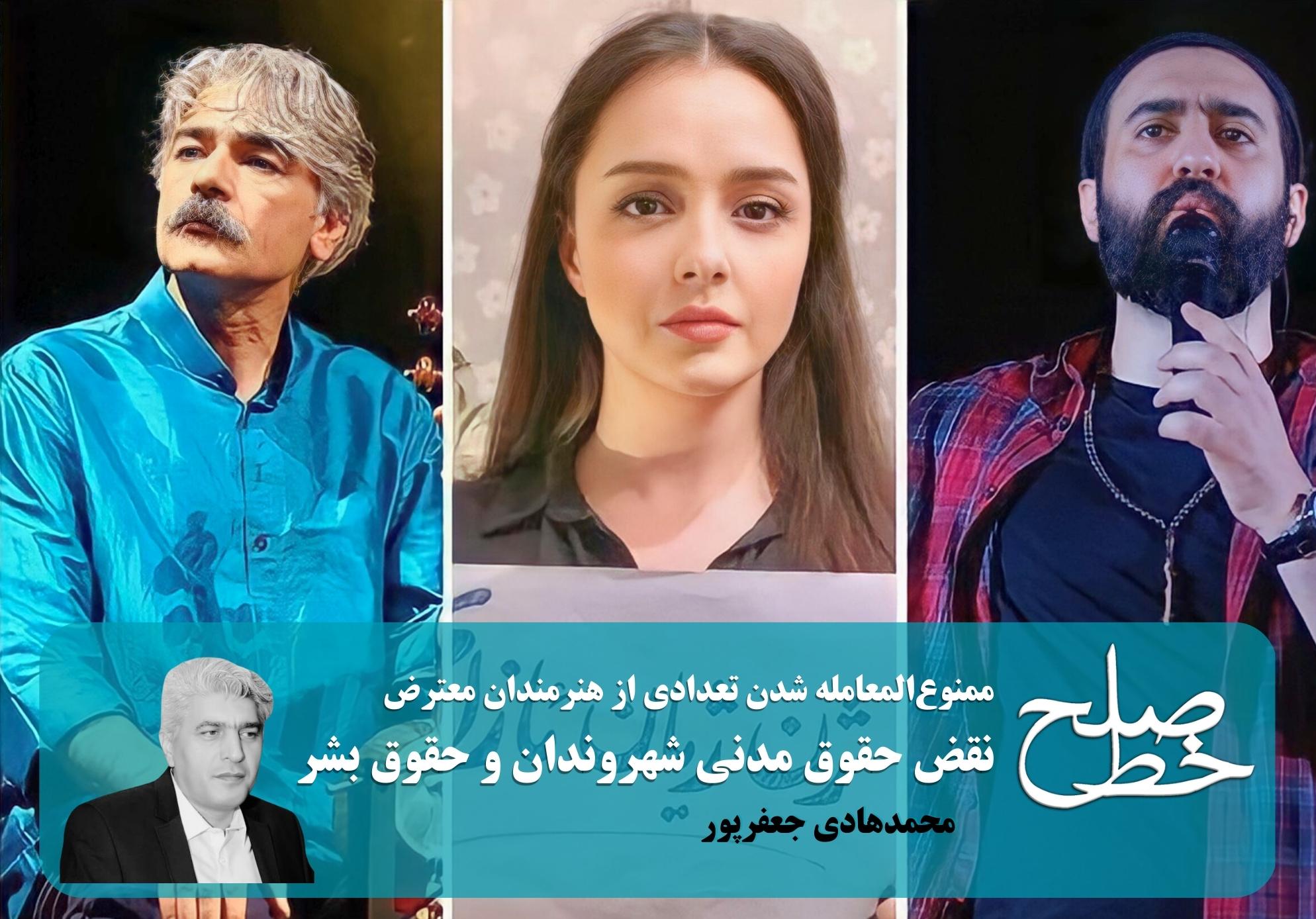
Violation of citizens’ civil rights and human rights / Mohammad Hadi Jafarpour
Some protesting artists have been banned from engaging in transactions.
Violation of civil rights and human rights.
In a world where social scientists, including philosophers and jurists, are striving to define a comprehensive global concept of human rights based on humanistic theories and analyses, and thinkers like Hannah Arendt and her colleagues are working towards the tangible realization of human beings’ entitlement to human rights and privileges without any conditions or restrictions – such as dependence on a specific political regime – the analysis and investigation of the reasons for deprivation of human rights is a bitter but true satire.
The Iranian society and citizens under the rule of law, with the title of the Constitution, are subject to and benefit from the rights and privileges that are referred to as the fundamental rights of the nation. From Articles 22, 32, 34, 38, 39, and 36 of the Constitution to the provisions stated in the Charter of Citizenship Rights, it refers to principles and foundations that ultimately aim to preserve human dignity and respect for the fundamental and basic rights of the nation.
In Article 37 of the mentioned circular, it is stated that judicial security is achieved when the dignity, life, property, and all material and spiritual affairs of individuals are protected from invasion and ensuring such fair security for everyone is the responsibility of the judiciary, and in Article 19, despite the explicit provisions of criminal procedure and the constitution, the principle of innocence is reiterated and in Article 20 it is stated that suspects, defendants, witnesses, etc. should not be subjected to any inhumane or degrading treatment.
The statement mentioned in Article 20 reflects a perspective and thinking on preserving human dignity and the high value of humanity, in a system where the highest judicial authority has issued a directive to prohibit any degrading and insulting behaviors, both verbal and practical, towards defendants and suspects in criminal cases, and considers those who engage in such behaviors deserving of punishment.
Despite such a mandatory decision to take any form or type of judicial order that deprives citizens of their basic rights, it is against the principles of legal rights and the rules stated in fair trials.
Depriving citizens of their basic rights is undoubtedly condemnable. In this regard, based on the principles governing the definition of private rights of individuals, including the principle of dominion (people have control over their property), the necessity of respecting the private property of individuals, and the principle of freedom of will of citizens in entering into contracts and specific agreements, depriving and limiting the discretionary powers of individuals contrary to the established legal principles is a violation of their legal rights. The legal system of Iran emphasizes the importance of respecting such rights by enacting various laws, such as Article 956 of the Civil Code, which states: “The capacity to possess rights begins with the birth of a person and ends with their death,” and Article 957, which recognizes the fetus as having the right to enjoyment. The civil rights of Iran are based on a fundamental and clear principle, which is the right of human beings to enjoy their human privileges, and therefore depriving and excusing individuals from these basic necessities
The great and wise leaders and thinkers of this land, both past and present, have emphasized the importance of upholding citizens’ rights and the philosophical foundations of the legal system. This essential matter cannot be achieved except through fairness and justice. With this in mind, depriving individuals of such rights solely based on an accusation or suspicion of committing a criminal act before a final verdict is issued, goes against the principles of fairness and is unjust.
The various legal schools of thought have always insisted on the necessity of human rights and the defense of citizenship rights. They believe that the interpretation and limitation of citizenship rights should be in favor of the accused or convicted individuals, to the extent possible, according to the principle of narrow interpretation of criminal rules. This means that individuals cannot be deprived of their civil and citizenship rights solely based on their conviction or accusation, even if this deprivation includes their legal actions such as entering into contracts or other legal acts. It is for this reason that the institution of supplementary and subsidiary punishments explicitly states that imposing such limitations requires specific conditions and is limited to cases defined by the law. Therefore, simply being accused or convicted and subject to punishment is not a valid reason for prohibiting individuals from engaging in transactions, unless there is a clear and transparent relationship between the accusation and the imposed limitation, and the law specifically includes such reactions and restrictions for proven accusations in the form of subsidiary punishments. In such cases, the judge may deprive the
 Created By: Mohammad Hadi Jafarpour
 April 21, 2023
Tags
Artists protest Asghar Farhadi Citizenship rights Kian Kohlar Mehdi Yarahi Mohammad Hadi Jafarpour Monthly Peace Line Magazine peace line Peace Line 144 Prohibited treatment The song of love.