


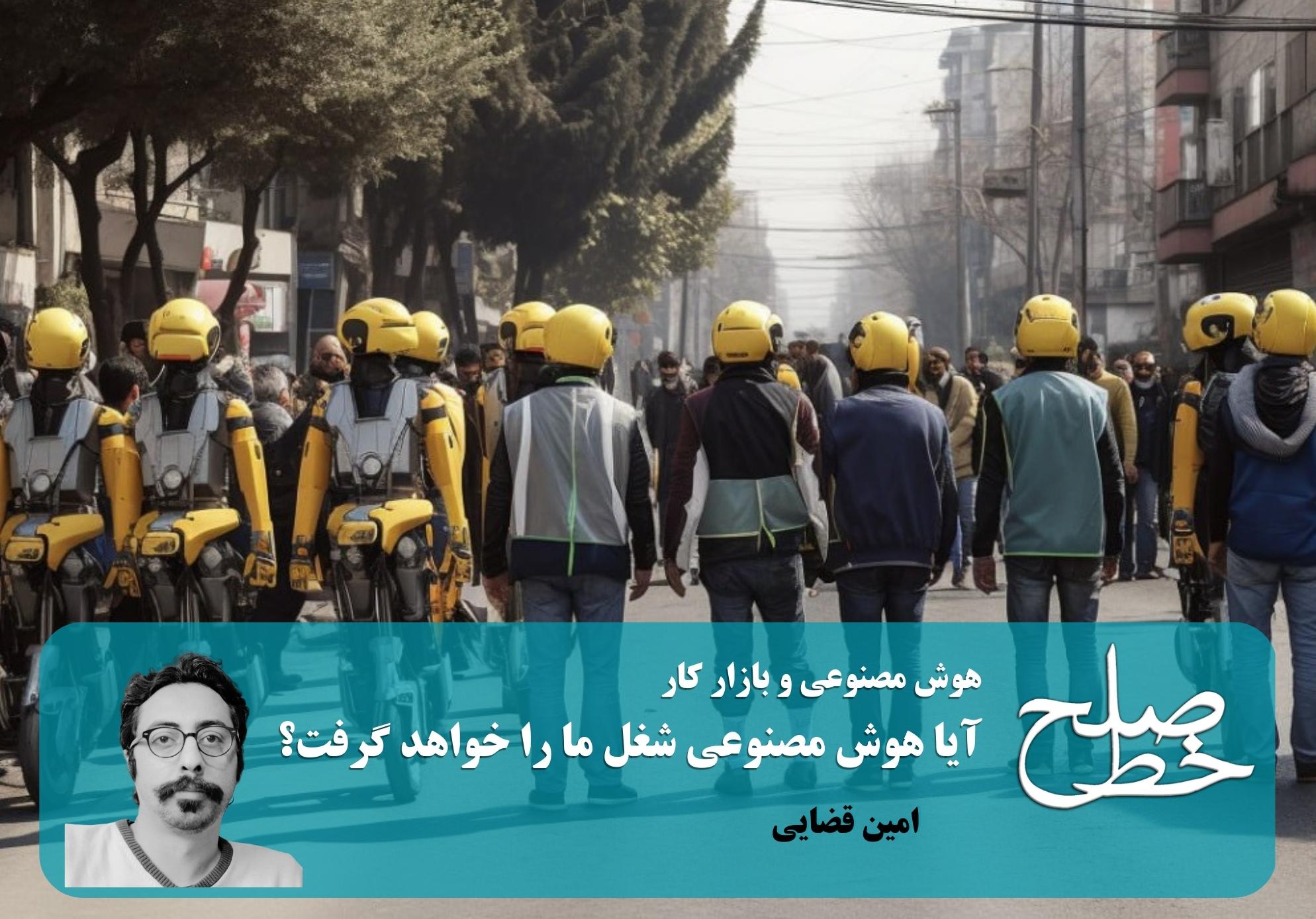
Will artificial intelligence take our jobs? / Amin Ghazaei
Since the beginning of the Industrial Revolution, the progress of technology and mechanization of production processes, or automation, has caused waves of unemployment in the job market. Marx and other social theorists show that due to the reliance of production on the profits of capitalists, machines instead of reducing the workload of workers, lead to their unemployment. Since the production process is in the hands of capitalists and owners of the means of production, their profits dictate that instead of reducing the working hours of workers, they reduce their numbers. Therefore, there is a direct relationship between automation and unemployment.
However, critics argue that it is impossible to stop the progress of technology and the workforce and job market must adapt to these new conditions over time. In other words, this unemployment is temporary and in the long run, it leads to a change in the nature of work and occupations. For example, in the late 19th century, the introduction of the electric lamp resulted in the mass unemployment of lamplighters who used to light the gas lamps on the streets at night and turn them off in the morning. This is a prominent example of the necessity of progress. Although many of these workers lost their jobs, a large portion of this workforce was eventually employed in other manufacturing sectors in the long run. So what may seem like unemployment in the short term, is actually beneficial in the long run.
But with the introduction of computers and the internet, the relationship between automation and unemployment became more ambiguous. These two not only did not significantly lead to job loss, but also, due to online commerce and the access of retailers to new customers around the world, created new jobs and strengthened entrepreneurship. Additionally, computers and the internet provided many job opportunities for young people from low-income backgrounds, who could increase their chances in the job market by self-learning computer languages, digital design, and more, with the cost of a personal computer. On the other hand, for example, many accountants feared that various accounting software would make them unemployed. However, this did not happen and instead, these software made the work of accountants easier and simpler.
Sometimes automation, like textile machinery, has led to widespread unemployment, while other times, like computers and the internet, it has created new job opportunities and brought a new generation of skilled workers and low-capital entrepreneurs into the market.
Now, with the entrance of artificial intelligence and robots, which one of these two scenarios will come true?
Scenario A: Artificial intelligence will take away many skilled workers’ jobs and create a huge wave of unemployment.
Scenario B (White Scenario): Artificial intelligence, like the internet and computers, creates more job opportunities and will bring a new generation of skilled workforce.
If the first scenario, which is mass unemployment, is correct, then there are two possibilities in the continuation:
Scenario A1 (Gray Scenario): This wave of unemployment will be temporary and in the long term, the nature of work will change.
Scenario A2 (Black Scenario): This is not a temporary change and we are on the verge of entering an era (perhaps the era of Transhumanism) where a large portion of humans have become obsolete as skilled and intelligent labor.
It seems that we have formulated the problem well. A documented response to these questions should be delegated to the future because artificial intelligence is currently in its early stages; but from now on, we can make a relatively accurate speculation about it.
First, we will examine the possibility of scenario B. In order for a new technology to create job opportunities instead of unemployment, its implementation must require acquiring skills and training. Therefore, these new skills will require skilled and knowledgeable workers and experts. So, an employer cannot simply get rid of their designer and artist by installing a graphic software, but ultimately they will need a designer, architect, and artist who are proficient in these softwares; because they probably do not have the time and background to acquire these new skills themselves. In the worst case scenario, they will replace their employees, but they will not significantly reduce their workforce.
Is the use of artificial intelligence in need of acquiring new knowledge and skills? Artificial intelligence does not simply replace our tools, but rather replaces human intelligence and awareness. An intelligent artificial secretary and responder will easily replace telephone secretaries and website operators and will answer customer questions with greater speed and accuracy. Employers do not need to acquire new skills to use artificial intelligence. So it is difficult to convince ourselves that artificial intelligence will create new job opportunities, as its use does not generally require new skills and knowledge. Of course, in using artificial intelligence and machine learning, one can be creative and must use it optimally. But this type of expertise in optimization or performance monitoring may only create jobs for some high-level experts.
Furthermore, artificial intelligence will not help entrepreneurship because ultimately entrepreneurship requires a scarcity (and therefore competition) in skills and expertise. Artificial intelligence replaces human skills and does not create a need for skills and expertise. It should also be noted that large companies will use more capable artificial intelligence and larger data as a support for their machine learning, which reduces the chances for new entrepreneurs.
Based on this argument, it does not seem that scenario B is correct; unless I have omitted an agent in this formula.
From now on, it is possible to prepare a long list of service jobs that are at risk of extinction with the entry of artificial intelligence. But is the A1 scenario correct and ultimately only creates a shift in the job market? That is, although some service workers may be replaced by artificial intelligence, they will eventually be employed in other service sectors (which may have been boosted by AI). Just as the workers who used to turn on and off the street lamps went on to other jobs, will this wave of widespread unemployment also subside in the long run?
Shift in the job market – meaning the entry of workers from one industry to another – occurs when the volume of this unemployed workforce is not greater than the capacity and speed of market expansion. Economic growth leads to an increase in jobs and, as a result, the growth of the job market. There is a fear that economic growth and market expansion will never be able to compensate for this huge volume of unemployed workforce by artificial intelligence.
Artificial intelligence will not only affect one sector, but other productive sectors will be able to compensate for it. Also, keep in mind that computing power and technological advancements are on an upward trend and economic growth will never catch up to it. It should be noted that on the other hand, automation and robotization also threaten the jobs of workers in the production sector. Population growth, scarcity of natural resources and energy are also other obstacles in the way of continuous growth in the job market. In developed countries, many workers have already been transferred to the service sector and many industries have also relocated to third world countries. Therefore, a large number of service workers who have become unemployed due to artificial intelligence will practically not find another place to work in a saturated job market.
In the end, there is no other option left for us besides the dark scenario of A2. Service and mental jobs that do not require much legal responsibility (1) are at the most risk. Even if a considerable number of untouched jobs remain, many workers will feel helpless, useless, and obsolete under the heavy shadow of artificial intelligence. They will not have much bargaining power against employers in low-paying service jobs. Artificial intelligence will increase employers’ monitoring capabilities. As a result of this feeling of weakness and helplessness, a new generation of rebels and Luddites (19th-century textile workers who destroyed machines due to unemployment) may ignite anti-technology revolutions. Service cities, like old industrial cities, will become empty. With the implementation of the proposal for “Universal Basic Income,” many people will become government welfare recipients, whose only contribution to society is adopting an environmentally friendly consumption pattern.
There is no empirical or strong evidence for any of the above-mentioned white, gray, and black scenarios. This article does not claim to provide strong evidence, but it shows where research should look for reasons. Optimistic individuals and supporters of the white scenario must demonstrate that artificial intelligence requires new and specialized skills, which will in turn bring new job opportunities. Even the simplest machines require skill and training on how to use them, and thus there is hope that workers can maintain their jobs by acquiring these skills. However, the problem with artificial intelligence is that it replaces our intelligence and skills. Supporters of the gray scenario must also look for reasons for the adaptability of the job market for this wave of unemployment. Will unemployed workers eventually find jobs elsewhere and will other industrial sectors thrive? I doubt that national job markets have such capacity. Unfortunately, based on available information (or my knowledge), the black scenario seems more likely.
Note:
1- For example, artificial intelligence may be able to replace legal counseling, but ultimately the legal and professional responsibility of a lawyer will be preserved for them.
 Created By: Amin Ghazaie
 April 21, 2023
Tags
Amin Ghazaei Artificial intelligence Automation Chat JPT ChatJipy Entrepreneurship Job opportunity Ladies Lodaiti Monthly Peace Line Magazine My skills peace line Peace Line 144 Robot Technology This is a sample text. Tolerance Unemployment Workers ماهنامه خط صلح